


 Voice AI Agent
A contact center in 2024 that confidently bet everything on chat. Chatbots handled tier-one queries. WhatsApp picked up the slack. Email managed the backlog. Voice, the story went, was the channel of last resort - expensive, slow, and headed for retirement.
That story did not survive contact with the data.
In 2026, enterprises across India's BFSI, retail, and EdTech sectors are fielding more voice interactions than they were three years ago.
The contact center industry in India has added over 300,000 new positions since 2021, with BFSI, eCommerce, and healthcare driving the surge.
Global research consistently shows that 69% of consumers, including Millennials and Gen Z, still prefer phone support for complex issues. Even more striking: 71% of Gen Z customers say live calls are the fastest way to resolve a problem - directly contradicting the generational narrative that young customers avoid the phone.
ALSO READ: Voice AI for Contact Centers: The Enterprise Guide to Resolution at Scale
In 2026, voice is doing something no other channel can: resolving the interactions that actually matter most to the business - high-stakes, high-emotion, high-complexity conversations where a wrong word costs a customer and a right one wins loyalty for years.
This article unpacks why voice has not just survived the omnichannel era but emerged as its most consequential channel - and what that means for enterprise CX leaders making investment decisions today.
The Data That Refuses to Cooperate With the "Voice Is Dying" Narrative
Call volume trends across BFSI, Retail, and EdTech in India 2023-2026
.png?width=4065&height=2287&name=01_Contact%20Center%20Demand%20Across%20India%20(2023-2026).png)
The macro narrative says digital channels are winning. The sectoral data says something more nuanced: digital is winning for transactional queries, while voice is growing for everything else.
India's call center market has expanded consistently - driven by a surge in digital financial services in BFSI, explosive growth in eCommerce returns and delivery exceptions in retail, and an admissions-counselling boom in EdTech.
BFSI contact center analytics - a proxy for call demand - is projected to grow at a CAGR of over 20% through 2032.
In India specifically, the BFSI segment within contact center analytics is forecast to grow at a 23.7% CAGR from 2025 to 2030.
Retail and eCommerce are not far behind, with contact-as-a-service demand in the consumer and retail segment growing at 26% CAGR.
EdTech, where every enrolled student represents a counselling call, an onboarding interaction, and a renewal conversation, is seeing call volumes rise in lockstep with market growth toward a projected $30 billion TAM by 2030.
ALSO READ: Voice Agents for Education: Resolving Every Student Query at Scale
The idea that India's customers are migrating away from voice ignores the basic arithmetic of a market adding hundreds of millions of first-time consumers of financial, retail, and educational services every year.The high-stakes moment effect - when and why customers choose to call
There is a predictable pattern to when any customer, regardless of age or digital fluency, reaches for the phone: when the stakes are high.
- Blocked accounts
- Loan approvals
- Disputed transactions
- Delayed shipments with perishable goods
- Last-minute admission deadlines
These are not moments people resolve over chat. They are moments people call.
TransUnion's 2024 research found that 65% of banking customers prefer a phone call when there is suspected fraud on their account.
Nearly 80% of consumers across segments consider the phone channel important for communicating with businesses on complex or urgent matters. It is a rational response to the fact that voice conveys urgency, enables real-time negotiation, and creates accountability in a way that a text thread simply cannot.
Why even digital natives call
The persistent assumption that Gen Z and Millennials do not use the phone is one of the most expensive myths in CX strategy.
McKinsey's 2024 research found that 71% of Gen Z customers consider live phone calls the quickest and most convenient way to resolve a customer service issue.
Digital natives are not anti-voice. They are anti-friction. They will use WhatsApp for a balance check. They will use an app to track a delivery. But when the app shows an error they cannot explain, or the chatbot sends them in circles on a refund they desperately need, they call. The channel is not the problem. Bad voice experiences are.
Voice as the Emotional and Trust Channel
The psychology of voice - why speech communicates more than text
Text is efficient. Voice is human.
The distinction matters enormously in customer experience because service is not purely transactional - it is relational.
When a customer is anxious about a loan rejection, confused about an insurance claim, or frustrated about a lost order, the medium of communication shapes how they experience the brand's response as much as the content of that response does.
Voice carries tonal cues, pacing, and empathy signals that text cannot replicate. A calm, assured voice telling a customer their issue is being resolved activates a fundamentally different emotional response than a chat bubble saying the same words.
Research consistently shows that how a customer feels after a service interaction determines loyalty far more than whether the issue was technically resolved.
High-emotion use cases that route to voice - and always will
There is a category of customer interactions that no enterprise should ever attempt to deflect to digital channels: interactions where emotion is at its highest.
These include:
- Fraud disputes
- Account closures
- Loan rejections
- Bereavement-related financial claims
- Medical insurance approvals
- Examination result-related counselling in EdTech
These are interactions where a customer's financial security, health, or future is in question.
Attempting to handle these via chatbot is not a cost-saving measure. It is a brand-damaging one. In high-emotion interactions, even one poor experience - a deflection to a bot when the customer needs a person, a dropped call without a callback, a chat agent who cannot escalate - can end the relationship.
The right voice AI agent strategy does not replace human empathy in these moments. It ensures that every high-emotion interaction is answered, contextualized, and routed intelligently - so the human agent who picks up already knows why the customer is calling and how they are feeling.
How call handling defines impacts brand perception
Customer experience research has established that nearly 90% of customers believe customer service is more important than ever.
Among the attributes that define a great service experience, voice interactions leave the deepest impression - positive or negative.
An agent who picks up quickly, already understands the customer's context, and resolves the issue without a transfer creates a loyalty signal that a self-service portal simply cannot generate.
This is why the quality of voice handling is a strategic differentiator. The enterprise that answers every call within seconds, surfaces the customer's history before the first word is spoken, and resolves without friction is not just providing good service. It is making a statement about how it values its customers.
How the Role of Voice Has Evolved - From Routing to Resolution
2005-2015: IVR as volume management
The first generation of enterprise voice strategy was defined by a single question: how do we handle call volume without hiring proportionally more agents?
RELATED: Why Enterprises are Replacing IVR with Voice Agents
The answer was the IVR - a menu-driven system that deflected calls into queues, automated routine queries, and created the infamous "press 1 for English" experience that customers came to dread.
IVR was volume management masquerading as customer service. It reduced cost-per-call by making calls harder to complete. Customer satisfaction scores for phone support in this era were predictably low - an artifact not of voice as a channel but of how poorly it was being used.
2015-2022: The omnichannel era and voice's "decline"
The rise of smartphones, messaging apps, and ecommerce created a genuine shift in how customers initiated service interactions.
Digital-first channels absorbed significant volume - password resets, order status queries, account balance checks - that had previously generated calls. Enterprise CX leaders read this as the beginning of the end for voice.
ALSO READ: How AI Service Agents Build Seamless Omnichannel Experiences
What happened was channel stratification. Simple queries migrated to digital. Complex, high-emotion queries stayed on voice. But because call volume appeared to flatten, the narrative of voice's decline took hold - and investment followed that narrative rather than the data underneath it.
2023-2026: Intelligent voice as the high-complexity resolution channel
The 2023-2026 period marks the third and most consequential evolution of enterprise voice.
Advances in voice AI and real-time transcription have transformed what a voice interaction can do. Modern voice AI does not route calls. It resolves them - handling complex queries, synthesizing customer history from CRM data, processing requests in real time, and escalating to human agents with full context when the situation demands it.
The result is a voice channel that is simultaneously more efficient and more capable than at any point in its history.
READ: Voice AI Use Cases for Customer Support That Actually Move the Needle
Enterprises that have deployed intelligent voice report reductions in average handle time and significant resolution improvements . The contact center that once needed 100 agents to handle 10,000 calls can now handle the same volume with a fraction of the headcount - while delivering a better customer experience.
What voice looks like in 2027
By 2027, the leading enterprises will not have a "voice channel."
They will have an intelligent voice layer - a continuous, context-aware system that handles inbound and outbound interactions, routes seamlessly between AI and human agents, integrates with every downstream system from CRM to fulfillment, and learns from every conversation.
Voice will be where the most complex, highest-value customer interactions happen. It will be the channel that earns loyalty, resolves disputes, closes sales, and builds the trust that digital interactions can initiate but rarely cement.
Voice in the Omnichannel Architecture - Not a Silo, a Hub
How voice completes the omnichannel picture
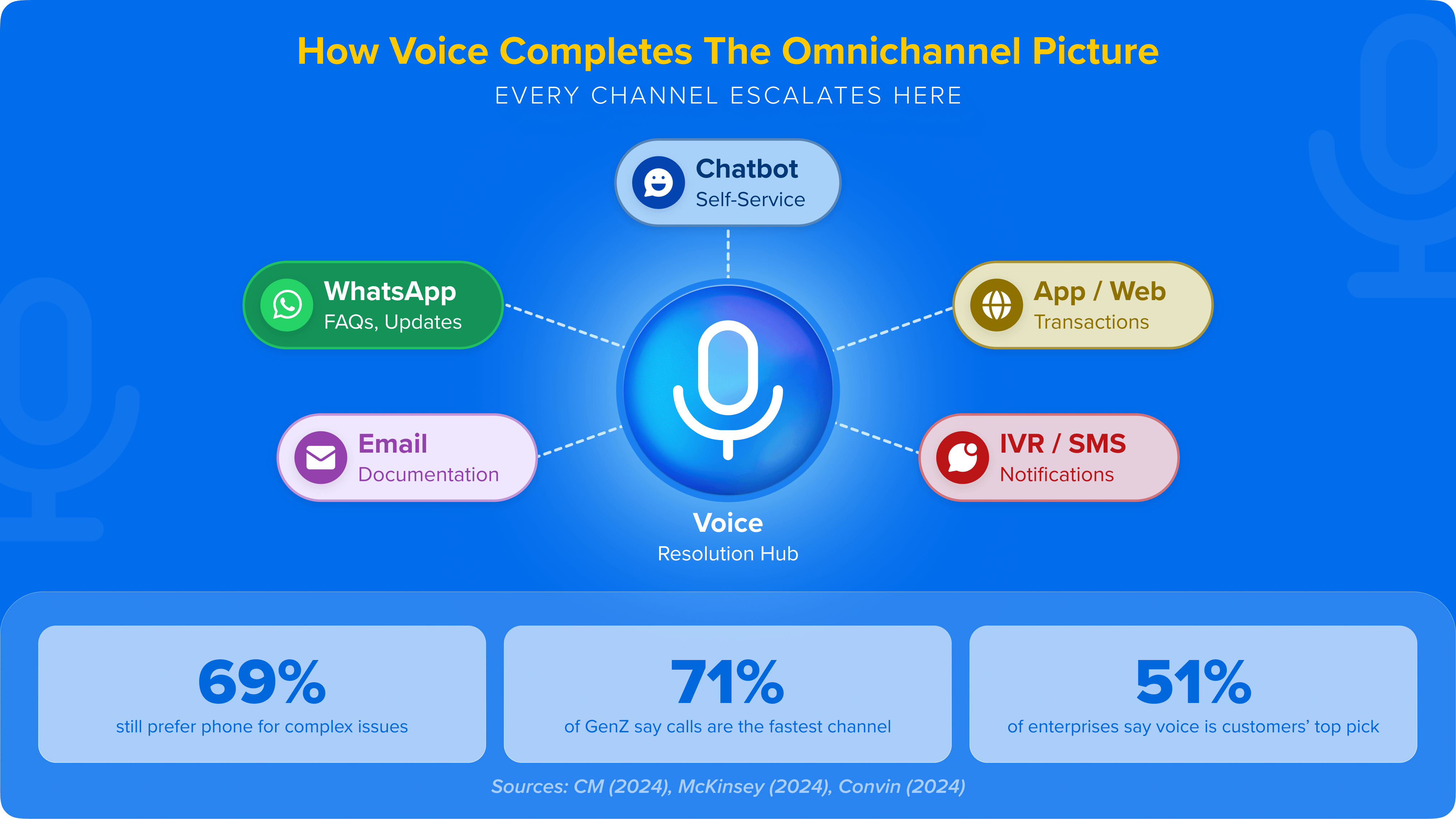
Most enterprise omnichannel architectures treat voice as one of several equivalent channels - a spoke in a wheel. This is the wrong mental model. Voice is the hub to which all other channels eventually escalate when they cannot resolve.
Digital channels - WhatsApp, chatbot, app, email - are excellent at handling the first 80% of a customer's service journey:
- Information retrieval
- Status updates
- Simple transactions
- Routine FAQs
They fail at the remaining 20% that is complex, emotional, or ambiguous. And that 20% is disproportionately important - influencing the brand impression for customers.
An omnichannel architecture that does not connect its digital channels to a capable voice layer is not truly omnichannel. It is multichannel with a gap - and that gap is precisely where customer frustration lives.
The context continuity problem
The most common failure mode in enterprise omnichannel is context loss at channel transition.
A customer starts a query on WhatsApp. The chatbot cannot resolve it and suggests they call. The customer calls. The agent has no record of the WhatsApp conversation. The customer repeats everything from the beginning.
ALSO READ: WhatsApp Voice AI: The Enterprise Guide to Deploying on the World's Largest Messaging Platform
Research shows that customers expect consistent interactions across channels. McKinsey notes that customers now use up to 10 channels in a purchase journey - and they expect those channels to know each other. When they don’t, customers experience the enterprise's internal silos as their problem.
The context continuity problem is solvable - but only if voice is architecturally connected to the rest of the channel stack. This requires a unified customer data layer that captures every interaction, across every channel, and makes it available to the voice agent - human or AI - the moment a call begins.
Designing channel transitions without losing customer state
Effective channel design treats the customer journey as a single thread.
When a customer moves from WhatsApp to voice, the transition should be invisible - the voice agent should already know who they are, what they tried to resolve digitally, and where the digital channel failed.
This requires three architectural elements:
- A unified customer identity layer that resolves across channels
- A real-time context relay that passes interaction state from channel to channel
- A voice AI system sophisticated enough to ingest that context and use it immediately
Enterprises that get this right report measurable outcomes. Businesses using omnichannel strategies with strong context continuity achieve over 90% higher year-over-year customer retention rates than those using disconnected multichannel approaches.
Haptik's View on Voice as a CX Strategy
At Haptik, we have worked with enterprises across BFSI, retail, EdTech, real estate, and others to build voice AI deployments that are purpose-built for the Indian market: multilingual, low-latency, and capable of handling the kinds of complex, high-emotion interactions that define these sectors.
Our perspective, grounded in deployment data rather than product positioning, is that voice AI's primary value is coverage:
- The ability to ensure that every inbound call is answered
- Every outbound lead is called
- Every high-stakes interaction is handled with the speed and context that customers expect
The enterprises getting the most out of voice AI are using it to do what human agents never could: be everywhere, at once, at scale, without quality degradation.
Voice AI handles the first mile - qualification, authentication, context-gathering, simple resolution - and hands off to human agents with a complete brief. The agent walks into the conversation already informed. The customer never has to repeat themselves.
The Bottom Line
Voice is not dying. Voice is maturing. The channels that have grown around it - chat, WhatsApp, email, app - have not replaced it. They have clarified its role.
Voice is where the moments that matter like dispute resolution, or winning or losing customer loyalty happens. It’s where the enterprise's commitment to the customer is tested under pressure.
For CXOs and digital transformation leaders, the strategic question is whether the voice channel you have is capable of handling the moments your customers bring to it. If customers have to wait, repeat themselves, or feel unheard when they call, no amount of digital channel investment compensates for that failure.
The enterprises that win on CX in 2026 are the ones that have made voice not just available, but intelligent - context-aware, low-latency, multilingual, and seamlessly connected to every other channel in their stack.
FAQs




source on Google