


 Voice AI Agent
Walk into a Tier-1 enterprise contact center today and the problem is instantly visible: agents juggling multiple screens, customers on 15-minute holds, and a queue that grows faster than headcount ever could. The conversation in boardrooms has shifted. Where 2024 was about deflection - keeping customers away from agents - 2026 is about resolution. More pertinently, getting it right on the first interaction, without friction.
The cost calculus has flipped. Gartner projects that enterprises will save $80 billion in contact center labor costs this year by shifting Tier-0 and Tier-1 queries to autonomous voice agents. Voice AI for contact centers has moved from a pilot line item to a board-level infrastructure decision, with enterprises that haven't moved are already playing catch-up.
Explained: What are Voice AI Agents and How They Work
The Market Conditions Forcing the Shift
Three forces are converging to make this moment structurally different from every previous wave of contact center technology.
Customer volumes have climbed 40% since 2024, but the talent pool for bilingual, high-empathy agents has contracted. Hiring your way out of this gap is no longer viable.
Meanwhile, the latency bar for AI has moved sharply. A two-second response delay, which felt acceptable in 2023, is now a failure. Haptik's voice AI agents have pushed sub-500ms latency into mainstream deployments, crossing the threshold where customers stop noticing they're talking to AI.
The third force is competitive pressure. Sixty-seven percent of Fortune 500 companies are now running production voice AI systems, up from a fraction of that two years ago. Production voice agent implementations grew 340% YoY across 500+ companies. For enterprises still running legacy IVR infrastructure, the gap is getting existential.
Why Legacy IVR Died (and What Replaced It)
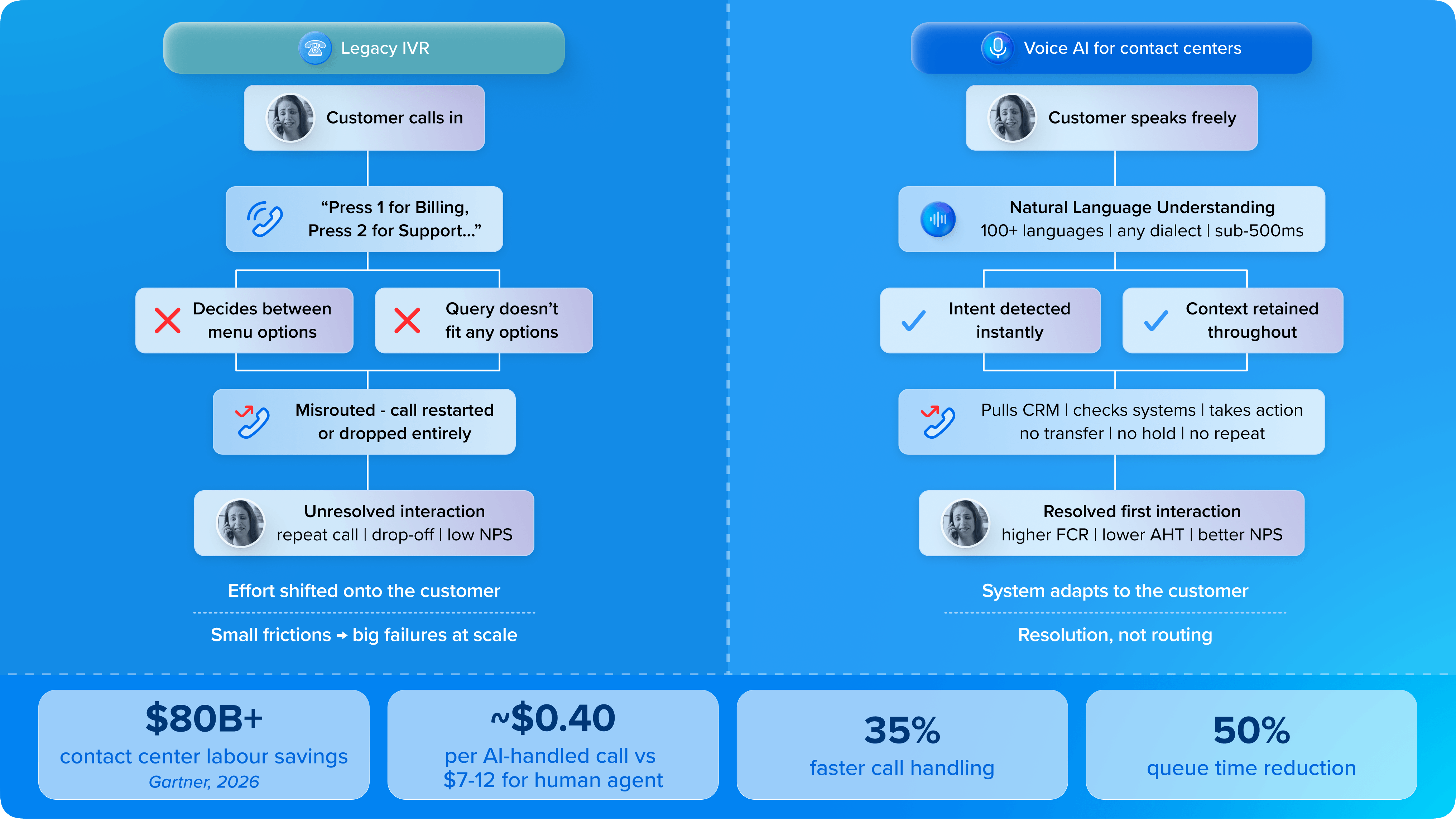
The traditional IVR was a routing mechanism dressed up as a CX tool. "Press 1 for Billing" forced customers to translate their intent into a menu structure the business designed for its own convenience.
The friction seems minor at the individual interaction level. A few seconds deciding between options. A misrouted call that needs restarting. A query that doesn't fit any category cleanly. At enterprise-scale, these micro-frictions become macro failures: abandoned calls, repeat contacts, unresolved interactions, and NPS scores that trend downward regardless of what else the business does right.
ALSO READ: AI Customer Service Agents for Voice-First Era: Trends and Use Cases
Voice AI for contact centers listens to natural speech, understands intent across dialects and languages, and routes or resolves without the customer navigating a tree.
Haptik supports 100+ languages, which matters enormously for enterprise deployments serving linguistically diverse customer bases across geographies. The shift isn't just from IVR to AI but from forcing adaptation onto the customer to building systems that adapt to them.
How Call Center Capabilities Have Evolved
The changes aren't incremental improvements layered on top of the same underlying model. They are a fundamentally different operating architecture where the system's default state is resolution.
| Capability | Traditional Call Center | Voice AI Agent | Business Impact |
| Entry point | IVR menus and routing trees | Natural, conversational input | Lower drop-offs at entry |
| Resolution | Multi-step, agent-dependent | End-to-end resolution in one flow | Faster closure, better CSAT |
| Query handling | Agents handle repetitive queries | AI resolves high-frequency intents instantly | Reduced AHT and agent load |
| Customer context | Repeated inputs across steps | Context retained throughout interaction | Higher FCR |
| Quality control | Sample-based QA post-call | Real-time monitoring across calls | Consistent experience |
| Scalability | Headcount-driven | AI-driven, demand-based scaling | Handles spikes without cost surge |
| Availability | Limited by shifts | Always-on for routine interactions | 24/7 resolution layer |
| Insights | Delayed reporting cycles | Real-time conversation intelligence | Faster decision-making |
| Cost structure | Linear with volume | Marginal cost reduces with scale | Sustainable operations |
Every category where traditional contact centers struggled - scalability, availability, consistency, cost at volume - is precisely where voice AI compounds its advantage. The performance gap widens as call volumes increase.
Enterprises using voice AI report call handling times that are 35% faster, with queue time reductions of up to 50%. At scale, those numbers translate directly to cost reduction and CSAT improvement - an outcome that was nearly impossible to achieve with purely human-staffed operations.
Inbound Resolution vs Outbound Engagement: Two Different Playbooks
Most of the conversation around voice AI focuses on inbound: a customer calls, the AI answers, the query gets resolved. That's half the picture.
Outbound voice AI is an equally significant, and often less discussed, enterprise use case. Proactive collections calls, appointment reminders, payment confirmations, re-engagement campaigns, and post-service follow-ups are high-volume, structured interactions where human agents are expensive and inconsistent. Haptik's Voice Campaign Manager enables enterprises to deploy outbound AI campaigns at scale - personalized, compliant, and triggered by real-time business logic.
The playbooks are different. Inbound is about resolution speed and containment. Outbound is about reach, timing, and conversion. An enterprise deploying voice AI only on the inbound side is leaving significant ROI on the table. The contact centers seeing the strongest returns in 2026 are running both using AI to handle the full customer communication lifecycle.
What Powers Resolution in Modern Call Centers
To understand how high-performance infrastructure translates into a better customer experience, we have to look at how a single, common request is handled across technological landscapes.
A real query, two distinct outcomes
Take a query that sounds simple but exposes every crack in a traditional contact center setup. A customer calls and asks: "Why hasn't my refund hit my bank account yet?"
In a legacy setup, this interaction involves authentication steps, a transfer to the right department, manual lookup by an agent, and a response based on whatever information that agent can access at that moment. The customer waits. The agent searches. Resolution quality depends on who picks up.
RELATED: Why GenAI Call Auditing Is the Future of Contact Center
In a voice AI-led contact center, the same interaction runs on a completely different track. The system identifies the caller, retrieves their transaction history, checks payment status in real-time, and pinpoints exactly where the delay is happening - whether at the payment gateway, the receiving bank, or an intermediary. Without stopping at information it triggers an escalation, updates the status, or sets clear expectations with a specific resolution timeline.
The integration layer that makes resolution possible
Behind this capability is an integration layer that connects customer identity, transactional systems, business rules, and real-time data flows. Without that connective tissue, even the most fluent AI can only tell a customer what it doesn't know. The resolution layer separates a voice AI deployment that reduces AHT from one that genuinely transforms the contact center into a competitive asset.
The Integration Problem Most Vendors Won't Talk About
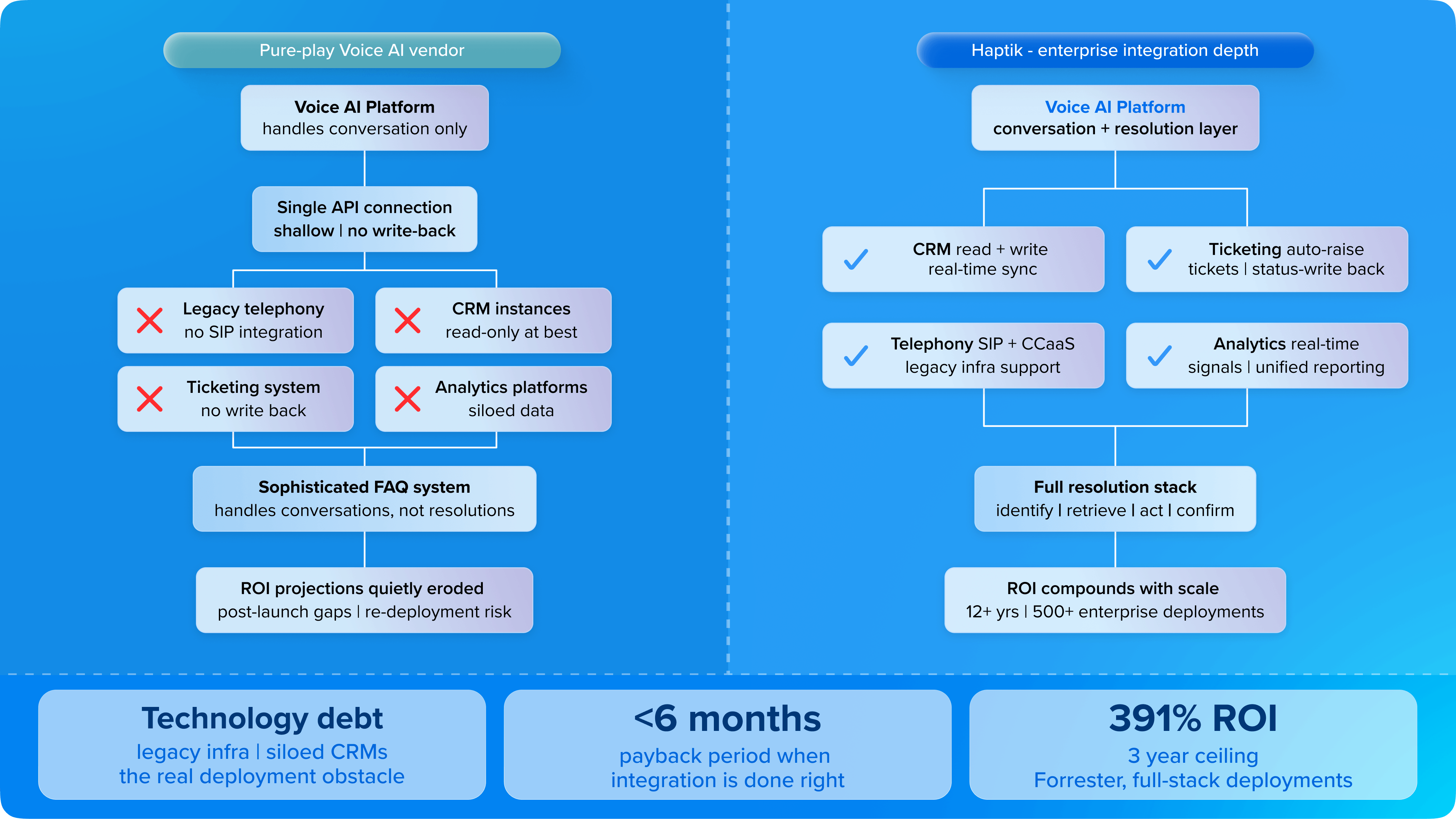
One frequent consistent failure mode in enterprise voice AI deployments is the integration layer. A voice agent that can't access real-time CRM data, can't write back to ticketing systems, and can't execute actions across connected platforms is a sophisticated FAQ system.
Enterprises running contact centers at scale have built up years of technology debt: legacy telephony infrastructure, multiple CRM instances, siloed ticketing systems, and analytics platforms that don't communicate.
READ: Integrating CRM, Service Desk, and Messaging Channels with AI for Customer Service
Deploying voice AI into that environment requires more than an API connection: it needs an integration architecture stress-tested in exactly those kinds of environments, which distinguishes vendors with genuine enterprise DNA from those who've scaled primarily in greenfield settings.
Haptik's deep integration experience across enterprise digital ecosystems - spanning CRMs, telephony platforms, and contact center infrastructure - means we’ve already solved the hard integration problems encountered by other vendors the first time with each new client. That experience compresses deployment timelines and reduces the risk of post-launch gaps that quietly erode ROI projections.
Why Enterprises Choose Haptik Voice AI for Contact Centers
The voice AI market is crowded, and differentiating on features alone is increasingly difficult. What separates enterprise-grade deployments from impressive demos is implementation depth, which is the ability to navigate complex integration environments, compliance constraints, and organizational change management at scale. This is where Haptik's 12+ years of enterprise AI experience becomes decisive.
500+ enterprise deployments
That longevity reflects 500+ enterprise customers across industries, geographies, and environments. Each engagement builds institutional knowledge about what breaks in production, what enterprises need versus what they ask for, and how AI deployments succeed or fail when they meet real contact center infrastructure.
Omnichannel by design
Many voice AI platforms treat omnichannel as a feature. Haptik's architecture treats it as a foundation. Voice, chat, and messaging channels are orchestrated within a single platform, fully integrated with CRM, ticketing, analytics, and telephony systems. A customer who starts a conversation on chat and escalates to a voice call doesn't restart from zero but context travels with them.
Consulting expertise
Pure-play technology companies can deploy a voice AI platform. Far fewer can solve the integration, compliance, and change management challenges that come with deploying it inside a complex enterprise environment. Haptik's consulting capability is built into the engagement model that ensures clients get support with navigating legacy telephony integrations, data residency requirements, regulatory constraints, and internal stakeholder alignment.
Optimized for ROI
Haptik measures success in business terms. The outcomes its deployments drive include lead conversion uplift of 8-10%, meaningful support volume reduction, NPS improvement, and demonstrable contact center cost reduction. These are the metrics that justify AI investment when voice AI is implemented with the full integration stack and enterprise context Haptik brings to each deployment.
RELATED: ROI of AI Agents: Measuring Impact and Elevating CX
The Strategic Question for 2026
The enterprises asking "should we invest in voice AI for our contact center" are already behind the ones asking "how do we scale what we've deployed." The question is not whether AI will transform customer experience but how organizations will implement it responsibly, reliably, and at scale.
For enterprises not yet deployed: What to evaluate first
The starting point is an honest audit of three things: the complexity of your existing telephony and CRM infrastructure, the query types that account for the highest volume of inbound contacts, and the compliance constraints that will govern how customer data moves between systems.
Enterprises that begin with this audit deploy faster and hit ROI milestones sooner. The right first deployment is a narrow, high-volume use case with clean integration requirements. That proof of concept builds the internal confidence and technical foundation for everything that follows.
For Enterprises already deployed: How to scale without diluting quality
The challenge at this stage is governance. As voice AI handles more query types across more channels, the risks shift from "will it work" to "will it stay consistent."
Enterprises scaling beyond their initial deployment need real-time monitoring across every AI interaction. They need an integration architecture that can absorb new systems without requiring a rebuild. And they need outcome metrics - FCR, AHT, NPS, cost per resolution - tracked at a granularity that surfaces degradation before it reaches the customer.
The evaluation criterion that matters most
What differentiates vendors at this stage isn't the sophistication of the AI model because most enterprise-grade platforms are competitive in that dimension.
It's integration depth, enterprise experience, and the ability to drive outcomes that show up in business metrics. A vendor who has solved your integration environment before - in a comparable enterprise, with comparable legacy infrastructure - compresses your deployment timeline and de-risks your investment in ways that no feature comparison matrix captures.
Voice AI for contact centers is the current standard. The question is whether your contact center is setting it or catching up to it.
FAQs
Book a 30-minute contact center assessment.


source on Google