


 Voice AI Agent
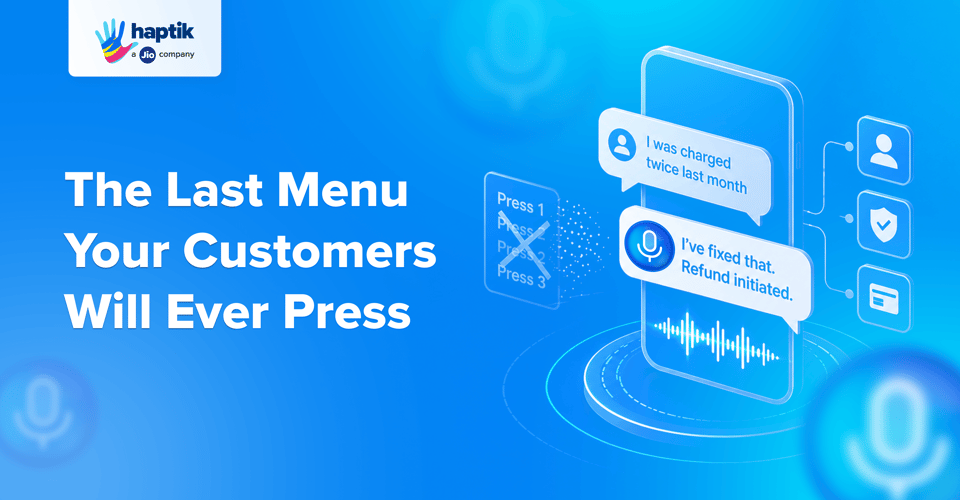
Picture this: a customer calls your support line at 7 PM on a Tuesday. They've waited three days for a refund. Your IVR greets them with five options, none of which matches what they need. They press zero. They're placed in a queue. Twelve minutes later, an agent picks up, asks for their account number, puts them on hold to look up the ticket before transferring them to another department - which proceeds to ask for the account number again.
This is the experience millions of customers have every single day with legacy IVR systems. And it is silently, systematically, destroying customer loyalty.
For decades, interactive voice response - the touch-tone menu trees that greet callers with 'Press 1 for billing, Press 2 for technical support' - was the backbone of enterprise contact center strategy. It was efficient at one thing: volume routing at low cost. But the world it was built for no longer exists.
Customers have been trained by consumer apps to expect instant, accurate, conversational help. When they call a business and get a robotic menu, the contrast is jarring. And now, with enterprise-grade AI voice agents finally ready for production, there's no longer a reason to accept it.
This article is a deep dive into the shift from IVR to AI voice agents, spanning everything that’s technical, operational, and financial.
What IVR Was Built to Do (and Why It No Longer Does It Well)
The original promise: Volume routing at low cost
IVR was a genuine innovation when it emerged in the 1970s and 1980s. Routing thousands of simultaneous callers without a human operator was transformative. At enterprise-scale like when a bank handles 200,000 calls a day, that routing function justified the technology's existence for thirty years.
The economics made sense: IVR could handle simple queries (check balance, confirm appointment, hear store hours) for pennies per call versus dollars per agent interaction. Contact center leaders built entire workforce models around it, and for a long time, those models worked.
RELATED: Voice AI for Contact Centers: The Enterprise Guide to Resolution at Scale
Where IVR falls short
The problem began when customer queries started outpacing the rigid decision trees IVR was built on. Today's contact center receives calls about billing disputes, service modifications, account security, technical troubleshooting, and dozens of micro-intents that don't fit neatly into any predefined option.
The result is a cascade of failures. A caller with a partially resolved issue that touches billing and technical support doesn't fit into Option 1 or Option 2; they abandon. A caller with an accent or non-standard phrasing doesn't match the DTMF or limited speech recognition. They get misrouted. A caller who can't find what they need presses 0, bypassing the system entirely: the 'zero-out problem' that turns your entire IVR investment into a queue.
The hidden cost of IVR
The cost of IVR failure doesn't show up in a single line item. It accumulates across three metrics that contact center leaders track but rarely attribute correctly to the system itself.
Average handle time (AHT) inflates because agents receive escalated, frustrated callers who must re-authenticate, re-explain their situation, and wait for lookups that a well-integrated AI could have completed during the automated interaction.
ALSO READ: Voice AI Use Cases for Customer Support That Actually Move the Needle
Abandonment rates spike during peak periods when hold times extend beyond three minutes. And repeat call rates, which are calls from the same customer within 48 hours, indicate a resolution failure that traces directly to IVR containment shortfalls.
Together, these hidden costs typically amount to 20-30% of a contact center's total operational spend. The IVR was supposed to reduce cost. In mature enterprises, it now generates a significant portion of it.
What AI Voice Agents Do That IVR Simply Cannot
Understanding natural language vs following a menu tree
The most fundamental difference is linguistic. IVR forces callers to speak the system's language. AI voice agents speak the caller's.
A caller who says 'I got charged twice for something I cancelled last month' is expressing a clear intent that would stump any IVR.
An AI voice agent, powered by a large language model, classifies it accurately, and proceeds to resolve it without the caller ever pressing a key or navigating a menu.
Dynamic context retention across a multi-turn call
IVR is stateless. Every interaction starts fresh. If a caller changes their mind mid-call or needs to clarify something they said three responses ago, the system can't accommodate it without starting over.
AI voice agents maintain context across the full conversation arc. They remember what was said two minutes ago, can reference it, and use it to shape subsequent responses. This transforms the caller experience from a series of disconnected prompts into something that genuinely resembles a helpful conversation.
Real-time backend integration
IVR routes. AI voice agents act. This is perhaps the most commercially significant distinction.
A well-deployed AI voice agent is connected to your CRM, order management system, billing platform, and ticketing stack. When a customer calls about a refund, the agent doesn't just route them to the refunds department. It looks up the transaction, validates the eligibility criteria, initiates the refund, and confirms it in the same call. The resolution happens on the phone. The customer never waits for an email. The agent never gets involved.
Personalization based on customer history and CRM data
IVR treats every caller identically. AI voice agents treat every caller individually.
With CRM integration, an AI voice agent that recognizes an inbound number knows this caller has been a customer for seven years, their last interaction was about a delayed delivery, and they're enrolled in a premium service tier.
RELATED: Integrating CRM, Service Desk, and Messaging Channels with AI Service Agent
That context shapes every aspect of the conversation from the tone and formality to the specific resolution options offered. Personalization at this level, delivered through a voice channel, is not possible with any version of IVR.
Graceful escalation vs dead-end transfers
When an AI voice agent reaches the boundary of what it can resolve, it escalates gracefully. The agent summarizes the conversation, the customer's expressed intent, and the steps already taken, and passes all of that context to the live agent who takes over. The customer doesn't repeat themselves. The live agent starts informed, not from zero.
This is categorically different from an IVR transfer, which typically hands off only the call, not the context. Agents who receive IVR transfers routinely cite 'starting from scratch' as their single biggest frustration. AI voice agents eliminate it.
The Business Case: IVR vs AI Voice Agent Side by Side
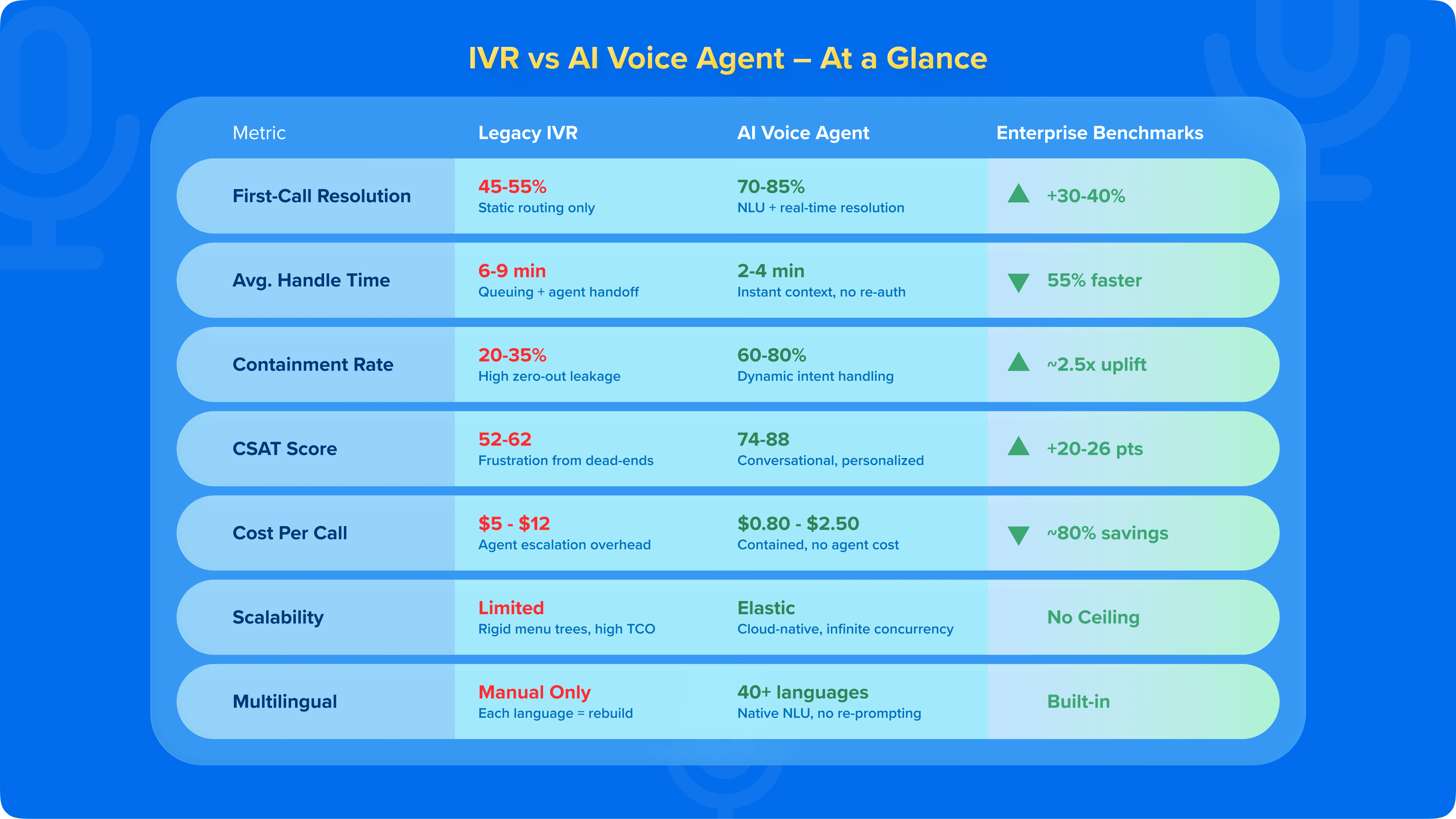
The numbers below reflect data from Haptik enterprise deployments, Gartner CX benchmarks, and McKinsey Contact Center research. They are enterprise actuals, not vendor projections.
The IVR-To-Voice-AI Migration Playbook
A failed voice AI migration typically traces back to one of two errors: organizations that tried to automate the wrong intents first, or organizations that skipped integration with their backend systems until after go-live. The five-step framework below is designed to prevent both.
Step 1: Audit your IVR call flows and contact driver data
Before any conversation is designed, pull twelve months of IVR interaction data.
- What are callers pressing?
- Where are they abandoning?
- What are the top 20 contact drivers by volume?
- Which intents are generating the most repeat calls?
This audit transforms a vague mandate to 'improve the voice experience' into a data-backed project with clear scope and measurable targets.
Step 2: Identify the top 10 intents
Not all intents are created equal. Start with those that can be fully resolved in a single automated interaction: account balance inquiries, delivery status checks, appointment rescheduling, basic troubleshooting scripts, payment confirmations.
These are your quick wins that generate the containment data in turn justifying the broader rollout.
Step 3: Design for conversation, not for menus
The most common mistake in voice AI deployments is translating IVR menu logic directly into dialog flows.
This produces an AI that talks like an IVR: rigid, scripted, and frustrating. Conversation design for an AI voice agent starts with intent, not structure.
- What is the caller trying to accomplish?
- What are the ten different ways they might express it?
- What are the logical next steps depending on their response?
This discipline requires both linguistic and UX expertise.
Step 4: Integrate with your CRM and ticketing stack before go-Live
An AI voice agent that cannot look up a customer record or create a ticket is a sophisticated answering machine.
The integration work that involves connecting to Salesforce, ServiceNow, SAP, or whatever your stack includes, must happen before the first call is routed to the agent, not as a post-launch enhancement. It is the integration that makes resolution possible.
Step 5: Run parallel operations and measure before full cutover
Run the AI voice agent in parallel with your existing IVR for four to six weeks before any full cutover. Route a defined percentage of calls to the agent, measure containment and CSAT in real-time, identify failure points, and iterate.
The data from this parallel period will be the most credible ROI evidence you can present to your CFO because it's your data, from your calls, with your customers.
What the First 90 Days of IVR Replacement Should Look Like
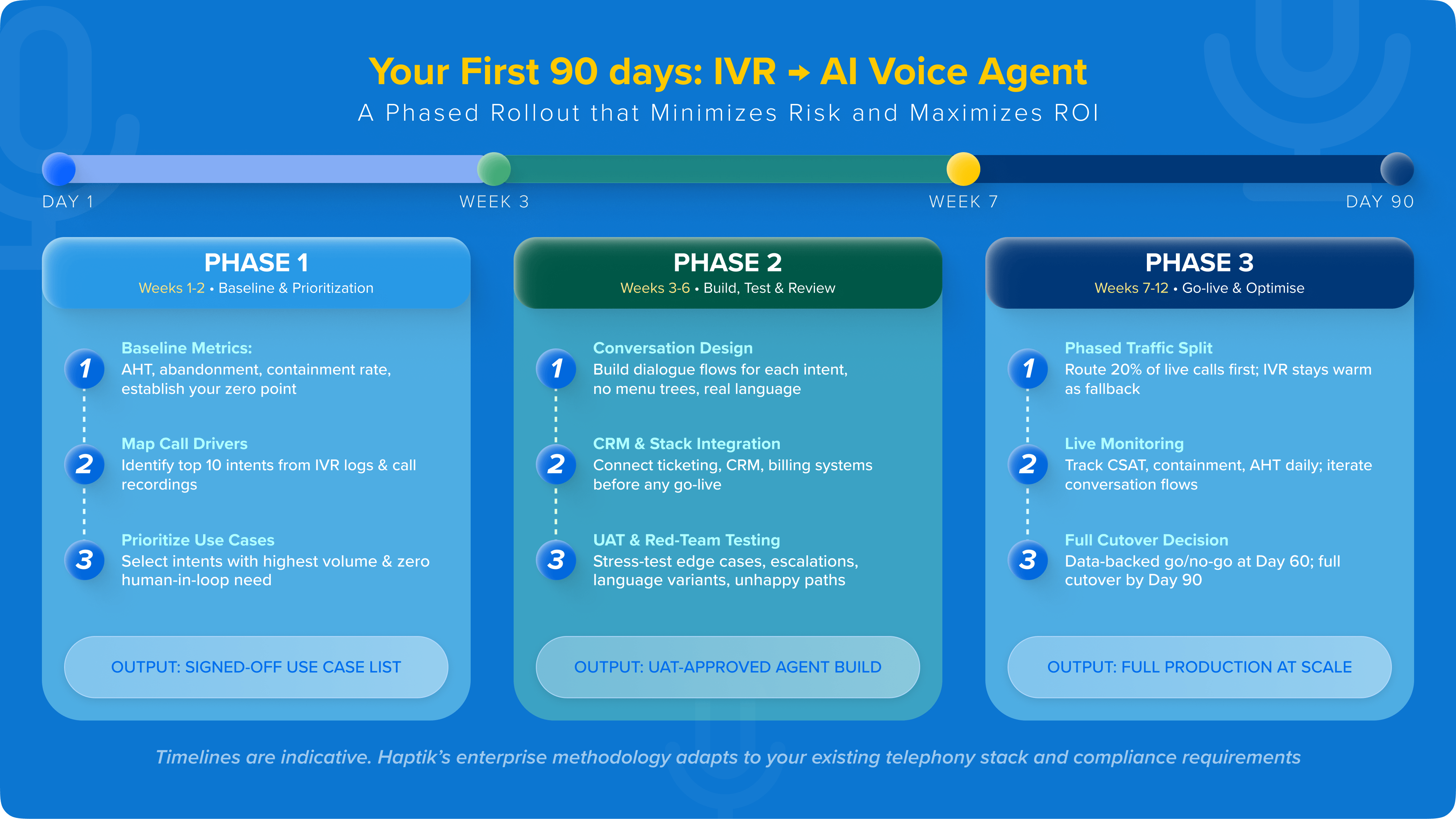
Enterprise voice AI migrations succeed or fail in the first ninety days. The phased approach below is built on learnings from 500+ deployments across industries where time-to-value and risk management are equally non-negotiable.
ALSO READ: How to Choose the Best Voice AI Platform for Enterprise CX
Week 1-2: Baseline measurement and use case prioritization
These two weeks are entirely analytical. Establish baseline KPIs like current containment rate, AHT by call type, abandonment rates by hour and day, and CSAT scores from post-call surveys.
Map every contact driver to its volume and resolution complexity.
Output: a prioritized list of the top 10 intents for Phase 1 automation, agreed upon by the contact center leadership and the digital transformation team.
Week 3-6: Build, test, conversation design review
Weeks three through six are where the agent is built.
Conversation flows are designed for each prioritized intent. Backend integrations are built and tested in staging. A conversation design review including contact center supervisors and experienced agents, checks flows for edge cases, unhappy paths, and language variants. UAT sessions stress-test the agent against adversarial inputs. The week 6 deliverable is a UAT-approved agent build, ready for controlled deployment.
Week 7-12: Phased go-Live, monitoring, iteration
Go-live begins with a controlled traffic split, typically 20% of calls routed to the AI agent, 80% to the existing IVR.
This is not caution for caution's sake; it's data collection. Every call processed by the agent generates learning: intent classification accuracy, fallback rates, call duration, containment, and CSAT signals.
Weekly iteration cycles address the failure patterns surfaced in production. By Day 60, a data-backed go/no-go decision on full cutover can be made with confidence.
By Day 90, the organization is operating at scale.
READ: Scaling Voice AI for Large Enterprises: What Changes After 10 Million Calls
How Haptik Handles IVR Migration
Most vendors sell voice AI software. Haptik delivers voice AI outcomes. The distinction matters — especially in enterprise environments where integration complexity, compliance requirements, and change management challenges can derail even technically sound deployments.
Here is what actually differentiates how Haptik approaches IVR migration:
12+ years of AI expertise
Haptik has been building enterprise AI for longer than most current voice AI vendors have existed.
That tenure translates into a depth of understanding about what enterprise deployments actually require in terms of the organizational, compliance, and change management dimensions that determine whether a deployment succeeds or becomes a cautionary tale.
500+ enterprise deployments
Haptik has deployed conversational AI solutions across 500+ enterprise clients in financial services, healthcare, retail, telecom, and logistics.
The breadth of that deployment history means the failure modes are already known and designed against. When Haptik advises on a migration strategy, that advice is grounded in real production data, including the deployments that were harder than anticipated and the adaptations they required.
Omnichannel CX orchestration
Replacing IVR in isolation creates a new silo. A customer who starts a support conversation on WhatsApp and then calls your contact center should not have to start over. Haptik's platform orchestrates customer interactions across voice, chat, and messaging channels within a unified intelligence layer connected to your CRM, ticketing system, analytics stack, and any other enterprise system that holds customer context.
Enterprise consulting DNA
Complex integration requirements, data residency constraints, industry-specific compliance frameworks, and contact center change management are not problems that resolve themselves.
Haptik brings consulting capability to every enterprise engagement. That means working through GDPR and SOC 2 requirements, mapping integration patterns across legacy telephony infrastructure, and supporting the internal stakeholder alignment that makes a migration land well operationally, not just technically.
The Bottom Line
The IVR was a remarkable piece of infrastructure for the era it was built for. That era has passed.
Today's customers arrive at your voice channel with expectations shaped by consumer digital experiences: immediate, conversational, accurate, and respectful of their time. IVR, by design, cannot deliver any of those things consistently. It routes; it doesn't resolve. It prompts; it doesn't understand. It transfers; it doesn't escalate with context.
AI voice agents are not an incremental upgrade to IVR. They are a category replacement that shifts the contact center from a cost center that frustrates customers into a service layer that resolves them. The enterprises making this shift now are responding to a customer expectation that has already moved, and building the infrastructure that will make loyalty possible.
The question is not whether to replace IVR but whether to do it before or after the competition does.


source on Google