


 Voice AI Agent
It begins, as most contact center crises do, with a surge.
A major airline's loyalty app goes down midway through a peak travel season. Within minutes, forty thousand customers are trying to reach support simultaneously. The queues spiral. Average handle time balloons. Agent attrition (already a slow bleed) hemorrhages. The CX head stares at a dashboard that looks like a cardiac monitor mid-arrest and makes the decision that thousands of their peers are quietly making too: it is time to bring in AI agents at scale.
But then comes the harder question.
Not "How do we deploy voice AI?" - that part has become almost mechanical.
The harder question is: “How far do we go? Can we replace the human support layer entirely? And if not, what exactly are we building?”
In 2026, that question is no longer theoretical. AI agents are resolving real queries, running live outbound campaigns, and holding full voice conversations in dozens of languages without a human in the loop. But they are also, in measurable, documented ways, still falling short on some of the most consequential customer interactions enterprises handle every day.
ALSO READ: Voice AI for Enterprises: How Inbound and Outbound Calling Works
AI in Customer Support
Let's start with what is actually possible today based on what is live in production across enterprise deployments.
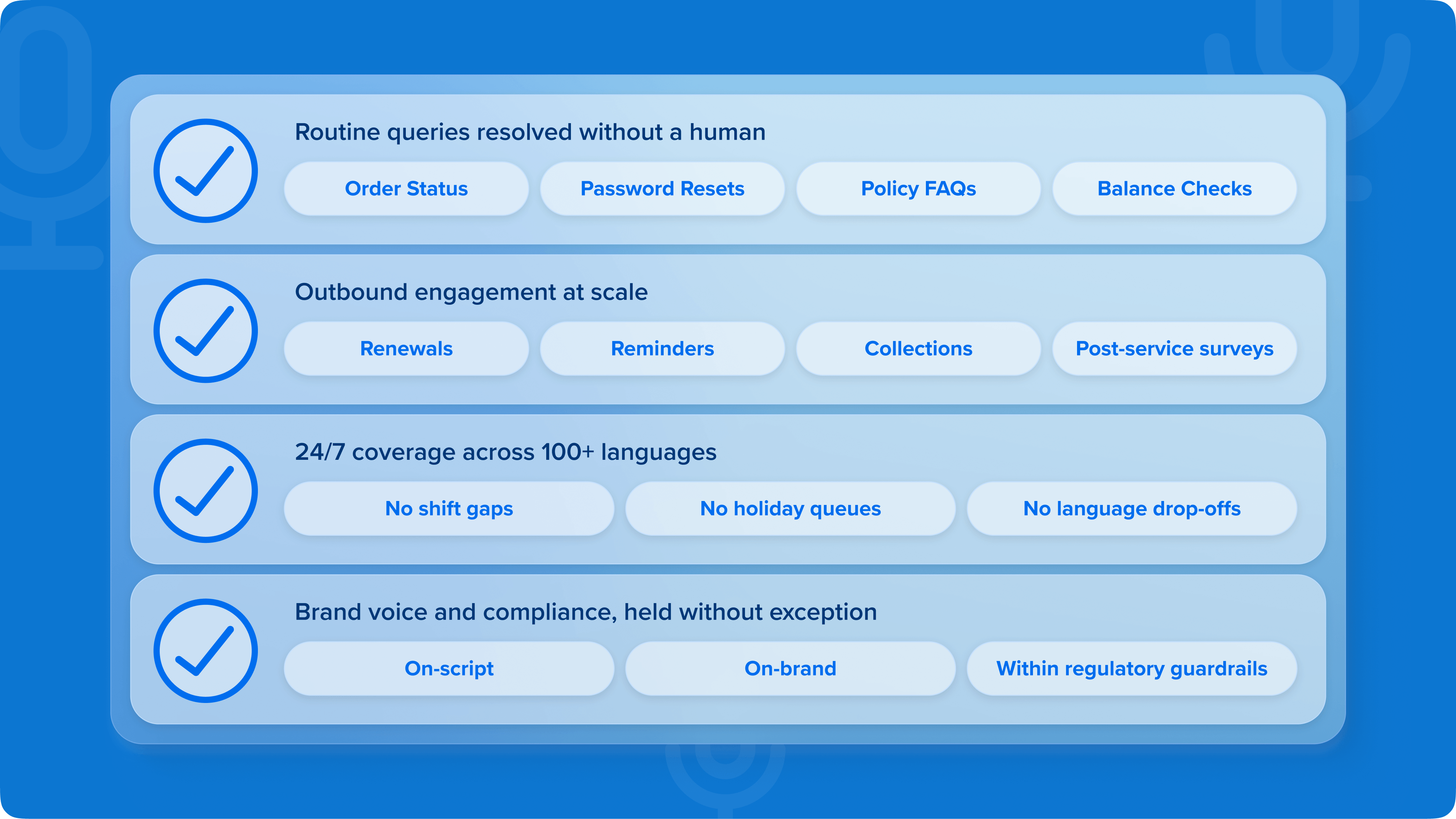
Full resolution of Tier-1 queries (the 60-70% reality)
If you operate a contact center at scale, somewhere between 60 and 70 percent of your inbound volume is composed of queries with a predictable pattern.
- Order status checks
- Policy clarifications
- Password resets
- Balance inquiries
- Appointment rescheduling
These interactions have something in common: they have a correct answer that is derivable from your systems, and they can be resolved without human judgment.
AI agents - when properly trained, integrated with your CRM and ticketing infrastructure, and tested across your real query distribution - can handle these end-to-end.
The key phrase, however, is "properly trained and integrated." Resolution rates don't happen because a model is powerful, but only when the conversation design is tightly mapped to your use cases, your back-end systems are connected in real-time, and the AI knows when a query has slipped outside its resolution domain.
Outbound engagement at scale
Outbound customer communication has historically been a resource bottleneck.
- Payment reminders
- Renewal nudges
- Post-service surveys
- Health check calls
- Appointment confirmations
There’s genuine business value in each of these but the cost of running them at scale through human agents makes them economically impractical.
AI voice agents change that equation. A single outbound campaign reaches hundreds of thousands of customers simultaneously, with each conversation personalized using live customer data.
Haptik's outbound voice capability connects directly to CRM data at call time, which means every call is contextual.
Enterprises running AI-led outbound collections campaigns have seen recovery rates that rival or exceed human-operated equivalents, at a fraction of the variable cost.
24/7 coverage
Human support teams operate in shifts.
They have peak capacity constraints, holiday schedules, and language coverage gaps. If your customer base is global, these constraints are structural limitations on your service quality.
AI agents do not have shift patterns. Haptik's multilingual NLU engine supports 100+ languages, with dialect-aware processing that handles the difference between, say, Mexican Spanish and Castilian Spanish at a phonetic and semantic level, not just a lexical one.
A customer in Singapore reaching out at 3 AM gets the same resolution quality as a customer in London reaching out at 11 AM.
For enterprises with global customer bases or 24/7 service commitments, this is a structural capability gap that AI fills.
Consistent tone, compliance, and brand voice at every interaction
Human agents, even the best ones, have bad days.
They go off-script. They use language that creates compliance exposure. They reflect their personal frustration in subtle ways that erode customer trust. At scale, the variance across thousands of daily interactions is substantial.
AI agents are constitutionally incapable of having a bad day. Every interaction follows the same guardrails, the same brand voice, the same compliance boundaries. In regulated industries like financial services, insurance, and healthcare - this is not a vanity metric. It is a legal and reputational necessity.
At Haptik, compliance isn't a post-deployment checklist, it's designed into the conversation from day one.
ALSO READ: Why Traditional QA Frameworks Fail for Voice AI Agents
What AI Still Cannot Do (and May Not for a Long Time)
Genuine empathy in high-distress situations
- When a customer calls to dispute a charge because they lost their job
- When a patient is confused and frightened about a medical bill
- When a traveler stranded at an airport has missed a funeral.
These are not edge cases; they happen in every enterprise contact center daily.
AI agents detect distress signals through voice tone analysis, sentiment classification, and keyword patterns.
What they cannot do is respond to distress with the kind of presence that actually de-escalates it. A human agent who says "I hear you, and I'm going to personally make sure we fix this" means something different neurologically and emotionally than an AI saying the same words. Customers feel the difference, even if they can't articulate why.
For these interactions, AI should be a routing mechanism and context-gathering tool, not the final voice the customer hears.
Novel problem-solving outside trained domains
AI agents are pattern-matching systems operating within the probability space of what they have been trained on.
When a customer presents a genuinely novel situation - a query that falls between two policy categories, a scenario no one anticipated, a complaint that requires synthesizing information across five different systems - the probability space runs thin.
The best AI systems know when they don't know. But they still cannot do what an experienced agent does in those moments:
- Reason from first principles
- Make judgment calls
- Improvise within the spirit of company policy even when the letter of it doesn't apply
Ethical judgment
Should an AI agent approve a late refund for a customer whose account shows a pattern of abuse, but who today is clearly in financial distress?
Should it flag a potentially fraudulent claim even when the evidence is circumstantial?
These are ethical questions that require human judgment informed by context, institutional knowledge, and moral reasoning.
Enterprises that let AI make these calls without human oversight are not just risking poor outcomes. They are abdicating moral responsibility in a way that eventually surfaces as a trust crisis.
Building lasting relationships with customers
Premium customers often do not want to be efficiently served. They want to be known.
They want a support experience that acknowledges their long association with the brand, anticipates their preferences, and treats them as individuals rather than query instances.
AI can personalize at a data level. It cannot form the relational continuity that a dedicated human relationship manager provides.
For enterprise customers managing high-value accounts, the human layer is the service product.
The Real Workforce Shift Happening in 2026 Contact Centers
From Tier-1 volume handlers to Tier-2 complex case specialists
The job of a contact center agent is changing.
As AI absorbs the 60-70% of routine interactions, human agents are increasingly spending their time on the interactions that involve complex complaints, sensitive escalations, high-value customer management, and cross-functional problem-solving.
RELATED: Voice AI for Contact Centers: The Enterprise Guide to Resolution at Scale
This is not a euphemistic reframing.
The data from enterprises that have deployed AI at scale consistently shows that agent satisfaction increases when the volume of repetitive, low-complexity interactions decreases.
People entered customer service to help people, not to read the same policy paragraph four hundred times a day.
The rise of AI trainer, conversation designer, and QA analyst
Every AI deployment creates a new category of work: keeping the AI performant.
Conversation designers build and refine the dialogue flows. AI trainers curate the data that keeps models accurate as query distributions shift. QA analysts review escalations, identify resolution failures, and feed improvements back into the system.
These roles require domain expertise, not just technical skills. A conversation designer who understands your customers' actual language patterns is far more valuable than one who is technically proficient but operationally naive.
The best source of talent for these roles is often your existing agent population.
Why Attrition in CX Teams May Decrease With the Right AI Model
Contact center attrition is structurally driven by the repetitive, high-volume, emotionally draining nature of the work. Remove the interactions that are routine and low-complexity, and you materially change the nature of the role.
Agents are handling more interesting, higher-stakes, more visible work.
Enterprises that have approached AI deployment as workforce augmentation rather than headcount reduction consistently report stabilizing attrition rates. Those that have treated it purely as a cost-cutting exercise report the opposite: demoralized teams, accelerating attrition, and AI deployments that underperform because institutional knowledge has walked out the door.
The Human-AI Collaboration Framework That Works
Containment vs escalation
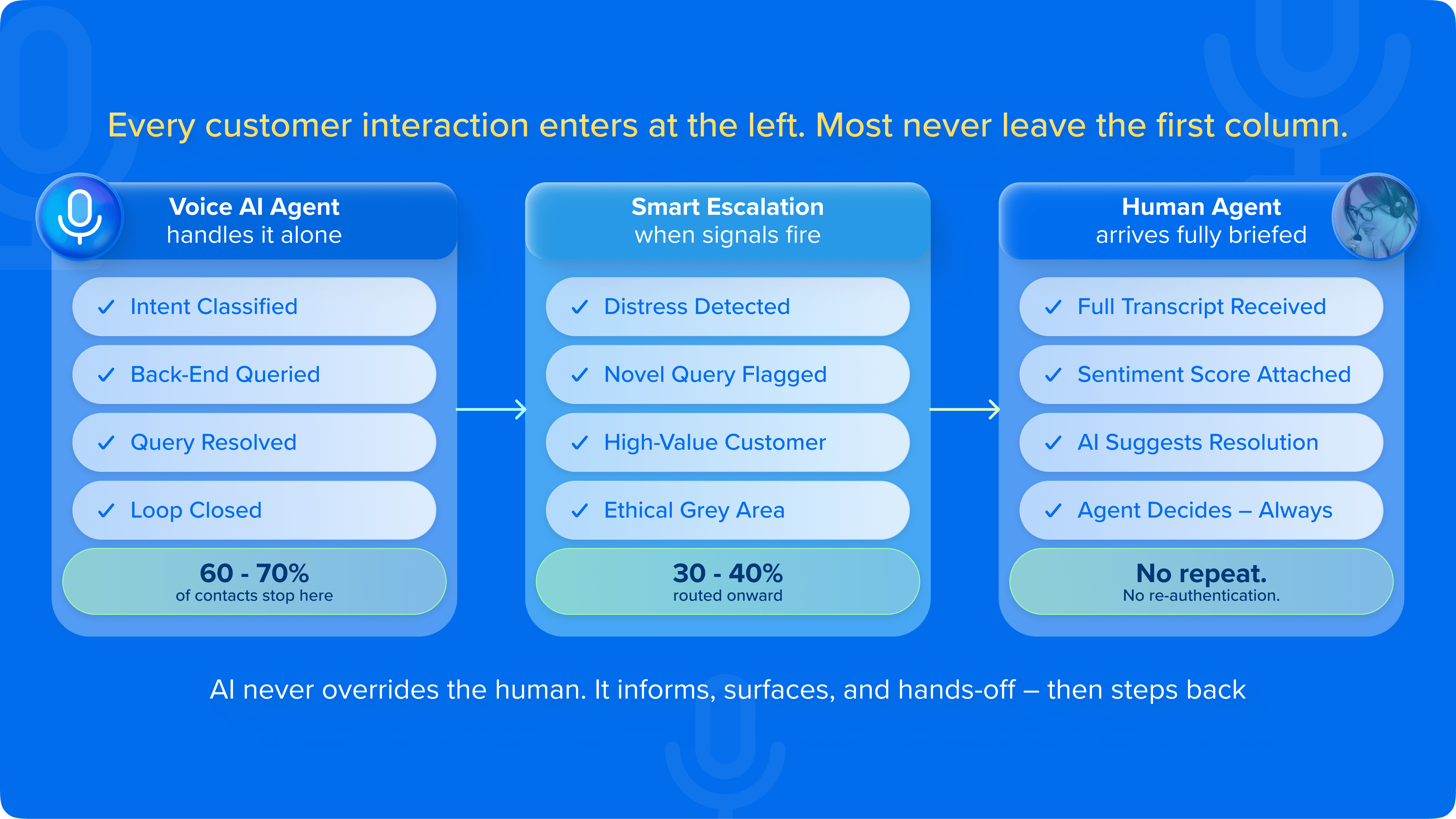
The single most consequential design decision in any voice AI deployment is where does the AI stop and the human begin?
Draw the line too conservatively, and you surrender most of the efficiency gains. Draw it too aggressively, and you start routing distressed or complex customers into AI conversations that cannot serve them.
The right line is not a static threshold. It is a dynamic routing logic that responds to intent classification, sentiment signals, customer tier, query complexity, and historical resolution data.
ALSO READ: From English to Hinglish: How Multilingual Voice Agents Break Language Barrier
Haptik's containment logic is designed to update continuously based on resolution outcomes where if a particular query type is consistently escalating despite being classified as tier-1, the model recalibrates.
AI-assisted human agents
When a customer is escalated to a human agent, the best AI deployments do not disappear. They transition from being the primary voice to being an intelligent co-pilot for the agent.
Real-time agent assist surfaces relevant knowledge base articles, flags compliance risks as the conversation unfolds, suggests next-best actions based on similar resolved cases, and provides the agent with the full sentiment and context history of the AI-led portion of the conversation. The agent never has to ask the customer to repeat themselves. They arrive informed, and they can focus on the judgment and empathy that the situation requires.
The critical design principle here: AI makes recommendations. It does not override. The agent has full authority, and the system is designed to support their decision-making, not supplant it.
Warm handoff protocols
Nothing erodes customer trust faster than being transferred between channels and having to repeat your entire situation from scratch.
"I understand you've already spoken to our digital assistant", and then asking four questions the customer already answered, is not a warm handoff.
Haptik's handoff architecture passes the full conversation transcript, the intent classification, the sentiment trajectory, and any data already collected to the receiving agent in real-time. The customer's first sentence to the human agent should be the continuation of a conversation, not the beginning of a new one.
The Ethics and Trust Dimension
Disclosure: Should customers know they're talking to an AI?
Yes. And not just because an increasing number of jurisdictions are moving toward mandating it.
Because customers who discover post-interaction that they were speaking with an AI, and were not told, consistently report significant trust damage, regardless of how well the interaction went.
The fear that disclosure reduces engagement or increases escalation rates is not well-supported by the evidence.
Customers, particularly in enterprise B2B and regulated consumer contexts, have a higher tolerance for AI interactions than the industry often assumes as long as they are given the choice to escalate, and provided the AI is genuinely competent within its domain.
Bias in AI support systems
AI models trained on historical interaction data inherit the biases of that data.
If your historical resolution patterns show differential treatment of customer segments - by region, by account type, by communication style - your AI model will reproduce and potentially amplify those patterns at scale.
Enterprises deploying AI in customer support need a structured bias audit process: regular analysis of resolution rates, escalation rates, and satisfaction scores segmented by customer demographic and behavioral variables.
This is not an ethical nicety. It is a governance requirement, and in regulated industries, increasingly a legal one.
The trust deficit
There is a point on the automation curve where efficiency gains begin to reverse trust outcomes.
Enterprises that route every interaction through AI, including the ones that should never have been routed through AI, create a customer experience where people feel systematically denied access to human judgment.
The backlash, when it comes, is not proportionate to the marginal interactions that went wrong. It is a cumulative trust withdrawal that manifests as churn, NPS deterioration, and public complaints.
The sustainable model is not maximum automation. It is optimal automation — using AI where it genuinely outperforms the alternative, and preserving the human layer for interactions where it does not.
Haptik's Philosophy: Augmentation Over Replacement
12+ years of AI domain expertise
Haptik was founded in 2013 - over a decade before "AI agents" became a category on analyst reports. That history matters, not as a credential for its own sake, but because 12+ years of enterprise AI deployment produces a kind of operational wisdom that cannot be synthesized from a product roadmap.
500+ enterprise deployments
With 500+ enterprise customers across financial services, eCommerce, healthcare, telecom, and travel, Haptik has encountered and resolved virtually every failure mode that emerges when AI meets real customer query distributions. The edge cases are documented, learned from, and built into the platform's design assumptions.
Omnichannel CX orchestration
Customer journeys do not happen in a single channel. A customer might initiate on a website chat widget, continue on WhatsApp, escalate to a voice call, and follow up on email in the same resolution journey. Haptik's CX platform orchestrates these touchpoints as a unified conversation rather than a series of disconnected interactions, with context preserved across every channel transition.
Integration maturity
Voice AI that cannot connect to your CRM, your ticketing system, your knowledge base, and your analytics infrastructure in real-time is a conversational toy, not an enterprise solution. Haptik’s proven expertise in complex integration work - including compliance-sensitive environments with strict data residency requirements - is a core competency.
Change management
Technology deployments fail less often because the technology is wrong than because the organizational change around it is mismanaged. Haptik brings consulting capability that helps enterprises navigate workforce transition, conversation design maturity, and governance frameworks. This is the difference between a platform that is deployed and a platform that gets adopted.
The Bottom Line
The question “Can AI replace human customer support entirely?” has a clear answer in 2026: no, and that is not a failure of AI ambition. It is a reflection of what genuinely excellent customer experience requires.
AI agents can handle the volume, the consistency, the scale, and the availability that human teams cannot. Human agents can handle the empathy, the judgment, the relationship continuity, and the ethical reasoning that AI cannot.
The enterprises winning on customer experience right now are the ones who designed a system where each does what it does best, and the seams between them are invisible to the customer.
That system is not easy to build. It requires deep integration work, careful conversation design, ongoing performance governance, and a workforce strategy that treats people as partners in the transition rather than obstacles to it.
But enterprises that invest in building it correctly, with partners who bring the operational depth to execute, not just the technology to deploy, are discovering that the outcome is not just more efficient support. It is better support, at scale, in a way that was not previously possible.
source on Google