


 Voice AI Agent
A customer calls your AI-powered contact center at 10:00 PM. They're anxious, voice slightly trembling, querying the status of a delayed insurance claim. Within seconds your voice AI agent greets them, confirms the policy number, and begins resolving her query. The interaction feels seamless (almost human).
But here’s what happened in the ten-second window that wasn’t narrated in the product demo: the customer’s voice was captured and transcribed by a third-party ASR engine. The words were processed by a large language model (LLM) whose data-handling practices your legal team has never reviewed. The transcript was written to a CRM record alongside her account details.
The voiceprint, which is a biometric identifier under India's Digital Personal Data Protection (DPDP) Act and the GDPR, now exists somewhere in a processing chain that spans at least four vendors.
Nobody obtained the customer’s explicit, informed consent. They weren’t informed how long their voice data would be retained. And there’s no documented procedure for when they ask for it to be deleted.
Across Indian enterprises deploying voice AI at scale - in financial services, retail and eCommerce, and healthcare - this is the default architecture. In 2026, it is also a compliance liability with real regulatory, financial, and reputational consequences.
This blog is for the leaders responsible for getting it right, who must answer for every byte of voice data their organization touches.
Why Voice Data Is a Special Category of Risk
Voice as biometric data: what the law says (DPDP, GDPR, CCPA)
Voice is not simply audio. When processed, even partially, to identify, authenticate, or infer personal information, voice data is biometric data under most major privacy frameworks in force today.
India's Digital Personal Data Protection Act, 2023, classifies biometric data as a subset of "sensitive personal data," triggering heightened obligations around consent, purpose limitation, and security.
The General Data Protection Regulation (GDPR) in Europe places biometric data in Article 9's "special categories," requiring explicit, granular consent or a qualifying legal basis.
The California Consumer Privacy Act (CCPA) and its amendment, the CPRA, include voiceprints in their definition of sensitive personal information, granting consumers enhanced opt-out rights.
The moment your voice AI system does anything more than route a call - when it transcribes, analyzes sentiment, verifies identity, or personalizes a response - it is processing biometric data. Your compliance posture must reflect that.
What's being captured in a voice AI call (and for how long)
A typical enterprise voice AI interaction generates far more data than most organizations account for.
The raw audio stream itself may be retained for quality assurance. The ASR engine produces a text transcript of every utterance. The LLM processing layer receives that transcript as a prompt, often alongside user profile context from your CRM. The TTS engine generates a synthesized audio response. And the outcome of the interaction like resolution status, sentiment score, and escalation flag is written back to your CRM as a structured record.
ALSO READ: Scaling Voice AI for Large Enterprises: What Changes After 10 Million Calls
Each of these artefacts has its own retention footprint. ASR logs are frequently held for 30-90 days as a default in cloud ASR products. LLM prompt logs may persist in vendor infrastructure indefinitely unless you negotiate otherwise. CRM records follow your organization's own retention schedules, which may never have been designed with voice AI in mind.
In the absence of explicit retention policies governing every layer of this chain, you are almost certainly retaining voice data far longer than you need to, and longer than regulators consider proportionate.
The breach surface: ASR logs, LLM prompts, TTS output, CRM writes
Traditional data breach thinking focuses on databases and files.
In a voice AI architecture, the breach surface is considerably wider and less visible. A misconfigured ASR vendor could expose thousands of call transcripts.
A poorly-scoped LLM API integration might send customer PII to a model hosted in a foreign jurisdiction. TTS output cached for replay could include sensitive customer disclosures. And CRM write-backs, if not properly governed, create structured records that aggregate voice-derived insights without any of the access controls applied to the original audio.
It is the reason regulators in every major market are starting to look specifically at AI pipeline data flows (not just the endpoint application) when assessing compliance.
The Regulatory Landscape in 2026: What Indian Enterprises Must Navigate
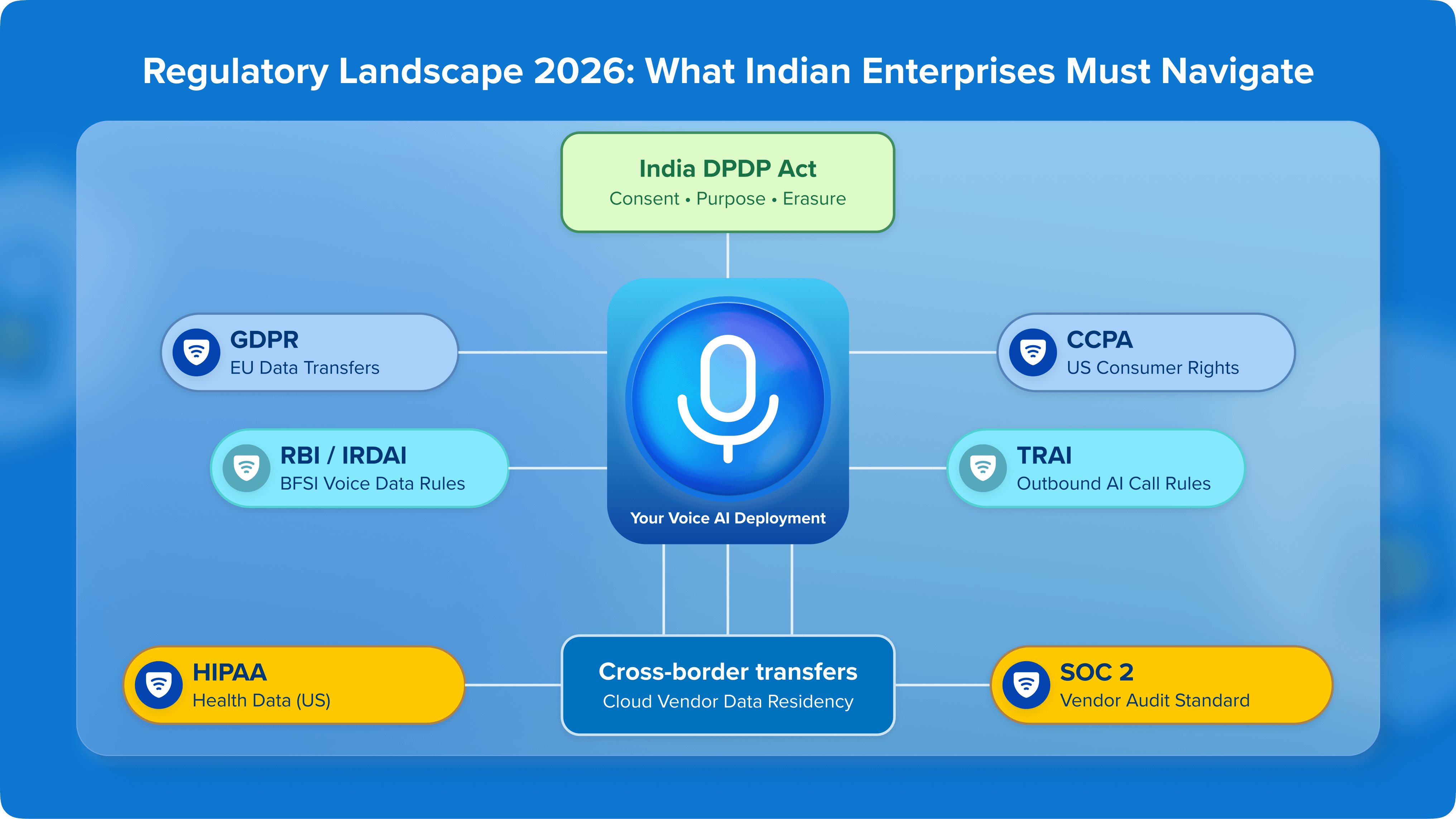
India's DPDP Act: consent, purpose limitation, and data principal rights
The Digital Personal Data Protection Act, 2023 is the governing framework for personal data processing in India, with specific implications for voice AI deployments.
The Act requires that consent be freely given, specific, informed, and unambiguous while being obtained before processing begins.
For a voice AI agent initiating an outbound call or receiving an inbound query, this means the consent mechanism must be built into the interaction itself, not buried in a terms-of-service update the customer accepted at account opening.
RELATED: Decoding the Indian Digital Personal and Data Protection Act (DPDP)
The DPDP Act also enshrines purpose limitation: data collected for one purpose cannot be used for another without fresh consent.
Voice data captured to resolve a billing query cannot be repurposed to train your sentiment model without explicit permission. Data Principal rights under the Act include the right to access, correct, and erase personal data - which your voice AI system must be architecturally capable of honoring.
The penalties for non-compliance are not trivial: up to INR 250 crore per breach instance under the proposed penalty framework, with repeat violations treated more severely. The Data Protection Board of India, once fully constituted, will have investigative and adjudicatory authority that enterprises should treat seriously.
RBI and IRDAI guidelines relevant to voice data in BFSI
For banking and financial services institutions, the Reserve Bank of India's guidelines on customer data, digital channels, and third-party outsourcing all apply when voice AI vendors process customer information.
ALSO READ: Voice AI for BFSI: High-Compliance Conversations at Enterprise Scale
RBI's Master Direction on Digital Payment Security Controls and the data localization requirements embedded in various RBI circulars mean that voice data generated from banking interactions must remain within India, significantly minimizing many cloud-based ASR and LLM options unless they offer India-specific data residency.
The Insurance Regulatory and Development Authority of India (IRDAI) has similar requirements for insurers around policyholder data protection and outsourcing of core functions.
Where voice AI handles policy servicing, claims queries, or renewal conversations, IRDAI expects that the data handling practices of the AI system meet the same standards as any other insurer data process.
Cross-border data transfer rules for enterprises using cloud-based voice AI
One of the most overlooked compliance risks in enterprise voice AI is the cross-border data transfer embedded in standard cloud deployments.
Many ASR engines, LLM APIs, and voice AI platforms process data on infrastructure hosted outside India, often in the United States or Europe. Under the DPDP Act, cross-border transfers of personal data will require either a government-approved adequacy framework with the destination country or appropriate contractual safeguards, mirroring the GDPR's approach.
In practice, this means that before deploying any cloud-based voice AI platform, your legal and procurement teams must understand exactly where data is processed at every stage of the pipeline, ensuring that adequate transfer mechanisms are in place.
On-premise deployment or private cloud within India remains the cleanest solution for enterprises with strict data residency requirements.
TRAI regulations on telemarketing and outbound AI calls
The Telecom Regulatory Authority of India's Telecom Commercial Communications Customer Preference Regulations govern outbound commercial calls, including those made by AI agents.
The Do Not Disturb registry, consent management obligations, and call time restrictions all apply to AI-initiated outbound voice interactions.
TRAI's evolving thinking on AI-generated calls, including questions around disclosure requirements when the caller is not human, means enterprises should expect increased regulatory attention on outbound voice AI use cases through 2026 and beyond.
The Privacy Architecture of a Compliant Voice AI System
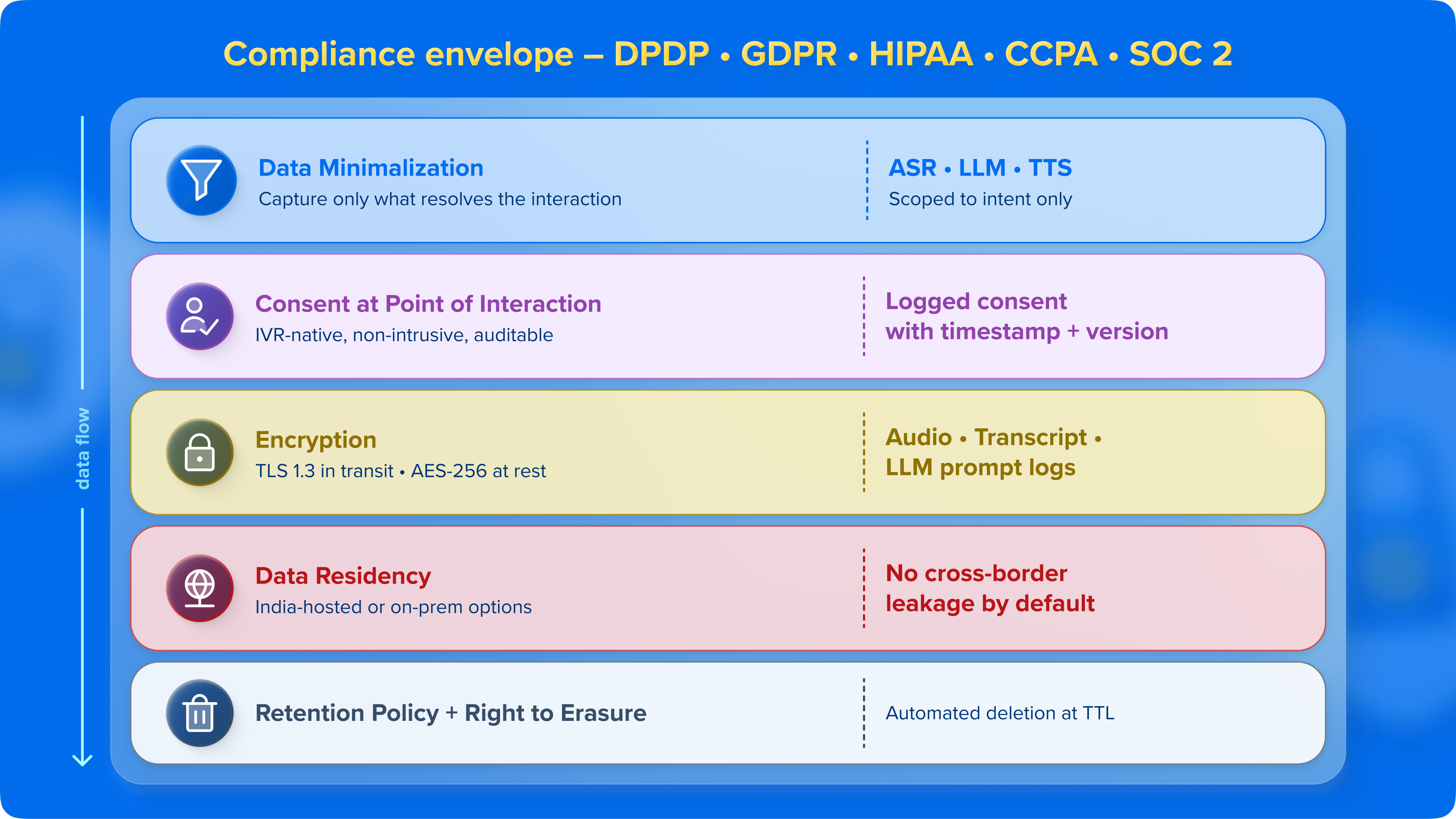
Data minimization: Capturing only what's needed for resolution
Data minimization is the foundational principle: collect only the data that is necessary for the specific purpose at hand, and nothing more.
In a voice AI context, this means configuring your ASR, LLM, and logging systems to capture what is genuinely needed to resolve the customer's query, and to discard or anonymize everything else as close to the point of collection as possible.
Haptik's voice AI platform is built with minimization-first architecture. Prompts sent to the LLM layer are scoped to the intent context, not padded with full customer profiles from CRM unless directly relevant to resolution.
Audio retention policies are configured at deployment, without leaving them to platform defaults.
Consent at the point of interaction: How to do it without killing UX
Consent, done well, is a two-second IVR prompt before the substantive interaction begins. Consent, done poorly, is a three-minute legal disclosure that causes customers to abandon calls.
The design challenge is to make consent genuine - informed, specific, and auditable - without making it an obstacle.
ALSO READ: Voice AI: How Inbound and Outbound Calling Works in 2026
The right architecture logs the consent event: timestamp, the consent text version the customer heard, and the customer's affirmative response, creating an auditable record that can be retrieved in response to a regulatory query or a data principal's request.
Haptik's platform generates this consent audit trail automatically for every voice AI interaction, supporting DPDP Act compliance without requiring bespoke engineering from the enterprise.
Encryption: In-transit and at-rest standards for voice data
Voice data in transit between the caller's telephony endpoint, your voice AI platform, ASR vendor, LLM API, and CRM must be encrypted using current best-practice standards - TLS 1.3 as the minimum for data in transit.
Audio recordings and transcripts stored at rest must be encrypted using AES-256 or equivalent.
Key management must be governed:
- Who holds the keys
- How rotation is managed
- What happens to stored data when a vendor relationship ends
These questions that belong in your procurement and compliance process, not discovered after the fact.
Data residency: Why where your voice AI stores data matters
Data residency is a regulatory requirement for many Indian enterprises, and a meaningful risk mitigation for all of them.
When voice data is processed and stored within India, it remains subject to Indian law and accessible to Indian regulatory authorities under established legal processes. When it is processed offshore, the jurisdictional picture becomes significantly more complex.
Haptik offers on-premise and private cloud deployment options that allow enterprises with strict data residency requirements to keep all voice data like audio, transcripts, LLM inputs and outputs, and analytics within their own infrastructure or within India-hosted cloud environments.
Retention policies and the right to erasure for voice records
Every voice AI deployment needs a retention policy that covers every data layer:
- Raw audio
- ASR transcripts
- LLM prompt logs
- TTS outputs
- CRM write-backs
The policy should specify the maximum retention period for each data type, the automated deletion mechanism that enforces it, and the process for responding to a data principal's erasure request within the timelines specified by applicable law.
Haptik's platform includes configurable retention policy enforcement, with automated deletion workflows that span the full data pipeline.
When a customer exercises their right to erasure under the DPDP Act, the deletion process propagates across audio storage, transcript databases, and analytics systems, not just the primary customer record.
Third-Party Risk in Voice AI Deployments
Understanding the vendor data processing chain (ASR → LLM → TTS)
Your voice AI vendor is rarely a single entity. Behind the customer-facing platform sits a chain of sub-processors: an ASR provider for speech recognition, one or more LLM providers for natural language understanding and response generation, a TTS provider for synthesised speech, and potentially additional vendors for analytics, storage, or telephony integration. Each of these entities processes your customer's voice data. Each introduces its own data handling practices, retention defaults, and infrastructure footprint.
As the data controller under the DPDP Act and GDPR, your organization is responsible for ensuring that every sub-processor in this chain meets the standards required by applicable law. This is not a responsibility you can fully delegate to your primary voice AI vendor, it requires your own due diligence on the complete processing chain.
What to audit in your voice AI vendor's privacy architecture
When evaluating a voice AI vendor, your compliance and procurement teams should be able to answer the following questions from the vendor's documentation and contractual commitments:
- Where is each category of voice data processed and stored?
- What are the default and configurable retention periods at each processing layer?
- Who are the sub-processors, and what data processing agreements govern those relationships?
- What certifications does the vendor hold - SOC 2 Type II, ISO 27001, and others relevant to your industry?
- What are the breach notification timelines and procedures?
- What happens to your data if the vendor relationship ends?
ALSO READ: How to Choose the Best Voice Platform for Enterprise CX
DPA (data processing agreement) checklist for enterprise procurement
A Data Processing Agreement is a legal requirement wherever a processor handles personal data on behalf of a controller under GDPR, and best practice under the DPDP Act. For voice AI deployments, the DPA should explicitly cover:
- Subject matter, nature, and purpose of voice data processing
- Categories of personal data processed (including biometric classification where applicable)
- Sub-processor disclosure and approval process
- Data transfer mechanisms and residency commitments
- Security measures, including encryption standards and access controls
- Retention and deletion obligations, including automated enforcement
- Breach notification timelines (72 hours is the GDPR standard)
- Audit rights for the controller
- Return or deletion of data upon contract termination
Haptik provides a clean, enterprise-grade DPA as a standard component of every deployment engagement. No vendor lock-in provisions are embedded in Haptik's DPA; data portability and return on contract termination are explicit obligations.
Operationalizing Privacy without Killing Functionality
PII redaction in real-time transcripts
One effective privacy control available in a voice AI system is real-time PII redaction from transcripts before they are stored or passed to downstream systems.
Named entity recognition (NER) models can identify and mask or tokenize personally identifiable information in the transcript stream before it reaches the LLM, the analytics pipeline, or the CRM.
Haptik's platform supports configurable PII redaction at the transcript layer, meaning that sensitive details spoken during a call are not retained in plain text in any downstream system. Voice AI can still use the information in context for resolution - it is masked for storage purposes only, preventing unnecessary data retention of high-sensitivity fields.
Anonymization protocols for analytics pipelines
Contact center analytics surfacing call volume patterns, resolution rates, sentiment trends, and frequent query topics are genuinely valuable.
They don’t require access to individual customer voice data to be useful. A well-designed analytics pipeline uses anonymized or aggregated data for reporting and model improvement, keeping identifiable information out of the analytics layer entirely.
This separation is both a privacy best practice and a practical risk reduction measure. If the analytics database is compromised, it contains no personal data. If a model is retrained on call data, it is retrained on appropriately anonymized data that cannot be reverse-engineered to identify individuals.
Audit trails: logging what you need without retaining what you shouldn't
Compliance requires that you can demonstrate what happened like which agent handled a call, what consent was obtained, when data was deleted, what sub-processors were involved.
It does not require that you retain full recordings and transcripts indefinitely to achieve this. A well-designed audit trail captures the metadata of each interaction like timestamps, consent events, agent IDs, resolution outcomes, and deletion confirmations without retaining the content of the interaction beyond its legitimate purpose period.
READ: Voice AI for Contact Centers: The Enterprise Guide to Resolution at Scale
Haptik's audit logging architecture is designed on this principle: rich, tamper-evident metadata logging for compliance purposes, with configurable content retention governed by purpose and regulatory requirement.
Audit logs themselves are encrypted and access-controlled, with retention periods appropriate for the regulatory environment of each deployment.
The Haptik Difference: Privacy-First Voice AI Architecture
Privacy compliance in voice AI is an architectural choice that must be made at the design stage and maintained through every deployment, update, and vendor relationship over the lifetime of the system. Haptik's voice AI platform is built with this reality at its foundation.
Enterprise compliance
Haptik's enterprise compliance credentials span GDPR, HIPAA, SOC 2 Type II, CCPA, and India's DPDP Act.
For BFSI clients, Haptik's approach is aligned with RBI data localization requirements and IRDAI outsourcing standards. For healthcare clients operating across jurisdictions, HIPAA-compliant data handling is a deployment default, not an optional module.
On-prem and private cloud deployment
On-premise and private cloud deployment options mean that enterprises with strict data residency requirements are not forced to choose between compliance and capability.
Haptik's platform delivers the full functionality of enterprise voice AI involving multi-turn conversation, CRM integration, and real-time analytics within the customer's own infrastructure perimeter.
No vendor lock-in
DPDP Act alignment is operationalized at the deployment level:
- Consent capture and logging
- Purpose-scoped data minimization
- Retention policy enforcement
- Erasure workflow automation
These are configured as part of the go-live process, with Haptik's compliance team working alongside the enterprise's legal and IT stakeholders to ensure the deployment meets the organization's specific regulatory obligations.
Compliance consulting
Haptik provides a clean DPA with every enterprise engagement, with no vendor lock-in provisions.
Data portability is a contractual commitment, not a commercial negotiation point. And when a deployment ends, documented data return and deletion procedures ensure that customer data does not persist in Haptik's infrastructure beyond the agreed terms.
Building your internal voice AI privacy checklist
Before any voice AI deployment goes live, your organization should be able to answer these ten questions.
If you cannot, there might be a compliance gap that needs to be addressed before the system handles a customer call.
- Have we classified our voice AI's output as biometric data where applicable, and applied the corresponding compliance obligations under the DPDP Act, GDPR, or other applicable law?
- Is there a documented consent mechanism in place that is specific to voice AI data processing, and does it generate an auditable record of each consent event?
- Do we have a complete, documented map of every vendor and sub-processor that touches voice data in our AI pipeline, including ASR, LLM, TTS, storage, and analytics providers?
- Does each vendor in the processing chain have a signed Data Processing Agreement that covers all categories of voice data processed, including biometric data where relevant?
- Is all voice data processed and stored within India, or do we have adequate cross-border transfer mechanisms in place for any offshore processing?
- Are there documented retention policies covering every data layer like raw audio, transcripts, LLM prompt logs, TTS outputs, and CRM records with automated deletion enforcement?
- Is there a tested, documented procedure for responding to a Data Principal's erasure request within the regulatory deadline, covering all data layers and all vendor systems?
- Are PII redaction and anonymization controls in place at the transcript and analytics layers, preventing unnecessary retention of identifiable voice-derived data?
- Do we have encryption in place for voice data both in transit (TLS 1.3 minimum) and at rest (AES-256 or equivalent), with documented key management procedures?
- Have we conducted a Data Protection Impact Assessment (DPIA) for the voice AI deployment, and is it documented and reviewed on a schedule aligned with system changes?
FAQs
Review your voice AI privacy architecture with Haptik’s compliance team.
source on Google