


 Voice AI Agent
It’s 11 AM in Pune.
A collections agent at a mid-sized NBFC has 47 follow-ups due today. One of those borrowers, a delivery driver with patchy internet and no appetite for IVR menus, has already ignored two SMS reminders. He would have answered a WhatsApp message.
He would have responded to a voice prompt in Hindi, in the app he already has open. The loan reminder that never reached him costs the NBFC a day's delay, a manual escalation, and a compounding default risk. Multiply that by 50,000 borrowers, and you're looking at a revenue operations problem.
That moment signifies why WhatsApp voice AI agent is the answer to a structural gap: the customer is already on WhatsApp, but the enterprise's voice capability isn't.
ALSO READ: Voice AI for Indian Languages: What Enterprise-Grade Really Means in 2026
Why WhatsApp Is the Channel Enterprises Can No Longer Ignore
3B+ users and the shift from consumer to business-critical
WhatsApp has crossed over 850 million monthly active users in India alone. It is the messaging layer that everything else sits on top of.
For Indian enterprises, customers receive bank alerts, track deliveries, and now, increasingly, interact with service workflows on WhatsApp. The platform has moved from consumer convenience to business-critical infrastructure faster than most IT teams have budgeted for.
From text to voice - why the last mile runs on audio
Text-first digital engagement has a ceiling, and India hits it faster than most markets. A significant portion of India's working population including field agents, blue-collar workers, and semi-urban customers navigates digital interfaces by voice or not at all.
Literacy, speed, and comfort all point the same direction: audio is the natural interface for a large share of enterprise customers. WhatsApp voice bridges this gap without asking the customer to download anything new or learn a new interface. The channel they trust is the channel that resolves their query.
What WhatsApp Business API enables for enterprise voice
Standard WhatsApp has no programmatic access, no webhook integration, no compliance audit trail. The WhatsApp Business API (WABA) changes the architecture, enabling enterprises to trigger and receive structured voice interactions, integrate with CRMs and backends in real time, and operate within Meta's approved messaging categories.
Without WABA certification, an enterprise voice AI deployment on WhatsApp isn't possible. With it, the channel becomes a production-grade enterprise interface.
How WhatsApp Voice AI Agents Work in Production
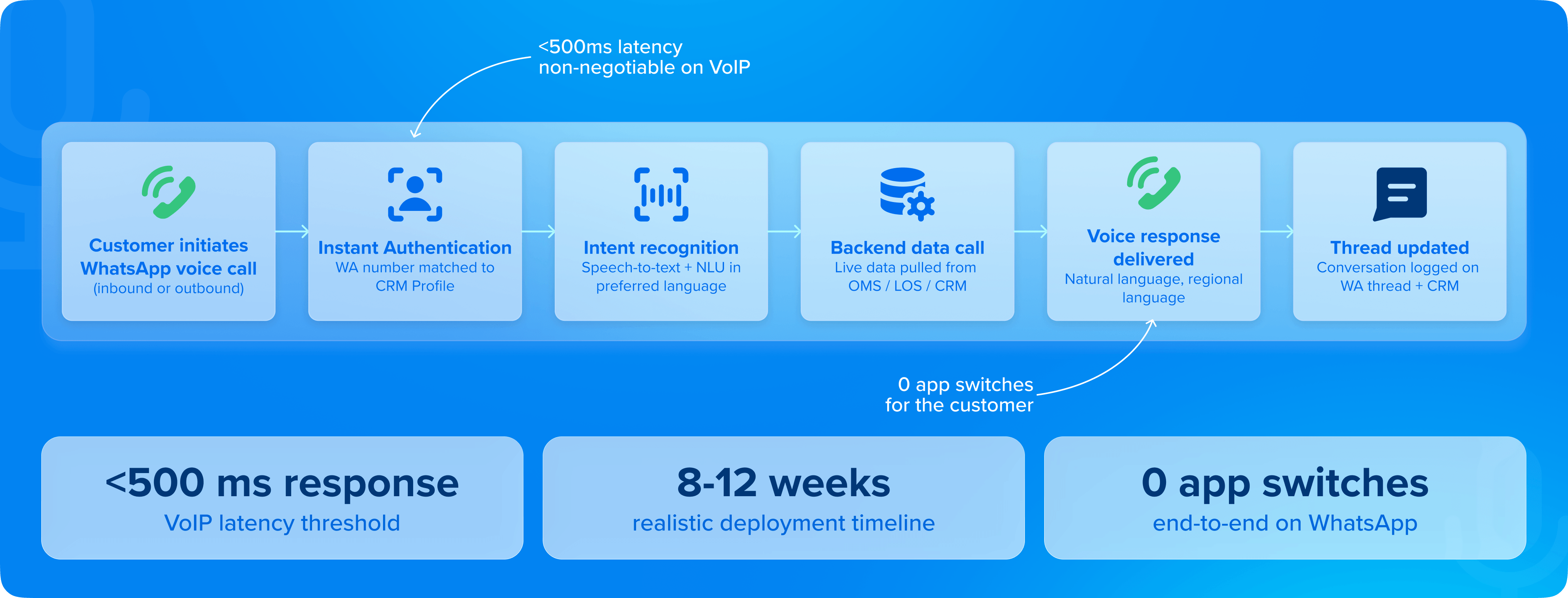
The conversation flow: From incoming call to resolved query
Consider a customer who triggers a WhatsApp voice interaction to track a delayed eCommerce order. The AI agent answers in under 500ms, identifies the customer from their WhatsApp number, pulls live order status from the OMS, and responds with an accurate ETA and an option to reschedule delivery. The interaction closes in under two minutes, and the conversation thread in WhatsApp shows the full record.
READ: Voice AI for Contact Centers: The Enterprise Guide to Resolution at Scale
What makes this work is the orchestration layer: the system that ties speech recognition, intent classification, backend API calls, and response generation into a coherent, low-latency loop.
Session handling and context across multi-turn conversations
Enterprise voice interactions are rarely single-turn. A customer calling about a payment dispute may ask about their outstanding balance, request a callback, ask whether their account is now current - in the same session, or across two calls three days apart.
A well-architected WhatsApp voice AI agent maintains context within the session via state management, and across sessions via a persistent customer profile tied to the WhatsApp number. Without this, every call starts from zero, which is noticeable to the customer.
Latency on VoIP: Why sub-500ms is non-negotiable on WhatsApp
WhatsApp voice operates over VoIP, and VoIP has zero tolerance for hesitation. A 700ms lag between a customer's question and the AI's response feels broken.
Across Haptik deployments, sub-500ms response latency is the threshold that separates interactions customers trust from interactions they abandon. On WhatsApp, where customers expect the responsiveness of a messaging app, this bar is non-negotiable. Platforms that perform well on traditional telephony often underperform on WhatsApp voice precisely because they weren't architected for VoIP latency constraints.
Enterprise Use Cases Driving WhatsApp Voice AI Adoption in 2026
The use cases that have moved from pilot to production share one characteristic: they involve high-frequency, structured interactions where the customer is already on WhatsApp and the enterprise needs resolution, not just engagement.
Customer support at scale
The highest-volume deployments are also the most repeatable: a borrower confirming a payment, a customer checking where their order is, or a patient rescheduling a clinic visit.
WhatsApp voice AI handles them at scale without queue times, without agent availability constraints, and without the drop-off that comes from asking customers to navigate an IVR.
Collections and payment reminders
BFSI enterprises are deploying WhatsApp voice AI to reach borrowers who don't answer unknown numbers but will engage with a WhatsApp voice message in their language, at a time they choose, with real-time payment options embedded in the conversation thread.
Haptik’s WhatsApp voice AI deployments have driven a 25-40% increase in response rates, reducing abandonment significantly.
Field agent enablement
Sales teams and delivery agents who live in WhatsApp all day are currently switching apps to log calls, escalate issues, or check order status. A WhatsApp voice AI layer that handles logging, escalation routing, and status retrieval inside WhatsApp removes that friction entirely.
Proactive engagement
Proactive outreach like appointment reminders, renewal nudges, and re-engagement campaigns completes the picture. WhatsApp voice AI as an outbound channel can reach customers where text notifications go unread, with a human-quality voice interaction that drives action.
The Compliance Minefield - What Legal and IT Teams Must Hear
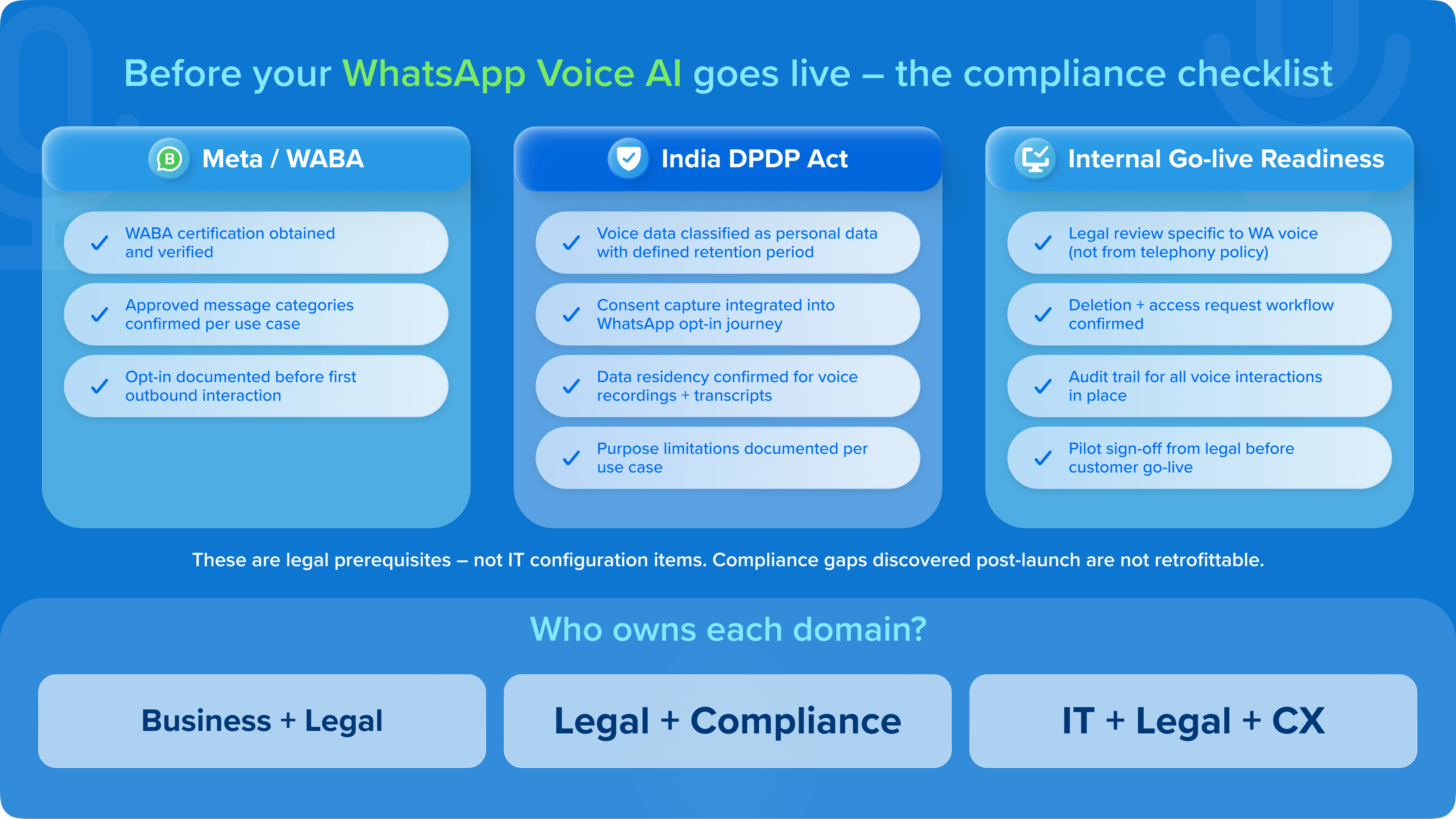
This is skipped by most vendors, while it’s the reason most enterprise deployments stall at legal review.
WhatsApp Business API policies for enterprises
Meta's WABA framework restricts voice interactions to specific approved categories. Enterprises cannot initiate unsolicited voice calls; opt-in must be explicit, documented, and tied to the use case.
Message templates for proactive outreach require Meta approval. These constraints aren't advisory, with violations resulting in API access suspension. Any deployment that doesn't build opt-in architecture before go-live is building toward a compliance incident.
DPDP, GDPR, and how voice data on WhatsApp is governed differently
India's Digital Personal Data Protection Act introduces a materially different compliance posture for voice data than traditional telephony.
Under DPDP, voice data collected via WhatsApp is personal data requiring explicit consent, defined retention limits, and documented purpose limitations. Unlike a call recording on a traditional IVR, where consent is typically captured via keypress, WhatsApp voice conversations require a consent framework that integrates with the customer's WhatsApp opt-in journey.
Consent frameworks and call recording on WhatsApp voice
Before any WhatsApp voice AI deployment goes live, legal teams should have clarity on three things:
- The opt-in capture mechanism and where it's stored
- The data residency of voice recordings and transcripts
- the retention and deletion policy for conversation data tied to WhatsApp numbers
These are legal prerequisites that decide whether a deployment is defensible under DPDP and Meta's own data policies.
How to Evaluate a Voice AI Platform for WhatsApp Deployment
Most platform evaluations use accuracy, integrations, and cost per interaction as evaluation criteria. WhatsApp voice deployments require a more specific lens.
RELATED: Haptik’s Six-Lens Framework to Choose the Right Voice AI Platform
WABA certification
This is table stakes. What differentiates platforms is VoIP-specific latency architecture, multilingual support that includes Indian regional languages at production quality, and integration depth with the CRM and backend systems the AI agent needs to resolve queries.
Implementation reality
A WhatsApp voice AI deployment involves WABA onboarding, consent framework setup, backend API integration, language model tuning, and compliance review before a single customer interaction goes live. Realistic timelines for a production deployment run eight to twelve weeks. Platforms that promise faster without scoping the integration layer are pricing in technical debt.
Haptik's deployment methodology accounts for this complexity upfront, ensuring post-launch performance holds at scale rather than degrading when edge cases emerge.
Evaluate for scale
When a payment deadline triggers 80,000 simultaneous WhatsApp voice interactions, or a logistics disruption drives a spike in order-tracking calls, the platform's concurrency handling, failover architecture, and queue management all come under pressure at once.
Enterprises should ask vendors explicitly:
- What is the tested concurrency ceiling?
- How is load distributed?
- What is the degradation curve when that ceiling is approached?
What's Next? WhatsApp Voice AI in the Agentic Era
The current generation of WhatsApp voice AI is reactive: a customer initiates, the agent responds. The next generation is goal-oriented.
From reactive assistants to proactive agents
A proactive WhatsApp voice AI agent doesn't wait for the customer to call about an overdue EMI; it identifies the risk signal, initiates a WhatsApp voice interaction at the optimal time, offers a restructuring option, and closes the loop with a payment confirmation. This is deployable today for enterprises with the right data infrastructure and AI orchestration layer.
Multimodality
UPI payments, document sharing, and identity verification are all native or near-native capabilities on the platform. The near-term opportunity for enterprise CX is threading these together: a voice AI agent that initiates a collections conversation, presents a payment link mid-call, confirms completion via UPI notification, and closes the ticket.
Unified CX interface
The longer horizon is WhatsApp as a: voice, text, payments, document verification, and identity confirmation on a single conversation thread.
For Indian enterprises, this is the direction Meta, RBI, and enterprise CX teams are moving toward. The enterprises that build their WhatsApp voice AI foundation now will own that interface when it matures.
The Bottom Line
WhatsApp is already where your customers are. Voice is how a significant share of them prefer to communicate. The question isn't whether WhatsApp voice AI belongs in your enterprise CX stack but whether you build the compliance, integration, and language architecture to make it work at scale. Haptik has deployed WhatsApp voice AI in production across BFSI, logistics, and retail, and the deployments that hold are the ones that treated compliance and integration depth as design inputs, not post-go-live cleanup.
FAQs
See Haptik's WhatsApp voice AI in action. Book a 20-minute live demo now.
source on Google