


 Voice AI Agent
India's EdTech sector has over 100 million active learners as of early 2026. Yet the average student support ticket still takes over three days to resolve.
During admissions season, inbound call volumes spike 4-6x, and counselor teams are expected to absorb it all without a drop in conversion. The cost of getting this wrong isn't a bad NPS score; it’s a student who quietly disengages.
It's a re-enrollment window that closes without a single follow-up call. More support staff is not the answer. Smarter infrastructure is, which is precisely where voice AI agents for education are changing the equation.
Why Education Is a High-Stakes Voice AI Opportunity
The volume problem: Admissions, fee queries, exam schedule, re-enrollment
Education is one of the highest-contact-intensity industries in the world, yet it operates on some of the tightest staffing budgets.
A single EdTech platform serving 200,000 learners might field 30,000+ support calls monthly, spanning fee confirmations, exam schedules, certificate status, and re-enrollment reminders.
Seasonality amplifies this: admissions windows and batch renewals create demand surges that no fixed team can staff for cost-effectively. Conversational AI in education has moved from pilot stage to operational necessity precisely because the volume math doesn't work any other way.
The emotional dimension: Why students and parents prefer voice
Text-based support assumes digital comfort. Voice assumes none of that.
A parent in Patna anxious about their child's admission status doesn't want to navigate a chatbot menu; they want a real-time conversation that resolves their concern in the moment.
AI voice agents for EdTech deliver exactly that, with the added advantage that voice is the primary input mode for first-time smartphone users across India's Tier 2 and Tier 3 markets.
ALSO READ: Voice AI for Contact Centers: The Enterprise Guide to Resolution at Scale
What happens when support fails
Unresolved queries don't wait. Students who contact support and don't receive resolution within 24 hours are significantly more likely to miss fee deadlines, defer enrollment, or churn quietly.
For an EdTech platform with average revenue per user of ₹15,000-₹40,000, even a single-digit improvement in resolution rates across open queries translates directly to crore-level revenue retention.
Where Voice AI Agents Fit Across the Student Lifecycle
Student support automation means ensuring no student moment goes unaddressed, at every phase of the journey.
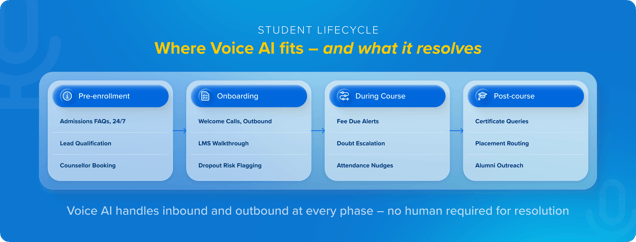
Pre-enrollment: Answering admission FAQs 24/7
Prospective students and parents contact institutions at all hours. Admissions voice AI can handle the full range of pre-enrollment queries - eligibility, batch timings, fee structures, and scholarships - in real time, without a counselor online.
Beyond answering, a well-configured agent captures lead intent, qualifies by course interest, and schedules callbacks for high-intent prospects, improving the signal-to-noise ratio for human teams.
Onboarding: Guiding new students through portals and first steps
The first 48 hours after enrollment are disproportionately predictive of course completion.
Voice AI agents can guide new students proactively by triggering outbound welcome calls, walking through LMS access step by step, and flagging students who haven't logged in within their onboarding window for counselor follow-up.
During the course: Reminders, doubt escalation, fee due alerts
Mid-course is where most dropout happens quietly, without a formal exit.
Proactive voice AI handles attendance reminders, fee due alerts, and live session nudges.
Inbound agents capture first-level doubt queries, assign to subject experts, and confirm resolution timelines - keeping learners engaged without overloading faculty.
Post-course: Certification, placement support, alumni engagement
Post-completion is chronically underserved.
Students with certificate queries or placement portal issues represent a referral and re-enrollment opportunity most institutions leave on the table.
Voice AI handles this high-volume tail at near-zero marginal cost, routing warm, placement-ready candidates directly to human placement teams.
Real Use Cases Generating ROI in EdTech
Outbound voice AI for re-enrollment campaigns
Re-enrollment campaigns involve reaching tens of thousands of past students in a compressed window.
An AI voice agent for EdTech executes personalized outbound calls at scale - referencing the student's previous course, surfacing a relevant next program, and confirming interest or scheduling a counselor callback, 24 hours a day, at a fraction of the cost of human-led outreach.
RELATED: How Inbound and Outbound Calling Works in 2026
Voice AI for parent communication in K-12 and test prep
In K-12 and test prep segments, the primary decision-maker is often the parent.
Voice AI handles parent-facing queries on batch timings, faculty credentials, and fee schedules in regional languages, at the parent's preferred calling hour, dramatically reducing inbound load on counselors while improving satisfaction scores.
Multilingual voice support across Tier 2 and Tier 3 markets
India's EdTech growth is being written in Hindi, Tamil, Telugu, Kannada, and Bengali - not just English.
Students from Tier 2 and Tier 3 cities represent the fastest-growing cohort for most major platforms, yet they are the most underserved by English-first support infrastructure. Multilingual voice AI bridges this gap with dialect awareness built in.
RELATED: How Multilingual Voice AI Breaks Language Barriers
Reducing counselor burnout during admissions season
Counselor attrition spikes predictably after every admissions cycle.
When teams handle 200+ calls daily, fielding many repetitive FAQ queries, burnout follows.
Voice AI absorbs that repetitive volume, leaving counselors for high-intent conversations where human judgment genuinely matters.
The Metrics That Matter in Education Voice AI
First call resolution (FCR) rate for student queries
FCR is the defining health metric for student support.
Human-led education support typically achieves 40-55% FCR on first contact.
Well-deployed voice AI agents for education regularly exceed 70% for structured query categories like fee status, schedule queries, and certificate updates because they access live data systems in real-time, without placing callers on hold.
Enrollment conversion lift from voice-Led outreach
Outbound voice AI for admissions and re-enrollment generates 2-3x higher engagement than SMS or email alone, driven by personalization, immediacy, and the ability to handle live objections within the same call.
Admissions season capacity
A team of 20 counselors handling 150 calls a day reaches a ceiling of 3,000 calls.
A voice AI deployment covering the same structured query volume can scale to 50,000+ calls in the same window without additional headcount, freeing every counselor for conversations that actually convert.
RELATED: Scaling Voice AI for Large Enterprises: What Changes After 10 Million Calls
What to Look for in a Voice AI Partner for Education
Integration with SIS, LMS, and CRM platforms
A voice AI agent that can't access your Student Information System, LMS, or CRM in real-time is a sophisticated IVR at best.
Genuine resolution requires live data like fee status, attendance records, and batch assignments, plus outcomes pushed back into your systems of record.
RELATED: Integrating CRM, Service Desk, and Messaging Channels with AI Service Agent
Evaluate vendors on native integrations with Salesforce, Zoho, and custom LMS environments from the outset.
Multilingual and dialect-aware capabilities
Language coverage is necessary but not sufficient.
Evaluate platforms on training data depth and dialect coverage, not just the language count in a feature matrix.
Data privacy for student records - DPDP Act India
With India's Digital Personal Data Protection Act now in force, any voice AI deployment handling student records or fee data must operate within a compliant data architecture.
Verify that data residency, consent management, and breach notification provisions are explicitly addressed.
Lead qualification: Filtering intent before a human spends time
Configurability without custom engineering every time
Admissions windows change. Course catalogs change. A deployment that requires custom engineering for every content update is a dependency, not a solution.
Look for platforms where business users update flows and FAQs without a developer in the loop.
How Haptik Approaches Education Voice AI
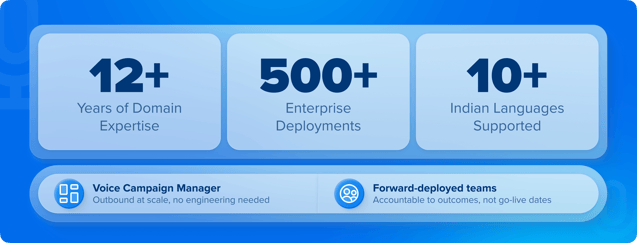
12+ years of domain expertise
Haptik brings institutional knowledge built across a decade of enterprise deployments spanning financial services, retail, healthcare, and education.
That depth matters because education has its own operating logic like seasonal demand spikes, multi-stakeholder communication chains, and a support failure cost that shows up in dropout rates.
At Haptik, we have seen what breaks in production and have already engineered past it.
500+ enterprise deployments
Haptik has encountered and resolved the integration challenges, edge cases, and scale failure points that newer vendors will meet for the first time in your environment.
For an EdTech platform or university deploying voice AI at scale, that experience translates directly into faster time-to-live, fewer surprises during admissions season, and a partner that can anticipate where things go wrong before they do.
Voice campaign manager: Outbound at scale
Haptik's Voice Campaign Manager is purpose-built for high-volume outbound use cases like re-enrollment drives, admissions follow-ups, fee due reminders, and placement outreach.
For EdTech teams running time-critical campaigns, this means outbound execution without dependency on engineering or external dialer vendors.
Forward-deployed teams
Haptik does not hand over a configured platform and step back. Forward-deployed teams stay embedded through go-live and beyond, monitoring resolution rates, flagging query categories the agent isn't handling well, and iterating on flows as admissions seasons evolve.
Multilingual support across 10+ Indian languages
Haptik's voice AI supports 10+ Indian languages with dialect-aware models, not surface-level language switching, but training depth that accounts for how a Hindi speaker in UP differs from one in Rajasthan, or how spoken Tamil in Chennai differs from Coimbatore.
For EdTech platforms serving learners across Bharat, this is the difference between a voice agent that works in a demo and one that actually resolves queries for your Tier 2 and Tier 3 cohorts.
The Bottom Line
The student experience gap in Indian education is an infrastructure problem.
Voice AI agents for education give EdTech platforms and universities the capacity to meet every student at any hour, in any language, at any stage of their journey without scaling headcount with every new cohort.
The platforms that build this infrastructure now won't just reduce support costs. They'll build enrollment and retention systems that competitors spend years trying to match.
FAQs
See how Haptik's voice AI agent handles education use cases. Request a Demo.
source on Google