


 Voice AI Agent
The contact center is at an inflection point. Across industries - BFSI, eCommerce, healthcare, education, real estate, and telecom - CX leaders are fielding the same pressure from above: do more with less, while customer expectations keep climbing.
AI is the answer everyone's been handed.
But as enterprise teams move from pilot to production, a harder question surfaces: which AI?
Voice AI agents and chatbots are often bundled under the same 'conversational AI' umbrella in vendor decks. That conflation is costing enterprises real money. Deploy a chatbot where customers need the human warmth of a voice interaction and you'll see CSAT drop. Deploy a voice AI agent for a research-heavy self-service flow and you'll build friction where there should be none.
RELATED: Are Conversational AI Agents Just Fancy Chatbots?
This guide is designed to cut through the noise to help enterprises understand exactly what each technology does, where it wins, and how leading brands are orchestrating both for maximum CX and commercial impact.
What They Have in Common, and Where the Similarities End
Shared foundation: NLP, intent recognition, backend integration
Both voice AI agents and chatbots are built on the same core stack: natural language processing (NLP), intent recognition engines, and backend integrations that connect the AI to your CRM, ticketing systems, order management platforms, and knowledge bases.
Whether a customer says 'I want to return my order' or types it, the AI must parse the intent, validate account context, and trigger the right workflow.
This shared foundation means that well-architected platforms like Haptik's, can power both surfaces from a unified NLP core. The same intent taxonomy, entity extraction logic, and backend connectors serve voice and chat simultaneously.
For enterprise teams, this is critical: it means you're not managing two disconnected AI programs. You're managing one intelligent CX layer that expresses itself across channels.
Where they diverge: Input modality, context, emotional register
The divergence begins the moment a customer opens their mouth versus opens an app. The input modality (speech versus typed text) cascades into a completely different set of technical requirements, UX expectations, and deployment considerations.
Voice carries information that text simply cannot: tone, pace, hesitation, emotional charge. A customer who says 'I've been waiting three weeks for this' with a tight, clipped delivery is signaling frustration that a text-based system would miss entirely. Voice AI agents must be built to read these signals and respond accordingly - not just resolve the query, but calibrate the interaction.
Context continuity also behaves differently. A chat thread stores history visually; the customer can scroll up. A voice conversation is ephemeral: once spoken, it must be captured, structured, and surfaced in real-time without breaking conversational flow. Getting this right requires a fundamentally different architecture.
The Main Technical Differences
Input channel: Real-time speech vs typed text
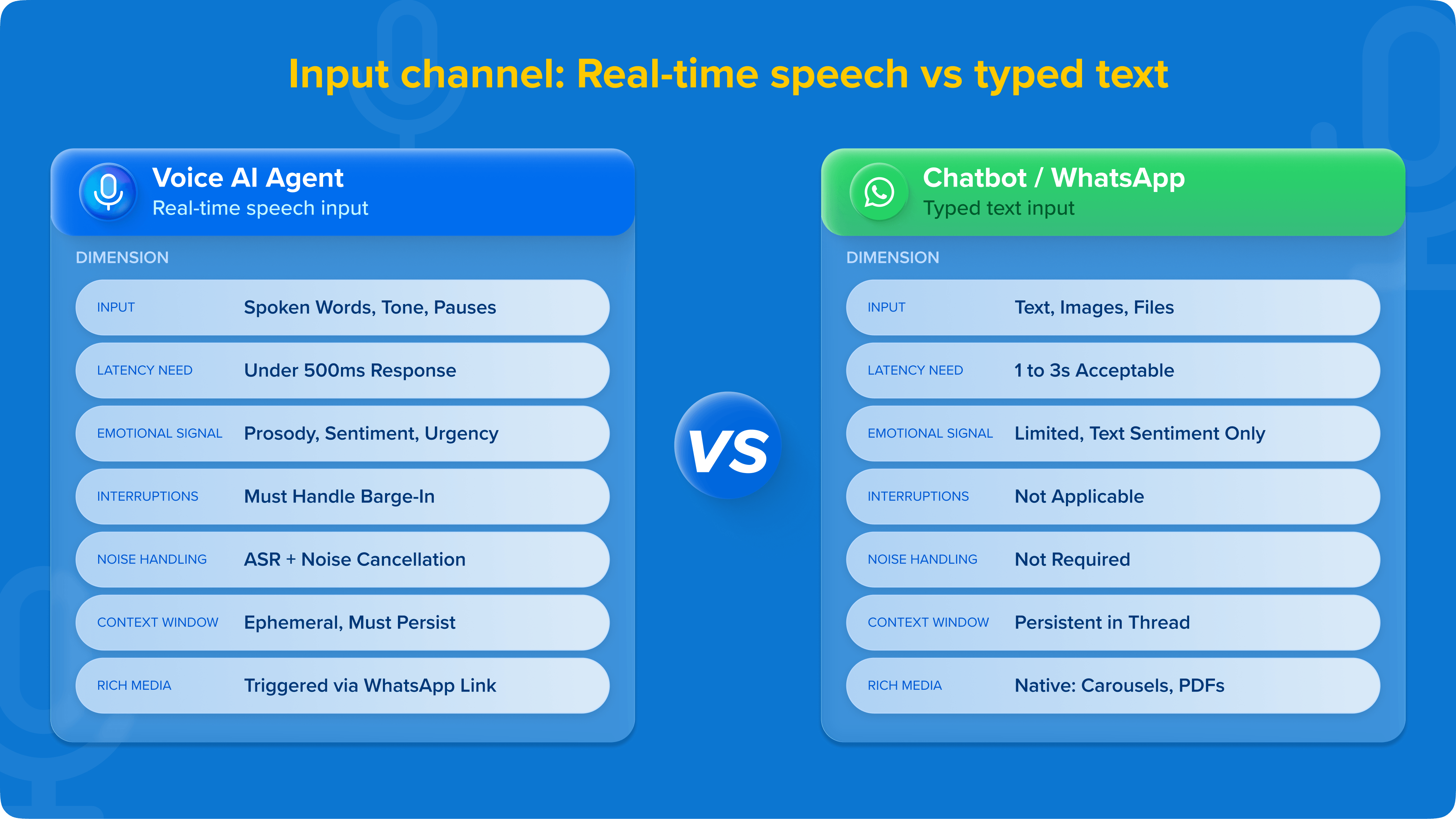
At the most fundamental level, voice AI agents process audio streams in real-time. This requires automatic speech recognition (ASR) to convert speech to text, often in noisy environments - customer calling from a busy marketplace or a moving vehicle.
The ASR layer must be trained on regional accents, code-switching between languages, and domain-specific vocabulary.
Chatbots, by contrast, receive clean typed input. This dramatically simplifies the parsing layer, but it also means you lose the richness of the vocal signal.
Latency requirements: Why voice demands more from infrastructure
In a text chat, a 2-3 second response feels normal. In a voice call, a 2-second pause after a question feels like a dropped call. Voice AI agents must respond within 400-600 milliseconds to feel natural. This creates intense infrastructure demands: low-latency inference pipelines, edge processing where possible, and telephony integrations (SIP, WebRTC) that can handle concurrent call volumes without queuing delays.
RELATED: Why Latency Is the New UX in Voice AI Conversations
Haptik's voice infrastructure is engineered for enterprise-grade concurrency, built to handle the spikes that contact centers know well: post-campaign surges, festive season call floods, product recall events. The architecture isn't borrowed from a consumer chatbot platform. It's purpose-built for voice at scale.
Interruption, tone, and prosody: What voice AI must handle that chatbots don't
Humans interrupt each other constantly.
It's how we signal understanding, redirect a conversation, or express impatience. A voice AI agent that cannot handle barge-in - the term for a customer speaking over the bot mid-response - will frustrate users instantly.
Every Haptik voice deployment includes barge-in handling as a baseline requirement.
Beyond interruption, prosody matters.
The rhythm, pitch, and pace of synthesized speech directly impacts whether a customer feels heard or processed. Haptik's voice AI agents use neural text-to-speech (TTS) engines that are tuned by language and regional dialect, ensuring an interaction in Hindi sounds natural to a speaker from Lucknow, not robotic.
Multimodal complexity: When a voice call must trigger a link or form
Real-world voice interactions rarely stay in one lane.
A customer calling about a loan application might need to be sent a document link mid-call. An insurance claim conversation might require the customer to receive a photo upload URL via WhatsApp.
ALSO READ: WhatsApp Voice: The Enterprise Guide to Deploying on the World's Largest Messaging Platfor
Voice AI agents must trigger multimodal actions - pushing a WhatsApp message, surfacing a form - without breaking the voice interaction.
This is where Haptik's omnichannel architecture becomes a genuine differentiator.
The voice AI agent connects to the same messaging fabric as Haptik's chat and WhatsApp solutions, enabling real-time cross-channel actions that most point-solution voice vendors simply cannot match.
The CX Use Case Divide
The table below provides a practical reference for CX and digital transformation leaders evaluating deployment decisions.
| Use Case | Better Fit | Why |
| High-emotion, high-urgency support | Voice AI Agent | Tone and empathy signals matter; latency and warmth are critical. |
| Self-serve research & comparison | Chatbot | Async, rich media - links, carousels, PDFs - elevate the experience. |
| Outbound engagement at scale | Voice AI Agent | Voice drives higher answer and conversion rates than text outreach. |
| Post-purchase support with rich media | Chatbot | Order tracking links, invoices, return labels - all native to chat. |
| Multilingual India Tier 2/3 markets | Voice Often Wins | Spoken vernacular is more accessible than typed regional script. |
| Account management & transactional queries | Context-Dependent | Low-complexity transactions suit chat; high-stakes moments need voice. |
High-emotion, high-urgency interactions
When a customer calls about a delayed medical shipment, a disputed transaction, or a service outage, they are not in browsing mode. They want to be heard.
Voice AI agents trained on empathy cues and equipped with sentiment-triggered escalation pathways resolve these interactions faster and with higher CSAT than text-based bots, which often feel clinical in emotionally charged moments.
Self-serve research and comparison
A customer comparing home loan options, evaluating insurance plans, or reading product specs is in a deliberate, exploratory mode. They want to pause, re-read, and compare. Chat interfaces, especially on WhatsApp, can surface carousels, comparison cards, and clickable CTAs that make this research journey seamless. Voice cannot replicate this experience.
Outbound engagement at scale
Outbound voice AI campaigns consistently outperform WhatsApp blasts in answer rates and conversion. Haptik's outbound voice deployments across BFSI clients have delivered measurable lead conversion uplift of 8-10% over text-based outreach because a voice interaction creates presence and urgency that a push notification cannot.
Post-purchase support with rich media
Sharing a return shipping label, a PDF invoice, or a product warranty document is native to chat. On voice, this requires a channel switch; the bot must push a link via WhatsApp. For post-purchase support where documentation is central, chat wins on simplicity and speed.
Multilingual India Tier 2/3 markets
India's next 300 million internet users are not comfortable with typed text interfaces in English or even their regional script. Voice, in their native tongue, removes friction entirely.
RELATED: Voice AI for Indian Languages: What Enterprise-Grade Really Means in 2026
Haptik's voice AI agents are deployed in Hindi, Tamil, Telugu, Marathi, Bengali, and Kannada - enabling enterprises to reach markets where chatbots, by design, cannot.
Account management and transactional queries
A balance inquiry or a flight status check works fine on chat. But an account dispute involving multiple transactions, escalating emotion, and compliance requirements? That is a voice interaction.
The channel decision here depends on interaction complexity, customer tenure, and the enterprise's risk profile.
The Channel Strategy Question - It's Not Either/Or
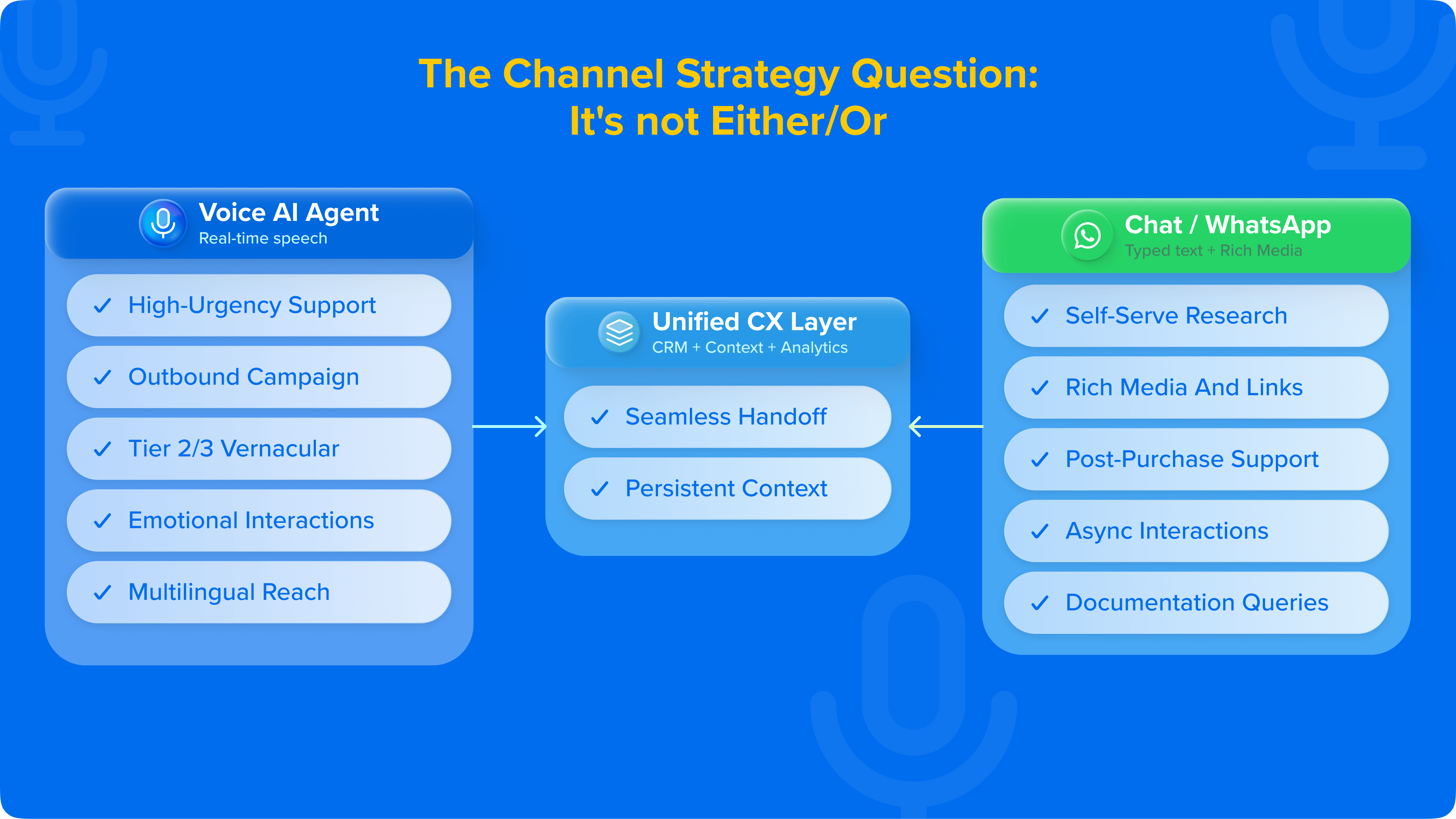
The most sophisticated CX brands have moved past the 'voice or chat' debate.
The real question is: how do you orchestrate across both channels so that customers always land in the right experience, with their context intact?
Why leading enterprises deploy both and orchestrate across channels
An enterprise that deploys only voice is leaving self-service efficiency on the table. One that deploys only chat under-serves the 40–60% of customer interactions that are high-touch, high-urgency, or linguistically complex.
The leaders across retail, BFSI, telecom, and healthcare run both, connected by a unified orchestration layer that routes customers intelligently based on intent, emotion, channel preference, and interaction history.
The omnichannel handoff
Consider this scenario: a customer starts a claim on WhatsApp, uploads documents through the chat interface, and then hits a complex coverage question.
The chatbot detects the complexity and emotional escalation, and seamlessly initiates a voice callback with the full conversation context pre-loaded for the voice AI agent.
No repeat, re-verification, or friction. This is not aspirational. It is live in Haptik deployments today.
Unified context
The handoff scenario above only works if both channels are connected to the same CRM and data layer.
If your voice AI agent and your chatbot are pulling from separate context stores, every cross-channel transition requires the customer to repeat themselves - which is the single most cited driver of poor CX in contact centers.
Haptik's platform architecture ensures that context like conversation history, authentication state, intent signals, and prior resolution travels with the customer, not with the channel.
How Haptik Handles Both
Haptik has built an omnichannel CX platform that treats voice and chat as complementary surfaces of a single intelligent system. Here is what that means in practice.
12+ years of AI domain expertise
Founded in 2013, Haptik has a longer production track record in enterprise conversational AI than most competitors combined. The models are not freshly fine-tuned on generic datasets, but they’re trained and battle-tested across verticals including BFSI, telecom, eCommerce, and healthcare, in Indian and global market conditions.
500+ enterprise deployments
Trust at this scale is not theoretical. Haptik's solutions live across some of the most demanding CX environments in Asia, handling millions of interactions monthly with the reliability, compliance, and integration depth that enterprise IT demands.
Omnichannel CX orchestration
Voice, WhatsApp, web chat, in-app messaging - Haptik's orchestration layer connects all channels to a unified CRM, ticketing, and analytics backbone.
The voice AI agent and the chatbot are not separate products. They are two expressions of the same CX intelligence, sharing context, intents, and resolution logic.
Enterprise consulting DNA
Complex integrations, compliance requirements (DPDP, GDPR, PCI-DSS), change management, agent augmentation strategies - Haptik's delivery model is built around these realities, not around a SaaS self-serve assumption. For enterprises where getting it wrong carries regulatory or reputational cost, this matters.
The outcome metrics Haptik drives reflect this integrated approach: lead conversion uplift of 8–10%, meaningful reduction in support volume handled by human agents, NPS improvement, and measurable contact center cost reduction.
The Bottom Line
The voice AI vs chatbot question is real but the answer is not a binary.
For enterprise CX leaders, the goal is not to pick a winner. It is to build a channel strategy that deploys the right AI surface for each interaction type, connects both through a unified data and orchestration layer, and evolves intelligently as customer behavior shifts.
Voice AI agents win in high-emotion, high-urgency, multilingual, and outbound scenarios. Chatbots win in self-serve, rich media, and async research journeys. Leading enterprises win by mastering both.
With 12+ years of AI expertise, 500+ enterprise deployments, and an omnichannel architecture purpose-built for this complexity, Haptik is the partner that enterprises trust to make this strategy real in production.
source on Google