


 Voice AI Agent
It’s 9 AM on Tuesday.
The dashboard is flashing red.
Call queues are building faster than they’re being cleared. Average wait times creep up as agents are in back-to-back conversations, juggling multiple systems just to piece together a single customer’s context.
A customer finally gets through after navigating the IVR.
“Can you explain your issue again?”
They’ve already done that twice.
This is the moment where customer experience breaks. Not because the enterprise lacks channels or manpower but because resolution doesn’t scale.
And that’s the gap voice AI agents for customer support are now closing for enterprises.
READ: A Comprehensive Guide to Voice AI Agents in 2026
Why Customer Support Is Voice AI’s Highest-ROI Deployment Zone
Most automation strategies in CX focus on deflection, pushing customers away from expensive channels like voice.
But deflection has limits.
Because when money is involved, when timelines matter, and when emotions run high - customers don’t want a faster channel. They want a definitive answer.
They call.
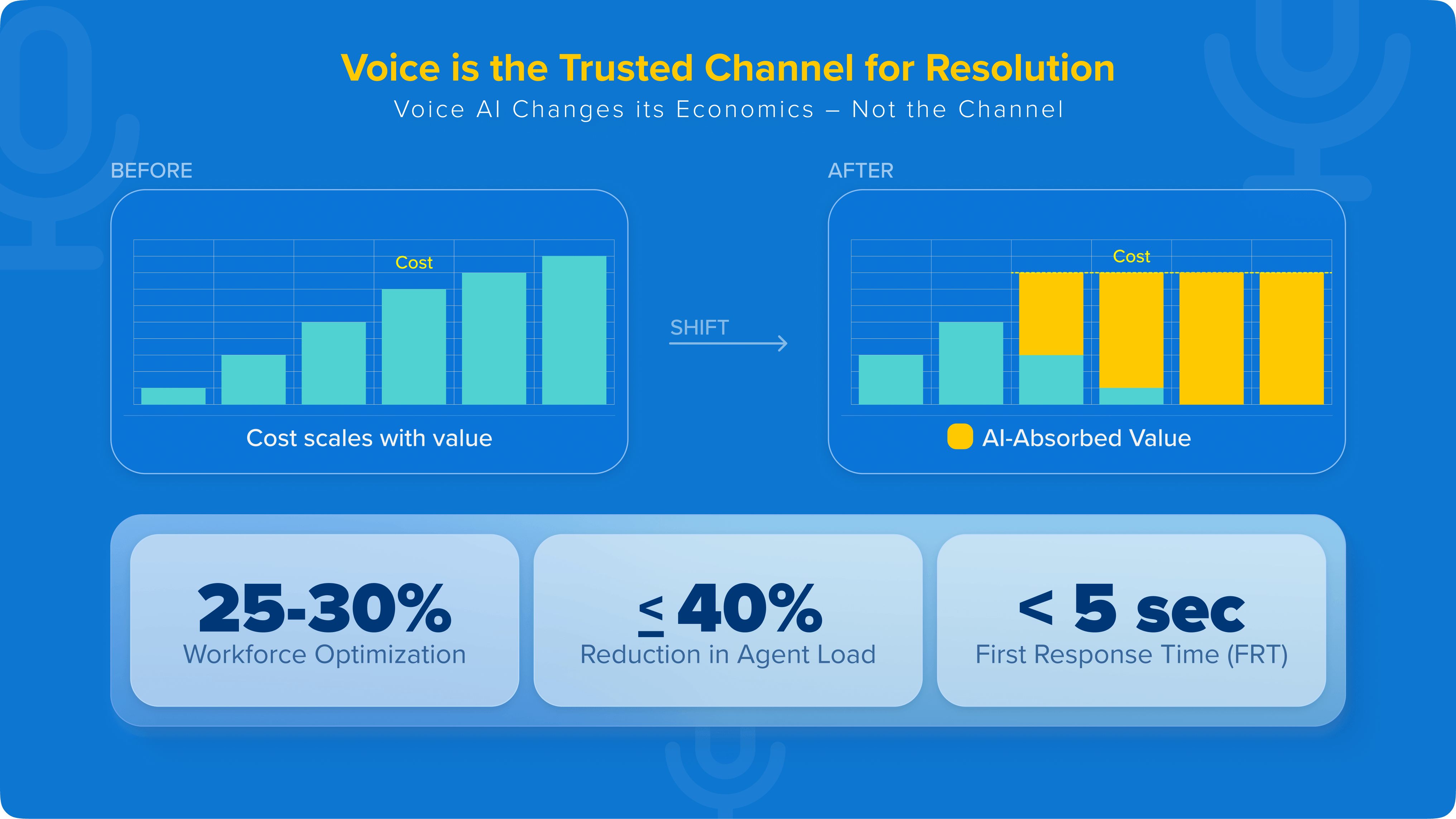
Voice is the most trusted channel for resolution.
What voice AI changes is not the channel but its economics.
RELATED: ROI of AI Agents: Measuring Impact and Elevating CX
Instead of scaling cost linearly with volume, enterprises are seeing voice AI absorb a significant share of repetitive and structured interactions without compromising experience.
In real deployments, this shift has led to:
- 25-30% workforce optimization, by offloading routine queries
- Up to 40% reduction in human agent load, especially across high-frequency support categories
- First response times (FRT) dropping to under 5 seconds, removing the “waiting to be heard” problem
This is why customer support is the highest-ROI entry point for voice AI adoption.
Use Case Prioritization: Where Enterprises Actually See Impact
The fastest way to fail with Voice AI is to treat it as a blanket solution.
On the flip side, the fastest way to succeed is to treat it as a precision tool.
Enterprises seeing meaningful outcomes start where:
- Volume is high
- Workflows are repeatable
- Resolution paths are clear
High-volume + low-complexity: The quick win zone
This is where Voice AI proves its value fastest, and most visibly.
These interactions dominate contact center volumes: order status checks, delivery tracking, returns, refunds, basic account queries.
They follow defined workflows and require access to systems, not human judgment, making them ideal for automation.
When deployed, voice AI not only assists but absorbs volume entirely.
RELATED: Scaling Voice AI for Large Enterprises: What Changes After 10 Million Calls
High-complexity + high-emotion: Where human-AI collaboration wins
Not every interaction should be automated, and that’s by design.
There’s a category of conversations where the issue is ambiguous, stakes are high, and the customer is frustrated.
In these scenarios, the role of voice AI shifts, becoming the first layer of intelligence.
It:
- Captures intent and context upfront
- Identifies sentiment in real time
- Routes the interaction intelligently
By the time a human agent joins, the conversation doesn’t start from zero, delivering real impact for enterprises:
- Reduced handling time
- Higher-quality resolutions
- CSAT improvements, driven by smoother, more informed interactions
Voice AI doesn’t replace empathy but ensures it’s applied at the right moment, with the right context.
Mapping your contact drivers to voice AI fit
The most effective voice AI strategies start with contact drivers.
Every enterprise has a pattern:
- A small chunk of use cases drive a large share of volume
- A subset of those follow structured, repeatable flows
- Another subset requires human intervention, but only after initial triage
Mapping these layers decides success.
The question isn’t where voice AI can be deployed, but: which interactions can be fully resolved, which can be assisted, and which should remain human-led?
RELATED: What Is Human in the Loop AI? A Primer for Enterprise Leaders
This is also where inbound and outbound strategies begin to converge.
For example:
- High inbound volume around missed appointments → triggers outbound reminder campaigns
- Repeated payment-related queries → enables proactive outbound nudges
- Frequent post-purchase calls → informs automated follow-ups
When this mapping is done, voice AI stops being reactive and becomes a system that shapes demand, not just responds to it.
The Voice AI Use Cases Delivering Measurable Results
The difference between a pilot and a production-grade deployment lies in outcomes.
The following use cases consistently deliver because they’re not only popular but also align with how customer support behaves at scale.
ALSO READ: How to Choose the Best Voice AI Platform for Enterprise CX
Zero-touch resolution: Order status, delivery tracking, and returns
These are among the highest-volume inbound queries in any support function.
Voice AI systems integrated with backend logistics and order management platforms can:
- Fetch real-time updates
- Initiate return workflows
- Provide instant resolution
At scale, automating these interactions contributes to a significant reduction in agent workload, while improving speed and consistency of responses.
Billing inquiries, statement disputes, and payment reminders
Billing is where confusion meets urgency.
Customers want clarity, but traditional support models often slow things down.
Voice AI changes this by:
- Breaking down billing components conversationally
- Handling common disputes
- Triggering payment workflows
On the outbound side, automated reminders and follow-ups ensure that payments don’t rely on manual effort, turning support into a proactive function.
Account verification and self-service updates
Authentication is often invisible in strategy but painfully visible in experience.
Voice AI reduces friction by enabling faster verification and seamless transitions into resolution.
The impact is instant:
- Lower average handling time
- Faster issue resolution
- Improved overall customer satisfaction
Appointment scheduling and rescheduling
This is where inbound and outbound Voice AI intersect most clearly.
With inbound, customers call to book or reschedule. In outbound, AI triggers reminders and confirmations
The result is a 10-20% reduction in no-shows, driven by timely AI-powered reminders and follow-ups
What was once operational overhead becomes a streamlined, automated flow.
Outbound follow-up: From reminders to re-engagement
Outbound Voice AI is often underutilized, but it’s where scale truly unlocks.
Enterprises are using it to:
- Drive collections and payment nudges
- Follow up post-purchase
-
Re-engage inactive users
With a dedicated voice campaign layer, these interactions are orchestrated at scale without increasing operational complexity.
Smart escalation: When human intervention adds value
The goal of Voice AI is to make escalation meaningful.
By the time a call reaches an agent:
- Context is captured
- Intent is identified
- History is available
This reduces repetition, shortens resolution time, and directly contributes to higher CSAT scores - often improving satisfaction to 75-85% in optimized deployments
Voice AI Use Cases That Drive Revenue
Cost savings are the entry point. Revenue impact is where the real transformation happens.
Upsell and cross-sell within inbound calls
Every support interaction is a moment of attention.
Voice AI detects context and introduces relevant offers without breaking conversational flow, turning service interactions into conversion opportunities.
Proactive outreach for renewals and retention
Outbound Voice AI ensures that critical touchpoints don’t depend on manual follow-ups.
Renewal reminders, subscription nudges, and reactivation campaigns can be automated consistently and at scale.
CSAT recovery
One of the most underleveraged use cases.
Voice AI can:
- Detect dissatisfaction signals
- Trigger follow-up calls
- Route them intelligently
This is where CSAT improvement becomes tangible - not as a metric, but as recovered customer trust.
What Decides Success in Voice AI Deployments
.png?width=4065&height=2287&name=02_Three%20Deciding%20Factors%20(1).png)
By the time most enterprises reach Voice AI, they’ve already experimented with automation.
They’ve launched pilots. Tested vendors. Seen early promise.
And yet, many deployments stall - stuck between proof-of-concept and real impact.
Not because the technology doesn’t work, but because production-scale success demands orchestration.
Across enterprise deployments, three factors consistently determine whether Voice AI becomes a layer or infrastructure.
Clean integration with CRM and ticketing systems
Voice AI without system access is just conversation. Voice AI with system access is resolution.
This is where most early deployments fall short.
If the AI cannot:
- Fetch real-time order or account data
- Update tickets or trigger workflows
- Log interactions back into the CRM
…it creates a fragmented experience. The customer still has to wait. The agent still has to step in. The system becomes an extra layer, not a replacement for effort.
RELATED: Integrating CRM, Service Desk, and Messaging Channels with AI Service Agent
In contrast, deeply integrated deployments allow voice AI to:
- Resolve queries end-to-end
- Execute actions in real-time
- Maintain continuity across channels
Integration is not a backend detail, but the difference between automation and actual impact.
Conversational design that handles real-world behavior
Most voice AI systems work perfectly until a real customer speaks.
Because real conversations are not linear.
- Customers interrupt
- They change topics mid-sentence
- They express intent indirectly
- They bring emotion into the interaction
Systems designed for ideal flows break under this pressure.
Production-grade voice AI is designed to:
- Handle interruptions without losing context
- Navigate topic shifts without restarting flows
- Interpret intent beyond keywords
- Adjust tone based on sentiment
This is especially critical in high-stakes interactions like billing issues, service failures, and missed appointments where frustration is already high.
When conversational design gets this right:
- Resolution gets faster, not just automated
- Escalations are smoother, not abrupt
- Customers feel heard even before a human steps in
Continuous learning from real interaction data
The biggest misconception about voice AI is that it’s a one-time deployment.
In reality, the first version is the least effective version.
What builds long-term success is how quickly, and consistently, the system improves.
Every interaction generates signal:
- New ways customers phrase the same intent
- Edge cases that weren’t anticipated
- Drop-off points in conversation flows
- Escalation patterns
High-performing deployments capture and act on this data continuously by refining intents and entities, optimizing conversation paths, and reducing friction points over time.
ALSO READ: Why Latency Is the New UX in AI Conversations
This is how containment improves, accuracy increases, and ROI compounds. It’s also how voice AI begins to influence upstream decisions.
For example:
- Repeated inbound queries trigger outbound campaigns
- High drop-offs at certain steps signal process gaps
- Frequent escalations indicate where human intervention should remain
Over time, voice AI stops being a support layer and becomes the feedback engine for the entire CX ecosystem.
Orchestrating inbound and outbound as one system
One of the clearest markers of maturity is when voice AI is no longer treated as just an inbound support tool.
Enterprises that see the highest impact connect inbound insights with outbound action.
- High inbound volume for missed appointments triggers automated reminder campaigns
- Payment-related queries activate outbound nudges and follow-ups
- Post-purchase confusion leads to proactive onboarding calls
This is where capabilities like a dedicated voice campaign layer becomes critical in enabling outbound workflows to run at scale, with the same intelligence as inbound interactions.
The result is a system that actively reduces and reshapes demand.
ALSO READ: How Inbound and Outbound Calling Works in 2026
From Deployment to Infrastructure
When integration, conversational intelligence, continuous learning, and inbound-outbound orchestration come together, voice AI stops being a feature. It becomes part of how customer support operates.
That’s when the metrics start to move together:
- Faster responses
- Lower operational load
- Higher resolution rates
- Stronger customer satisfaction
And more importantly, they sustain.
Because the system is no longer static, it’s learning, adapting, and improving with every interaction.
The Haptik Advantage in Deploying Voice AI for Customer Support
At scale, deployment success depends less on tools, and more on how those tools are applied.
Haptik’s approach is shaped by structural advantages:
Built on proven scale
With 12+ years of conversational AI experience and 500+ enterprise deployments, Haptik brings a level of maturity to voice AI deployments setting the bar high. It’s a repeatable deployment model, refined across industries, use cases, and geographies that moves enterprises from pilot to production without friction.
Forward-deployed teams
Technology alone doesn’t deliver ROI. Execution does.
Haptik’s forward-deployed teams work alongside enterprise stakeholders - from contact center leaders to IT and CX teams - to:
- Identify high-impact use cases
- Design conversation flows aligned to real contact drivers
- Optimize continuously using live interaction data
The result is faster go-live, quicker iteration cycles, and shorter time-to-value.
Enterprise-grade integration and compliance by design
Voice AI sits at the center of your CX stack.
Haptik approaches deployment with a strong enterprise consulting DNA, ensuring:
- Deep integration with CRM, ticketing, and backend systems
- Seamless data flow across channels and workflows
- Alignment with enterprise security, governance, and compliance requirements
This enables voice AI to move beyond handling queries to executing actions and resolving them end-to-end, within the boundaries enterprises require.
Outbound at scale with voice campaign manager
Most Voice AI solutions treat outbound as an add-on.
Haptik treats it as core.
With a dedicated Voice Campaign Manager, enterprises can:
- Launch and manage large-scale outbound campaigns
- Orchestrate reminders, collections, and re-engagement flows
- Continuously optimize outreach based on performance data
This bridges the gap between inbound demand and proactive engagement, turning support into a two-way system.
The Bottom Line
Customer support is no longer just a cost center. It’s where experience, efficiency, and revenue intersect. Voice AI gives enterprises the ability to scale all three. Not by reducing conversations. But by resolving them faster, smarter, and at scale. Haptik’s capabilities do more than enable Voice AI by embedding it into the core of customer support operations as a system that drives resolution, efficiency, and experience at scale. That’s why enterprises don’t just deploy Voice AI with Haptik but operationalize it.
FAQs
Turn your highest-volume support calls into fully resolved conversations with Haptik’s voice AI. Get a demo now.



source on Google