


 Voice AI Agent
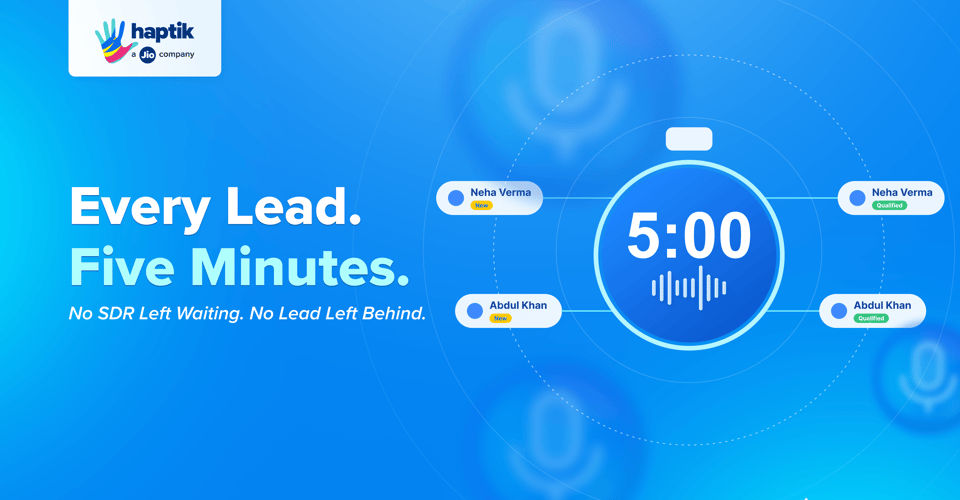
A student submits an inquiry at 11:00 PM. By 11:05 PM, a voice AI agent has already called them, confirmed their course interest, gauged their timeline, and logged a qualified lead into the CRM.
Now contrast that with the current enterprise reality: the average inbound lead waits 47 hours before a sales development representative (SDR) places a call. In that window, intent decays, competitors move in, and pipeline opportunities quietly bleed out.
Here is the number that should keep enterprise leaders up at night: calling a lead within 5 minutes delivers a 21x higher conversion rate than waiting 30 minutes or longer. In high-volume industries like EdTech, real estate, and BFSI, where thousands of inbound leads arrive daily, no human team can realistically close that response gap.
This is the exact problem voice AI was designed to solve, leveraging it as a precision sales intelligence layer that qualifies every lead, at any hour, in any volume, without the SDR bandwidth constraint.
The Lead Qualification Problem At Enterprise Scale
Speed-to-lead: Why the first 5 minutes define the funnel
A lead's purchase intent is at its peak at the moment of form submission or product inquiry. Delay that first conversation by even 30 minutes, and you have already lost more than half the conversion probability. Wait a full business day, and the lead has almost certainly researched alternatives, spoken to a competitor, or simply moved on.
For enterprise sales teams managing hundreds or thousands of daily inbound leads, the math is brutal. Hiring enough SDRs to call every lead within 5 minutes, across multiple time zones, every day, is neither financially viable nor operationally realistic.
SDR bandwidth vs lead volume: Why human-only teams are structurally limited
The core tension in enterprise lead qualification is a volume-to-capacity mismatch.
An SDR can realistically run 50 to 80 outbound dials a day, accounting for connection attempts, conversations, CRM logging, and follow-up.
During peak periods that involve a marketing campaign, a seasonal spike, or a product launch - inbound volume can surge to 500, 1,000, or even 5,000 leads a day.
No human team scales linearly with that surge. What typically happens is a triage model: SDRs call the "best" leads first, based on lead score or recency. The rest enter a queue that stretches into days. Those leads, by the time they receive a call, are no longer warm; they are cold, and the pipeline value attached to them has eroded significantly.
What happens to leads that don't get a call on time
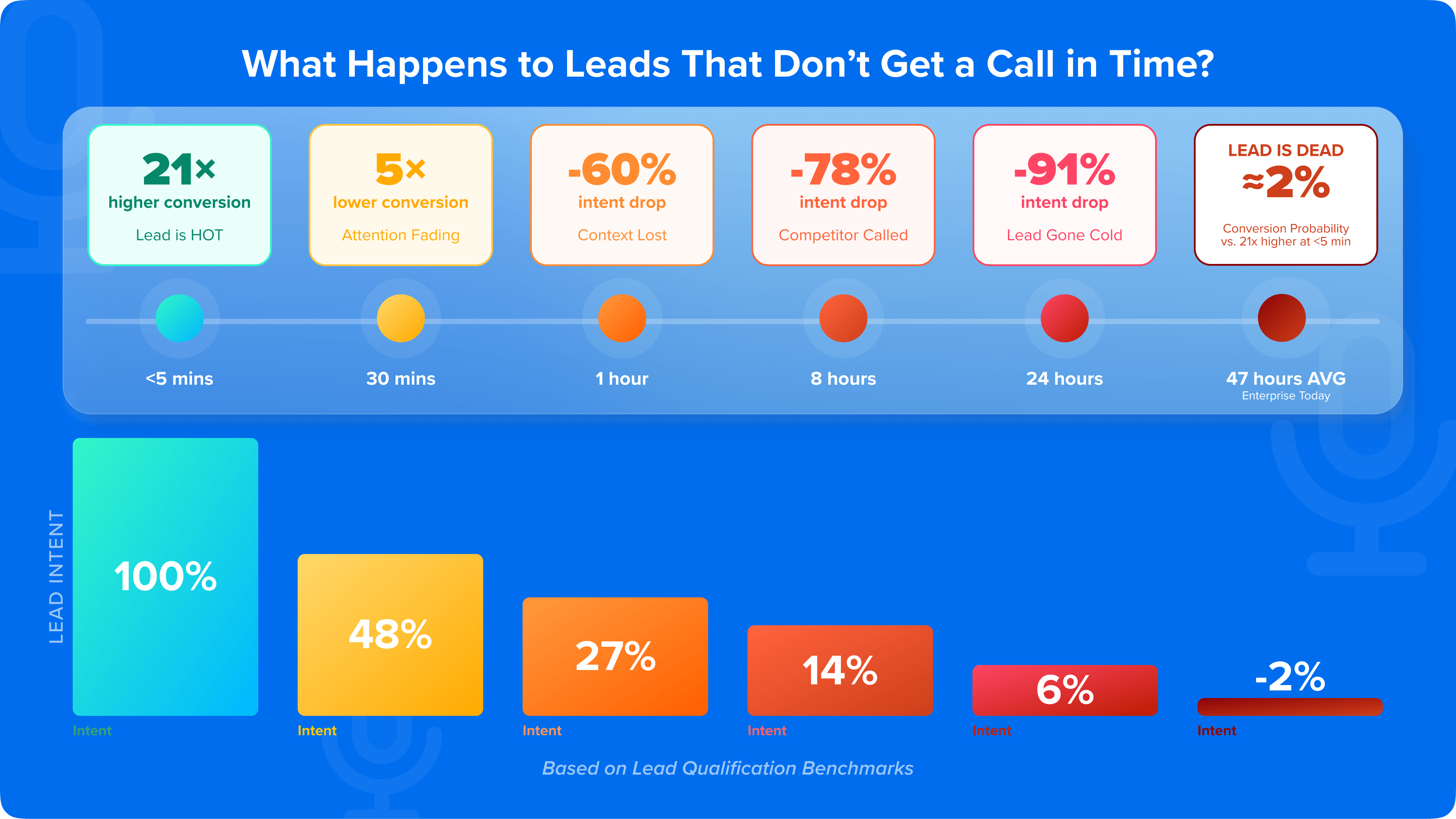
The consequences of delayed response are compounding.
- First, intent decays, which means a lead that wants to speak with someone at 2 PM is far less receptive at 2 AM the following day.
- Second, competitor windows open. In commoditized sectors like edtech or lending, lead data is often shared across platforms and competitors, meaning your delay is another brand's opportunity.
-
Third, the lead's internal context changes. The urgency that drove the inquiry, a job change, a salary hike, a deadline, fades as days pass.
The aggregate effect is a pipeline that looks full on paper but converts at a fraction of its theoretical value. Voice AI directly addresses this decay curve by compressing the response window from hours to seconds.
How Voice AI Agents Qualify Leads At Scale
The qualification conversation
A high-quality AI-led qualification call does not sound like an IVR. It opens with a natural, brand-consistent greeting, acknowledges the specific action the prospect took (filling out a form, requesting a callback), and moves into a structured discovery conversation that mirrors the criteria a human SDR would use.
ALSO READ: Why Enterprises are Replacing IVR with Voice Agents
Haptik's voice AI agents are trained on enterprise-grade conversation design frameworks, built around the specific qualification logic of each business. The result is a call that feels like a conversation, capturing the intent signals your sales team actually needs.Dynamic Branching
Unlike a static script, an intelligent voice AI uses dynamic branching to adapt the conversation in real time. If a prospect says they are looking to purchase within the next two weeks, the agent routes toward urgency-based qualification and surfaces a warm handoff trigger.
If they mention budget constraints, the agent can pre-qualify against your product's pricing bands and recommend the appropriate tier.
Haptik's conversation engine supports multi-level branching across qualification trees, allowing enterprises to encode complex sales logic, product portfolios, and prospect segments into the voice flow without rebuilding from scratch.
Intent scoring from a voice conversation
Every voice qualification call generates structured data that is far richer than a form submission. Voice AI captures and passes the following signals to your CRM:
- Timeline and urgency indicators (buying within X days, months, quarters)
- Budget qualification signals (stated range, financing interest, cost sensitivity)
- Product or use case fit (specific features mentioned, competitive comparisons)
- Engagement quality score (response depth, tone, call completion rate)
- Objection type and handling outcome
Warm handoff to a human SDR
Voice AI does not replace the human in the sales process, but it identifies precisely when a human is needed and transfers with context.
When a lead meets your predefined qualification criteria (demo request, confirmed budget, short timeline), Haptik's agent can trigger an immediate live transfer to an available SDR, complete with a real-time summary of the qualification data gathered.
The SDR enters the conversation knowing the prospect's intent, budget range, and key objections already handled. Close rates improve not just because leads are warmer, but because the human conversation begins exactly where the qualification left off.
Voice AI Lead Qualification Use Cases By Vertical
Retail and eCommerce: Purchase intent qualification and abandonment recovery
High-traffic retail and eCommerce brands deal with a qualification challenge that is deceptively simple on the surface: a shopper expressed interest, so why didn't they buy?
The answer is almost always intent ambiguity: they were browsing, comparing, or waiting on a trigger (a discount, a size restock, a payday). Voice AI brings structure to that ambiguity.
Haptik's voice AI agents for retail and eCommerce qualify inbound leads across two primary scenarios.
RELATED: Voice AI Use Cases for Customer Support That Actually Move the Needle
The first is high-consideration purchase inquiry pertaining to furniture, electronics, jewellery, and luxury apparel where a customer has submitted a callback request or product query. The agent qualifies for purchase timeline, budget range, and product-fit, routing high-intent buyers directly to a sales associate or a personalized offer trigger.
The second scenario is cart abandonment recovery. Rather than relying solely on email sequences, brands deploy voice AI to call abandoners within minutes of drop-off, understand the blocker and resolve it in the moment.
EdTech: Qualifying course interest and counselor readiness
In EdTech, lead volume spikes around admission cycles and campaign periods. A student submitting an interest form at midnight cannot wait until the next morning for a counselor callback.
RELATED: Voice Agents for Education: Resolving Every Student Query, at Scale
Haptik's voice AI immediately engages with course-specific qualification:
- Which program are you interested in?
- What is your current qualification?
- Are you looking at the upcoming batch?
This pre-qualification ensures that when a counselor does engage, they are speaking with students who are both genuinely interested and batch-ready - dramatically improving counselor efficiency and seat fill rates.
Real estate: Site visit intent, budget, and timeline qualification
Real estate is a sector where a single qualified lead can represent seven or eight figures in revenue.
Voice AI qualifies for the variables that matter most:
- Property type preference
- Budget range
- Possession timeline
- Location flexibility
Haptik's real estate clients use voice qualification to sort site-visit-ready prospects from casual browsers, routing the former to relationship managers and the latter to nurture campaigns.
For a deeper dive into voice AI applications in real estate, read our dedicated piece on site visit scheduling and pipeline management.
BFSI: Loan eligibility pre-check and product-fit assessment
In banking and financial services, compliance-aware qualification is non-negotiable. Haptik's voice AI agents for BFSI conduct eligibility pre-checks - income range, employment type, and existing liabilities - without creating a compliance exposure.
READ: Voice Agents for BFSI: High-Compliance Conversations at Enterprise-Scale
The conversation flow mirrors the intake questions a loan officer would ask, while routing qualified applicants to the appropriate product: personal loan, home loan, MSME credit, or insurance.
The result is a pipeline of pre-screened applicants who meet base eligibility criteria before a human officer ever makes contact.
Building High-Performing Voice AI Lead Qualification Flow
Opening: Human-like, brand-consistent, non-salesy
The opening of a qualification call sets the entire tone. It’s vital that the conversation design is warm, acknowledges the prospect's specific trigger action, and immediately communicates value: "Hi, this is Priya from [Brand]. You reached out earlier about our MBA programs. I am calling to quickly understand your goals and see if we can help."
The opener avoids the common failure modes of robotic phrasing, interrogation-style immediacy, and scripts that feel obviously automated. Natural language patterns, appropriate pacing, and brand-consistent voice profiles are configured at the deployment level.
Discovery: 3 to 5 key qualification questions based on sales criteria
The discovery section is the qualification engine. Questions should be sequenced for conversational flow, not form-filling efficiency:
- Budget range before timeline
- Use case before technical requirements
- urgency before pricing
Each question is mapped to a qualification dimension that gets written to the CRM lead record making sure the data captured is actionable.
Objection handling
Not every lead is ready to engage at the moment of the call.
Haptik's voice AI is trained on common objection patterns like "I'm busy right now," "Can you send me details?", or "I'll call you back" with response logic that acknowledges the objection, offers an alternative (callback scheduling, email summary), and ensures the interaction ends positively and is logged correctly.
The system distinguishes between a genuine busy signal and a soft rejection, routing accordingly. A requested callback is scheduled in the CRM. A disengaged lead is flagged for a different nurture path.
CRM writeback
Every interaction variable from the qualification call - qualification status, call duration, intent score, specific answers captured, objection type, next action - is written back to your CRM in structured format, mapped to the fields your sales team actually uses.
Haptik's integrations with Salesforce, HubSpot, Zoho, and LeadSquared are pre-built and configurable. Lead stages update automatically based on qualification outcome, triggering downstream workflows: SDR assignment for sales-ready leads, sequence enrollment for nurture-track leads, disqualification tagging for no-fit responses.
Metrics that matter in voice AI lead qualification
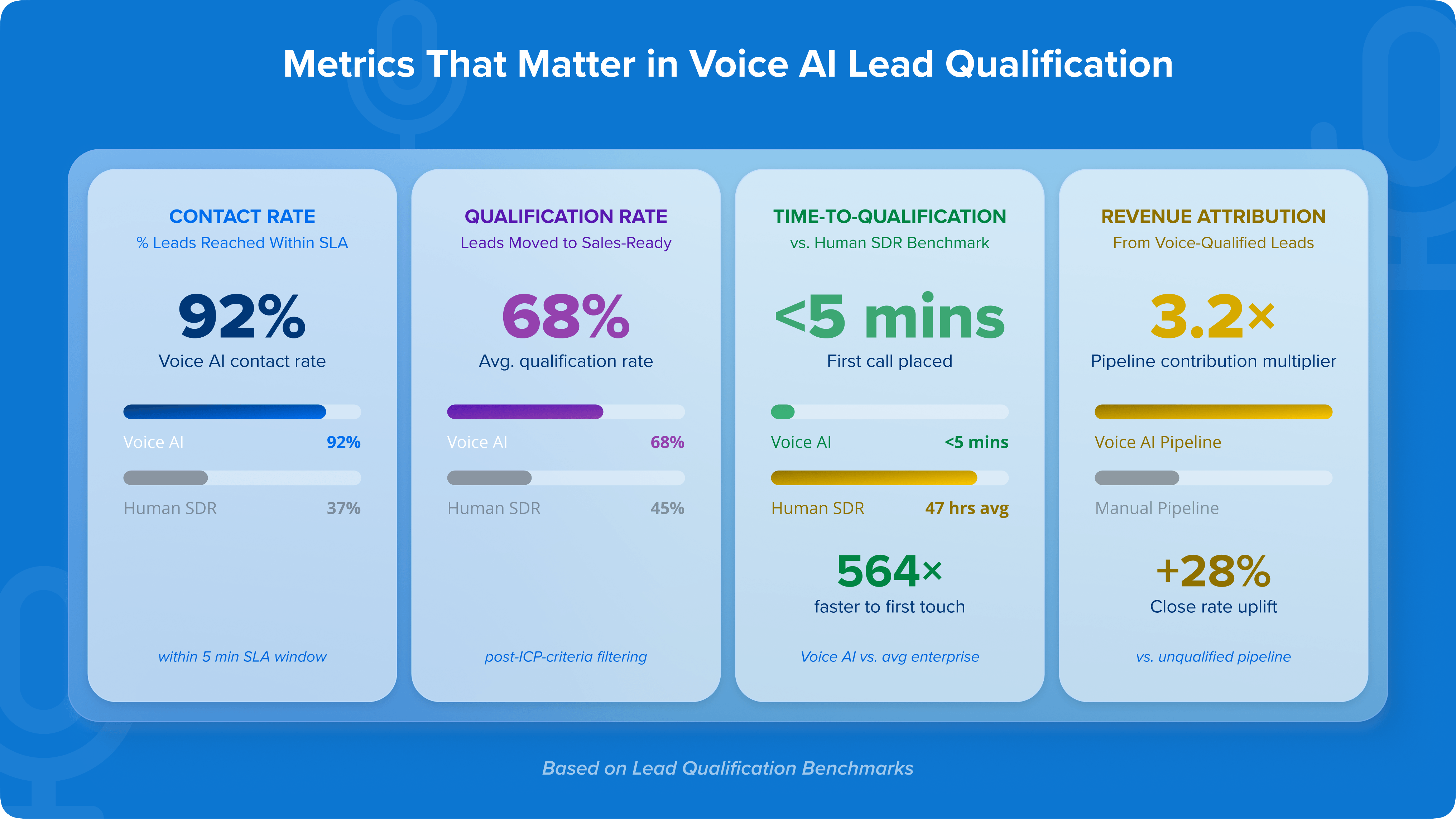
Measuring the performance of a voice AI qualification program requires a framework that connects operational efficiency to revenue outcomes.
Here are the four metrics that matter most, and the benchmarks you should target at deployment.
Contact rate: Percentage of leads reached within SLA
Contact rate measures what percentage of inbound leads receive a call within your defined response SLA, which is typically 5 minutes for high-intent verticals.
With a human SDR team, enterprise contact rates average 30 to 40 percent within SLA.
Haptik's voice AI consistently achieves contact rates above 90 percent, because the system calls the moment a lead enters the pipeline, without queue dependency.
Qualification rate: Leads moved to sales-ready status
Of the leads contacted, what percentage meet your qualification criteria and move to sales-ready status?
This metric is a direct function of conversation design quality and ICP alignment. Poorly designed flows generate low qualification rates because they ask the wrong questions or fail to probe intent depth.
Haptik's outcome-based partnership model means qualification rate improvement is a shared KPI, not a post-deployment afterthought.
Time-to-qualification vs human benchmark
Time-to-qualification compresses dramatically with voice AI. Where a human SDR might take 2 to 4 days to work through a lead batch, voice AI qualifies in real-time. This metric matters for revenue forecasting: a pipeline where all leads are qualified within 24 hours of submission is a fundamentally more accurate and actionable pipeline than one where qualification status trails by days.
Revenue attribution from voice-qualified leads
The ultimate metric is revenue: what percentage of closed revenue can be attributed to leads that were qualified via voice AI, and what is the close rate differential compared to unqualified or manually qualified leads?
Enterprises deploying Haptik's voice AI report a significant pipeline contribution multiplier from voice-qualified leads, with close rate uplifts averaging 28 percent compared to unqualified pipeline.
The Haptik Difference
Not all voice AI platforms are built for enterprise lead qualification. Many offer generic voice assistants that require significant custom engineering to become sales-relevant. Haptik's approach is different: sales intelligence is baked into the qualification layer from day one.
Enterprise-grade CRM integration
Haptik's voice AI integrates natively with Salesforce, Zoho CRM, HubSpot, LeadSquared, and custom CRM stacks. Integrations are not superficial webhooks, they are bidirectional, field-mapped, and configured to match your existing lead management workflows.
Conversation design
Haptik brings dedicated conversation designers to every enterprise deployment. These are specialists with deep domain knowledge in EdTech, BFSI, real estate, and retail who build qualification flows that reflect your actual sales criteria, product nuances, and compliance requirements.
500+ enterprise deployments
Haptik brings pattern recognition that off-the-shelf voice platforms simply cannot replicate. Qualification flows are informed by what has worked (and what hasn’t) across similar deployments, dramatically shortening time-to-value for new clients.
Outcome-based partnership model
Haptik operates as a partner in outcomes. Qualification rate, contact rate, and revenue attribution are tracked jointly. Ongoing conversation optimization is part of the engagement. The agent improves as it learns from live data, and the Haptik team actively monitors performance and iterates on qualification flows post-launch.
FAQs
See how Haptik's Voice AI agent qualifies leads in real-time

source on Google