


 Voice AI Agent
 Voice AI for Tier 2 & Tier 3 India: Why Vernacular Is the Next Growth Channel
 Add as a preferred
 source on Google
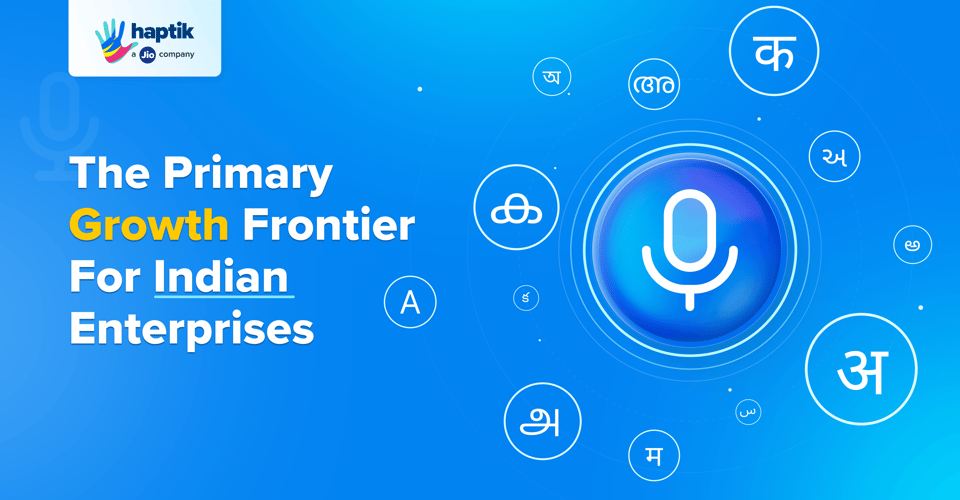
The digital divide in India is effectively closing, and it’s being replaced by a linguistic opportunity gap. While Tier 1 metros have reached smartphone saturation, the real economic engine is now humming in the non-metro markets of Bharat.
With rural internet users now accounting for over 57 percent of India’s active base - growing at four times the pace of urban markets - the text-heavy, English-first interfaces of the past are no longer viable. For these users, voice AI agents are not a luxury feature; it is the default mode of discovery, transaction, and trust.
This blog explores how vernacular Voice AI is transforming Tier 2 and Tier 3 cities into the primary growth frontier for enterprise banking, eCommerce, and education.
The Rise of Bharat: Why Voice Is the Only Interface That Scales
In a market where 90 percent of new internet users prefer vernacular content, voice is the only bridge that bypasses the friction of digital literacy.
The voice-first behavior of the next 500 million users
For the next half-billion users entering the digital economy, the keyboard is an obstacle.
Observations in early 2026 show a 156 percent growth in vernacular voice queries compared to English. These users do not type; they speak.
RELATED: Voice Agents for Indian Languages: What Enterprise-Grade Really Means in 2026
Whether they are searching for agricultural prices or checking their bank balance, voice provides a natural, frictionless entry point that text simply cannot match. Enterprises that fail to adopt a voice-first vernacular strategy are effectively locking themselves out of the most aggressive growth segment in the world.
Closing the trust deficit through regional linguistic nuance
Trust is the currency of Bharat. In smaller cities and rural pockets, a generic automated voice that sounds like a translation engine creates immediate suspicion.
Cultural relevance, manifested through local dialects, familiar accents, and regional idioms, drives five times more trust than standard celebrity-led advertisements.
When a Voice AI speaks to a farmer in Vidarbha in his native Marathi dialect, the psychological barrier to digital adoption vanishes. This linguistic empathy is what converts a skeptical browser into a loyal transacting customer.
The mobile-only reality of non-metro commerce
Sixty-six percent of new direct-to-consumer orders in the 2026 fiscal year originate from Tier 2 and Tier 3 cities. These transactions happen almost exclusively on mobile devices, often in environments with high ambient noise or low lighting.
In these conditions, navigating complex drop-down menus is a chore. Vernacular voice AI agents simplify this by allowing users to speak their orders or queries in their mother tongue, making commerce accessible to anyone with a microphone and a mobile signal.
Use Cases Driving High-Velocity Growth in Tier 2 and Tier 3
From agricultural advisories to fintech inclusion, voice AI is solving localized problems that were previously unscalable due to human constraints.
Hyper-local fintech and micro-lending in regional tongues
Financial inclusion has reached a tipping point where vernacular support is no longer optional. Micro-lending platforms are now using Voice AI to handle the entire loan lifecycle from eligibility checks to promise-to-pay negotiations in regional languages.
Data shows an approximately 3.5 times higher return on investment when collection and sales campaigns are conducted in regional voice versus static English text. The clarity provided by a native language reduces errors in document submission and significantly improves repayment rates.
Agricultural advisories and rural commerce fulfillment
Agritech platforms are utilizing Voice AI to provide real-time price discovery and weather-based nudges.
A farmer can ask the AI about the current mandi prices for cotton in his local dialect and receive an immediate, actionable response. This level of real-time, voice-led information empowers rural producers and integrates them more deeply into the organized supply chain.
By removing the need for physical intermediaries or complex web forms, Voice AI scales rural commerce at a pace that was previously impossible.
Edtech support for the 100 million active learners in non-metros
Education in India is rapidly decentralizing. With over 100 million active learners now based in non-metro areas, the demand for vernacular support has skyrocketed.
RELATED: Voice Agents for Education: Resolving Every Student Query at Scale
Voice AI agents resolve student queries in real-time, preventing dropouts that occur due to a lack of immediate guidance. By providing support in the language of instruction, Edtech companies are ensuring that their platforms remain accessible and effective for the millions of students who are the first in their families to access digital higher education.
Solving for Code-Switching and Hinglish
Managing the distributed intelligence of India requires an AI that understands how people actually speak, not just how they write.
Multilingual support for 20+ plus Indic languages
True vernacular AI goes beyond simple translation layers. It requires native Indic large language models that understand the syntax and semantics of languages like Hindi, Tamil, Telugu, and Marathi from the ground up.
ALSO READ: How Latency and Interruption Handling Define Voice AI Quality
Haptik’s engine does not just translate; it thinks in the regional language. This prevents the loss of meaning that often occurs in traditional machine translation and ensures that the AI’s responses are culturally appropriate and contextually accurate.
Handling code-switching and dialect-specific phonetic variations
In India, no one speaks a pure language. Most conversations involve code-switching, which is mixing English with regional tongues to create hybrids like Hinglish, Tamlish, or Benglish.
Furthermore, a single language like Hindi has dozens of phonetic variations depending on the geography. A successful vernacular AI must recognize these shifts natively.
RELATED: How Multilingual Voice Agents Break Language Barrier
Offline-first voice capabilities for low-bandwidth rural areas
While 5G is spreading, many Tier 3 areas still operate on intermittent or low-bandwidth connections.
A Voice AI that requires a constant, high-speed uplink will fail in these environments. The technical requirement for 2026 is an architecture that can process voice locally or optimize data packets for low-bandwidth scenarios. This ensures that the agricultural or banking advisor remains available even in the most remote corners of Bharat, providing consistent service regardless of infrastructure limitations.
Why Haptik Is the Market Leader for Vernacular Voice AI
With the backing of one of India’s largest conglomerates and over a decade of Indic data, Haptik’s vernacular intelligence is engineered specifically for the Indian scale.
12+ years of domain expertise
With over 12 years of experience in deploying state-of-the-art conversational AI for large enterprises, we have processed millions of hours of Indian conversations, giving us an unmatched understanding of how Bharat speaks. This means a significantly faster go-live and higher intent recognition from day one, without the need for extensive retraining.
Outcome-driven architecture
Our vernacular agents are built for more than just conversation; they are built for resolution. In rural markets, where every rupee counts, our AI focuses on securing outcomes - whether it is a loan application completion or a successful promise-to-pay.
Our outcome-driven architecture ensures that the AI guides the user through the transaction, reducing abandonment and increasing the bottom-line impact of your regional outreach.
Forward-deployed teams
Linguistic trends in Tier 2 cities shift rapidly. Haptik provides forward-deployed teams that actively monitor and tune your vernacular agents.
If a new dialectal variation or a specific regional term begins to trend among your users, our teams identify and integrate it into the model within 24 hours. This constant human-in-the-loop optimization ensures that your AI remains accurate and culturally relevant, preventing the model drift that often derails unmanaged vernacular projects.
Bottom Line
The growth story of 2026 is being written in the vernacular voices of Tier 2 and Tier 3 India. As Bharat accounts for 60 percent of incremental digital commerce growth, enterprises can no longer rely on English-first interfaces to build trust or drive transactions.
Vernacular Voice AI is the primary bridge to digital inclusion, transforming skeptics into loyal customers by speaking their language with empathy and precision.
To win in this new frontier, you need a partner like Haptik that combines a decade of Indic data with the technical scale of 100 plus out of the box integrations. By investing in regional voice today, you are not just automating support; you are securing your foothold in the world's most aggressive emerging market.
FAQs
A: Haptik supports over 20+ major Indic languages and dozens of regional dialects natively, including Hindi, Marathi, Tamil, Telugu, and Kannada, with the ability to handle mixed-language code-switching.
A: While the initial training requires domain expertise, the ROI is significantly higher. Data shows that vernacular voice campaigns achieve 3.5 times higher conversion rates in non-metros, making the cost-per-acquisition much lower than English-only strategies.
A: Our NLU is trained on over 12 years of real-world Indian conversations, which includes a vast library of regional accents and slang. Our forward-deployed teams also provide continuous tuning to ensure the AI stays current with local linguistic trends.


source on Google