


 Voice AI Agent
A textile merchant had been trying to complete a two-wheeler loan application with a mid-sized NBFC. He'd called the IVR three times. Each time, the system greeted him in English, walked him through options in English, and - when he pressed 1 for Tamil - switched to a Tamil so clipped and robotic it felt like reading a government notice aloud.
On the fourth call, after the NBFC had quietly deployed a Tamil-first voice AI agent, something flipped. The agent opened in natural Tamil, unique to Coimbatore: warm, slightly informal, with the cadence of someone who understood why he was calling before he'd finished his sentence.
RELATED: A Comprehensive Guide to Voice AI Agents
The person completed the application in four minutes and twelve seconds.
Not only did it close the loan, it closed the argument about whether vernacular voice AI is a nice-to-have.
Why India Is the World's Leading Voice AI Market
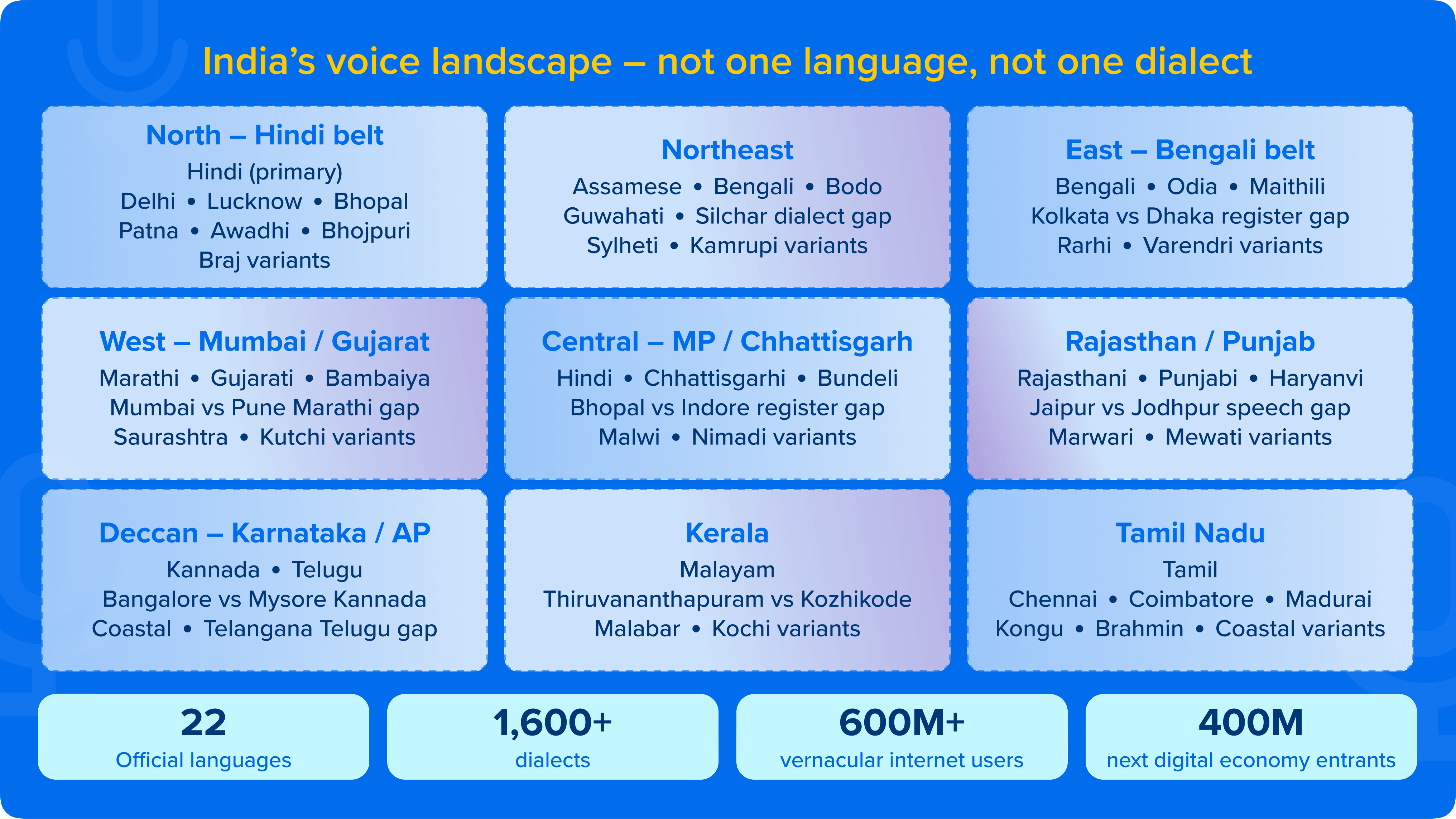
When people talk about the scale of India's language challenge, they reach for the big numbers: 22 scheduled languages, 1,600+ dialects, dozens of scripts. These numbers are accurate. They're also, on their own, almost entirely useless for thinking about enterprise AI deployment.
Variance within languages
The real challenge isn't volume. It's the variance demands from an AI system that has to make decisions in real-time, on live calls, with customers who have no patience for errors on topics as consequential as their money, health, or deliveries.
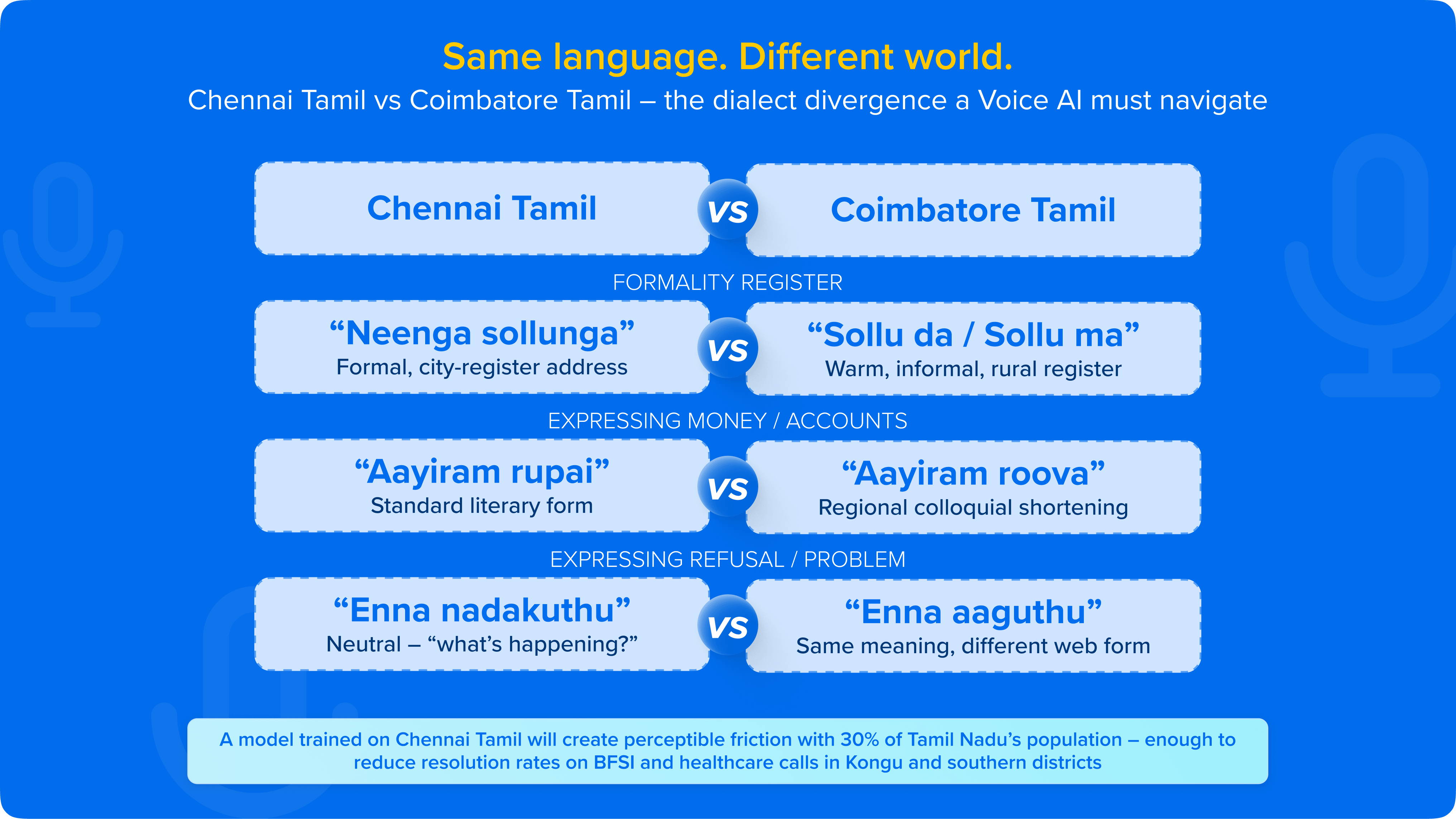
Chennai Tamil and Coimbatore Tamil are both Tamil. But the lexical choices, the rhythm, the level of formality, and the code-switching patterns differ enough that a voice AI trained purely on Chennai speech will create friction with a customer from the Kongu region. Mumbai Hindi and Bhopal Hindi are both Hindi. But Mumbai Hindi has absorbed decades of Marathi, Gujarati, and Bambaiya slang into its phonology and syntax in ways that a "standard Hindi" model will stumble over, especially when the conversation moves fast.
ALSO READ: From English to Hinglish: How Multilingual AI Voice Agents Break Language Barrier
Enterprise-grade means understanding that each of the 22 languages is actually a family and that serving the family requires more than a single model trained on a single accent from a single city.
600M+ vernacular internet users who prefer voice over text
India has over 600 million vernacular internet users who access digital services primarily in languages other than English. This number is growing faster than English-language internet adoption. And critically: a significant proportion of these users actively disengage with English-first products.
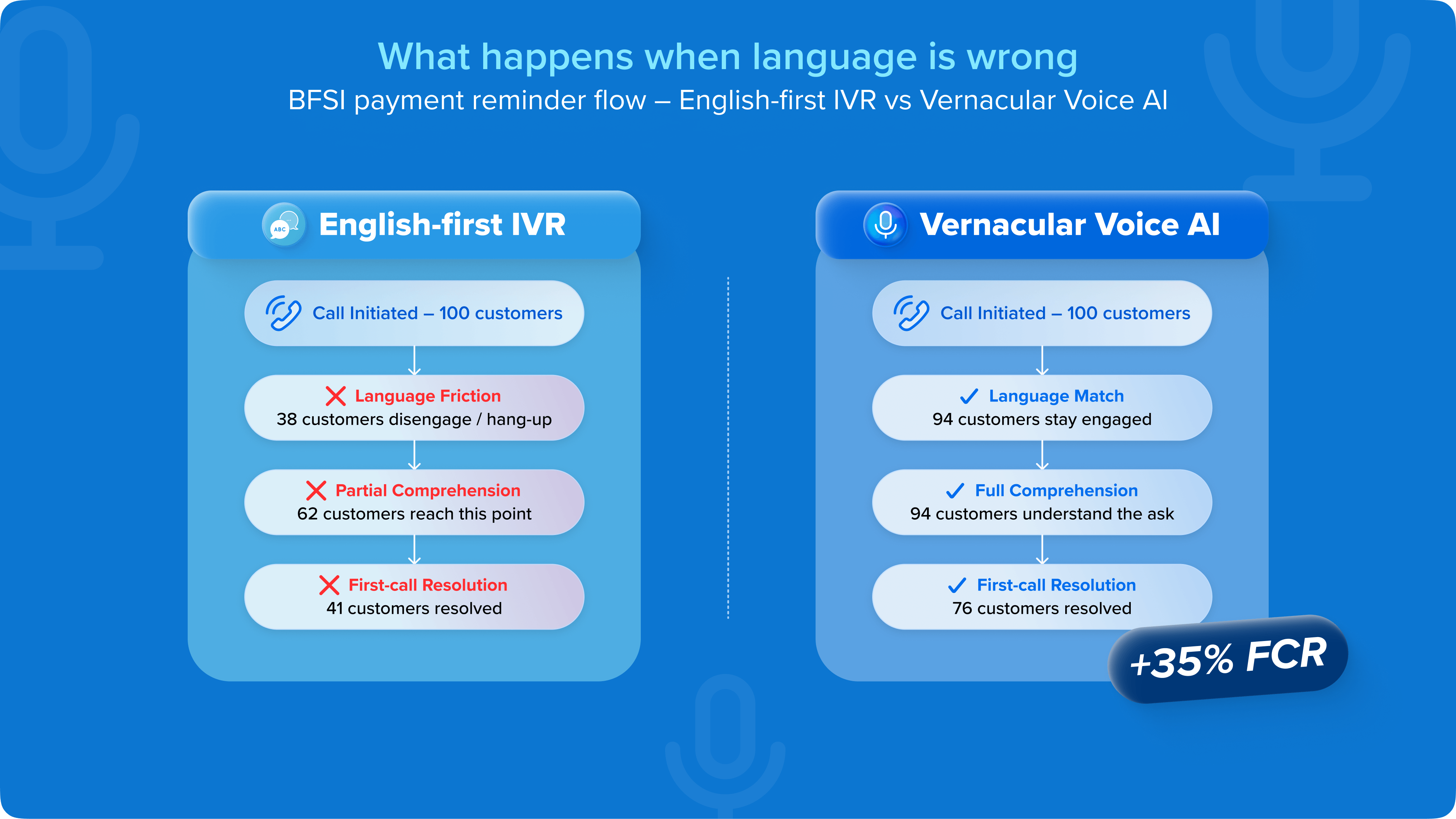
Across BFSI deployments, vernacular-first voice interactions consistently outperform English-first IVR on resolution rate, call completion, and most critically, customer-initiated follow-through. When a person understands what they're being asked, when they feel genuinely addressed rather than processed, they complete the transaction.
And in a market where the next 300 million customers are concentrated in Tier-2 and Tier-3 cities like Nagpur, Surat, Madurai, Patna, and Hubli - the enterprise that solves vernacular voice at scale will own a customer relationship that English-first competitors cannot reach.
Why solving for India means solving for code-switching
The default mode of communication for hundreds of millions of Indians is not Hindi. It is a fluid, sentence-level mixture of their mother tongue and English, and sometimes a third language that switches registers mid-thought.
Hinglish, Tanglish, and Benglish aren't edge cases but the primary mode of expression for the urban and semi-urban India that enterprise BFSI, healthcare, and eCommerce and retail most urgently needs to reach.
A customer service call in Mumbai might go: "Mera account mein kuch problem hai - can you check the last three transactions and tell me if the EMI has been deducted?" That single sentence contains Hindi, English, and a financial term (EMI) that the AI must recognize as contextually significant regardless of which language frame it appears in.
A voice AI system that handles Hindi and English separately will fail on this sentence because it was built for a reality that doesn't exist in Indian conversations.
True enterprise-grade voice AI for India is a code-switching problem. Everything else is downstream of solving that.
The State of Indian Language Voice AI in 2026
How far Indic ASR has come
The progress in Automatic Speech Recognition (ASR) for Indian languages over the past three years has been real and significant. It would be dishonest to minimize it. It would be equally dishonest to oversell it.
Here is where things actually stand in 2026:
Hindi is the most mature. Production-grade deployments can achieve Word Error Rates (WER) of 8–12% on clean audio, rising to 15-20% in noisy environments (background sound, mobile compression, rural connectivity). For enterprise use cases with high financial or health stakes, 15% WER should be considered the floor, not the ceiling.
Tamil and Telugu have seen significant model improvement, with leading platforms achieving WER of 12–18% on standard dialect inputs. The accuracy drop-off on regional variants like Coimbatore Tamil, Telangana Telugu, remains a real and unresolved gap.
Bengali and Marathi are in a similar range, with Bengali benefiting from a larger digital corpus and Marathi from active investment by Maharashtra-focused enterprises.
Kannada, Gujarati, and Malayalam have improved substantially but still lag on domain-specific vocabulary, particularly in BFSI and healthcare, where technical terms, product names, and regulatory language create out-of-vocabulary challenges that general-purpose models struggle with.
Odia, Punjabi, Assamese, and smaller scheduled languages remain underserved. Honest vendors will tell you this. Be cautious of any platform that claims production-grade accuracy across all 22 official languages without showing you language-specific WER data.
The code-switching reality: Why Hinglish is a default
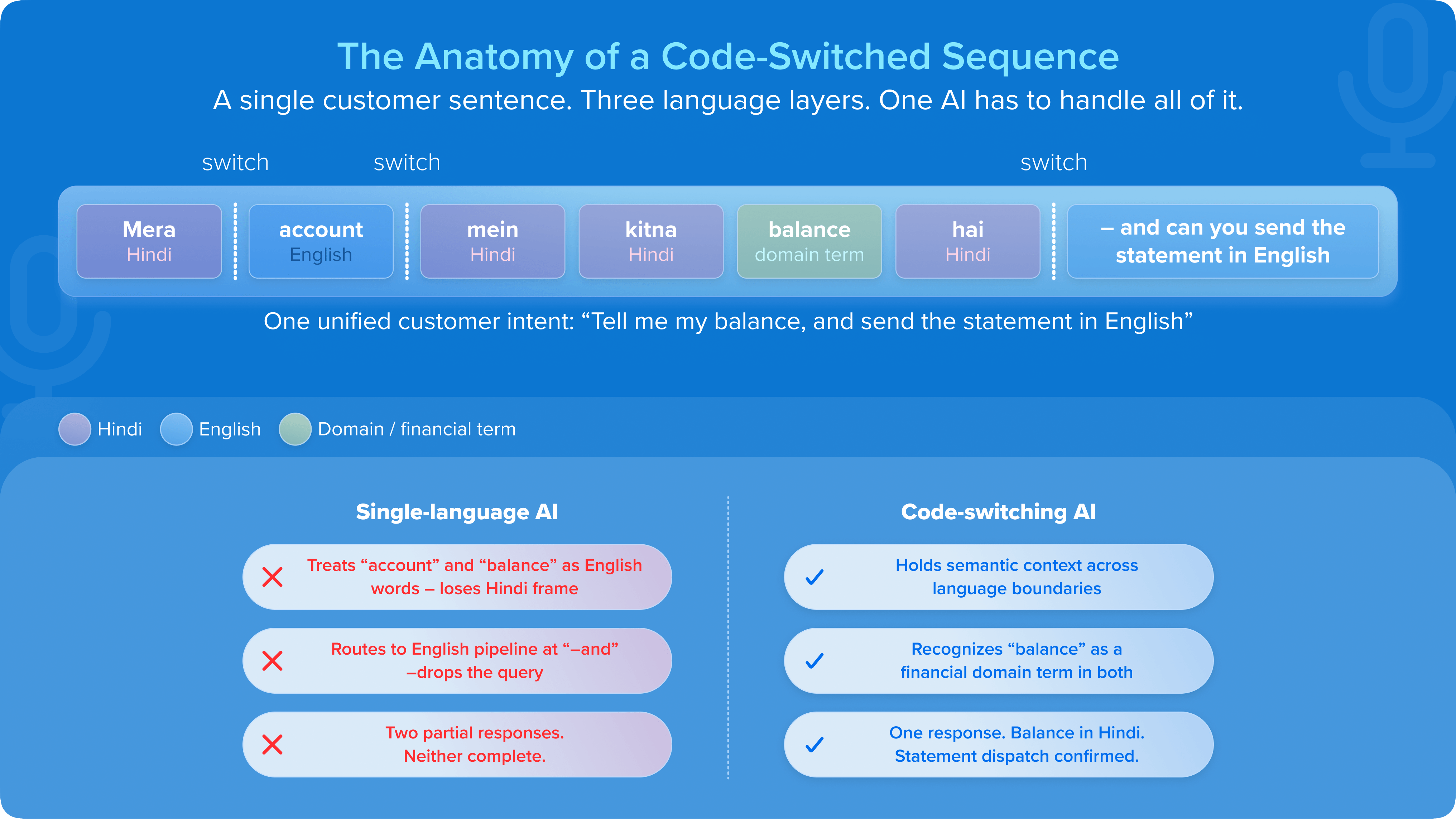
Building a voice AI system that handles code-switching is architecturally different from building one that handles multiple languages.
A multilingual system that handles languages sequentially, which involves detecting the language at the start of a call and routing to the appropriate model, is already obsolete for most Indian enterprise contexts. The customer often moves between languages, unconsciously.
What mid-sentence language switching demands from an NLU (Natural Language Understanding) model is non-trivial: the system must maintain semantic continuity across a language boundary, correctly map intent fragments from different language frames onto a single coherent interpretation, and do this without introducing latency that makes the call feel broken.
Consider: "Mera order kahan hai? I need it by tomorrow, my daughter's function hai." This isn't just multilingual. It's culturally layered. The word "function" is being used in its Indian-English sense (a family ceremony), not its English-English sense. The urgency is embedded not just in "tomorrow" but in the social weight of "function" which an AI without cultural context will parse as neutral and an AI with cultural context will parse as high-stakes.
This is the gap between a multilingual voice AI and an enterprise-grade voice AI for India. The former handles languages, while the latter handles conversations.
TTS in Indic languages: The gap between fluency and natural prosody
Text-to-Speech for Indian languages has improved dramatically in intelligibility. A customer can understand what a well-configured Indic TTS engine is saying. But enterprise-grade voice AI demands trust. And nothing destroys trust faster than a robotic voice in your mother tongue.
The prosody problem is specific and underappreciated. Natural speech in Tamil, Telugu, or Kannada carries emotional register like warmth, urgency, and formality in its rhythm and intonation. A TTS system that generates semantically correct Tamil with the flat prosodic contour of a text-to-speech engine from 2019 will create an uncanny valley effect: the customer understands the words and simultaneously feels that something is wrong.
In collections calls and healthcare reminders, this uncanny valley actively degrades outcomes. Patients who find the reminder voice unsettling don't engage. Customers who feel processed rather than addressed default to hostility.
The standard that enterprise deployments should hold TTS to is not "does it sound like a voice?" but "does it sound like a person who speaks this language from this region, in this context?" That bar is higher. The market is getting there, though not uniformly there yet.
Enterprise Use Cases That Demand Indic Language Voice AI
BFSI: Why customers default to their mother tongue under financial stress
Under cognitive load and emotional stress, humans default to their first language - the one they learned before they learned to perform fluency.
Financial stress is precisely this kind of trigger. A customer calling about an overdue EMI, a suspicious transaction, or a loan rejection is not in a frame of mind to navigate an English IVR. They are worried. And a worried person in Tamil Nadu speaks Tamil.
This is why NBFC collections calls in vernacular languages perform better. Resolution rates on collections calls improve measurably when the AI agent speaks the customer's language because they're more comprehending. They understand the options, understand what they're agreeing to and, when they agree, they follow through.
In regulated BFSI conversations, the customer must genuinely consent to and understand what they're agreeing to. A customer who nods along in English they don't fully follow is a compliance risk. A customer who responds clearly in their own language is a customer whose consent is real.
Healthcare: Where language is the biggest barrier to patient engagement
A post-discharge care reminder only works if the patient understands it. A medication adherence call only drives adherence if the patient grasps the instruction. An appointment confirmation only prevents no-shows if the patient processes the time, location, and what they need to bring.
Every one of these interactions - routine, low-stakes in isolation, and catastrophic in aggregate when they fail - depends on language comprehension. And in the semi-urban and rural healthcare contexts where patient engagement is most urgently needed, English comprehension is not the baseline.
Voice AI in Indian languages for healthcare is the difference between a patient engagement system that functions and one that doesn't. For rural health networks, community health workers, and digital health platforms targeting Bharat rather than metro India, vernacular voice is the product.
eCommerce and Retail: Vernacular at the last mile
The WISMO call - Where Is My Order - is the highest-volume inbound query for any e-commerce operation. In metro India, it's manageable with English-first AI assistants. In the districts of Uttar Pradesh, Bihar, Rajasthan, and the northeast, it becomes a problem that English-first systems cannot solve.
When a package is held at a hub because the delivery agent can't reach the customer, and the IVR that's supposed to facilitate re-delivery speaks English to a customer in Bhojpuri-speaking Deoria, the package doesn't move. The customer calls repeatedly. The repeat contact rate climbs. The NPS score falls. And a logistics operation that is otherwise optimized loses its last-mile efficiency to a language gap.
Vernacular voice AI at the last mile is not about the unboxing but whether the package arrives.
The same logic applies to return flows, COD confirmation calls, and subscription renewals for the D2C brands that are growing fastest in Tier-3 India. The customer who understands the return process completes it. The customer who doesn't, abandons it - and the brand eats the cost.
What Enterprise-Grade Actually Means for Indian Language Voice AI
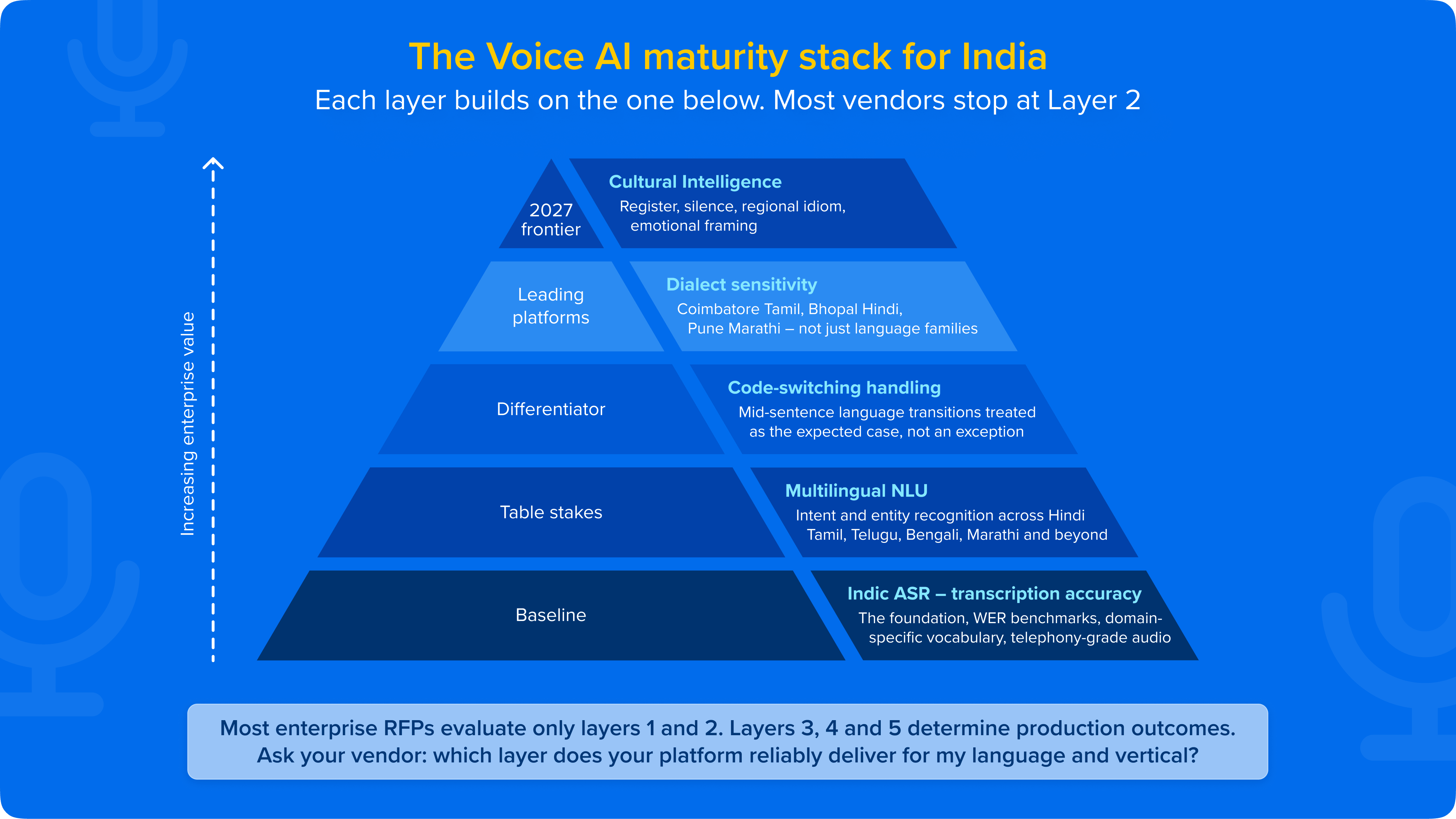
Accuracy benchmarks by language: What's acceptable vs. what breaks trust
Word Error Rate is a technology metric. Trust is a business outcome. The gap between the two is where enterprise deployments succeed or fail.
A 10% WER sounds good. On a collections call about an unpaid EMI of ₹8,400, 10% WER means 1 in 10 words is wrong. If one of those wrong words is the EMI amount, the due date, or the consequence of non-payment, the call becomes a compliance risk. Possibly a legal one.
The acceptable WER threshold is use-case-dependent:
-
Loan collections and payment reminders: WER must be below 8% for financial figures and dates to be reliably accurate.
-
Healthcare reminders: Medication names and dosage instructions demand similarly low error rates. A wrong instruction on a cardiac medication is a patient safety issue.
-
eCommerce WISMO calls: Higher tolerance of 12-15% WER is workable when the core information (delivery date, tracking number) is structured data confirmed before TTS rendering.
-
Customer service and query resolution: 10-12% acceptable if the system has strong fallback handling for low-confidence transcriptions.
Set these benchmarks by vertical before you evaluate a vendor and test them on your audio.
Dialect sensitivity: Why language-level support isn’t enough
Chennai Tamil reads differently from Coimbatore Tamil in vocabulary, prosody, and the ratio of Sanskrit-origin versus Dravidian-origin words. Bhopal Hindi is more formal and Urdu-inflected than the clipped, fast Mumbai Hindi spoken in suburban train corridors.
Dialect sensitivity in an enterprise voice AI system means the model is not only transcribing but also calibrating. It adjusts intent interpretation to account for regional idiom, and adjusts response register to match the formality level of the incoming speech. It reads silence and hesitation differently depending on regional conversational norms.
This level of calibration cannot be retrofitted into a model after the fact. It requires intentional data collection, annotation, and fine-tuning at the dialect level, making it expensive, time-consuming, and exactly what separates a research demo from a production system.
Ask your vendor:
- Which specific dialects of Tamil have you fine-tuned on?
- Where did you source that data?
- When was the model last updated?
Vague answers to these specific questions are a red flag.
How to test a vendor's code-switching capability
The vendor demo will always go well. It uses prepared audio, clean recordings, and carefully selected examples, but your production environment will not look like the vendor demo.
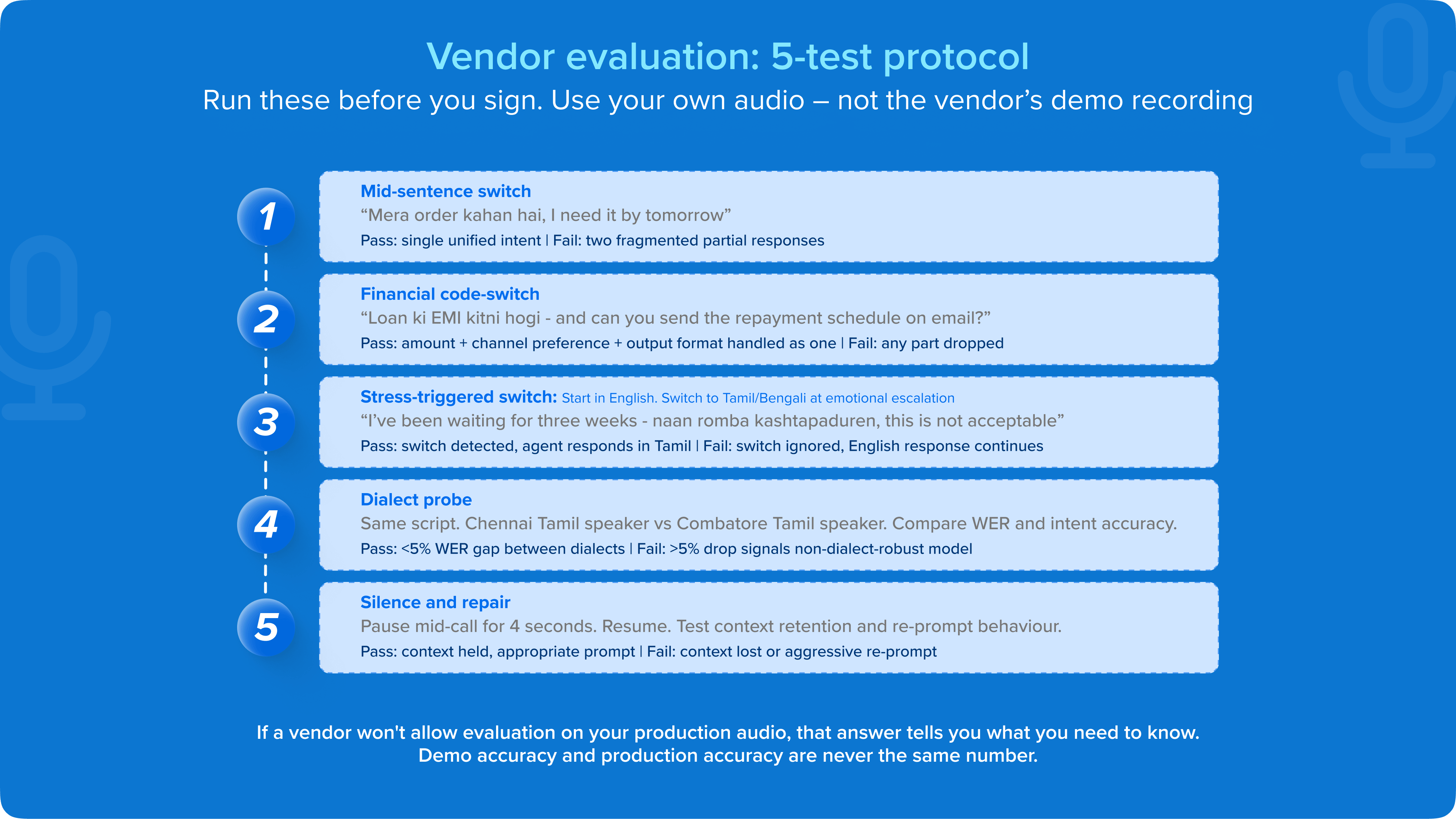
Here is a specific test protocol for evaluating code-switching capability before you sign:
-
Mid-sentence switch: "Mera order kahan hai, I need it by tomorrow." Does the system maintain a single intent thread across the language boundary, or does it produce two fragmented partial interpretations?
-
Financial code-switch: "Loan ki EMI kitni hogi? Can you send the repayment schedule by email?" The system must handle the Hindi financial query, the English channel preference, and the implicit output format instruction as a unified request.
-
Stress switch: Begin the call in English, switch to Tamil or Bengali at the moment of emotional escalation ("I've been waiting for three weeks - naan romba kashtapaduren"). Does the system recognize the shift? Does it respond in Tamil or ignore the switch?
-
Dialect probe: Use a Coimbatore Tamil speaker and a Chennai Tamil speaker with the same script. Compare transcription accuracy and intent detection to check if accuracy drops more than 5 percentage points between dialects, and whether the model is not dialect-robust.
-
Silence and repair: Mid-call, pause for four seconds before continuing. Does the system hold the context correctly? Does it prompt appropriately? Silence handling in Indian conversational norms is different from Western call center norms, so test it explicitly.
READ: How to Choose the Best Voice AI Platform for Enterprise CX
Low-bandwidth reality: What designing for India's connectivity means
For healthcare networks in rural Maharashtra, agri-platforms reaching smallholder farmers in Chhattisgarh, and any enterprise operation touching the true hinterland of Indian commerce, low-bandwidth is not an edge case to be handled gracefully but the primary environment.
2G connectivity means compressed audio, broken packets, and calls that drop mid-sentence and resume with context intact or context lost, and the system has to distinguish between these states. Feature phone constraints mean no rich client, no app, no data-channel fallback. The voice call is the entire interface.
Enterprise-grade for this context means:
- ASR models optimized for 8kHz telephony audio, not 16kHz wideband - because that's what 2G voice calls deliver
- Graceful context recovery when calls are interrupted and resumed within a session window
- Confirmation-first dialogue design that catches transcription errors before they propagate into consequential decisions
- Minimal round-trip latency architecture because a 4-second response lag on a 2G call feels like the line has died
This is not every enterprise deployment. A Mumbai fintech deploying voice AI for urban HNI customers has different infrastructure assumptions. But for enterprises trying to reach customers who matter most to India's next decade of growth, the constraints are the design brief.
Evaluating a Voice AI Platform for Indic Language Deployments
The questions to ask: Language coverage, model Recency, and fine-tuning
The claim "we support 22 Indian languages" is close to meaningless as a differentiator. Every credible vendor makes it. The questions that actually distinguish enterprise-ready platforms from demo-ready ones are:
-
Which model underpins each language? Is it a foundation model fine-tuned on domain data, or a general-purpose model applied without adaptation?
-
When was each language model last updated? Language evolves. Slang enters financial conversations. New product names become common vocabulary. A model that hasn't been updated in 18 months is accumulating vocabulary debt.
-
What WER can you demonstrate on domain-specific audio? Not benchmark datasets or clean recordings. Audio that represents your actual call types, your actual customers, your actual background noise profile.
-
Do you support dialect-level fine-tuning? If a vendor's answer is "our Hindi model handles all Hindi dialects," they have defined it away.
-
How do you handle out-of-vocabulary terms? In BFSI, product names, regulatory terms, and scheme names change. The system needs a mechanism for updating vocabulary without full model retraining.
Green flags:
- Published accuracy data by language and domain.
- Willingness to run an evaluation on your audio.
- Evidence of recent model updates.
- Domain-specific fine-tuning as a defined offering.
Red flags:
- "22 language support" as a headline claim with no supporting data.
- Demo environments that differ significantly from production configurations.
- Inability to specify which ASR engine underpins which language.
Integration with Indian contact center infrastructure
The Indian enterprise contact center stack is not the same as the Western enterprise contact center stack that most global voice AI vendors have built for.
Dialer platforms widely used by Indian BPOs and in-house contact centers have different API architectures, different SIP implementations, and different call recording and compliance logging standards than their US or European counterparts. CRMs serving Indian NBFCs often have custom-built loan management system integrations that a generic voice AI platform won't have pre-built connectors for.
READ: Voice AI for Contact Centers: The Enterprise Guide to Resolution at Scale
The enterprise voice AI vendor you evaluate needs to demonstrate integration experience with the specific stack you run — not generic "we integrate with all major platforms" claims, but actual deployment experience with systems your team can verify.
Ask for specific customer references in your industry vertical with your dialer and CRM combination. If they don't have them, that's a discovery to make before deployment, not during it.
Haptik's approach to Indian language voice AI
Haptik's voice AI platform supports 100+ languages and has been built specifically for the code-switching, dialect-variant, low-bandwidth reality of Indian enterprise deployments.
In BFSI, Haptik has deployed vernacular voice agents for collections, payment reminders, and loan servicing for NBFCs and banks serving Tier-2 and Tier-3 India, with measurable improvements in first-call resolution and customer-reported comprehension.
In eCommerce and retail, last-mile delivery communication flows in regional languages have demonstrably reduced repeat contact rates.
In healthcare, appointment and adherence reminder flows have been deployed across multiple Indian languages with dialect sensitivity built into the model configuration, not bolted on.
In Haptik's implementation, every dialog model is built to handle mid-sentence language transitions as the expected case. The evaluation framework described in this article - the dialect probes, the code-switching test scenarios, the WER-by-domain thresholds - represents the standard Haptik builds to, because it's the standard India's enterprise reality demands.
The Road Ahead: From Language Support to Cultural Intelligence
The next competitive frontier in Indian language voice AI is cultural intelligence: the capacity of an AI system to understand not just what a customer said, but what it means in context.
Consider what this actually requires:
- A polite refusal in Tamil is linguistically and prosodically different from a polite refusal in Bengali. Tamil refusals tend to be indirect, embedded in contextual explanation, and accompanied by prosodic softening. Bengali refusals can be more direct without carrying the same social weight.
- Financial urgency is expressed differently in Marathi and Gujarati - not because Marathi speakers care more or less about money, but because cultural conventions around discussing financial distress vary in directness, in the use of face-saving language, and in whether urgency is stated or implied.
- Silence on a collections call means something different in a rural UP context than in a Mumbai enterprise call. In some high-context communication cultures, silence after a question is thinking time. A voice AI that interprets four seconds of silence as call dropout and re-prompts aggressively has misread the moment.
Cultural intelligence is the capacity to get these readings right - systematically, at scale, without a human interpreter in the loop. It requires training data that captures not just language but interaction norms. It requires dialogue design that is culturally calibrated, not culturally neutral. And it requires a commitment to ongoing refinement as the platform accumulates real interaction data that reveals where cultural misreadings are occurring.
This is the work. It's harder than accuracy. And it matters more to outcomes.
FAQs
See Haptik's multilingual voice AI in action. Book a 20-minute demo in your language →

source on Google