


 Voice AI Agent
Vertical vs Horizontal AI Agents: Why Domain Depth Matters in Regulated CX
 Add as a preferred
source on Google
TL;DR:
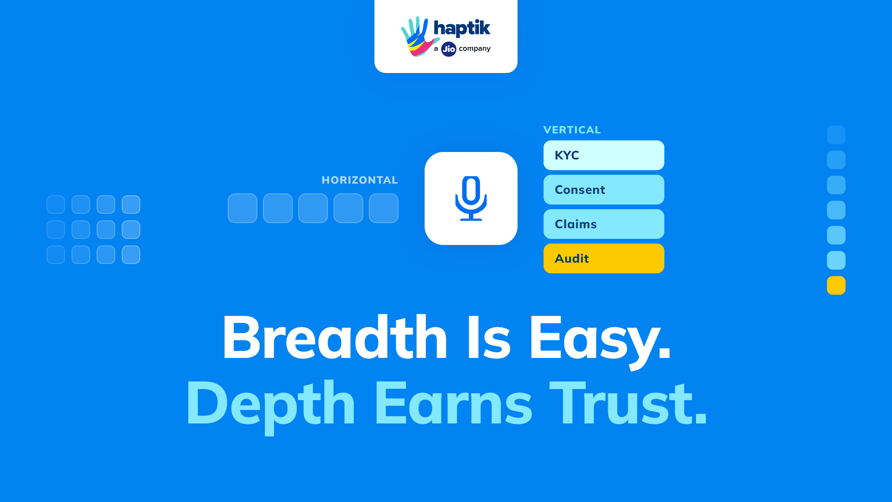
- The core debate: The choice between horizontal and vertical AI agents is not about platform architecture but about where operational domain depth must reside.
- The regulated reality: For high-stakes customer experience in banking, insurance, and healthcare, generic conversational capabilities fall short when faced with complex sector regulations, specialized systems of record, and localized language dynamics.
- Five markers of depth: Domain depth manifests across structured workflows, built-in compliance guardrails, native backend integrations, industry-specific conversation design, and vertical evaluation benchmarks.
- The hybrid model: Leading enterprise deployments increasingly rely on horizontal platforms engineered with deep, pre-packaged vertical capabilities.
- Evaluation framework: Test vendor domain depth using real-world scenarios, regulatory evidence requirements, and verified vertical call recordings.
IThe debate between vertical and horizontal AI agents is often framed as a winner-take-all technology battle: Will specialized, single-industry agents dominate, or will general-purpose horizontal platforms capture the enterprise market?
For CX leaders in regulated industries, however, that framing misses the operational point. The useful question is not whether a platform is labeled horizontal or vertical, but where domain depth actually lives within the software stack.
In low-risk environments, generic text generation and broad conversational flows are often sufficient. But in regulated CX, conversational errors carry immediate legal, financial, and regulatory consequences. Enterprise buyers must evaluate how deeply a platform understands their industry's specific operational realities.
Vertical vs Horizontal: Defining the Options
To navigate the vendor landscape, enterprise procurement teams should distinguish between three distinct platform architectures:
| Platform model | Structural definition | Core advantage | Operational risk |
|---|---|---|---|
| Horizontal AI agent | General-purpose conversational agents designed across functions (e.g., HR, IT, general support) and industries. | Fast initial deployment; broad utility across non-specialized tasks. | Lacks embedded regulatory rules, specialized data models, and sector-specific integrations. |
| Pure vertical AI agent | Point solutions engineered strictly around a single industry's workflows, terminology, and compliance rules. | High specialized domain depth out of the box for targeted use cases. | Narrow functional footprint; difficult to scale or extend across adjacent business units. |
| Horizontal platform with vertical depth | Shared core AI orchestration layer paired with pre-packaged, industry-specific workflows, integrations, and guardrails. | Combines enterprise scalability with deep domain specialization where risk is highest. | Variable depth by vertical; requires buyers to verify capabilities per specific industry. |
Why Regulated CX Raises the Stakes
Deploying AI agents in regulated sectors such as Financial Services, Healthcare, and Telecommunications introduces constraints that general-purpose AI agents are ill-equipped to manage.
Conversations in these environments carry statutory obligations:
-
Legal and financial Exposure: A mistake in debt collection disclosures, an inaccurate insurance coverage statement, or an improper health data disclosure leads to regulatory penalties, formal customer grievances, and legal liability rather than merely a poor review score.
-
Linguistic and vocabulary precision: Callers use complex, localized industry terminology (e.g., loan moratorium terms, policy endorsement codes, or clinical intake jargon) that must be parsed accurately across regional dialects and mid-sentence language blending (code-switching).
-
Systems of record execution: Regulated voice agents cannot simply read static answer scripts; they must read from and write to core systems of record such as loan management systems, policy administration portals, and electronic health records (EHR) in real-time.
General-purpose agents frequently encounter severe operational friction when deployed in highly technical or strictly governed environments without specialized domain adaptations.
Five Places Domain Depth Shows Up
When evaluating whether an AI agent platform possesses genuine domain depth for regulated customer experience, look for specialization across these five operational dimensions:
How Haptik Approaches Architecture
1. Workflows and data models
The agent architecture natively understands the specific states, entities, and lifecycle stages of an industry transaction - whether tracking a loan application pipeline, processing an insurance claim intake, or guiding a patient care journey. It automatically prompts for missing variables in the correct sequence without relying on generic prompt engineering.
2. Compliance built in
Regulatory guardrails are embedded into the platform architecture rather than added as a prompt engineering instruction. This includes mandatory disclosure delivery, explicit consent capture, prohibited statement filters, localized data residency configurations, and immutable audit logging.
3. Native system integrations
The platform provides pre-built connectors to industry-standard systems of record such as core banking platforms, loan origination systems, insurance policy management software, and hospital information systems. This enables the agent to execute transactions mid-call rather than redirecting callers to an online portal.
4. Sector conversation design
Conversational models are tuned for emotional and high-stakes customer moments. Handling financial hardship during a collections call, processing an emergency insurance claim after an accident, or guiding an anxious patient through intake requires distinct tone controls, specialized escalation triggers, and approved local-language phrasing.
5. Vertical evaluation sets
The platform is tested against industry-specific evaluation suites and benchmark datasets. Success is evaluated using meaningful domain metrics such as debt recovery rates, claim processing cycle times, or patient show-up rates with an explicit, written definition of what constitutes a ‘resolved’ interaction for each specific call type.
Where Horizontal Generalization Still Wins
While domain depth is critical for regulated customer interactions, broad horizontal platforms retain clear advantages across specific enterprise scenarios:
- Speed to initial deployment: Horizontal agents can be deployed rapidly for low-risk, cross-industry administrative tasks like internal IT helpdesks, employee onboarding, or basic corporate FAQs.
- Unified administrative overhead: Managing a single horizontal AI platform across non-regulated business units reduces vendor management complexity, licensing overhead, and technical maintenance.
- Broad functional utility: For non-sensitive interactions where regulatory exposure is zero and language complexity is low, general-purpose conversational models offer a cost-effective solution.
The decision to prioritize domain depth should align directly with an organization's regulatory exposure, transactional complexity, and customer risk profile.
A Buyer's Test for Domain Depth
To separate marketing claims from genuine domain depth during vendor selection, enterprise procurement teams should execute this six-point verification test:
- Verify live vertical deployments: Ask the vendor to demonstrate live enterprise deployments within your specific industry and state what percentage of their total business those deployments represent.
- Audit regulatory wording and controls: Require the vendor to show how specific sector regulations (e.g., DPDP Act, TRAI rules, or financial disclosure mandates) are enforced within the platform, backed by compliance audit logs.
- Inspect native systems integration: Ask for a list of pre-built, out-of-the-box connectors to your industry's core systems of record and request a demonstration of a live API failure path.
- Stress-test high-friction scenarios: Request a step-by-step walkthrough of how the system handles your most complex customer scenario (e.g., a disputed charge, a hardship claim, or an unverified caller).
- Evaluate against industry transcripts: Require the vendor to run test calls using your raw production recordings, including background noise, regional accents, and mixed-language speech, rather than generic benchmarks.
- Assess team expertise: Inquire about the background of the vendor's forward-deployed engineering and conversation design teams to ensure they have hands-on experience operating within your regulated sector.
How Haptik Approaches Domain Depth
Haptik operates as a horizontal conversational AI platform engineered with deep vertical capabilities, combining an enterprise-grade orchestration layer with specialized domain expertise for regulated industries:
Multi-industry platform foundation
Haptik provides tailored conversational solutions across diverse enterprise sectors—including banking, financial services, insurance, healthcare, retail, e-commerce, telecommunications, and media.
Specialized depth for regulated operations
Haptik delivers deep operational domain expertise in high-consequence sectors, holding a leading position in Indian BFSI conversational AI, healthcare, and other. This depth is supported by localized data architectures, and proven voice AI deployments across housing finance, banking, and insurance brands.
Forward-deployed sector expertise
Forward-deployed engineering and conversation design teams work directly within client environments to map industry-specific workflows, integrate with core systems of record, and enforce compliance guardrails across 500+ enterprise deployments.
The Bottom Line
Choosing an enterprise AI agent is not a choice between vertical and horizontal labels. To protect customer relationships and meet regulatory requirements, evaluate vendors across their workflows, compliance guardrails, system integrations, conversation design, and vertical testing sets, selecting the platform that provides verifiable proof in your industry.
FAQs
Not universally. While pure vertical agents offer specialized capabilities for a single industry, they can be difficult to scale across adjacent business units. A horizontal platform built with deep, pre-packaged vertical capabilities often provides the optimal balance between enterprise scale and domain depth.
Not necessarily. A horizontal platform that features verified vertical depth, including pre-built industry integrations, compliant workflow templates, and sector-specific conversation design, can satisfy regulated requirements while providing broader architectural flexibility.
This refers to an enterprise conversational AI platform that provides a unified core architecture (orchestration, analytics, security) while delivering specialized, packaged modules (data models, API connectors, compliance rules) tailored to specific vertical industries.
Require vendors to present live production references in your vertical, demonstrate native integrations with your core systems of record, supply audit-backed compliance documentation, and run test calls using your real-world call recordings.
Yes, provided the platform maintains separate, specialized compliance configurations, system integration libraries, and conversation design frameworks for each supported industry, backed by dedicated domain teams and verified vertical reference deployments.
source on Google