


 Voice AI Agent
Your enterprise deployed a voice AI agent to handle first-line customer support.
The pitch was compelling:
- 24/7 availability
- Real-time responses
- Reduced agent load
But three weeks in, your contact center head walks into your office with a problem.
Customers are dropping off. CSAT has dipped. And the voice AI, despite answering correctly, feels wrong. Conversations feel stilted. The voice AI agent seems to cut people off mid-sentence, or worse, hangs in silence for nearly two seconds before replying.
It's a latency and interruption handling problem that's quietly killing the ROI of voice AI deployments across Indian enterprises.
The boardroom conversation around voice AI tends to revolve around accuracy, intent recognition, and language support.
Rarely does anyone ask:
- How fast does your pipeline respond?
- What happens when a customer interrupts?
These engineering-level questions have direct, measurable consequences for your containment rate, your CSAT scores, and your cost-per-call. Understanding the mechanics - the 'under the hood' engineering - separates enterprises who sign good contracts from those who spend 18 months retrofitting a broken deployment.
RELATED: Why Latency Is the New UX in Voice AI Conversations
The Three Layers of Latency in a Voice AI Pipeline
Voice AI is a chain of three distinct processing stages. Each introduces its own latency. Each compounds the others. And together, they define whether your AI agent sounds natural or robotic.
ASR latency: How fast is speech being transcribed?
Automatic Speech Recognition (ASR) converts spoken audio into text.
Modern ASR systems, whether cloud-based or on-premise engines, typically add 80 to 250 milliseconds of latency per utterance. The key variable is whether the ASR system streams audio incrementally (partial transcription in real-time) or waits for an end-of-speech signal before transcribing (batch mode).
Streaming ASR begins transcribing before the customer has finished speaking - shaving critical milliseconds off the total pipeline.
For Indian deployments, ASR accuracy on accented English, Hindi, Tamil, and other regional languages is a separate but connected concern: a misfire in transcription forces a re-prompt, adding not just latency but friction.
Also Read : Voice AI Agents for Indian Languages: What Enterprise-Grade Really Means in 2026
LLM inference latency: How fast is the intent processed?
Once transcribed, the text is passed to a Large Language Model (LLM) or a dialogue management system that interprets intent and determines the appropriate response. This is typically the most latency-heavy stage, ranging from 150ms for optimized, smaller models to 800ms or more for frontier LLMs running on shared cloud infrastructure.
Model size matters here, but so does deployment architecture.
A 7B parameter model running on dedicated GPU infrastructure with optimized inference frameworks like vLLM or TensorRT will outperform a 70B model on a shared API endpoint.
The art lies in selecting the right model for the task: smaller models for FAQ-style lookups, larger models for nuanced complaint resolution.
TTS latency: How fast is the response being synthesized?
Text-to-Speech synthesis converts the LLM's text response into audio.
Traditional TTS systems wait for the full response before generating audio. Neural TTS systems (the current standard) can stream audio chunk-by-chunk, allowing the first syllable to begin playing before the last word is even synthesized. This streaming approach is essential to keeping total end-to-end latency under 500ms. Without it, a 200-word response that takes 0.8 seconds to synthesize would be heard only after an agonizing wait.
The cumulative effect: Why each layer matters to the human ear
In a well-optimized pipeline: ASR adds ~100ms, LLM inference adds ~200ms, and TTS streaming begins at ~150ms - totalling roughly 450 to 500ms from end of utterance to first audio byte.
In a poorly optimized pipeline: ASR adds 250ms, LLM adds 600ms, and batch TTS adds another 400ms - totalling over 1,250ms.
That 750ms difference doesn't sound like much on paper. But in human conversation, it is the difference between a colleague and a robot. Anything above 800ms is perceptible as delay. Above 1,200ms, customers begin to disengage.
What "Real-Time" Actually Means in Enterprise Voice AI
The 500ms benchmark: Where it comes from and why it matters
The 500ms benchmark for voice AI response latency is derived from psychoacoustic research on conversational turn-taking.
Human conversational pauses average 200 to 300ms between turns. Pauses exceeding 500ms are perceived as hesitation or confusion. Pauses exceeding 800ms trigger reinterpretation: callers assume the system has failed to understand them and either repeat themselves or disengage.
Haptik's voice AI achieves approximately 500ms end-to-end latency in production environments - a benchmark that has taken years of infrastructure engineering, model optimization, and India-specific network adaptation.
Streaming vs batch processing: Why streaming wins for voice
Batch processing means, wait for complete input, process entirely, return complete output.
Streaming means, process incrementally as data arrives.
For voice, streaming is non-negotiable. Streaming ASR reduces transcription lag. Streaming LLM inference (via techniques like speculative decoding) returns partial tokens to TTS before generation completes. Streaming TTS begins audio playback before the full response is synthesized. At every layer, streaming shaves the latency that batch architectures lock in structurally.
Enterprises evaluating voice AI should explicitly ask:
- “Does your pipeline stream at the ASR layer, the LLM layer, and the TTS layer?”
A 'yes' at all three is the only acceptable answer for a sub-600ms deployment.
Network and infrastructure factors affecting perceived latency in India
India's network landscape introduces unique challenges for voice AI latency.
Average 4G speeds in Tier 2 and Tier 3 cities range from 8 to 18 Mbps - adequate for voice but vulnerable to jitter.
Haptik's architecture accounts for voice traffic that’s routed through India-based cloud availability zones, and for deployments serving Tier 2 customers, on-premise options are available that eliminate public internet hops entirely.
The Business Metrics That Latency Directly Impacts
Containment rate: How response speed affects whether customers stay on the line
Containment rate is the percentage of callers who complete their query via the voice AI without escalating to a human agent, and it is the primary ROI metric for voice AI deployments.
Latency is one of the most underappreciated drivers of containment failure. When a voice AI pauses for 1.5 seconds before responding, callers interpret the silence as a system error and say 'agent' or 'representative' - triggering escalation.
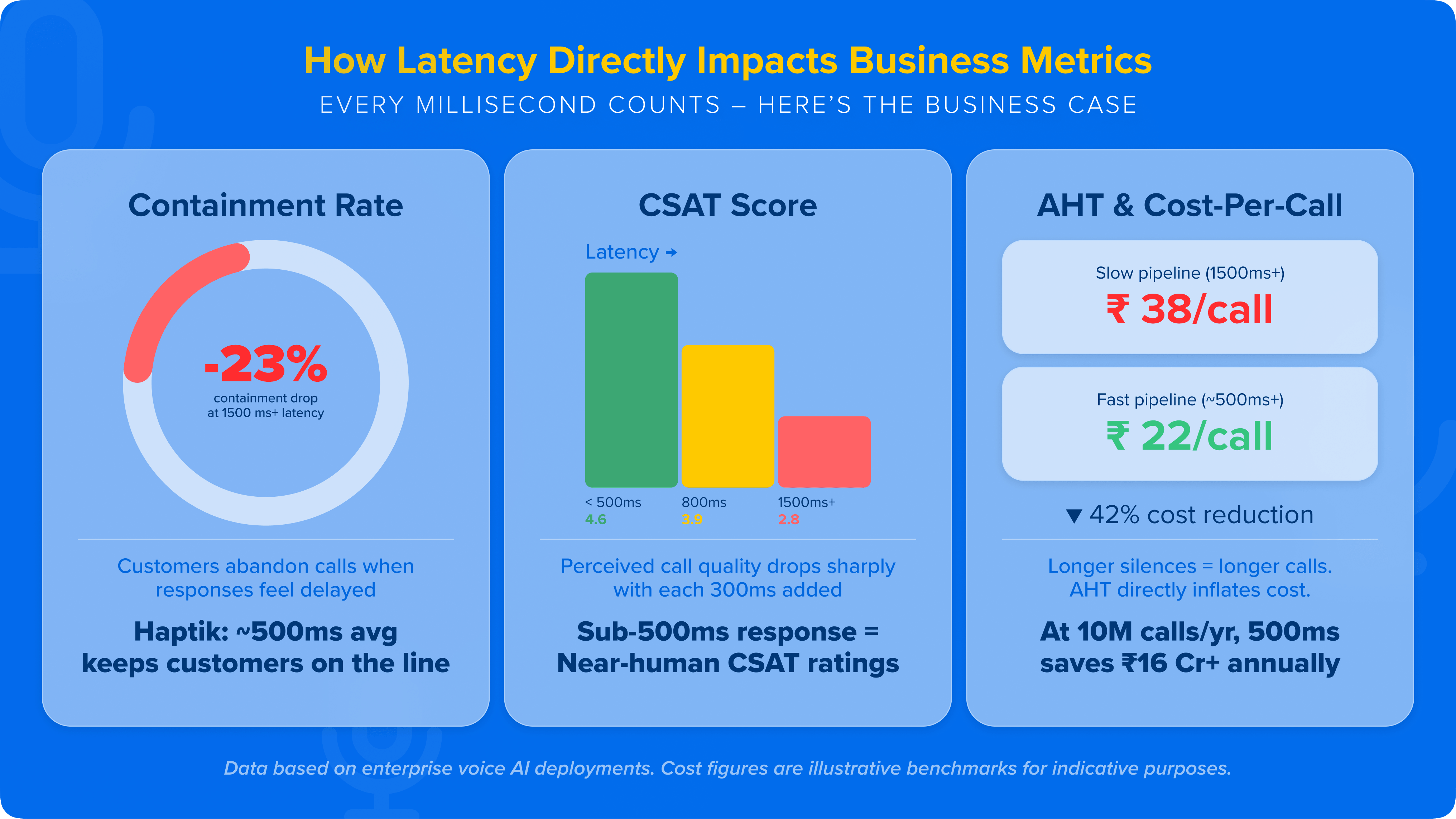
Enterprise data from Haptik deployments shows containment rates drop significantly at latencies above 1,200ms, even when the AI's response is accurate.
CSAT and how call quality perception correlates with latency
Customer satisfaction scores in voice AI interactions are shaped not just by whether the AI resolves the query, but how the interaction feels.
A voice AI that responds in 500ms with a natural voice profile is rated comparably to a well-trained human agent by callers.
The same AI at 1,500ms latency receives scores that mirror IVR systems - transactional, frustrating, and impersonal. CSAT in voice AI is a perception game, and latency is the most manipulable variable in that game.
AHT and cost-per-call implications of a slow pipeline
Average Handle Time (AHT) in a voice AI interaction is directly inflated by latency.
A 1,000ms pipeline operating across a 6-turn conversation adds 6 seconds to AHT compared to a 500ms pipeline. At a scale of say, 10 million calls per year, that 6-second differential translates to over 16,000 agent-equivalent hours of wasted capacity.
ALSO READ: Scaling Voice AI for Large Enterprises: What Changes After 10 Million Calls
Cost-per-call for voice AI ranges from ₹1 to ₹8 in well-optimized deployments. Pipeline latency is a silent multiplier that pushes this number upward through longer call durations and higher escalation rates.
Interruption Handling: The Hardest Problem in Conversational Voice AI
What is barge-in and why legacy systems get it wrong
Barge-in refers to a caller's ability to interrupt the AI agent mid-utterance.
In natural conversation, humans interrupt each other constantly to correct misunderstandings, to answer early, to express frustration.
A voice AI that cannot handle barge-in gracefully forces callers to wait through the AI's full response before speaking - an experience that feels unnatural, controlling, and often maddening.
Legacy IVR systems simply stop playing audio when they detect voice energy. This is crude barge-in: it doesn't distinguish between the caller saying something meaningful and background noise. Modern voice AI requires much more sophisticated mechanisms.
The false barge-in problem: When silence isn't silence
False barge-in occurs when background noise, a TV in the background, or even the caller's own breathing triggers the AI's end-of-speech detector and interrupts its response prematurely.
In noisy environments, which is the reality for a significant portion of Indian contact center callers, false barge-in rates can be as high as 15 to 20% with naive voice activity detection.
Multi-layered VAD (Voice Activity Detection) is a technique that distinguishes speaker intent from ambient noise, reducing false barge-in rates to under 3% in production across diverse acoustic environments.
Designing for natural turn-taking
Natural turn-taking in voice AI requires three coordinated capabilities:
- Accurate end-of-speech detection (knowing when the caller has finished speaking)
- Intent-aware barge-in (distinguishing a meaningful interruption from noise)
- Graceful mid-response cancellation (stopping TTS playback and processing the new input without jarring audio artefacts).
Achieving all three simultaneously, at sub-500ms latency, is non-trivial.
It is the engineering challenge that separates enterprise-grade voice AI from demo-grade prototypes.
The emotional cost of poor interruption handling on CSAT
Poor interruption handling is the single fastest path to a negative caller experience.
When a voice AI speaks over a caller, or fails to register that the caller has already answered, callers feel unheard.
CSAT impact is disproportionate to the frequency: a single barge-in failure in an otherwise smooth 90-second interaction can drop a caller's rating by a full star.
This makes interruption handling not just a technical problem but a customer experience imperative that warrants dedicated evaluation during vendor selection.
What Enterprise Buyers Should Test During a Voice AI Evaluation
The 10-point latency and interruption stress test
When evaluating a voice AI vendor, insist on running a structured stress test before signing. Here are ten specific tests to run:
When evaluating a voice AI vendor, insist on running a structured stress test before signing. Here are ten specific tests to run:
- Measure end-to-end latency from end of utterance to first audio byte across 50 consecutive calls.
- Test under simulated peak load: what happens at 500 concurrent calls?
- Introduce 200ms of artificial network jitter and measure latency degradation.
- Test barge-in with a caller speaking before the AI finishes a 10-word sentence.
- Test false barge-in with ambient noise (TV, crowd noise) at 65 dB SPL in the background.
- Test with accented Indian English from callers with heavy regional inflections.
- Test with whispering or low-volume speech.
- Test with multi-turn conversations of 8+ turns and measure latency drift.
- Test the system's behavior when the caller says 'sorry' or 'wait a moment' mid-response.
- Test failover behavior: what happens when the LLM endpoint is unavailable?
How to simulate real-world edge cases in a demo environment
Most vendors will present a polished demo in a quiet, high-bandwidth environment. That is not your production environment. Ask the vendor to run the demo using your actual telephony infrastructure — be it a Genesys, Avaya, or Cisco contact center platform. Introduce real-world conditions: cellular callers from Tier 2 cities, bilingual code-switching mid-call, and simultaneous peak load simulation. The delta between a controlled demo and a real-world environment is often where voice AI deployments fail.
Benchmarking questions to ask every voice AI vendor
Ask vendors these direct questions:
- What is your production P50, P90, and P99 latency, measured from end of utterance to first audio byte?
- Do you stream at ASR, LLM, and TTS layers?
- What is your false barge-in rate in ambient noise environments above 60 dB?
- How do you handle low-bandwidth network conditions common in Indian Tier 2 geographies?
- What is your SLA for latency degradation under peak load?
A vendor who cannot answer these questions with specific numbers is a vendor whose deployment you are funding as a live experiment.
How Infrastructure Choices Affect Latency at Scale
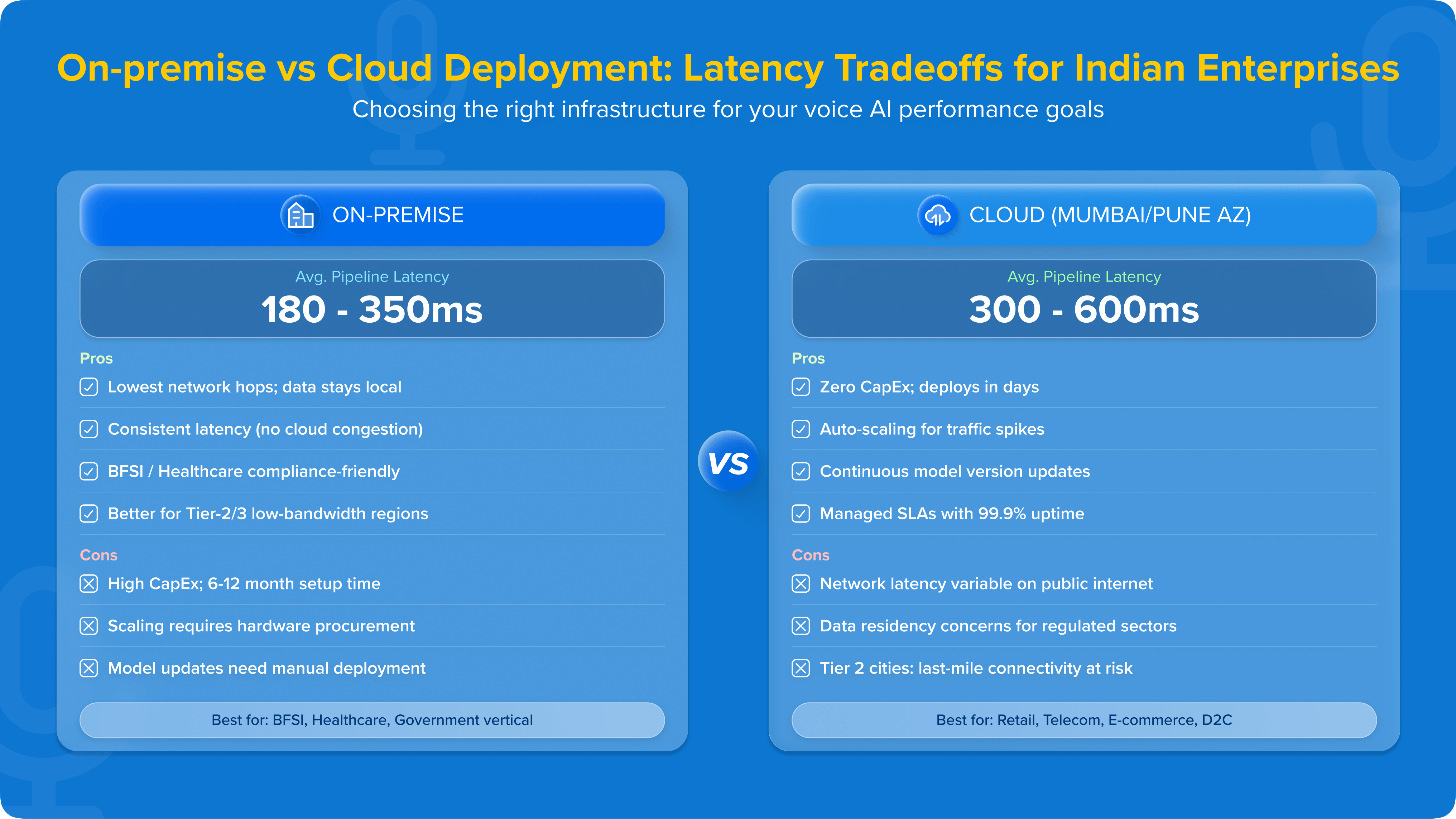
On-premise vs cloud deployment: Latency tradeoffs for Indian enterprises
The deployment model, whether on-premise vs cloud-hosted, has significant implications for latency, compliance, and scalability for Indian enterprises.
The right choice depends on your vertical, geography, and regulatory posture.
LLM model selection and its impact on inference speed
LLM selection is the highest-impact lever for inference latency. Frontier models like GPT-4 Turbo or Claude Opus offer superior reasoning but introduce 400 to 800ms of inference latency on shared API infrastructure.
Purpose-built, fine-tuned models in the 7B to 13B parameter range, deployed on dedicated GPU instances, can achieve inference latency of 120 to 200ms with 85 to 92% of the intent accuracy of their larger counterparts for domain-specific tasks.
Haptik's approach is pragmatic: use the smallest model that can reliably handle the task. For a telecom IVR handling balance queries and recharge issues, a fine-tuned 7B model outperforms a generic 70B model on both speed and domain accuracy.
For complex complaint resolution requiring multi-turn contextual reasoning, a larger model is engaged selectively. This tiered model architecture is what enables Haptik to sustain ~500ms latency while maintaining enterprise-grade response quality.
How Haptik Engineers for Real-World Conversation Quality
The gap between a voice AI that sounds promising in a demo and one that performs at 10 million calls a year is a gap in engineering depth. Haptik has spent over a decade building that depth, and it shows in four specific ways.
12+ years of AI domain expertise
Haptik has been building and deploying conversational AI longer than most of its current competitors have existed. That longevity translates into something invaluable in voice AI: accumulated failure data.
We know what breaks in production. We have seen every edge case - the caller who whispers, the caller who code-switches between Tamil and English, the caller who stays silent for eight seconds and then says 'hello?' Haptik's pipeline has been hardened against real-world failure modes that a newer vendor's architecture has never encountered.
500+ enterprise deployments
Having deployed voice and chat AI for over 500 enterprise customers - spanning BFSI, telecom, retail, healthcare, and government - means Haptik brings operational playbooks that pure-play tech vendors lack. We know how to integrate with legacy telephony stacks, how to manage change in a 2,000-seat contact center, and how to build the internal stakeholder buy-in that separates a pilot from a production rollout.
Omnichannel CX orchestration
Voice is rarely a standalone channel. The customer who calls your contact center has likely already attempted resolution via your website chatbot or WhatsApp.
Haptik's platform orchestrates context across voice, chat, and messaging so when a caller says 'I already raised a complaint last week,' the voice AI knows about it. This omnichannel context is the difference between a voice AI that feels integrated into your CX ecosystem and one that forces customers to repeat themselves on every channel.
Consulting-first approach
Haptik offers both deep integration with India's enterprise digital ecosystem (across CRMs, telephony providers, and contact center platforms) and the organizational gravity to solve complex compliance and change management challenges.
BFSI deployments require RBI-aligned data handling. Healthcare deployments require HIPAA-equivalent controls. Government deployments require on-premise data residency.
Haptik's track record of driving measurable outcomes - including 8 to 10% uplift in lead conversion, significant support volume reduction, and NPS improvement - is built on this consulting-first approach.
The Bottom Line
Voice AI quality is not decided in the boardroom when a vendor's deck is presented. It is determined in the engineering lab, in the milliseconds between when your customer finishes speaking and when your AI begins responding, and in the moment when your customer tries to interrupt, and whether the system listens.
Latency and interruption handling are the primary user experience variables that determine whether your voice AI deployment achieves containment, earns CSAT, and justifies its commercial case. They are also the variables that most enterprise buyers fail to evaluate rigorously before signing.
source on Google