


 Voice AI Agent
How Automotive Leaders Use Voice AI to Scale Dealer Operations & In-Vehicle CX (2026)
 Add as a preferred
source on Google
TL;DR:
- The dual-frontier shift: Voice AI in automotive has evolved into a unified operational strategy spanning two high-value environments: dealership tele-operations (BDC & Service Lane) and in-vehicle cockpit intelligence.
- Speed-to-lead economics: In automotive retail, leads contacted within 60 seconds are 21x more likely to qualify; automated voice agents resolve missed-call volume, after-hours sales queries, and service bay scheduling in real time.
- Deep DMS/CRM integration: Voice agents drive real business value when connected bi-directionally to Dealer Management Systems (DMS) and CRMs (e.g., CDK Global, Tekion, Salesforce) to write service bookings and update inventory records directly.
- Cockpit hybrid architecture: In-vehicle voice control is transitioning to agentic, edge-cloud hybrid architectures that execute offline vehicle commands instantly while tapping cloud LLMs for contextual navigation and maintenance diagnostics.
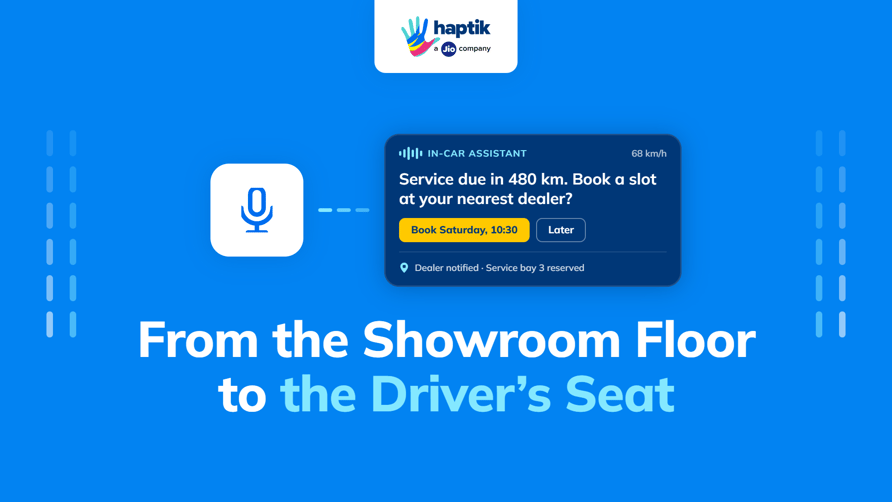
- Omnichannel continuity: Unified voice architectures ensure that a driver’s in-car service request automatically flows to the local dealer’s service queue without losing context.
The automotive industry is navigating a structural transformation where software-defined vehicles meet digitally demanding consumers. Yet, despite billions invested in online car configurators and digital showrooms, the primary operational bottleneck in automotive retail remains the surprisingly traditional phone line.
During peak operational hours, dealership Business Development Centers (BDCs) and service advisors miss up to 30% of inbound calls due to floor traffic. Simultaneously, behind the wheel, drivers demand natural, conversational controls that extend beyond rigid, legacy voice-command buttons.
To solve these friction points, automotive Original Equipment Manufacturers (OEMs) and major dealer groups are deploying Voice AI across a unified dual frontier:
- Scaling dealer operations on the retail side
- Powering in-vehicle cockpit experiences on the product side
Part 1: Scaling Dealership Operations (Retail & After-Sales)
At the dealership level, unanswered phone calls represent lost vehicle sales, unbooked service bays, and decaying customer loyalty.
AI voice agents act as an autonomous operational layer across three core dealership departments.
1. Fixed operations: Service lane automation
Service departments drive a massive portion of dealership profitability, yet service advisors spend hours each day handling routine scheduling calls.
Voice AI integrates directly into Dealer Management Systems (DMS) to check real-time service bay availability, verify recall notices against Vehicle Identification Numbers (VINs), and write appointment bookings directly into service schedules without human intervention.
2. Speed-to-lead qualification
Automotive retail research shows that sales leads contacted within 60 seconds are 21x more likely to enter the qualification pipeline than those contacted after five minutes.
Voice AI agents respond instantly to web form submissions, inbound pricing queries, and trade-in valuation requests - qualifying buyer intent, scheduling test drives, and logging transcripts directly into the CRM.
3. Outbound recall and maintenance campaigns
Running proactive outbound campaigns via human staff is labor-intensive. Voice AI automates targeted outbound outreach for factory recall notices, scheduled maintenance reminders, and lease-end notifications, processing thousands of concurrent calls while transferring interested drivers to finance or service specialists.
Part 2: Redefining In-Vehicle Cockpit CX
While voice agents streamline retail operations on the ground, in-vehicle voice AI is reshaping the driving experience inside the cockpit.
Legacy, menu-driven voice command systems are being replaced by multimodal, conversational co-pilots powered by generative AI.
In-vehicle hybrid voice architecture
Edge AI execution (sub-400ms)
| Cloud AI reasoning (sub-900ms)
|
Hybrid edge-cloud processing
Modern in-vehicle architectures utilize a hybrid AI deployment model:
- Edge AI: Runs lightweight, offline models directly on vehicle silicon to process safety-critical controls (e.g., climate adjustments, window controls, and emergency alerts) with sub-400ms responsiveness, independent of cellular connectivity.
- Cloud AI: Streams complex queries to cloud-hosted Large Language Models (LLMs) to handle contextual navigation, natural dialog, and personalized recommendations.
Predictive maintenance diagnostics
In-car voice agents do not simply wait for user prompts; they act proactively.
By interfacing with vehicle telematics, an AI assistant can analyze sensor anomalies (e.g., tire pressure drops or brake pad wear) and explain the issue verbally:
"I've detected a low pressure reading in your rear-left tire. Would you like me to check service availability at your nearest preferred dealership and book an inspection?"
Connecting the Loop: Omnichannel Context Continuity
The ultimate competitive advantage for automotive OEMs and large dealer groups lies in unifying the in-car experience with dealer operations.
When a driver schedules a service appointment using their vehicle's dashboard assistant, that interaction should not exist in a vacuum. The voice ecosystem passes the vehicle diagnostics, preferred time slot, and voice transcript directly to the local dealership’s DMS.
When the driver later calls the dealership to modify their booking, the dealer's inbound Voice AI instantly recognizes the caller, recalls the exact vehicle diagnostic history, and adjusts the reservation seamlessly.
Key Technical Requirements for Automotive Deployments
To deploy voice AI across automotive retail and connected-vehicle environments, enterprise teams must mandate strict technical guardrails:
- Deep DMS and CRM integration coverage: The voice platform must support bi-directional integration with major automotive DMS platforms (e.g., CDK Global, Reynolds & Reynolds, Tekion) and CRMs.
- Noise and acoustic robustness: In-vehicle and dealership call environments suffer from ambient background noise, speakerphone compression, and road hum. Acoustic models must be trained specifically on compressed mobile and cabin audio streams.
- Multilingual and code-switching Support: Automotive retail markets demand native processing for regional dialects and mid-sentence language blending (e.g., Hinglish or Spanglish).
- Sub-second latency benchmarks: In-vehicle safety and dealership call conversions both degrade rapidly if total round-trip response latency exceeds 1.0 second.
How Haptik Empowers Automotive Voice Operations
Haptik delivers enterprise conversational AI solutions engineered for complex automotive retail networks and enterprise customer engagement:
- Seamless DMS/CRM Integration: Connects directly into core dealership management software, CRMs, and inventory databases to write service appointments and qualify sales leads in real time.
- Built for complex linguistic reality: Purpose-built to process regional dialects, code-switched speech, and noisy audio streams over mobile networks.
- Sovereign, high-availability infrastructure: Haptik provides localized data residency, high concurrency management, and sub-1.5-second performance across high-volume enterprise operations.
The Bottom Line
Automotive leaders are no longer treating dealership customer service and in-car voice assistants as separate technology projects. By connecting real-time voice intelligence from the vehicle dashboard directly to the dealership service bay, automotive brands can capture missed demand, boost fixed-operations revenue, and deliver a frictionless ownership experience.
FAQs
No. AI voice agents automate routine, repetitive call types such as checking service bay availability or confirming business hours - freeing human staff to handle complex sales negotiations and in-person customer service.
Modern in-car systems utilize a hybrid AI architecture where safety and basic vehicle controls are processed locally on edge hardware, while complex conversational queries stream over cloud networks when signal is available.
The most critical metrics are verified appointment booking rate (written directly into the DMS), speed-to-lead response times, and 95th-percentile (p95) call response latency.


source on Google