


 Voice AI Agent
Voice AI in BFSI: Security, Compliance, and Core Banking Automation (2026 Guide)
 Add as a preferred
source on Google
TL;DR:
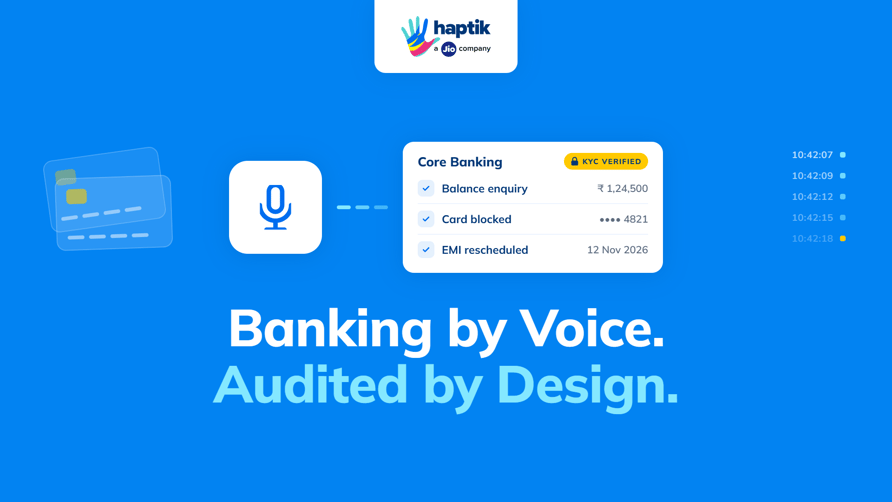
- The new enterprise reality: Voice AI in Banking, Financial Services, and Insurance (BFSI) has evolved from simple FAQ deflection into an execution engine directly connected to Core Banking Systems (CBS).
- The security pivot: Rising deepfake identity threats mean traditional voice biometrics alone are insufficient; voice AI must integrate passive liveness checks, Zero Trust context rules, and multi-factor authentication (MFA).
- Compliance as infrastructure: Regulatory frameworks like India’s Digital Personal Data Protection (DPDP) Act, RBI cybersecurity guidelines, and global mandates enforce strict data localization, board-approved model risk frameworks, and tested kill-switch protocols.
- Deterministic execution: High-stakes financial actions such as card blocking, loan status queries, and payment arrangements require strict Retrieval-Augmented Generation (RAG) grounding and zero-data-retention sub-processors.
For fintech brands, integrating AI into customer conversations is no longer a matter of basic customer service convenience. Voice AI sits squarely within core transactional pathways processing account inquiries, executing payments, and managing credit collections over telephony networks.
However, bringing real-time voice intelligence into banking operations introduces operational constraints. Spoken conversations in financial services carry binding legal, regulatory, and financial obligations.
A single hallucinated fee structure, unverified identity check, or data leak across overseas servers creates immediate regulatory penalties and legal exposure.
Modern BFSI voice deployment requires looking beyond basic conversational fluency to focus on three non-negotiable pillars:
- Defensible security architectures
- Regulatory compliance
- Deep core banking integration
1. The Security Paradox: Countering Deepfakes with Multi-Layered Trust
The rapid proliferation of high-fidelity voice cloning technology has reshaped risk management for call center operations.
Static voice biometrics, historically used by financial institutions as a frictionless identity factor, can no longer serve as a single point of authentication for sensitive accounts.
To combat synthetic audio fraud and unauthorized access, production voice AI architectures in BFSI enforce a multi-layered security model:
Passive liveness detection: Advanced acoustic neural nets analyze incoming audio streams in real time, detecting micro-compression artifacts, phase inconsistencies, and synthetic latency signatures characteristic of cloned voice audio.
Step-up out-of-band verification: For high-risk transactions such as modifying primary account credentials or transferring funds, the voice AI triggers a secondary authentication factor (e.g., a push notification in a mobile banking app or an encrypted OTP) before executing the request.
Zero trust contextual enforcement: The platform treats every incoming voice call as untrusted regardless of network origin. Contextual risk scoring considers device posture, ANI matching, historical calling patterns, and real-time sentiment anomalies before granting access to sensitive data.
2. Regulatory Compliance as Code: Navigating Mandates
Deploying voice AI across regulated financial environments requires translating complex legal frameworks into deterministic software rules.
BFSI compliance engine
| Data localization (tier-3 cloud) | DPDP Act & DPO Annual Impact Assessment | Board-approved model governance framework | Test rollback and kill-switch protocol |
Data localization and sovereignty
Under Reserve Bank of India (RBI) mandates and sector regulations (such as SEBI and IRDAI rules), core customer financial data, payment logs, and transaction records must reside strictly within local data centers.
Voice AI architectures must process and store audio streams, transcripts, and model prompts on locally hosted, Tier-3 or higher sovereign cloud data centers, ensuring zero data egress through foreign sub-processor APIs.
DPDP Act and consent architecture
India's Digital Personal Data Protection (DPDP) Act mandates granular purpose limitation, explicit consent capture, and minimal data retention. Voice AI agents must open interactions with compliance-approved recording disclosures, capture auditable verbal consent, and automatically purge ephemeral conversation buffers once transactions complete.
Model risk management and kill-switches
Regulatory expectations require financial institutions to establish board-approved Model Risk Management Frameworks (MRMF) for production AI systems.
This includes cataloging all underlying models, executing periodic independent validations, and maintaining a validated, technical kill-switch procedure. If a model experiences drift or unexpected behavior, the system must instantly revert to human queues or traditional IVR paths without dropping live call connections.
3. Core Banking System (CBS) Automation
An enterprise voice agent delivers minimal ROI if it merely reads static FAQ answers back to callers. True business value is unlocked when the AI acts as an execution layer connected directly to core systems of record.
High-impact BFSI voice workflows
-
Card management and emergency blocking: Instantly authenticating a caller and executing a real-time card lock on core platforms (e.g., Infosys Finacle, TCS BaNCS) during emergency lost-card reports.
-
Loan status and repayment structuring: Checking real-time loan application states, verifying credit bureau variables, and offering compliant payment arrangement terms during debt recovery conversations.
-
Policy endorsements and claims intake: Guiding insurance policyholders through initial claims registration, collecting structured verbal details, and filing preliminary claims directly into policy administration portals.
To prevent long silences during complex backend database queries, modern architectures deploy speculative filler phrases (e.g., "Checking your account details with the secure system now...") to maintain fluid turn-taking while real-time API integrations complete in the background.
4. Architectural Determinism: Preventing Hallucinations
In retail customer service, a minor conversational error might result in a negative survey score. In financial services, an ungrounded or fabricated statement regarding an interest rate, penalty fee, or insurance coverage term constitutes a direct regulatory violation.
To remove hallucinations in high-stakes environments, financial voice architectures enforce strict structural controls:
-
Strict RAG grounding: The Large Language Model (LLM) is strictly constrained to generate responses from approved, verified internal documentation (RAG).
-
Deterministic middleware guardrails: Hard-coded business logic intercepts every generated text string before it reaches the speech synthesis engine. If a generated string contains unverified numbers, rates, or unauthorized promises, the guardrail aborts the response and routes the call to a specialist.
-
Audit-ready telemetry: Every customer interaction generates a complete, timestamped audit log - recording the raw audio, transcript, prompt context, API payload, and specific RAG source chunk for internal compliance reviews.
How Haptik Powers Enterprise BFSI Voice AI
Haptik builds enterprise-grade conversational AI solutions designed specifically for the security, operational scale, and regulatory demands of financial institutions:
- Sovereign infrastructure and data localization: Built on local data center infrastructure, Haptik provides localized data residency, and complete alignment with DPDP and RBI mandates.
- Pre-built BFSI connectors: Features pre-configured integration modules for major core banking platforms, loan management systems, and CRM databases, enabling sub-second transactional execution.
- Field-tested governance: Trusted across major enterprise deployments in banking, insurance, and housing finance, Haptik’s platform incorporates rigid hallucination controls, automated human transfer triggers, and comprehensive compliance logging.
The Bottom Line
Deploying voice AI in banking, financial services, and insurance is not a text-bot experiment but a mission-critical infrastructure project. To achieve sustainable operational value, financial institutions must select platforms that combine passive anti-spoofing security, audited local data residency, deterministic hallucination guardrails, and deep integration into core systems of record.
FAQs
Modern platforms combine passive acoustic liveness detection with multi-factor authentication, such as out-of-band app push notifications or encrypted OTPs, ensuring secure step-up verification for transactional calls.
Yes, provided the voice platform operates within localized Tier-3 data centers, enforces auditable verbal consent workflows, purges ephemeral session logs, and provides complete zero-data-retention terms across all model execution layers.
The voice AI orchestrator detects the slow response and streams natural, context-aware bridge phrases to the caller, preventing awkward pauses while maintaining conversational turn-taking until the transaction completes.




source on Google