


 Voice AI Agent
It's Monday morning. Your contact center is in a deluge of calls spanning billing disputes to policy renewals, and order status queries. The voice AI agent efficiently handles the volume but somewhere in that queue, customers are stuck in a loop - either they are cycling through menu options, or their query falls outside the scope of what the platform was trained to recognize.
It's a common scenario when enterprises choose a voice AI platform based on a demo.
At Haptik, having deployed voice AI across global enterprises for 3x faster resolution and significant CSAT improvements, we see the teams that got it right were those who came in with the right evaluation framework, not just the right budget.
This guide is that framework.
Explainer: An Enterprise Guide to Voice AI Agents
The Demo Trap: Where Enterprises Go Wrong
Voice AI demos are optimized for controlled conditions - clean audio, standard accents, scripted intents, and a CRM sandbox that behaves nothing like actual customer records.
They are, by design, the best possible version of the platform. What they rarely show is how the system behaves when a customer calls from a noisy environment, speaks in a regional dialect, or needs the platform to pull live data from three backend systems simultaneously to resolve their query.
What demos optimize for:
- Fluency and voice naturalness
- Clean intent recognition on expected queries
- Smooth conversation flow in a controlled environment
What production actually tests:
- Accuracy under real acoustic conditions like background noise, accents, code-switching
- Intent coverage for queries that fall outside the training set
- System performance under concurrent load - what happens at 10,000 simultaneous calls?
- Integration reliability is an indicator of whether the platform can act on a query
-
Handoff logic is about what happens when the AI can't resolve and a human needs to take over cleanly
The enterprises that get voice AI right bring their own test cases, not the vendor's. They stress-test edge intents, not showcase flows. They ask to see the platform fail, and they pay close attention to how it recovers.
ALSO READ: From Sandbox to Production - How to Test Voice AI Agents
At Haptik, the evaluations that lead to the strongest deployments share one consistent trait: the enterprise team came in with hard questions before they ever heard a pitch.
The demo is a starting point. The real evaluation begins the moment you step outside the script.
Rethinking What a Voice AI Platform Should Actually Be
Before evaluating vendors, it's worth pausing to reset the definition.
The term "voice AI platform" is often used loosely. It refers to tools that automate specific interactions or layer intelligence onto legacy systems. But that framing no longer holds in an enterprise CX environment.
A voice AI platform today must function as operational infrastructure which resolves, routes, upsells, and proactively engages customers based on live context.
At Haptik, this is the standard we've built to. Across deployments spanning financial services, telecom, and retail, we've seen what separates platforms that handle conversations from platforms that drive outcomes: it's the depth of the stack beneath the voice layer.
That's why a tightly-integrated architecture spanning voice, chat, and backend orchestration is a structural advantage. It’s also the strength of platforms that combine interaction data with an analytics layer to drive continuous optimization, not just automation.
Build vs Buy: The Question Your Tech Team Will Raise
It will come up. Usually from the tech team, sometimes from procurement, even from a CTO who has seen vendor lock-in to be cautious.
The logic is familiar: “We have engineers, we have infrastructure, why don't we just build it?”
The answer to that is both paths have merit, and both have costs that rarely appear in the initial proposal.
RELATED: Enterprise AI Agents: Should You Buy or Build in 2026?
Building gives you control. Custom architecture, proprietary data, and no dependency on a vendor's roadmap. But it also means absorbing the full weight of ASR tuning, telephony integration, failover logic, and ongoing optimization - typically an 18-to-24-month runway before production-grade performance, plus a dedicated team to maintain it.
Buying gives you speed and depth. Proven infrastructure, pre-built integrations, and a platform that has absorbed the lessons across hundreds of enterprise deployments.
At Haptik, our answer is “Co-build”. Forward-deployed teams embedded in your environment, working alongside your engineers, not handing off a product and walking away. The platform offers the foundation; your team retains visibility, control, and institutional knowledge throughout.
For most enterprises, that's the model capable of bridging the gap between what build would cost versus what buy alone would deliver.
How to Think About Voice AI Platform Costs (Beyond the License Fee)
Pricing is non-negotiable in evaluations. Yet most vendor conversations reduce it to a license fee and a deployment quote. It’s a framing that ignores the costs that typically decide whether a voice AI investment delivers ROI.
There are four cost layers worth understanding.
The license fee
It's the fee that vendors lead with but also the least predictive of total cost. A lower license fee on a platform that requires heavy customization is likely to cost more over 24 months than a higher license on one that deploys cleanly into your existing stack.
Implementation costs
Telephony configuration, CRM integration, conversation design, UAT cycles, and change management across your contact center operations: these are real, variable, and frequently underestimated.
Integration costs
Every backend system your voice AI needs to act on - from ticketing, billing, order management, to policy databases - represents an integration investment. Platforms with shallow native integration capabilities transfer this cost to the engineering team permanently.
Running costs
Voice AI is not a set-and-forget deployment. Accent coverage gaps, intent drift, new product lines, and regulatory changes require continuous refinement. The question isn't just what the platform costs at launch, but what it costs to keep it performing.
The metric that cuts through all of this is cost per resolution. If your voice AI resolves a query end-to-end without human intervention, that interaction has a measurable cost and a measurable value. That ratio, tracked consistently, separates a platform that appears affordable from one that is.
In Haptik deployments, the enterprises that enter pricing conversations with this lens - total cost across implementation, integration, and optimization, measured against resolution outcomes - consistently make better platform decisions than those anchored to the headline number.
The Six-Lens Framework for Enterprise Voice AI Evaluation
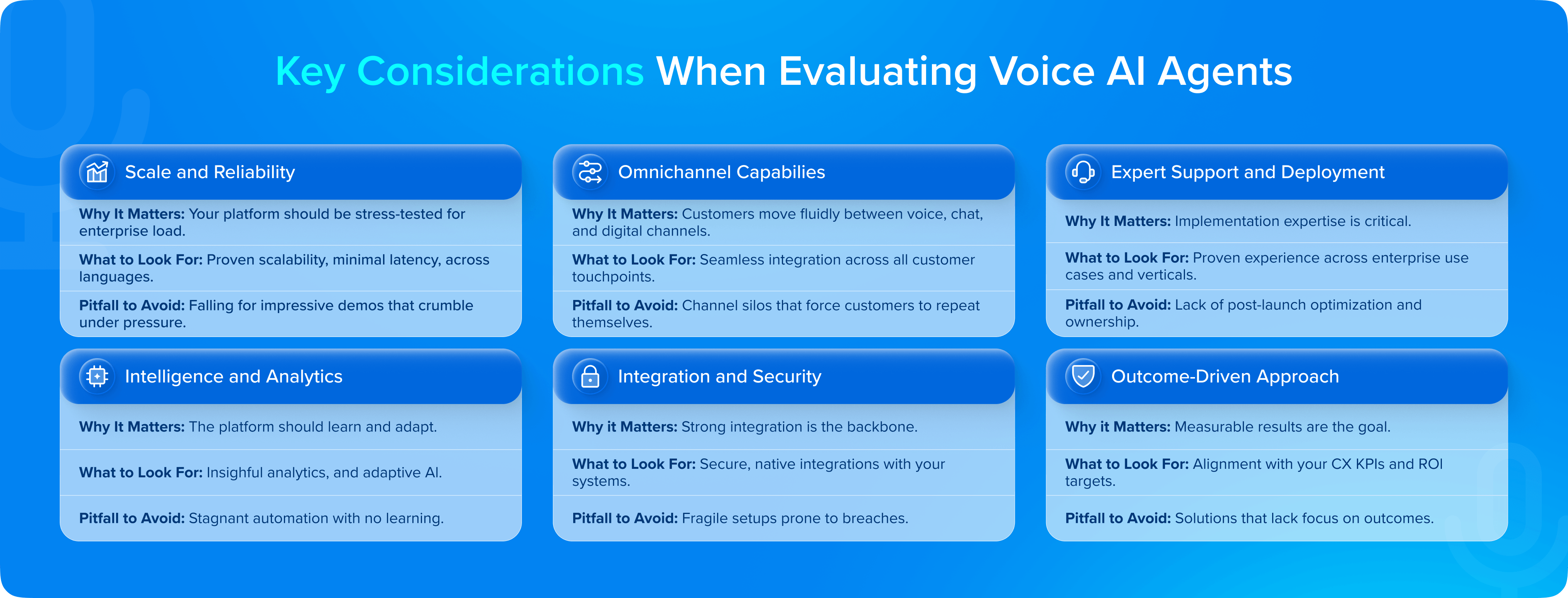
To cut through the noise, focus on six evaluation lenses that actually determine long-term success.
1. Scalability
Platforms perform well in controlled environments, but few are tested under enterprise pressure.
At scale, latency creeps in, accuracy drops across accents, and concurrency is a bottleneck. What looks seamless in a demo with ten concurrent calls rarely holds at ten thousand.
What to look for:
- Proven performance across high concurrent call volumes
- Consistency across languages and dialects
- Infrastructure that holds up during spikes (campaigns, outages, seasonal surges)
What this really means: You're testing reliability under stress, not conversational polish.
With Haptik's enterprise deployments, the scalability test is where platforms first reveal their limits, and where architecture decisions made at the platform level either pay off or compound into operational firefighting.
2. Omnichannel
Customers don't think in channels. They think in journeys.
A user might start on voice, move to WhatsApp, and expect the conversation to carry forward. If systems don't preserve context across that transition, every handoff is a fresh source of friction.
What to look for:
- Native omnichannel capabilities, not integrations bolted on later
- Persistent context across interactions
- Unified journey orchestration
The difference here is voice as a channel versus voice as part of a connected CX system.
What we consistently see at Haptik is that enterprises who treat omnichannel as a foundation retain greater customer trust in high-stakes moments.
3. Intelligence
Early automation was rule-based. Modern voice AI should be adaptive.
If the platform isn't learning from interactions, optimizing flows, and surfacing insights over time, it's already falling behind.
What to look for:
- Feedback loops that improve performance over time
- Built-in analytics tied to business impact
- Context-aware conversations that go beyond keyword matching
Across Haptik's deployments, enterprises leveraging adaptive intelligence have seen repetitive query volume drop by 60% - which is not through more scripting, but through systems that learn what customers actually ask and continuously close the gaps.
4. Integration depth
Voice AI is only as powerful as what it can act on.
Answering a query is easy. Resolving it requires pulling live data from your CRM, triggering workflows in your ticketing system, and responding with context existing in the systems of record. Without that depth, voice AI remains a front-end layer that’s impressive in demo but constrained in production.
What to look for:
- Native integrations with CRM, ticketing, and backend systems
- Real-time data exchange
- Flexibility to support custom enterprise workflows
Haptik connects natively with 100+ OOTB integrations, enabling real-time resolution. The difference is whether your voice AI acts on a query and doesn’t just acknowledge it.
5. Execution capability
Even the best platform fails without the right implementation.
Enterprise deployments require alignment across teams, workflows, and KPIs. The technical setup is rarely where value is lost; it's in the gap between configuration and what the business actually needed.
The question to bring into any vendor conversation is: “What does your team do after go-live, and who owns performance when the numbers aren't moving?"
At Haptik, this is where the forward-deployed model was built from, as a response to a pattern we kept seeing. Our forward-deployed teams work inside your environment aligned to your KPIs. With over 12+ years of enterprise deployment experience across BFSI, telecom, retail, and e-commerce, the implementation knowledge comes pre-loaded.
Our teams don't hand off and monitor from a distance. They sit inside the deployment, working the same KPIs the enterprise is accountable to, until the numbers move, with an average time from deployment to measurable impact of approximately 6 weeks, well below what enterprises typically experience with implementation models built around hand-offs.
The gap between buying a voice AI platform and realizing its value is an execution problem. Evaluate vendors accordingly.
6. Outcome alignment
If your platform isn't aligned to metrics like containment, CSAT, conversion, or cost efficiency, it's solving the wrong problem.
Deployment isn’t the milestone. Impact is.
What to look for:
- Clear link to business KPIs from day one
- Continuous optimization post go-live
- Accountability that extends beyond launch
The enterprises that define success metrics before signing a contract are the ones who hit them. Outcome alignment is a design principle that shapes every decision from architecture to conversation flow.
READ: Beyond Accuracy: The 7 Metrics That Actually Define Voice AI Performance
Five Pressure Tests Before You Sign
The demo is over. The proposal looks good. Before you sign, run these five tests yourself.
1. The edge intent test
Pull your top 20 unresolved or escalated queries from the last 90 days - the ones your current system struggles with most. Feed them into the platform. If it handles your showcase intents cleanly but stumbles on your real-world edge cases, you're evaluating a demo, not a deployment.
2. The accent and noise test
Record real customer calls from your busiest queues involving background noise, regional accents, code-switching included. Run them through the platform unedited. Accuracy on clean, studio-quality speech is table stakes. Accuracy on your actual customers is the number that matters.
3. The concurrent load test
Ask for a live environment and spike the call volume to your peak campaign launch, outage, or open enrolment. Observe what happens to latency and accuracy as concurrency climbs. Platforms that degrade gracefully are built for enterprise. Platforms that drop calls are built for pilots.
4. The integration depth test
Pick your most complex live query that requires pulling data from at least two backend systems to resolve. Run it end-to-end. If the platform acknowledges the query but can't action it without a human handoff, the integration is shallow. Real resolution needs real system access.
5. The post-go-live test
Ask the vendor to walk you through what happens six weeks after deployment when containment is flat, and results aren't moving. Who owns the problem? What does the escalation path look like? Who is in the room? A vendor who answers this confidently has done it before. One who pivots to feature roadmaps hasn't.
Where Haptik Fits In?
The five pressure tests are deliberately vendor-agnostic. But it's worth walking through what a vendor that passes all five looks like in practice because the standard they describe is one Haptik is built to meet.
Built for edge cases
Haptik's onboarding process begins with your real query data. Before a single line of conversation design is written, we map your highest-volume and most complex unresolved queries. The platform is built around your edge cases from day one, not retrofitted to handle them after go-live.
Trained on how your customers speak
Haptik's voice infrastructure is trained across Indian languages, dialects, and the code-switching patterns that most enterprise platforms treat as exceptions. In markets where a customer switches mid-sentence from Hindi to English, that isn't an edge case but the default. Our models are built accordingly.
Architected for volume
Haptik's infrastructure is designed for the load spikes that enterprise CX environments generate without warning. Performance data from live deployments is available on request, at the call volumes that matter to your business.
Integrated to resolve
Haptik's ecosystem of 100+ connectors and out-of-the-box integrations spans CRM platforms, messaging channels, live chat, and payment gateways - enabling real-time data exchange that turns a voice interaction into a resolved transaction, not a logged ticket for someone else to action
Accountable beyond the contract
Most vendors measure success at go-live. Haptik's forward-deployed teams measure it against the same business KPIs like containment, resolution time, and cost per call, long after the implementation milestone has passed.
The Takeaway: Five Checks Before You Decide
When evaluating a Voice AI platform, complexity can quickly cloud judgment. This is where a simple mental model helps cut through the noise.
Use these checks to pressure-test what you’re seeing:
-
If it works well in demos, question its scale
Demos show ideal conditions. Enterprise CX runs on unpredictability and volume. -
If it handles voice alone, check for depth
Voice without omnichannel continuity creates more silos, not better journeys. - If it automates without learning, question longevity
Static systems degrade as customer expectations evolve. - If it integrates lightly, test its impact
Without deep system access, conversations don’t translate into real resolution. - If it deploys fast but doesn’t optimize, question its ROI
Speed to launch means little without sustained performance and measurable outcomes.
FAQs
See Haptik's Voice AI in action. Book a walkthrough with our team.


source on Google