


 Voice AI Agent
A salaried professional notices an unfamiliar debit on his account. He opens his bank's app, finds the helpline number, and calls.
What greets him matters more than most product teams realize.
If he hears a clunky IVR that asks him to "press 1 for English," puts him on hold for six minutes, and then connects to an agent who asks him to repeat everything he just entered - he hangs up. He screenshots the transaction, posts about it, and somewhere in the back of his mind, a question rises: “Do I actually trust this bank?”
Now run that scenario across 300,000 calls a month. Across retail banking, lending, insurance, and collections. Across customers calling in Hindi, Tamil, Marathi, and Bengali - often mid-sentence switching between two. Across interactions where a wrong word is a compliance incident.
This is the reality BFSI customer experience teams manage every day. It is precisely why voice - the channel customers reach for when something feels urgent or uncertain - is both the hardest problem and the highest-value opportunity in financial services CX.
READ: Voice AI for Contact Centers: The Enterprise Guide to Resolution at Scale
Why BFSI Is the Hardest and Highest-Value Voice AI Vertical
Volume + complexity + compliance: The BFSI Triple Constraint
No other industry asks a voice channel to do more. A mid-sized private bank might handle 500k+ inbound calls a month. Each of those calls could involve real-time data lookups, customer authentication, regulatory scripting, and an emotionally sensitive conversation simultaneously. Scaling that without sacrificing quality or control is the BFSI Triple Constraint, and it is precisely why voice AI built for generic call centers routinely fails here.
The cost of a poor voice experience in financial services
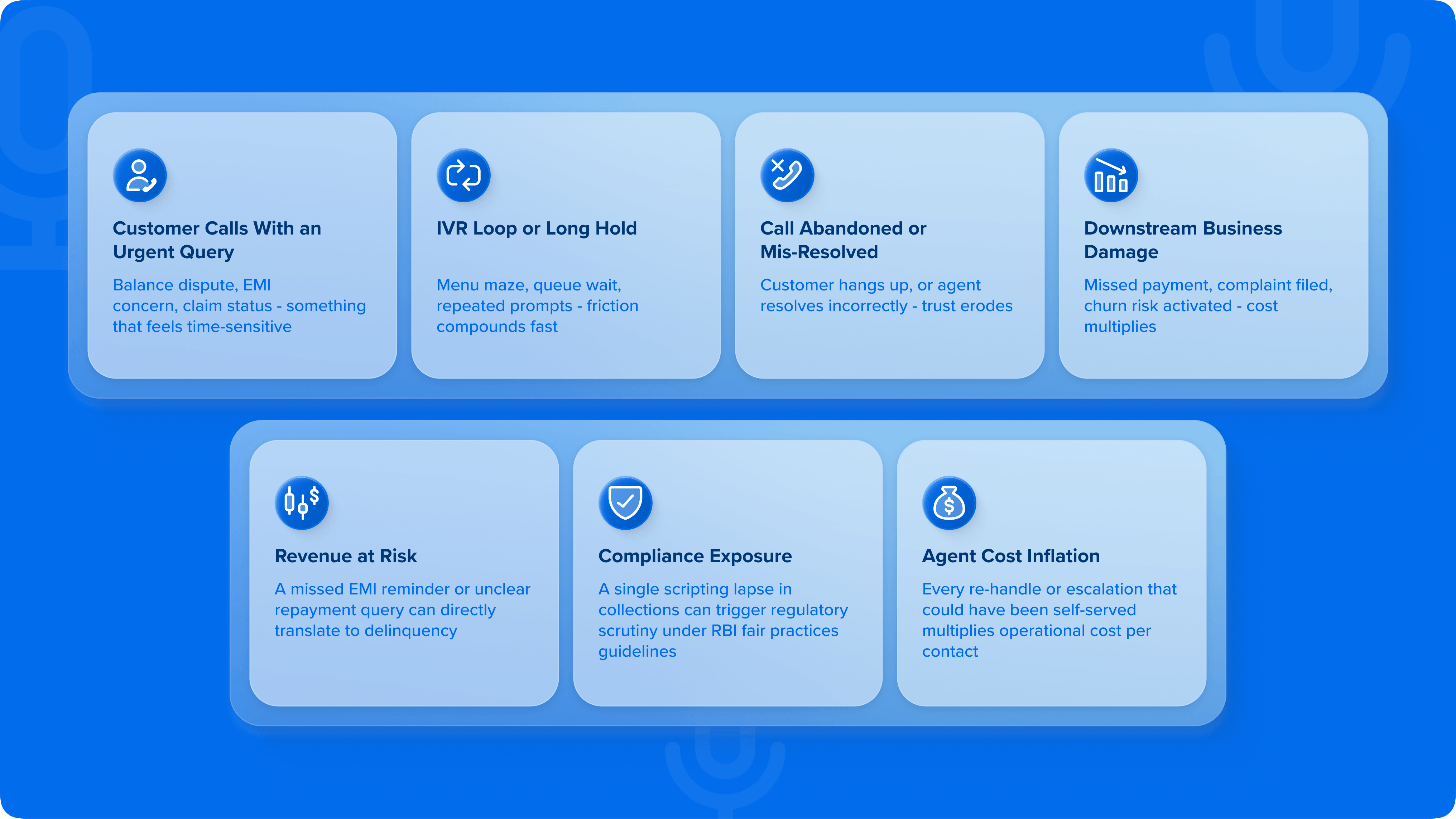
Friction isn't just frustrating in BFSI, it's expensive. A customer unable to get a clear EMI update might miss a payment. A claim inquiry gone cold transfers to a complaint. And a single compliance lapse in a collections call can trigger regulatory scrutiny. The numbers tell a sharp story.
RBI guidelines, DPDP Act, compliance pressure
The Digital Personal Data Protection Act, 2023, came into effect in phases through 2025, fundamentally reframing how financial institutions handle voice data.
Combined with tightened RBI circulars on fair practices in collections and updated IRDAI guidelines on outbound insurance communications, BFSI teams are no longer asking if their voice channel is compliant - they're being audited on it. Voice AI deployments that weren't built with compliance-first architecture are either being retrofitted or replaced.
Core Voice AI Use Cases Across the BFSI Value Chain
Retail banking: Account services, balance queries, KYC reminders
The highest-volume, lowest-complexity tier is also the biggest opportunity for deflection. Balance inquiries, mini-statement requests, card block/unblock, and KYC document reminders are fully containable via voice AI when integrated with core banking APIs. The result is agents preserved for the calls that actually require them.
RELATED: Top Use Cases of Voice AI in Customer Support
Lending: Loan status, EMI reminders, prepayment queries, disbursement
Loan customers are often anxious customers.
Voice AI here needs to be both informative and reassuring - surfacing loan outstanding amounts, upcoming EMI dates, and prepayment penalties without sending customers on a menu maze. Proactive outbound EMI reminders, when timed and toned correctly, have a measurable impact on delinquency rates.
Insurance: Policy inquiry, renewal reminders, claim status, premium confirmation
Insurance is where omission kills trust.
A Voice AI agent handling claim status queries must have real-time access to claims data and be trained to handle the emotional register of someone mid-crisis. Renewal reminders are a proactive revenue use case - well-executed outbound calls with clear value communication outperform messaging by a wide margin in conversion.
Collections: Empathetic, compliant outbound voice AI for soft and hard buckets
Voice AI delivers the most financially significant ROI in collections and carries the most regulatory exposure.
Soft-bucket calls (days past due of 1-30) benefit enormously from consistent, empathetic automated outreach that respects call timing, DND rules, and RBI fair practices.
Hard-bucket interactions require tighter human escalation paths and near-zero tolerance for scripting errors.
Wealth management: RM appointment scheduling, portfolio query routing
For HNI and mass-affluent segments, the role of voice AI is more orchestral than operational - routing intelligently to the right Relationship Manager (RM), scheduling callbacks, and capturing portfolio query context before the human agent picks up. The experience lift here is subtle but loyalty-defining.
Why BFSI customers default to their mother tongue under financial stress
Cognitive load research consistently shows that people revert to their first language when anxious or confused.
In BFSI, this means a customer who manages their professional life entirely in English will switch to Tamil, Marathi, or Bengali the moment they're trying to understand a foreclosure notice. Voice AI that handles only English is not enterprise-ready for India. Multilingual capability with natural code-switching is table stakes, not a feature.
ALSO READ: Voice AI Agents for Indian Languages: What Enterprise-Grade Really Means in 2026
Compliance Is Not Optional: What BFSI Voice AI Must Handle
DND registry compliance and call timing rules
Every outbound call must be scrubbed against TRAI's DND registry in real time. Call timing windows - no outbound calls before 9 AM or after 9 PM - must be enforced at the system level, not through manual process. Voice AI platforms that rely on upstream teams to manage these lists introduce avoidable compliance risk.
Consent recording and audit trails
Under the DPDP Act, the ability to demonstrate that consent was obtained - and when, and in what form - is not optional. Every Voice AI interaction must generate a tamper-evident audit log. For collections specifically, call recordings must be retained per RBI guidelines and surfaceable on regulatory demand.
Data residency and encryption in-transit and at-rest
Financial voice data is among the most sensitive categories under India's data governance framework.
Deployments must enforce data residency within RBI-approved jurisdictions, TLS encryption in transit, and AES-256 or equivalent at rest. Any vendor unable to provide independent certification of these controls should not be in a BFSI Voice AI shortlist.
PCI DSS compliance for payment-related voice interactions
Any voice flow that touches card numbers, account details, or payment authorization falls under PCI DSS scope.
This requires DTMF masking for card entry, no-storage policies for in-call payment data, and regular third-party audits. Voice AI platforms need to be PCI DSS Level 1 certified or architected to keep payment flows entirely out of scope through tokenization.
The Human-AI Collaboration Model That Works in BFSI
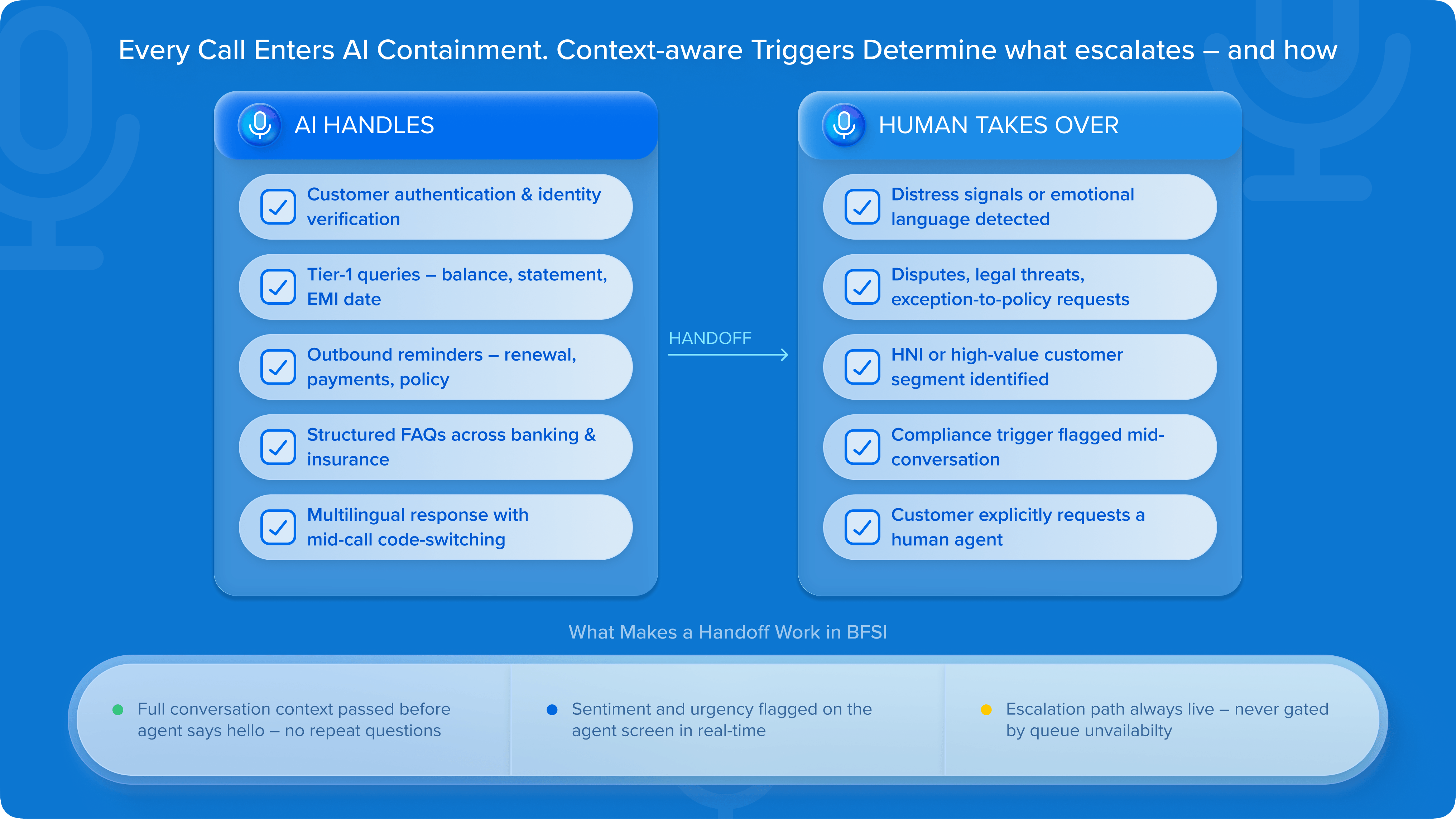
When to contain, when to escalate, and how to do it gracefully
The failure mode of most voice AI deployments is that they escalate clumsily. A customer who has just described a financial hardship to a voice agent and is then placed on hold for four minutes without their context being forwarded will not feel served.
Graceful escalation requires real-time intent detection, structured context packaging, and agent-side display of the full conversation before the human says "hello."
ALSO READ: What Is Human in the Loop AI? A Primer for Enterprise Leaders
Warm handoff protocols for high-value or distressed customers
For wealth management customers or anyone showing emotional distress signals, the handoff should feel invisible.
The agent picks up with the customer's name, their issue, and the sentiment context surfaced on their screen. In BFSI, it is the difference between retaining a customer and losing them to a competitor at a vulnerable moment.
Agent assist mode: Supporting human agents on complex calls
Agent Assist is Voice AI's highest-leverage application for complex BFSI calls.
As a human agent speaks with a customer, the AI listens in real time, surfaces relevant policy wording, flags compliance risks in the conversation, and suggests next best actions. Average Handle Time drops. First-call resolution rises. And agents - especially newer ones - perform at a level that previously required years of institutional knowledge.
Measuring Voice AI Success in BFSI
Right party contact rate for collections
RPC rate - reaching the actual borrower rather than a voicemail, wrong number, or family member - is the primary efficiency metric for collections Voice AI.
Smart dialling logic, time-zone-aware scheduling, and multi-attempt sequencing can push RPC rates from the low-40s to the mid-70s, materially changing recovery economics.
Self-service resolution rate for Tier-1 banking queries
A well-deployed retail banking voice AI should resolve 80-90% of balance, statement, and card-related queries without human intervention within 12 months of go-live. Anything below 70% signals integration gaps or NLU model issues requiring intervention.
Compliance incident rate
This is not a stretch goal but a design requirement. A BFSI Voice AI deployment that cannot guarantee DND compliance, call timing enforcement, and scripted disclosure delivery at scale is not production-ready. The metric exists to make visible what should never happen.
NPS Impact from proactive outbound touchpoints
Counterintuitively, well-designed outbound Voice AI improves NPS. Customers who receive a timely reminder about an EMI, a clear update on a pending claim, or a renewal heads-up before lapse report higher satisfaction than those reached by agent-driven outbound. The bar is personalization and timing, not silence.
How Haptik Approaches BFSI Voice AI
Haptik's BFSI practice isn't an afterthought. It's been built through more than a decade of enterprise CX deployments across banking, insurance, and lending at some of India's largest financial institutions.
Where most Voice AI vendors hand over a platform and a playbook, Haptik embeds compliance architects and BFSI CX specialists directly into the deployment.
Integration with core banking systems is treated as a first-class engineering problem. The result is a voice channel that goes from pilot to production without exposing clients to regulatory or reputational risk.
The Bottom Line
BFSI is not a vertical where Voice AI can be deployed generically and expected to perform. The compliance surface is too large, the customer stakes too high, and the language complexity too real.
The institutions that will win on voice in 2026 are those that stopped treating it as a cost-reduction exercise and started treating it as a precision compliance and customer trust instrument.
The good news: the technology is ready. The regulatory framework is clearer than it has ever been. What separates deployments that scale from those that stall is the depth of domain knowledge and compliance architecture baked in from day one, not retrofitted after the first audit finding.




source on Google