


 Voice AI Agent
 How to Measure Voice AI ROI: The Framework Every Enterprise CX Leader Needs
 Add as a preferred
 source on Google
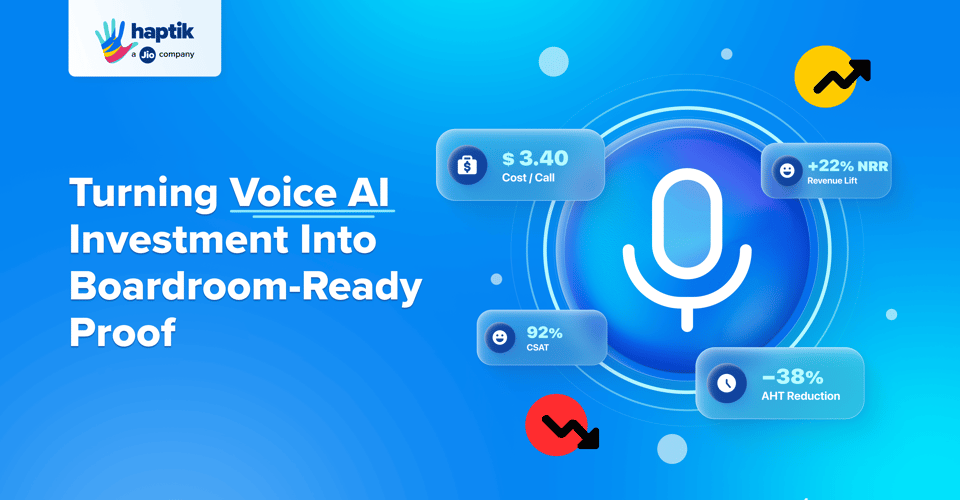
Voice AI agents are an operational reality for enterprise contact centers - and it’s a measurable investment. A deployment that goes live this quarter should be producing trackable, reportable outcomes within 60 days.
Yet the most common reason enterprise voice AI projects stall - beyond IT procurement delays and vendor selection cycles - is the absence of a clear, defensible ROI framework at the outset. CX leaders secure approvals based on projected savings. Finance signs off on the business case. But when the time comes to report outcomes, the metrics don't line up with the promises made in slide decks.
The problem is the measurement model.
This blog provides what's missing: a structured, metric-level framework for measuring voice AI ROI across cost, quality, and revenue dimensions - built for CX leaders who need to justify investment to a CFO, and for digital transformation heads who need outcomes, not architecture diagrams.
Why Voice AI ROI Is Often Measured Wrong
Most enterprise voice AI programs inherit their measurement frameworks from traditional IVR or chatbot pilots - and that's the first mistake. Voice AI operates differently, resolves differently, and impacts revenue differently. Measuring it the same way produces misleading numbers and erodes leadership confidence.
ALSO READ: Voice AI for Contact Centers: The Enterprise Guide to Resolution at Scale
The deflection trap: Why containment rate alone is not ROI
Containment rate is the most frequently cited voice AI metric. It is also the most frequently misread. Deflecting a call that wasn't resolved is a deferral. An AI agent that contains 70% of calls but leaves customers re-calling, escalating, or churning has simply delayed the cost.
The distinction enterprise leaders need to internalize is this:
- Activity metrics (calls deflected, sessions handled) tell you what the AI did
- Outcome metrics (FCR, CSAT, repeat contact rate) tell you whether it worked
- ROI lives in the outcome column, not the activity column
Haptik's deployment approach is built around this principle - containment rate is tracked, but it's never the headline metric in a client review.
The baseline problem: Why pre-deployment measurement determines everything
ROI is always a delta - a before and after. Without a documented baseline of current cost-per-call, AHT by call type, FCR rate, and CSAT scores, there's no denominator for the ROI equation. Enterprises that skip baseline measurement before go-live find themselves unable to prove value even when it's clearly being delivered.
ALSO READ: Why Voice Is the Primary CX Channel
Haptik's pre-deployment consulting engagement begins with a structured baseline audit. This involves capturing the top 10-15 call driver volumes, existing escalation rates by category, and current BPO costs - before a single line of AI is deployed.
That data becomes the benchmark against which every post-live KPI is measured.
The attribution gap: Call drivers that are partly AI, partly human
Not all contact center value is generated by fully contained AI calls. A significant portion of ROI in hybrid deployments comes from AI-assisted calls - where the voice agent handles authentication, intent identification, and data capture before transferring to a live agent, reducing that agent's AHT by 40-60 seconds per call.
The attribution gap emerges when enterprises measure only fully AI-resolved interactions and ignore the efficiency lift on human-handled calls. A rigorous ROI framework accounts for both - and the sum of those two numbers is typically 30-40% larger than containment alone would suggest.
The Three Dimensions of Voice AI ROI
Voice AI ROI doesn't collapse into a single number. It distributes across three dimensions - cost, quality, and revenue - each with its own measurement cadence and stakeholder audience. Below is the infographic text for your design team, followed by the narrative detail.
| DIMENSION 1 Cost Reduction | DIMENSION 2 Quality & Experience | DIMENSION 3 Revenue Impact |
|---|---|---|
| Cost-per-call reduction | First Call Resolution (FCR) rate | Renewal conversion lift |
| AHT reduction | CSAT lift | Upsell/cross-sell from AI-assisted inbound |
| Agent headcount efficiency | NPS impact | Lead qualification speed |
| Overtime & BPO cost avoidance | Repeat contact rate reduction | Revenue attributed to AI-resolved calls |
Dimension 1 - Cost reduction
This is the ROI dimension that CFOs engage with first. The primary levers are cost-per-call reduction (AI calls cost a fraction of human-handled calls), AHT reduction on human-assisted interactions, agent headcount efficiency (handling higher volume without proportional headcount growth), and avoidance of overtime and BPO surge costs.
RELATED: Voice Agents for BFSI: High-Compliance Conversations at Enterprise Scale
Haptik clients in the BFSI and telecom verticals consistently report cost-per-call reductions of 40-60% on AI-eligible call types within the first 90 days of full deployment. The key phrase is 'AI-eligible' - not every call driver is a candidate for containment, and a credible ROI model segments call types before projecting savings.
Dimension 2 - Quality and experience improvement
FCR rate is the quality anchor metric for voice AI. A deployment that improves FCR - because the AI resolves the call correctly and completely the first time - simultaneously reduces repeat contact rate, reduces agent handle volume for the same issue, and improves CSAT.
NPS is a lagging indicator but a powerful one for board-level reporting.
Enterprises that deploy Haptik's voice AI have seen NPS lifts of 8-15 points in programs where the AI interaction is measured separately from human interactions - allowing a direct quality comparison.
Dimension 3 - Revenue impact
Revenue attribution from voice AI is underreported because it's harder to measure. But it's real. Inbound AI agents can identify renewal-eligible customers, surface upsell prompts based on CRM data, and hand off to agents with a warm context summary that increases conversion.
ALSO READ: Enterprise Voice Agents: How Inbound and Outbound Calling Works
Outbound AI agents can run payment reminders or lead nurturing campaigns at scale, with conversion rates that outperform traditional dialer-based approaches.
Haptik's voice AI is integrated with CRM and billing systems in most enterprise deployments, enabling closed-loop revenue attribution - tracking the exact call leg, agent note, and downstream transaction that followed an AI-initiated touchpoint.
The Core Voice AI KPIs: A Metric Glossary for CX Leaders
Below is the definitive reference set for enterprise voice AI measurement. Each KPI is defined, contextualised, and paired with a performance benchmark. This table is the infographic source copy for your design team.
| KPI / Metric | Definition | Enterprise Benchmark |
|---|---|---|
| Containment Rate | % of calls fully resolved by AI without human escalation | Target: 60-75% for mature deployments |
| First Call Resolution (FCR) | % of calls resolved on the first contact, regardless of channel | Best-in-class: 85%+; AI-handled calls should match or exceed human benchmark |
| Average Handle Time (AHT) | Total time from call start to disposition (AI vs. human) | AI AHT should be 30-50% lower than human baseline for eligible call types |
| Escalation Rate | % of AI-handled calls handed off to a live agent | Decreasing trend month-over-month signals improving AI capability |
| Customer Effort Score (CES) | Survey-based measure of how easy it was to resolve an issue via voice | Lower CES = less friction; track AI vs. human channel split |
| Right Party Contact (RPC) Rate | % of outbound calls that reach the intended decision-maker | Industry range: 15-35%; AI can improve targeting and timing |
| Outbound Conversion Rate | % of outbound AI-initiated calls resulting in a desired outcome (payment, booking, renewal) | Baseline from current agent campaigns; AI target: 10-20% lift |
Containment rate
The percentage of voice AI interactions that are fully resolved without human escalation. A high containment rate is valuable only when paired with a high FCR rate. Containment without resolution is deflection - and deflection inflates cost in the medium term through repeat contacts.
First Call Resolution (FCR) rate
The percentage of calls resolved completely on the first contact. For voice AI, FCR is measured by tracking whether the same caller (identified by phone number or account ID) contacts the brand again within 72 hours for the same issue category. A declining repeat contact rate is the clearest proof of FCR improvement.
Average Handle Time (AHT) - AI vs human benchmark
AHT is measured separately for AI-handled and human-handled calls. For AI interactions, AHT should trend downward month-over-month as the model improves.
For human-handled calls that followed an AI-assisted leg, AHT should be 30-50 seconds lower than calls with no AI involvement - because authentication and intent capture have already been completed.
Escalation rate and what it signals
The percentage of AI-handled interactions that are escalated to a human agent. A declining escalation rate signals expanding AI competency.
A spiking escalation rate is an early warning signal for intent gaps (calls the AI isn't trained to handle) or policy gaps (calls the AI is trained to handle but isn't empowered to resolve). Haptik's analytics layer surfaces escalation rate by intent category, making root cause identification a two-click operation.
Customer Effort Score (CES) for voice interactions
CES measures how easy it was for the customer to resolve their issue. For voice AI, CES captures friction at a channel level - was the AI interaction faster and clearer than a human interaction would have been?
Enterprises that deploy CES as a post-call metric alongside CSAT gain a nuanced view of AI interaction quality that net-satisfaction scores alone can't provide.
Right Party Contact rate (outbound)
For outbound voice AI - payment reminders, renewal campaigns, lead qualification - RPC rate measures the percentage of calls that reach the intended decision-maker. AI-driven outbound deployments improve RPC by optimizing call timing, number sequencing, and attempt cadence using historical contact data.
Outbound Conversion rate by campaign type
Conversion rate is the revenue metric for outbound voice AI. It should be tracked by campaign type (collections, renewals, lead qualification), by time of day, and by customer segment. Haptik's outbound deployments include campaign-level conversion tracking that maps AI call legs to downstream CRM outcomes - giving revenue teams full visibility into which AI campaign configurations drive the best results.
Building the Business Case: The ROI Calculation Model
A voice AI business case that survives CFO scrutiny is built on five structured steps. Each step produces a number, and the sum of those numbers is the ROI projection. Here is the model, step by step.
Step 1: Baseline your current contact center cost structure
Pull the following data points for the last 12 months:
- Total contact center operating cost (including BPO and agent salaries)
- Average cost per call by channel (inbound, outbound, chat)
- Total call volume by month, AHT by top-10 call driver
- Current FCR and CSAT scores
If you can't pull these numbers, the baseline audit is itself the first project deliverable.
Step 2: Map your top call drivers to AI containment potential
Not every call type is AI-eligible. A call requiring empathy, complex negotiation, or regulatory verification typically isn't. But account balance inquiries, appointment rescheduling, payment status checks, and FAQ-type queries usually are.
Map your top 10-15 call drivers against an AI-eligibility rubric and assign a containment probability (high, medium, low) to each. This gives you the AI-addressable volume.
Step 3: Project Cost-Per-Call delta (human vs. AI)
The average cost of a human-handled call in enterprise contact centers ranges from $4 to $12 depending on complexity and channel. The cost of an AI-resolved call - inclusive of platform and integration costs amortized over volume - typically lands between $0.40 and $1.20. Multiply the projected AI-addressable call volume by the cost delta to get your annual cost avoidance figure.
Step 4: Model revenue impact scenarios
For inbound: model the upsell and renewal conversion lift from AI-assisted agent handoffs. For outbound: model the incremental conversion from AI-driven campaign volume that would be cost-prohibitive to run with human agents.
Use conservative, base, and optimistic scenarios - and present all three to your CFO. Single-point estimates rarely survive scrutiny; scenario ranges demonstrate analytical rigor.
Step 5: Factor in deployment, integration, and ongoing costs
A credible ROI model includes full deployment cost - platform licensing, integration with IVR, CRM and telephony stack, quality assurance during training, and post-go-live optimization.
Haptik's enterprise contracts include outcome-based SLAs, which means deployment and post-live performance costs are predictable and tied to delivered results - not open-ended consulting retainers.
What Good ROI Benchmarks Look Like in Practice
Enterprise voice AI ROI varies by deployment scale, call driver mix, and vertical. The ranges below are drawn from production deployments, not proof-of-concept pilots. They represent what organizations with mature deployments - 12+ months post go-live - typically report.
Typical first-year cost savings range by industry
BFSI (Banking, Financial Services, Insurance): 35-55% reduction in cost-per-call on high-volume inbound query types (balance, EMI status, claim status).
Telecom: 40-60% reduction on billing, plan change, and technical support queries.
Retail and eCommerce: 30-45% reduction on order status, return processing, and delivery inquiry calls.
Healthcare: 25-40% reduction on appointment scheduling, prescription refill status, and insurance eligibility queries.
These ranges assume deployments handling a minimum of 50,000 calls per month on AI-eligible intents. Below that threshold, ROI is still positive but the payback period extends beyond 12 months.
CSAT and NPS improvements seen in enterprise deployments
CSAT improvements of 8-18 percentage points are reported in deployments where the AI interaction is faster and more consistent than the previous IVR or human-handled experience. NPS lifts of 6-15 points are reported in programs with 12+ months of AI maturity, where the model has been retrained on local data patterns and regional language variations.
RELATED: Voice AI for Indian Languages: What Enterprise-Grade Really Means
Payback period: what to expect at different deployment scales
- Small-scale deployments (under 30,000 calls/month AI-handled): 18-24 month payback period.
- Mid-scale deployments (30,000-100,000 calls/month AI-handled): 9-14 month payback period.
- Large-scale deployments (100,000+ calls/month AI-handled): 4-8 month payback period.
The scale dependency is significant - voice AI economics are volume-driven. A pilot covering 5% of call volume will not produce the unit economics of a full-channel deployment.
This is why Haptik's business case methodology begins with a call driver mapping exercise: to identify which intents have enough volume to justify prioritized deployment and fast ROI.
The Haptik Advantage: Outcome-SLA Deployments with Built-In ROI Tracking
Haptik was built as an enterprise product from day one - not a startup tool scaled up. The result is a platform and a team that's designed around measurable outcomes, not feature demonstrations.
Haptik's analytics layer: Real-time visibility into every KPI
Haptik's reporting dashboard surfaces every KPI in real-time, at the intent level. CX leaders can see containment rate, FCR, escalation rate, and conversion rate broken down by call driver, campaign, language, and time period.
This is the reporting layer that makes CFO conversations possible because it puts defensible numbers in the hands of CX leaders without a data science team to compile them.
Forward-deployed teams that own post-go-live performance
One consistent finding from enterprise voice AI post-mortems is that deployments stall when the vendor treats go-live as the end of the engagement.
Haptik's model is the opposite.
Forward-deployed customer success teams are assigned to each enterprise account with explicit post-go-live KPI ownership. They retrain intents, reconfigure escalation logic, and run A/B tests on conversation design.
This is what makes Haptik's outcome SLAs credible. The team that wrote the SLA is the team responsible for delivering it.
Consulting DNA
Haptik's pre-sales engagement includes a structured business case workshop that outputs a deployment roadmap ranked by ROI potential, a call driver segmentation by AI eligibility, and a baseline-to-target KPI model that becomes the performance contract for the engagement.
Enterprise companies that come to Haptik having done internal evaluations often find that the business case workshop reorders their deployment priorities entirely - because intent-level call volume data reveals which use cases will generate ROI fastest, and that ranking rarely matches the initial assumptions.
FAQs
A: First Call Resolution rate - it captures both containment (AI resolved the call) and quality (the customer didn't call back). Cost-per-call is a close second for CFO reporting.
A: Most enterprises see meaningful cost reduction within 60-90 days of go-live for high-volume use cases. Revenue impact metrics typically show results in 90-120 days.
At minimum: Hindi, Tamil, Telugu, Kannada, Bengali, and Marathi - aligned to policyholder geography. Haptik supports 10A: Post-call CSAT surveys, repeat contact rate, and escalation rate comparison between AI-handled and human-handled calls provide a quality-adjusted view of AI performance.
+ Indian languages with dialect sensitivity, enabling accurate, natural-sounding interactions across regional policyholder bases.
A: Current cost-per-call, AHT by call type, FCR rate, top 10-15 call driver volumes, existing CSAT and NPS scores, and current escalation rates by category.
A: Lead with cost-per-call reduction, add FCR improvement, and model the payback period. Avoid jargon-heavy technology narratives - the CFO wants numbers, not architecture diagrams.

source on Google