


 Voice AI Agent
It is 9:30 PM on a Tuesday. A prospect has filled out an inquiry form for a 3BHK in Pune. She has been browsing listings for three months. Tonight, something clicked - the floor plan, the price point, the location - and she finally made a move.
The next morning, when the sales team arrives at the office, checks the CRM, and assigns the lead to a rep, she has already toured a competing property and is in active conversation with their sales executive.
It is the default outcome in real estate sales where the average lead response time is 15 hours and the conversion window closes in minutes. The developer did not lose that lead for lack of budget, product quality, or pricing. They lost it because no one called.
Voice AI changes this equation entirely, by ensuring that every lead is contacted within minutes, every hour of every day - and that the site visit booking journey runs end-to-end without a human having to pick up the phone first. In a market where speed-to-lead and show-up rates decide revenue, voice AI is the infrastructure.
ALSO READ: Voice AI for Contact Centers: The Enterprise Guide to Resolution at Scale
Why Real Estate Is Voice AI's Highest-ROI Deployment
Real estate sales combine high transaction value, long decision cycles, and a critical dependency on human conversation - making it one of the strongest fits for voice AI. Three structural problems make the ROI case.
The speed-to-lead problem in property sales
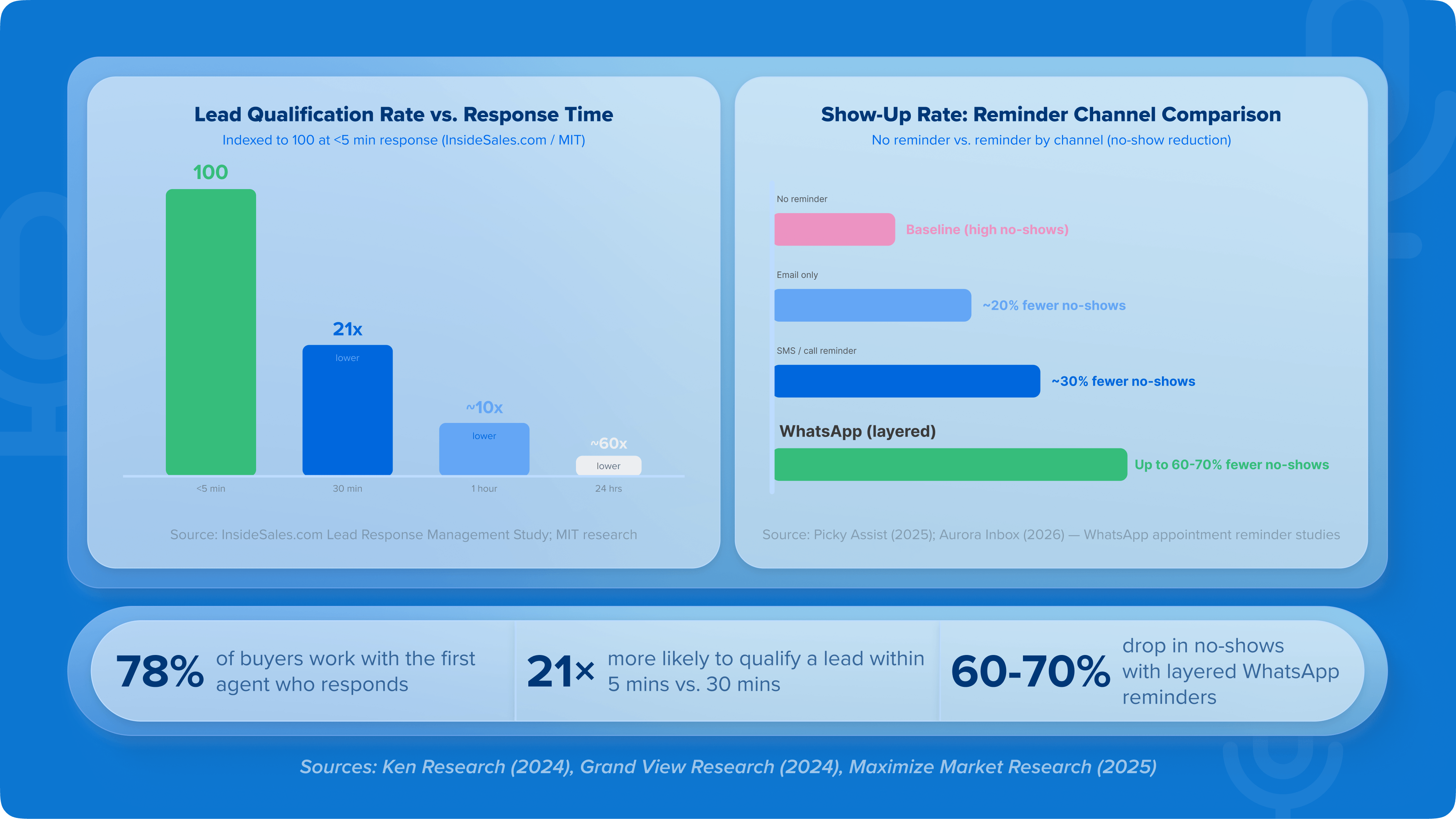
When a prospect submits an inquiry, their intent is at its absolute peak. Research confirms that leads contacted within 5 minutes are 21x more likely to qualify compared to those reached after 30 minutes. After one hour, the odds of making meaningful contact drop tenfold.
In real estate the gap between what conversion science demands and what sales teams actually deliver is where revenue disappears.
Voice AI for real estate closes this gap by triggering an outbound call the moment a lead is captured - regardless of time zone, day, or volume. The sub-5-minute response is the operational baseline.
Site visit show-up rate and its impact on conversion
In residential real estate, a booked site visit is not a conversion event - it is the precondition for one.
Developers and brokers consistently report that prospects who complete a site visit convert at dramatically higher rates than those who do not. The journey from inquiry to booking matters, but the journey from booking to actual show-up matters even more.
Industry data points to a consistent pattern: show-up rates without structured reminders hover well below optimal levels, with no-show rates frequently exceeding 30-40% for unconfirmed bookings.
Structured reminder sequences that combine a confirmation, a 24-hour WhatsApp message, and a pre-visit call reduce no-shows by 60 to 70%.
RELATED: WhatsApp Voice Agents: The Enterprise Guide to Deployment
The infographic above illustrates two compounding dynamics:
- How fast lead qualification rates decay after the 5-minute window
- How much the reminder channel decides whether a booked prospect actually walks through the door
Both levers are automated by voice AI.
Why human sales teams can’t call every lead fast enough
A high-volume developer generating 500 to 2,000 leads per month cannot staff for a sub-5-minute response at all hours.
Sales development reps (SDRs) are expensive, have limited bandwidth, work business hours, and spend a significant portion of their time on low-intent leads.
The math is unforgiving.
READ: Can AI Replace Human Customer Support? The 2026 Reality Check
If an SDR can make 60 to 80 calls per day and a third of those are repeats or follow-ups, the effective new-lead capacity per rep is narrow. At 1,000 leads per month, reaching every prospect within 5 minutes requires either a large, always-on team or automation.
Voice AI makes the latter viable - handling first contact, qualification, and scheduling at scale, before human attention is ever required.
How Real Estate Voice AI Handles the Site Visit Booking Journey
Voice AI orchestrates the complete sequence - from lead capture to visit confirmation to post-visit follow-up - without human intervention.
Instant outbound call on lead capture
The moment a lead form is submitted - from a property portal, a Facebook ad, a developer's website, or a campaign landing page - the voice AI agent initiates an outbound call. This trigger is near-instant, typically within 60 to 300 seconds of form submission.
RELATED: How Inbound and Outbound Voice Calling Works?
The opening of the call is conversational and context-aware. The agent greets the prospect by name, references the specific project or location they inquired about, and moves naturally into a discovery conversation.
Qualification: Location preference, budget, unit type, timeline
During the call, the voice AI works through a structured qualification framework adapted to real estate:
- Which micro-markets or localities does the prospect prefer?
- What is their budget range?
- Are they looking for a 2BHK, 3BHK, or a villa?
- Are they ready to visit within the week, or still in early research?
- Is this for self-use or investment?
RELATED: Voice-Led Lead Qualification: How Enterprises Are Calling Every Lead In 5 Minutes
The AI understands natural responses, handles partial answers, and asks follow-up questions where the prospect's intent is ambiguous. Prospect data is captured in real-time and synced to the CRM, giving the sales team a qualified, profiled lead before any human has spoken to them.
Site visit scheduling
Once intent is established, the voice AI moves to scheduling.
It accesses live calendar availability - synced with the developer's site visit slots, sales team schedules, or showroom open windows - and offers specific time options to the prospect.
The booking is confirmed on the call and immediately followed by a WhatsApp confirmation message containing the date, time, location, directions, and a contact number. The prospect receives a calendar-friendly confirmation within seconds of agreeing to a slot.
Reminder calls and WhatsApp follow-up before the visit
A booked visit is not a guaranteed show-up. The voice AI agent for real estate runs a timed reminder sequence: a WhatsApp message 24 hours before the visit, an outbound voice call 2 to 3 hours before, and a final WhatsApp nudge 30 minutes prior.
Each touchpoint is brief, warm, and action-oriented - confirming the visit, offering a reschedule option if needed, and providing directions or contact details.
This layered approach exploits WhatsApp's 98% open rate versus email's 20%, while the voice call adds a human-like urgency that text alone cannot replicate. Platforms using structured WhatsApp reminder flows report 60 to 70% reductions in no-show rates.
Post-visit follow-up and next-step nudge
After the site visit, the voice AI re-engages. It calls the prospect within 24 hours to capture feedback, answer follow-up questions, and assess where they are in the decision process.
If the prospect signals strong intent - questions about payment plans, possession timelines, or unit availability - the AI flags them as hot and routes them to a senior sales executive for closing conversations.
If the prospect is still evaluating, the AI continues a nurture cadence - periodic follow-up calls and WhatsApp messages timed to re-engage at natural decision inflection points.
Handling the Complexity of Real Estate Conversations
Property sales conversations are rarely linear. Prospects object, hedge, deflect, and switch languages mid-call. Voice AI built for real estate is designed for this complexity.
Objection handling: ‘I'm just exploring’ and ‘Send me a brochure’
Two objections dominate the early stages of real estate outreach.
The first is the exploration hedge - "I'm just looking, not ready to decide yet." A well-designed voice AI does not argue with this; it validates it and reframes the site visit as a low-commitment, information-gathering step rather than a purchase decision.
"Completely understood. Would it help to just walk through the property once so you have a real sense of the space?" is more effective than any counter-argument.
The second is the brochure deflection - "Can you just send me something?" This is often a polite way of ending the conversation rather than a genuine request. The AI acknowledges it, sends the collateral via WhatsApp, and uses the act of sending as a transition back to scheduling: "I'll send that over right now - and while I have you, would Thursday morning work for a quick walkthrough?"
Multilingual conversations
In markets like India, the language of trust is rarely English. A prospect who prefers Hindi, Tamil, Telugu, Kannada, or Bengali will qualify faster, disclose budget and intent more accurately, and convert at higher rates when spoken to in their language.
RELATED: Voice AI for Indian Languages: What Enterprise-Grade Really Means
Voice AI deployments for real estate increasingly support 10 or more regional languages - not just translation, but conversation flow, objection handling, and scheduling - all conducted natively. This expands the effective market for a developer's sales team without adding multilingual headcount.
When to transfer to a senior sales executive
Voice AI’s role is to qualify, book, and nurture - and to know when to hand off.
The AI monitors the conversation for intent signals that indicate a prospect is ready for a human:
- Repeated questions about pricing or payment plans
- Requests for negotiation
- Mentions of competing offers
- Explicit requests to speak with someone senior
When these signals appear, the AI executes a real-time handoff to a sales executive who receives the full conversation context, qualification data, and a summary of the prospect's stated preferences before picking up the call.
The Voice + WhatsApp Journey to Maximize Show-Up Rate
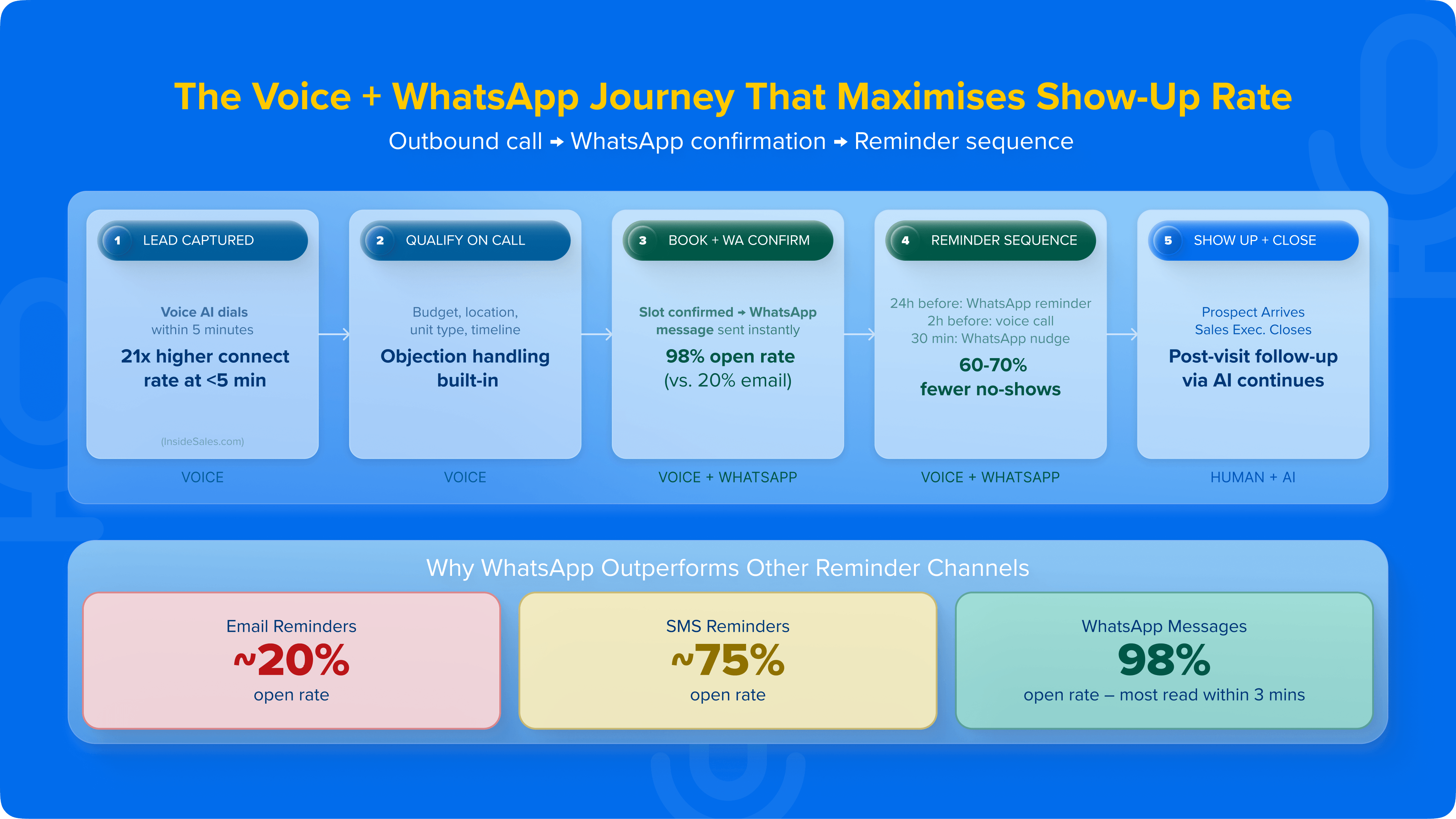
The highest-performing real estate voice AI deployments run voice and WhatsApp in sequence, each channel doing what it does best at precisely the right moment.
Why the best real estate deployments run voice and WhatsApp together
Voice is optimal for the first contact - it is personal, hard to ignore, and creates the conversational context that drives a booking. WhatsApp is optimal for confirmation and reminders - it has a 98% open rate, supports rich media (maps, property images, documents), and allows the prospect to respond on their own schedule without the pressure of a live call.
Running these channels in sequence - voice for the outbound call and booking, WhatsApp for confirmation and reminders - produces significantly better outcomes than either channel alone. The voice call secures commitment; the WhatsApp sequence protects it.
Designing the reminder sequence
The timing and structure of reminders determines whether a booked visit converts to an actual show-up. The highest-performing sequences follow a consistent pattern:
- Immediately after booking: WhatsApp confirmation with date, time, address, map link, and sales contact.
- 24 hours before: WhatsApp reminder with a simple confirm-or-reschedule option.
- 2 to 3 hours before: Outbound voice call to reconfirm and answer any last-minute questions.
-
30 minutes before: WhatsApp nudge with directions and parking details.
Platforms that have deployed this four-touch sequence report no-show reductions of 60 to 70% compared to unreminded bookings.
Integration Requirements for a Real Estate Voice AI Deployment
The quality of integration with existing systems determines how much of the sales workflow voice AI can automate - and how useful its output is to the human team.
CRM integration
Every qualified lead, call transcript, outcome, and scheduled visit must flow automatically into the CRM.
For most real estate developers and brokers, this means Salesforce, Zoho CRM, or a custom-built lead management system. Voice AI captures structured data fields - name, phone, budget range, unit preference, locality, timeline, and visit slot - and writes them directly to the prospect record without manual data entry.
Integration also enables the AI to access existing lead data before a call, so the conversation is contextualized from the first second. A prospect who previously inquired about a project but did not convert gets a different opening than a net-new lead.
Calendar and availability sync
Real-time calendar integration prevents double-bookings, manages slot capacity, and ensures the AI only offers times that are genuinely available. This sync typically connects to the developer's internal scheduling system, the sales team's Google or Outlook calendars, or a purpose-built site visit booking tool.
When slot availability changes - a weekend visit window fills up, a sales executive calls in sick, a property is temporarily off-show - the AI's available options update automatically.
Lead source attribution
Real estate marketing teams run simultaneous campaigns across portals, social platforms, Google, and offline sources. Knowing which source drove a qualified visit booking is the data that optimizes future spend.
Voice AI deployments integrated with UTM tracking and campaign metadata can attribute each qualified call and booked visit back to the specific source that generated it. This closes the loop between marketing investment and sales outcome at a granularity that manual call tracking cannot match.
Real-World Outcomes
The impact of voice AI in real estate is measurable across four dimensions.
Contact rate improvement
Before voice AI deployment, most real estate teams reach fewer than 30 to 40% of inbound leads within the first hour, and a significant share - often upward of 20 to 30% - are never contacted at all.
With voice AI handling first outreach, contact rates within 5 minutes typically reach 80 to 95% of all inbound leads, including those that arrive overnight, on weekends, or during peak volume periods when human teams are at capacity.
Increased site visit bookings
Voice AI's ability to qualify, handle objections, and move directly to scheduling within a single call - rather than relying on a callback cycle - meaningfully improves visit booking rates.
Deployments in residential real estate commonly report 2 to 3x improvements in the ratio of leads to booked site visits, driven primarily by the combination of faster response and in-call scheduling capability.
Higher show-up rate
The structured reminder sequence - confirmation, 24-hour WhatsApp, 2-hour voice call, 30-minute nudge - consistently drives show-up rate improvements of 40 to 70% compared to unautomated booking flows.
For a developer booking 200 site visits per month, even a 40% improvement in show-up rate translates to 80 additional prospects who actually walk through the property - each of whom is a credible conversion candidate.
SDR Team Efficiency
The most significant operational shift is reallocation. When voice AI handles first contact, qualification, and scheduling for the full lead volume, the human SDR team's time shifts almost entirely to high-intent prospects:
- Those who have asked for negotiation
- Requested a second visit
-
Flagged by the AI as purchase-ready
Conversion rates among human-handled prospects improve because the humans are not diluting their time across unqualified volume.
How Haptik Approaches Real Estate Voice AI
Enterprise-grade infrastructure
Haptik's voice AI platform is built for enterprise-grade deployment in high-stakes sales environments. For real estate specifically, this means a system designed around the full lead-to-visit journey rather than isolated call automation.
Pre-built real estate conversation flows
The platform integrates with the CRM and lead management infrastructure already in place - Salesforce, Zoho, custom systems - and is calibrated to the conversation patterns specific to property sales:
- Budget objections
- Locality preferences
- Multi-language qualification
- Distinction between an exploration call and a purchase-intent conversation
Intent-aware escalation
Voice AI from Haptik isn’t a generic contact center bot with a real estate skin. It is a purpose-configured agent that understands when to schedule, when to nurture, when to escalate, and when to let the conversation breathe. Deployments are supported by a combination of pre-built real estate conversation flows and configuration support that adapts the system to each developer's inventory, target customer profile, and sales team structure.
Voice and WhatsApp in one platform
The WhatsApp channel - integrated with Haptik's broader conversational AI platform - runs the confirmation and reminder sequence in tandem with voice, ensuring continuity across the prospect's journey from first call to site visit.
The Bottom Line
The real estate sales problem isn’t a shortage of leads. It has been the consistent failure to reach those leads fast enough, qualify them efficiently, and keep booked visits from falling through.
Voice AI solves all three by doing what sales executives cannot:
- Being available in the first minute after every form submission
- Running qualification at scale across hundreds of leads simultaneously
- maintaining a structured reminder cadence for every booked visit without exception
For developers and brokers evaluating where voice AI fits in their go-to-market stack, the site visit booking journey is the highest-ROI entry point. It is measurable, high-volume, and directly connected to revenue. The leads are already there. The question is whether they are being reached before the competition does.
FAQs




source on Google