


 Voice AI Agent
A patient calls the healthcare center at 8 PM. Six IVR levels. Voicemail. They call back the next morning, repeat their information to three different people, and still don't get the answer they called for.
Now run the same call through an AI voice agent. It picks up instantly. Authenticates the patient by name. Retrieves their records, schedules the appointment, and confirms the slot with a calendar invite. Total call time: 90 seconds.
That's the production reality of enterprise AI voice agents in 2026. The gap between that experience and the legacy IVR model is precisely where customer trust is won or lost.
If 2024 was the year enterprises talked about voice AI, 2026 is the year they're measuring it. AI voice agents now handle up to 80% of routine inbound enquiries freeing human agents for the work that actually requires them: complex problem-solving, empathy-driven conversations, and high-stakes decisions.
In this article, we cover what changed, where the ROI is concentrated, how to design inbound and outbound deployments that hold in production, the mistakes enterprises consistently make, and how to evaluate platforms against the criteria that actually matter.
ALSO READ: The Ultimate Guide to Enterprise Voice AI Agents
From Scripted Bots to Agentic Voice Intelligence
The old model: IVR as a routing mechanism dressed up as CX
Interactive voice response systems were built to route calls.
The architecture was simple:
- Present a menu
- Capture a keypress
- Route to the corresponding queue
And repeat.
Enterprises deployed IVR as a cost reduction tool, and for a decade, that was enough.
The problem is what happens at scale. A customer calling about a billing dispute presses 2 for billing, gets transferred to collections, explains their situation, gets transferred again to a supervisor, and repeats themselves a third time.
At enterprise call volumes that involve hundreds of thousands of interactions per month, those micro-frictions compound into macro failures. Abandonment rates spike. CSAT scores crater. Agents spend their first 60 seconds of every call listening to a frustrated customer explain what the machine just put them through.
The new model: LLMs, real-time speech, agentic action
AI voice agents are architecturally different from IVR at every layer.
They listen in real time using speech recognition that handles natural interruptions, regional accents, background noise, and domain-specific vocabulary. They reason using large language models grounded in your enterprise knowledge comprising policies, customer history, and compliance constraints. They respond using near-human speech synthesis that adapts tone, pacing, and register to the conversational context.
The result is a system that conducts full, bidirectional conversations: understanding what a customer means; maintaining context across multiple turns; acting on that context inside live connected systems, and everything without a human in the loop.
Haptik's AI voice agents operate as real-time decision engines: processing speech recognition, intent detection, reasoning, and speech synthesis in parallel, with sub-second latency, handling complex multi-turn conversations dynamically rather than following a fixed script.
Why "Agentic" is the word that changes everything
The distinction between a voice bot that answers and a voice agent that resolves is the difference between deflection and outcomes.
A voice bot captures intent and routes. An agentic voice system authenticates the caller, retrieves the relevant account, applies the applicable business policy, executes the transaction, verifies the result, and closes the loop.
That sequence of authenticate, retrieve, apply policy, execute, confirm, close, makes agentic voice AI a revenue channel, not just a cost reduction lever. When a voice agent can complete work rather than just manage the call, the economics of the voice channel transform entirely.
Inbound Voice AI Use Cases: Resolution, Not Just Routing
AI voice agents roughly handle up to 80% of routine inbound enquiries. Here's where that 80% lives across four enterprise verticals, and what resolution looks like in each one.
Retail and eCommerce: WISMO, returns, and post-purchase support
"Where is my order?" is the single most automatable high-volume query in eCommerce. It is predictable, structured, and resolvable with a CRM lookup and a real-time logistics API call. Yet most retail contact centers still route it to a human agent.
AI voice agents handle WISMO queries end-to-end: the customer calls, the agent authenticates, retrieves the order, checks shipping status, and delivers an accurate update in under two minutes, at any hour. The same flow handles return initiation, exchange requests, and delivery complaint logging, with the full interaction summarized and pushed to the CRM automatically.
The outcome impact is significant: enterprises deploying voice AI for WISMO and post-purchase support consistently report a 40-60% reduction in call volume for those intents, with human agents redirected to complaint resolution and escalated service recovery - the interactions where empathy and judgment matter.
BFSI: Account queries, loan status, and payment confirmation
Banking and financial services is the most mature vertical for enterprise voice AI adoption.
The reasons are structural:
- High call volumes
- Heavily documented resolution logic
- Strict compliance requirements
- Customers who default to their mother tongue under financial stress
An AI voice agent handling a loan status query doesn't just read back the outstanding balance. It authenticates the caller, retrieves the EMI schedule, confirms upcoming payment dates, explains the overdue position if applicable, and offers to initiate a payment within a compliant, recorded, auditable interaction.
READ: Top AI Agents Use Cases in Banking, Finance and Insurance for 2026
Haptik's fintech deployments cover account balance checks, fund transfers, bill payments, and credit card management, which are voice-first, compliance-aware, and connected to the enterprise stack without requiring a rip-and-replace of existing systems.
Healthcare: Appointment scheduling, triage, and test results
Healthcare contact centres carry a burden that no other vertical quite matches: patients who are anxious, often confused, sometimes in pain, and calling outside business hours when the front desk is closed.
Legacy IVR fails them at exactly the moment when friction has the highest human cost.
AI voice agents in healthcare run 24/7 without front-desk load. They handle appointment scheduling (including rescheduling and cancellations), prescription refill requests, test result notifications, and insurance verification queries. More sophisticated deployments route patients based on symptom triage, directing appropriate cases to clinical staff with context already captured and structured.
The downstream metric that surprises most healthcare CX leaders is no-show rates. Proactive AI follow-up with reminder calls placed 24 and 48 hours before appointments, personalized by patient name, appointment type, and location, reduces no-shows by 30-40% in consistent production deployments.
Real Estate: Lead qualification and site visit scheduling
A real estate developer running an active project launch may receive 3,000+ inbound enquiries in a single month. Human agents cannot screen that volume without significant drop-off in response time.
In real estate, a delayed response is a lost lead.
AI voice agents handle inbound inquiries, capturing intent, budget range, preferred location, timeline, and contact preference before a human agent spends a minute of their time.
RELATED: AI Agents in Real Estate: Redefining Property Discovery, Support and Sales
Leads arrive pre-qualified, structured, and scored. The human agent's first conversation is with someone who has expressed real intent.
The conversion impact is measurable: enterprises deploying AI-first lead qualification in real estate consistently report an 8-10% lead conversion uplift, driven by speed-to-engagement and the quality of context that human agents receive at handoff.
Outbound Voice AI Use Cases: Precision at Scale, Not Robocalling
This is where most enterprises leave money on the table. Outbound voice AI done right is intelligent, compliant, personalized outreach - not robocalling. The distinction matters both commercially and legally.
Lead qualification: Filtering intent before a human spends time
The speed-to-lead problem is well-documented: every minute between an inbound form submission and a first human contact reduces conversion probability.
AI voice agents eliminate that gap entirely. The moment a lead submits a form, the AI places a call to qualify intent, budget, and timeline in a natural conversation, routing high-intent leads directly to a human agent with a structured summary already waiting.
AI-first qualification filters out low-intent contacts before a salesperson spends 20 minutes on a call that was never going to convert. The result is better conversion efficiency across the sales team, with human effort concentrated where it has the highest return.
Collections and payment reminders
Collections is the highest-ROI outbound use case in BFSI where the gap between AI and legacy outbound is widest.
A collections reminder placed by an AI voice agent is personalized (outstanding balance, due date, payment link), timed correctly, and delivered within compliant guardrails that a human dialler cannot consistently enforce at scale.
The AI doesn't deviate from the compliance script under pressure. It doesn't make promises outside its authority. It doesn't lose its composure when a customer is hostile. And when the interaction requires negotiation or empathy beyond its configured scope, it escalates with full context to a collections specialist.
Production deployments show 20-30% improvements in collections recovery rates with AI-led outbound, driven equally by reach (more contacts attempted at optimal times) and compliance (zero disclosure failures across thousands of calls).
Healthcare follow-up
Post-discharge outreach is where outbound voice AI carries the highest empathy requirement.
A patient who missed a follow-up appointment or stopped taking a prescribed medication needs a different tone than a retail customer with an abandoned cart, and enterprise-grade voice AI platforms modulate accordingly.
AI outbound in healthcare handles medication adherence reminders, post-surgical check-in calls, and chronic disease management follow-ups - flagging concerns back to clinical teams for human review. The outcome isn't just operational efficiency. It's measurable reductions in hospital readmission for patients receiving consistent, timely follow-up that a human team operating at scale cannot sustain.
Re-engagement and renewals: Recovering revenue at scale
Insurance renewals, e-commerce cart recovery, and loyalty re-engagement are all structurally similar outbound problems: known customers, known behavior patterns, predictable conversion windows, and outcomes that depend more on timing than on the persuasive skill of the agent making the call.
AI voice agents are optimized for exactly these use cases. An insurance renewal call placed 30 days before policy expiry, personalized with the customer's current coverage details and the renewal offer, converts at materially higher rates than a generic email, and costs a fraction of a human-agent-led renewal campaign. eCommerce cart recovery called within 60 minutes of abandonment captures intent before it dissipates. Alumni and loyalty re-engagement programs run at enterprise-scale without the headcount cost of a human outbound team.
The Human-in-the-Loop: Why Handoff Is Strategy, Not Failure
The old handoff model
In legacy voice automation, the handoff was a failure state. The bot reached its limit, triggered a transfer, and the customer arrived at a human agent with no context. They repeated their name, their account number, their problem, but the agent started from zero.
This is handoff as a bailout: the system giving up and passing the problem to a human. It's the moment that defines how customers feel about the entire brand, and it's where the most damage is done.
The new handoff model
In an agentic voice deployment, the handoff is a deliberate, designed transition.
The AI has already done the work:
- Authenticated the caller
- Captured the issue
- Verified the account
- Triaged the complexity
When it escalates to a human agent, it passes a structured conversation summary, the customer's intent, their emotional signal, and the relevant account context.
The customer's problem arrives before the customer does. The human agent doesn't ask "how can I help you today?" They open with "I can see you're calling about your loan EMI schedule for October, and our team is looking into the discrepancy right now."
RELATED: What is Human in the Loop? A Primer for Enterprise Leaders
Haptik's confidence-driven escalation
Haptik's smart handover mechanism is confidence-driven rather than trigger-based. At each conversational turn, the system scores intent detection confidence and complexity. When the confidence score drops below a defined threshold, or when the conversation type flags for human handling (a distressed customer, a compliance-sensitive query, an edge case outside the defined resolution path), it escalates.
What arrives with the escalation: the full conversation transcript, the detected intent, the customer's authentication status, the actions already taken or offered, and a plain-language summary for the human agent. The agent doesn't need to read the transcript. They need to read the summary and pick up where the AI left off.
The result is measurable: reduced repetition, faster time-to-resolution on escalated calls, and higher CSAT on escalated interactions than on transfers from legacy IVR, because the customer arrives at a human who is already informed and already invested in resolving their issue.
Why Most Enterprise Voice AI Deployments Underperform (and What to Do Instead)
After 500+ enterprise deployments, we know exactly where voice AI projects go wrong. None of these failures is about technology.
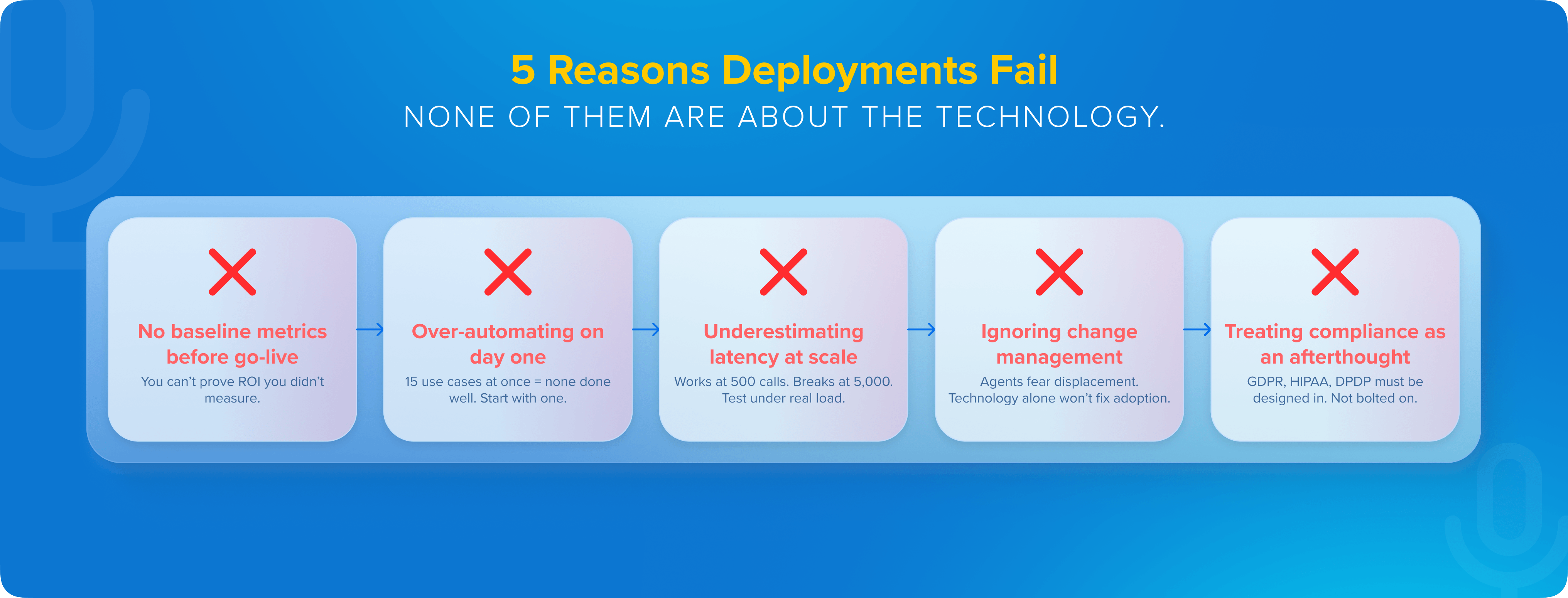
Mistake 1: Going Live without baseline metrics
You cannot prove ROI you didn't measure. Enterprises that deploy voice AI without establishing pre-deployment baselines like call volume by intent, current average handle time, current containment rate, and CSAT by call type have no credible way to demonstrate the value the system is generating, and no way to identify where it isn't.
Before deployment: export 12 months of call detail records. Classify intents. Calculate current cost per call (wages, benefits, occupancy, telecom, QA overhead - industry average is $5–$8 per voice interaction). Establish CSAT and NPS baselines by call type. These numbers are the foundation of every business case conversation you will have after go-live.
Mistake 2: Over-automating on day one
The enterprises that try to automate everything first usually automate nothing well.
A voice AI system handling 15 different use cases on day one, none of them fully trained, all of them operating at suboptimal containment rates, generates more customer frustration than the IVR it replaced.
Successful deployment is always phased. Start with one narrowly scoped, high-volume use case tied to a single measurable outcome. WISMO for an eCommerce brand. Appointment scheduling for a healthcare provider. Balance inquiries for a bank. Get that use case to 80%+ containment. Learn what the system does when it fails. Build the escalation path. Then expand.
Mistake 3: Underestimating latency risk
Latency is the hidden variable that separates voice AI that works in demos from voice AI that holds in production.
Response time gets inconsistent across longer calls. Systems that handle 500 concurrent calls comfortably can break at 5,000. Cost per call increases unpredictably when infrastructure isn't designed for enterprise-scale concurrency.
The benchmark to hold vendors to: sub-500ms response latency on 95% of turns, sustained across peak concurrency.
Mistake 4: Ignoring change management
Technology alone does not solve adoption. Agents fear displacement, which is a real organizational dynamic, not a soft concern to be managed with a company-wide email.
Managers resist new workflows when the KPI framework hasn't changed to reflect the new operating model. Supervisors who built careers on team performance metrics struggle to reframe their role when AI is handling 70% of the call volume.
The enterprises that deploy voice AI successfully treat change management as a delivery workstream. That means clear communication about what AI handles and what humans handle, retraining for the higher-complexity work that human agents are freed to do, and KPI frameworks updated to reflect the new split of labour. Forward-deployed teams are the operational model that makes this work in practice.
Mistake 5: Treating compliance as a post-deployment task
In BFSI and healthcare especially, compliance is an architectural constraint. Data residency, PII handling, consent capture, disclosure logic, call recording policies, and audit trail requirements must be designed into the system from day one.
Enterprises that treat compliance as a final checklist item before go-live discover that their call recording violates a data protection requirement, or that their outbound consent architecture doesn't meet DPDP standards.
RELATED: How to Choose the Best Voice AI Platform for Enterprise CX
Measuring Voice AI ROI
Inbound KPIs: What the dashboard should show
Containment rate
It’s the metric most voice AI vendors lead with, but it's the wrong headline number.
A voice agent that contains 90% of calls by deflecting customers to dead ends or generic responses isn't creating value. Resolution rate, which is the percentage of calls where the customer's actual issue was resolved without a human agent, is the metric that matters.
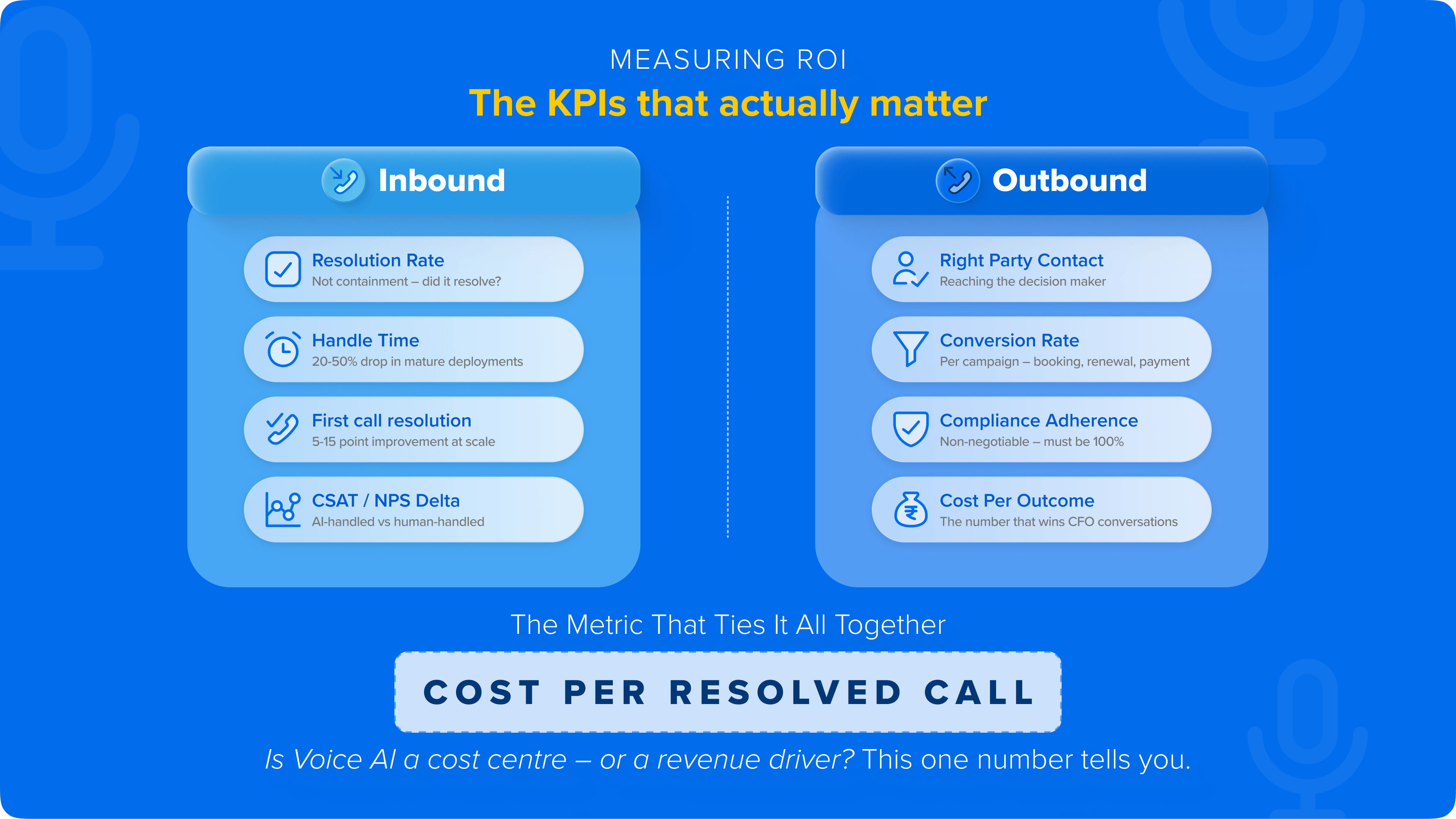
The dashboard for inbound voice AI should show:
- Resolution rate by intent
- Average handle time reduction against baseline (benchmark: 20-50% reduction in mature deployments)
- First call resolution improvement (benchmark: 5-15 point FCR gain)
- CSAT and NPS delta between AI-handled and human-handled interactions
- Transfer ratio broken down by call type
Outbound KPIs: How campaigns are measured
Outbound voice AI is a campaign medium, and it should be measured like one.
Contact rate matters less than right-party contact rate, reaching the actual decision-maker or account holder.
Conversion rate per campaign type tracks whether the AI is actually moving the outcome (appointment booked, payment made, renewal confirmed).
Compliance adherence rate is non-negotiable at 100%.
Cost per outcome, which is the total campaign cost divided by measurable resolved outcomes, is the number that justifies the investment in CFO conversations.
The one metric that ties both together
Cost per resolved call is the indicator whether voice AI is a cost center or a revenue driver.
It accounts for the fully loaded cost of every interaction including platform fees, telephony, human agent time on escalated calls, and QA overhead, divided by the number of calls that ended with the customer's issue resolved.
In a mature enterprise voice AI deployment, cost per resolved call falls below $1. Human-agent-only contact centres run at $5-$8 per interaction. That gap, sustained across hundreds of thousands of monthly interactions, is the financial case for enterprise voice AI, and it compounds as the system improves through ongoing training and optimization.
How Haptik Approaches Enterprise Inbound and Outbound Voice AI
12+ years and 500+ deployments
Most voice AI vendors are 2-4 years old. Haptik has been building enterprise conversational AI since 2013, through the rule-based chatbot era, the NLP era, and now the LLM and agentic era. That longitudinal experience means institutional knowledge about what breaks in production that pilots never reveal: the edge cases that surface at month three, the integration failure modes that appear when call volume scales, the change management dynamics that kill adoption regardless of how good the technology is.
Five hundred enterprise deployments across BFSI, healthcare, retail, real estate, and education empowers us with, among others, production data on what worked and what didn't.
Integration, compliance, no vendor lock-in
Pure-play voice AI vendors hand off a platform. Haptik brings an enterprise consulting practice that solves the three problems platforms alone cannot: integration, compliance, and change management.
On integration: Haptik's voice agents connect to CRMs, ticketing systems, ERPs, and enterprise knowledge bases via REST APIs, with support for client-chosen LLMs and no vendor lock-in. You stay in control of your stack.
On compliance: GDPR, CCPA, and ISO standards are built into the architecture - PII protection, end-to-end encryption, DPDP-compliant consent handling for India - not bolted on after go-live.
On change management: the consulting engagement doesn't end at deployment. It runs through the organizational adoption challenge that every enterprise faces when AI takes on a material share of voice interactions.
Forward-deployed teams
The forward-deployed model is the operational difference between a platform that works in a demo and one that holds in production at scale.
Haptik's engineers and CX specialists are embedded with enterprise teams through the first 90 days of production - sitting with the business, watching what the system does under real call volume, and iterating in real-time.
The voice campaign manager - Haptik's outbound differentiator
Large-scale outbound voice AI requires a campaign management layer that handles scheduling, personalization, compliance gating, outcome tracking, and continuous optimization across millions of interactions. Haptik's Voice Campaign Manager is a platform capability built specifically for this, not an add-on.
Looking Ahead
Voice has historically been the most expensive, least scalable customer channel. High agent cost, constrained availability, inconsistent quality, and no systematic learning from every interaction. Enterprises managed it because they had to, not because it was a strategic asset.
AI is inverting that equation entirely. The voice channel, when built on agentic AI with the right deployment model, integration depth, and governance architecture, becomes the highest-context, highest-resolution customer touchpoint an enterprise operates. It handles more interactions, at better quality, at a fraction of the cost, 24 hours a day, in the customer's language, with every conversation logged and every pattern surfaced for operational improvement.
The enterprises investing now in BFSI, healthcare, telecom, and retail are reclaiming voice as a revenue driver, a loyalty lever, and a differentiation surface. In a competitive market where customer experience is the primary battleground, the voice channel is an advantage to be built.
FAQs
Ready to hear what AI voice agents sound like on a real call from your industry? Book a 20-minute live demo.
source on Google