


 Voice AI Agent
A customer in Lucknow has placed an order during a flash sale - one of 4.2 million orders processed by an eCommerce platform in under six hours. By morning, she wants to know where her order is. She picks up the phone, and is on hold.
Average hold time: 14 minutes. When she finally reaches an agent, the agent toggles between three systems to locate her order. Five minutes later, she is told there may be a delay. She hangs up - still unsatisfied - and does not come back. A customer lost. An LTV gone.
Now multiply that by 80,000 calls. That is what a leading Indian eCommerce platform can receive in a single day during a mega sale event. Traditional contact center infrastructure was never built for this. It was built for normal. And in eCommerce, normal no longer exists.
As we move deeper into 2026, voice is the highest-stakes channel in customer support. It is where returns get decided, where refunds get confirmed, and where trust - or the lack of it - gets sealed.
ALSO READ: Voice AI Use Cases for Customer Support That Actually Move the Needle
Voice AI, when deployed correctly, is the only technology that answers every one of those calls instantly, resolves without a human, and sounds like a conversation that matters.
This blog explores how the voice AI agent rewrites the rules of eCommerce customer support - from the use cases that drive the highest contact volume to the infrastructure that makes sub-90-second resolution possible.
The eCommerce CX Problem Is a Voice AI Problem
Before evaluating any technology, it helps to understand the nature of the fire. Here is what is burning - and why conventional approaches fail to contain it.
Why order, delivery, and return queries dominate the contact center
The anatomy of an eCommerce contact center is surprisingly predictable.
Across categories - fashion, electronics, grocery, beauty, and home goods - three query types consistently make up 60 to 70 percent of total inbound volume:
- Order status
- Delivery tracking
- Return or refund initiation
These are not complex queries that require empathy or negotiation. They require accurate, real-time data - pulled from an OMS, a logistics API, or a payment gateway - and delivered to the customer in plain language.
Every minute these calls are routed to a human agent is a minute of capacity wasted on something a well-deployed voice AI can handle with higher accuracy, better speed, and zero fatigue.
Yet most enterprise contact centers still funnel these calls through IVR trees that frustrate before they help, or queue them behind general support tickets where a 6-to-8-minute average handle time becomes the floor, not the ceiling.
RELATED: Why Enterprises are Replacing IVR with AI Voice Agents
The peak season surge - and why it breaks support
Every eCommerce business has a peak - and that peak breaks support.
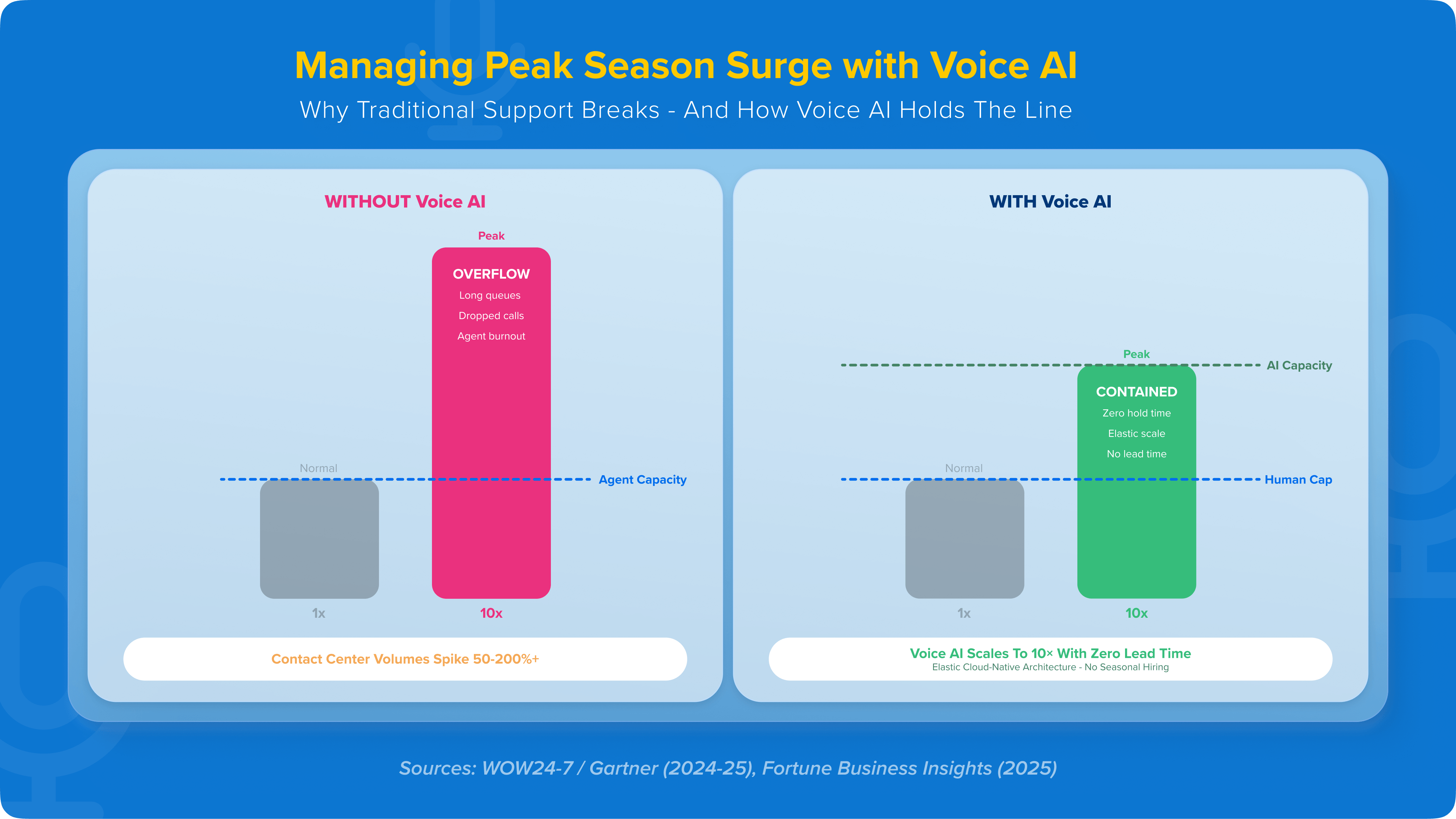
Industry data shows eCommerce and retail contact center interaction volumes surge by 50 percent or more during high-sale events, with some brands seeing spikes of 200 to 400 percent over baseline volume during campaigns like the Big Billion Days, End of Season Sale, or Diwali season.
According to Gartner, contact centers can face up to 10 times normal call volumes during holiday and promotional events.
Traditional responses - seasonal hiring, overtime staffing, and outsourcing - solve headcount, not architecture. Training a batch of seasonal agents takes 4 to 6 weeks. Peak season is a weekend.
The result:
- Long queues
- Abandoned calls
- Customer frustration
- Post-sale return volumes that pile on top of an already overwhelmed operation
For eCommerce brands, the busiest revenue moment is often the worst service moment.
The cost of a missed return call
A missed return call is not just a service failure but also a revenue event.
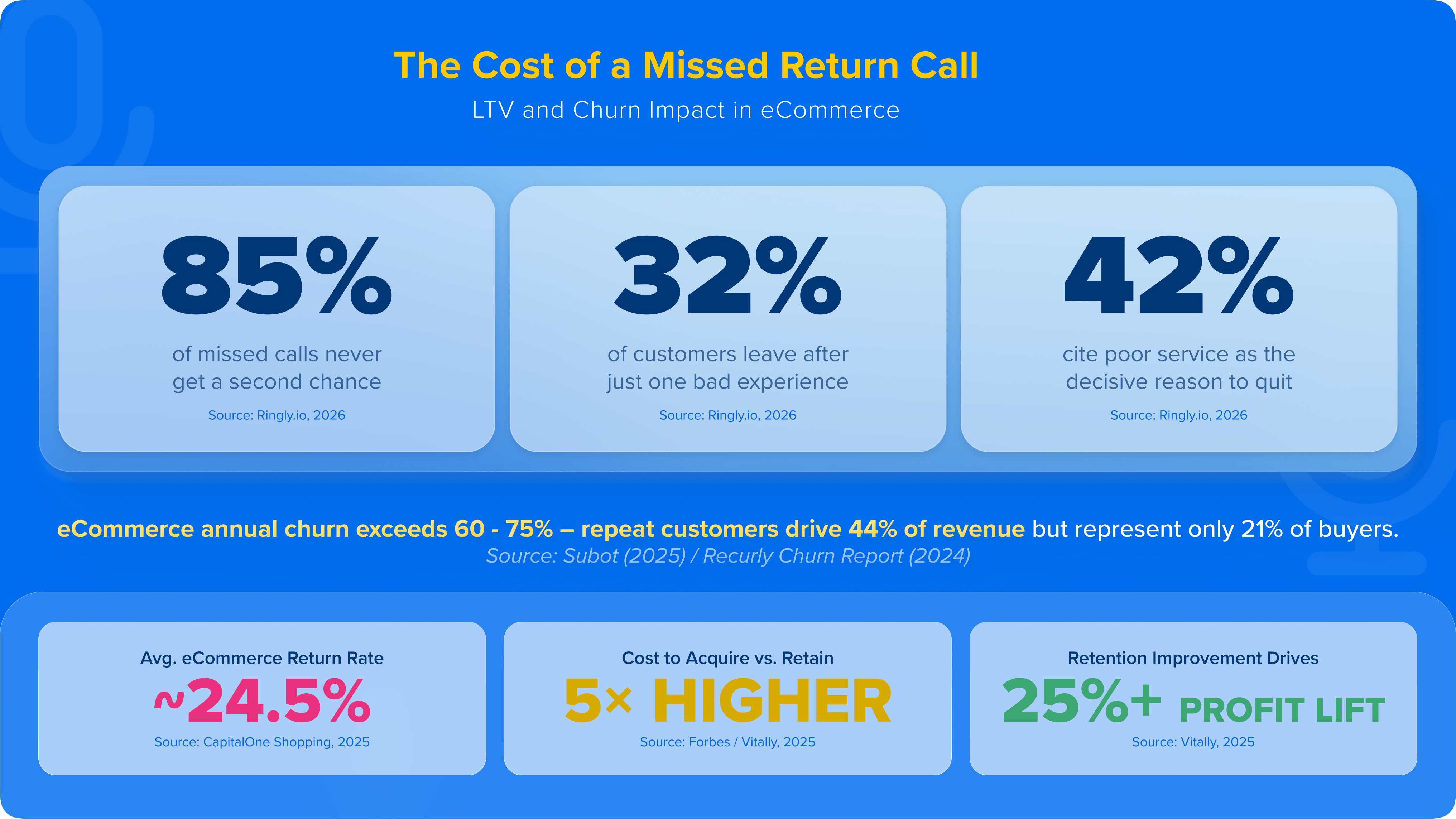
Research shows that 85 percent of missed calls never get a second chance - the customer moves on, sometimes to a competitor. Thirty-two percent of customers leave after just one bad experience. Forty-two percent cite poor customer service as their primary reason for abandoning a brand entirely.
In eCommerce, where annual churn already exceeds 60 to 75 percent and repeat customers - just 21 percent of buyers - account for 44 percent of revenue, every lost customer is a disproportionate hit to LTV.
The return moment, when handled poorly, accelerates that churn. When handled well, it builds the exact kind of trust that converts a transactional buyer into a loyal one. Research consistently shows that a 5 percent improvement in retention can drive a 25 percent or more increase in profitability.
The Top Voice AI Use Cases for eCommerce Support
Voice AI in eCommerce is not a monolithic capability. It is a set of targeted interventions across the customer journey - each one resolving a specific query with zero hold time and no human dependency.
Order status
The most common inbound call in any eCommerce contact center - Where is my order (WISMO)? - is also the most automatable.
Voice AI integrated with the OMS and logistics platform can pull real-time tracking data, confirm delivery status, flag delays, and proactively communicate revised ETAs. When a shipment is delayed, the AI does not wait for the customer to call - it calls them first.
Return initiation and status
Voice AI can verify return eligibility, generate pickup requests, coordinate with reverse logistics partners, and provide status updates on a return in progress - all within a single call.
No agent handoff, or form to fill, need for a callback. For brands processing thousands of returns daily during peak season, this is an operational necessity.
Refund status and timeline confirmation
Refund queries spike sharply after returns are completed and again when timelines slip.
Voice AI can access payment gateway data in real-time, confirm refund status, and communicate accurate timelines - reducing repeat calls and the anxiety that drives them. Customers do not need sympathy. They need answers in real-time.
Payment failure and double-deduction resolution
Failed payments and double charges generate calls with a high emotional charge. Voice AI can verify transaction status, identify failure codes, and - where integrated with the payment gateway - initiate re-trigger flows or flag refunds.
For straightforward cases, resolution within a single call is achievable. Complex exceptions escalate with full context to a live agent.
Exchange requests and replacement coordination
Voice AI can verify product eligibility for exchange, check inventory availability, initiate a replacement dispatch, and coordinate return pickup - end-to-end, within a single interaction.
This capability is especially high-value in categories like fashion and electronics where size or functionality issues drive high exchange rates.
Address change and delivery rescheduling
Last-mile delivery exceptions - wrong address entered, customer unavailable, access restrictions - are a significant source of inbound volume.
Voice AI can validate new delivery addresses against pin-code serviceability, coordinate rescheduling with logistics partners, and confirm the updated window with the customer, all in under two minutes.
Proactive outbound - delivery exception notifications
Beyond inbound resolution, Voice AI enables proactive outbound at scale.
RELATED: Enterprise Voice Agents: How Inbound and Outbound Calling Works in 2026
When a delivery exception is detected - a failed delivery attempt, a shipment held at a hub, a customs delay - the AI initiates an outbound call before the customer has a reason to complain. This proactive posture reduces inbound call volume, improves CSAT, and signals to the customer that the brand is in control.
The eCommerce Voice AI Difference - Speed and Scale
Use cases are only half the equation. The other half is how Voice AI delivers on them - the infrastructure and design decisions that separate a truly capable system from a sophisticated IVR with a better voice.
Sub-90-second resolution
Sub-90-second resolution is the threshold below which customer effort scores drop sharply and satisfaction recovers even from a delayed or flawed experience.
RELATED: Why Latency Is the New UX in Voice Conversations
Getting there requires three things working in concert:
- Accurate intent recognition from the first utterance
- Zero-latency API calls to backend systems
- Conversation design that removes confirmation loops
Traditional IVR systems carry an industry average handle time of 6 to 8 minutes for routine queries.
Well-designed Voice AI agents, integrated directly into OMS and logistics systems, can resolve the same queries in under 90 seconds - while maintaining accuracy and a natural conversational tone.
Real-time OMS and logistics API integration
The intelligence of a Voice AI agent is only as good as the data it can access in real time.
An order status bot that pulls from a cache updated every 30 minutes is not a voice AI solution - it is an expensive error generator.
True enterprise-grade Voice AI for eCommerce requires live, bidirectional integration with the OMS, logistics platforms like Delhivery, Shiprocket, or Ekart, and the payment gateway. Any gap in this integration chain creates a resolution dead end.
Handling ambiguous queries
Real customer queries are rarely clean. My order has not come could mean any of four active orders.
I want to return might refer to a purchase made six weeks ago or one made yesterday.
A production-ready voice AI must handle query ambiguity gracefully - prompting for clarification without sounding scripted, retaining context across turns, and resolving multi-order, multi-intent queries without requiring the customer to repeat information -making it a dialog design challenge as much as a technology one.
Regional language support
India's eCommerce customer base does not speak English by default. Hindi, Tamil, Telugu, Bengali, Kannada, and Marathi are not edge cases - they are the primary languages of a significant share of online buyers. Voice AI that cannot serve customers in their preferred language is Voice AI that cannot serve India. Production-ready multilingual capability requires not just ASR in regional languages but NLU models trained on the idioms, abbreviations, and code-switching patterns that characterize how real customers actually speak.
RELATED: Voice AI for Indian Languages: What Enterprise-Grade Really Means
Managing Peak Season Surges With Voice AI
Peak season is the ultimate stress test for any support infrastructure. Voice AI changes what it means to be ready for it - not by adding more of the same, but by removing the ceiling on capacity entirely.
Elastic scalability
Traditional contact center scaling requires weeks of lead time - sourcing agents, completing training, onboarding to systems. Voice AI requires none of that.
ALSO READ: Scaling Voice AI for Large Enterprises: What Changes After 10 Million Calls
A cloud-native Voice AI infrastructure scales elastically to handle 10 times normal call volume with zero lead time and zero incremental cost per call above infrastructure. When 80,000 calls arrive in a day, the AI answers all of them simultaneously. No queue. No hold music, or abandon rate spike.
Priority routing for high-value customers
Not all customers carry equal LTV, and not all queries carry equal urgency. During peak events, voice AI enables intelligent priority routing - surfacing high-value customer profiles, flagging time-sensitive escalations, and ensuring that the interactions most likely to affect revenue or churn get the fastest, highest-quality handling.
This is a capability that a uniform human agent pool cannot offer at scale, but a well-integrated Voice AI system can operationalize from day one.
Post-sale campaign support - managing returns season intelligently
Peak season does not end at checkout. The return wave that follows a major sale event can last 4 to 6 weeks and represent 20 to 25 percent of all orders in high-return categories like apparel.
Voice AI enables returns season to be managed as a distinct operational phase - with dedicated flows, proactive outbound on return status, and intelligent triage that separates straightforward return requests from cases that require agent judgment. The result is a return experience that is faster, less costly, and less likely to permanently damage the brand relationship.
Beyond Support - Voice AI as a Revenue Tool in eCommerce
The ROI case for Voice AI in eCommerce extends beyond cost deflection. When deployed thoughtfully, it is an active revenue lever - generating upsell, recovering lapsed buyers, and closing the loop on customer satisfaction at scale.
Upsell and cross-sell during inbound service calls
An inbound service call is a moment of attention.
When a customer's issue is resolved in under 90 seconds, there is a natural opening - a satisfied customer, a live interaction, a brand that’s top of mind.
Voice AI can be designed to identify the right upsell or cross-sell moment, surface a contextually relevant offer, and present it conversationally rather than transactionally. Done with the right product intelligence and conversation design, this converts a cost-center interaction into a revenue-generating one.
Proactive win-back calls
Cart abandonment rates in eCommerce typically exceed 70 percent.
Lapsed buyers - customers who purchased once and never returned - represent the largest untapped revenue pool for most brands.
Voice AI enables proactive outbound at a scale no human team can match: personalized, contextual, conversational win-back calls that surface the right offer, at the right moment, in the customer's preferred language.
NPS collection and recovery calls at scale
NPS collection via automated voice surveys has a response rate significantly higher than email or native messaging.
But the real value lies in what happens after a detractor response. Voice AI enables real-time recovery: when a low NPS response is detected, the system escalates the call to a human agent briefed on the customer's history and the reason for dissatisfaction. This closes the loop on negative experiences before they become churn or public reviews.
How Haptik Approaches eCommerce Voice AI
12+ years of expertise
Haptik brings over 12 years of AI domain expertise and more than 500 enterprise deployments to the eCommerce Voice AI space - a combination that makes a meaningful operational difference for brands evaluating this technology.
The depth of that experience shows in how Haptik designs integrations. Connecting Voice AI to an OMS, a logistics API, or a payment gateway is not a plug-and-play exercise for most enterprise environments. It requires an understanding of the data models, latency constraints, and edge cases that only come from having done it hundreds of times across verticals.
Haptik's consulting-first approach means integration architecture is designed for production from the outset - not retrofitted after a pilot breaks in peak conditions.
Omnichannel CX orchestration
Voice AI in isolation solves one channel. Voice AI that is part of a coherent omnichannel CX strategy - where context from a chat interaction carries into a voice call, and a voice resolution updates the customer's profile across all touchpoints - solves the customer's actual experience. Haptik's platform is built for this kind of orchestration.
Compliance and data governance
Compliance and data governance is particularly relevant for brands operating across India's diverse regulatory landscape.
Haptik's enterprise consulting DNA means that data residency, PII handling, and audit trail requirements are addressed at the design phase - not added on as afterthoughts. For CXOs and transformation leaders, this translates to lower regulatory risk and faster enterprise sign-off.
The Bottom Line
Voice AI is the operational reality that separates brands that scale CX with revenue from those that scramble to staff up for every peak event, absorb churn from every missed call, and watch LTV erode one frustrated customer at a time.
The business case is straightforward: the queries that dominate eCommerce contact centers are highly automatable, the peaks that break traditional support are perfectly predictable, and the LTV at stake in every missed return call is too significant to leave to hold time and queue depth.
The question for 2026 is not whether Voice AI belongs in your eCommerce CX strategy. It is whether you are deploying it with the integration depth, conversation design maturity, and omnichannel coherence needed to make it actually work - at speed, at scale, and with zero hold time.
FAQs




source on Google