


 Voice AI Agent
Every year, enterprises spend millions of dollars establishing distinct visual and textual brand guidelines. Graphic elements, typography sets, Hex color palettes, and copywriting style manuals are rigorously audited to ensure consistency across web apps, marketing campaigns, and packaging.
Yet, when a customer transitions from these meticulously designed interfaces to the telephone network or an interactive voice assistant, that distinct brand personality vanishes entirely.
Instead of a recognizable corporate persona, the customer is greeted by the exact same synthetic text-to-speech (TTS) voice used by thousands of other applications across the web, creating a severe brand disconnect.
ALSO READ: How Goal-Driven Agentic Voice AI Outperforms Task-Based Automation
When your AI voice agent sounds identical to a food delivery app, a local transit notification system, or a generic utility bot, you have given up your unique brand identity, one of your most valuable competitive assets.
As customer interactions shift from text screens to voice channels, reliance on stock voice libraries introduces substantial brand risk. Recent cross-industry studies show that over 75% of business leaders now prioritize exclusive voice licensing.
Forward-thinking enterprises have come to realize that customer experience differentiation requires moving past generic audio tools and investing in full-stack, tailored voice identities.
What Is Brand Voice in Conversational AI?
In the era of agentic Voice AI, brand voice is the core extension of corporate identity. It represents the sonic expression of your company's values, culture, and customer relationship strategy.
A true custom voice identity goes far beyond simple audio clarity. It encompasses the distinct combination of vocal timbre, pitch, regional accent, and speech patterns that make an automated agent instantly recognizable to a consumer.
It ensures that every automated call behaves like an immersive brand experience rather than a cold, robotic transaction.
ALSO READ: Voice AI for Enterprise Deployment Checklist: What to Verify Before Go-Live
The Anatomy of an Enterprise Brand Voice
To build a truly effective, production-grade custom voice identity, enterprise teams must move away from subjective, arbitrary evaluations and structure their designs across four critical sonic dimensions.
Timbre and persona
This establishes the core acoustic fingerprint of the voice. Is the character authoritative and structured, or approachable, reassuring, and lighthearted?
This baseline frequency profile dictates how customers perceive your brand's underlying authority and corporate style.
Dynamic tone modulation
Human speech naturally shifts in response to situational context. A sophisticated voice architecture does not rely on a static, unchanging audio stream.
It can alter emotional resonance dynamically by shifting smoothly between professional focus, warm encouragement, or polite empathy based on the real-time needs of the customer conversation.
Speech cadence and flow
The rhythm and pacing of an interaction heavily influence comprehension and comfort. High-velocity, rapid-fire phrasing signals haste and can elevate customer anxiety, while overly long pauses create artificial friction and drive up network holding costs.
Optimizing conversational flow requires carefully calibrating breath simulations, natural pauses, and phrase timing.
Targeted regional accents
Language is inherently local. Deploying an AI voice agent with an accent that feels artificial or detached from the caller's geographic region reduces conversational comfort.
Matching the voice's accent profile to regional user groups fosters instant familiarity and signals a localized commitment to service.
RELATED: Voice Agents for Indian Languages: What Enterprise-Grade Really Means
Custom Voice Cloning vs Pre-Built Voice Libraries: What Enterprises Choose and Why
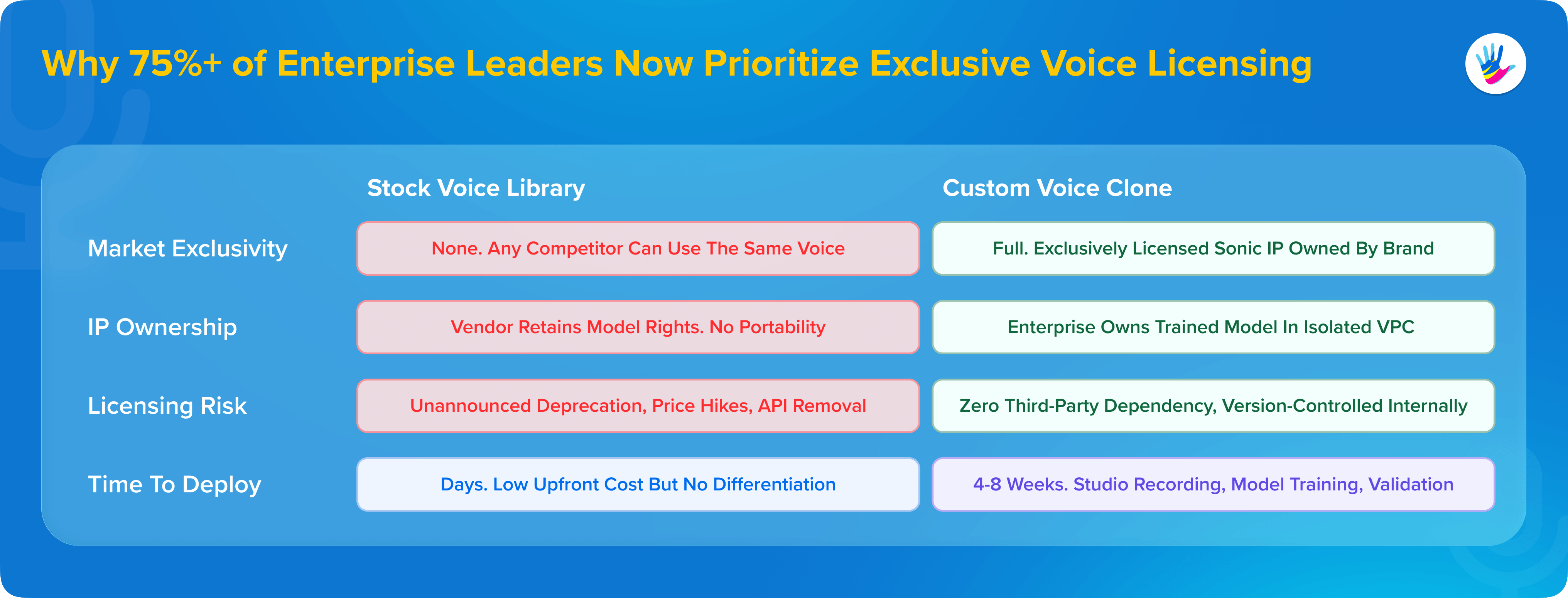
When architects deploy conversational voice systems, they face a fundamental choice: utilize standard pre-built voice libraries or invest in custom voice cloning.
While stock voice libraries offer low upfront deployment costs and rapid initial implementation, they introduce long-term operational liabilities. Stock voices lack any market exclusivity, meaning your brand's primary user interface can be copied by any competitor overnight.
Moreover, relying on external voice libraries leaves enterprises vulnerable to third-party pricing changes, unannounced model deprecations, and sudden licensing shifts that can disrupt critical customer-facing channels.
In contrast, custom voice cloning enables enterprises to take complete ownership over their sonic intellectual property.
ALSO READ: Scaling Voice AI for Large Enterprises: What Changes After 10 Million Calls
A Practical Framework to Building Your Brand Voice for AI
Developing an enterprise voice identity requires a structured, multi-phase methodology that aligns creative brand vision with rigorous technical architecture.
Step 1: Voice discovery: Defining who your AI sounds like
Brand strategy teams must identify the primary attributes they intend to project across customer touchpoints.
If your core brand pillar is technical precision, the voice profile should emphasize controlled, even cadences and clear, crisp articulation.
If your brand focus is supportive care, the profile should prioritize warmer mid-range frequencies, softer inflections, and open, reassuring speech rhythms.
Step 2: Voice design: Accent, age, gender, and warmth calibration
Once the core persona attributes are locked in, engineering and brand teams collaborate to calibrate specific acoustic parameters.
This includes determining the voice's ideal age profile, gender representation, and baseline pitch frequencies.
ALSO READ: How Latency and Interruption Handling Define Voice AI Quality
During this phase, technical teams select and audit professional voice actors whose natural voice profiles match these target metrics, ensuring the underlying training datasets are built on stable, premium foundations.
Step 3: Voice validation: Testing brand alignment across use cases
A voice that performs exceptionally well in marketing environments can feel cold or inappropriate when deployed in collections or technical support channels.
True voice validation requires evaluating the voice model across diverse, simulated customer journeys.
The system must prove it can adapt its tone and emotional delivery contextually without losing its core identity.
Step 4: Voice governance: Who controls it, who can change it, and how
To maintain identity consistency over time, enterprises must establish strict voice governance frameworks.
This requires specifying clear roles for who is authorized to modify core model configurations, update underlying phonetic dictionaries, or generate new voice assets. Implementing version control across voice models ensures that updates do not introduce unwanted shifts in dialect, pronunciation accuracy, or pacing across live production environments.
Industry-Specific Considerations for Brand Voice
Vocal requirements change based on the operating context and the industry landscape of the enterprise.
Retail and eCommerce: Personality as a conversion lever
Retail and eCommerce brands operate in highly competitive environments where customer engagement directly drives revenue growth.
In these sectors, an AI voice agent should act as a dynamic brand ambassador. The voice profile can leverage greater pitch variation, conversational energy, and localized phrasing to capture attention, guide users through tailored product recommendations, reduce cart abandonment rates, and convert transactional inquiries into brand-building moments.
RELATED: Voice AI for eCommerce Customer Support: Resolve at Speed, Scale, and Zero Hold Time
BFSI: Trust and authority over warmth
In the banking, financial services, and insurance sectors, customers frequently call regarding sensitive, high-stress matters like disputed credit card charges, loan approvals, or suspected account fraud.
In these environments, an overly casual or light-hearted voice agent can easily frustrate users.
Financial voice agents must project absolute security, expertise, and structured calm. The cadence must be deliberate, measured, and highly clear, reassuring the caller that their financial matters are being managed with institutional precision.
RELATED: Voice AI for Banking: Navigating the High-Stakes Shift to Agentic CX
Healthcare: Empathy and calm as non-negotiables
Healthcare voice applications regularly interact with individuals who may be dealing with physical discomfort, situational stress, or complex medical systems.
For these interactions, projection of safety and empathy is a non-negotiable architectural requirement.
The voice model must incorporate gentle inflections, warm tones, and unhurried pacing, ensuring that critical medical information, appointment schedules, and pharmacy details are delivered in a clear, accessible, and comforting manner.
RELATED: Voice AI for Healthcare: Reducing No-Shows, Improving Adherence and Patient Engagement
How to Evaluate a Voice AI Platform for Brand Voice Capability
Let’s look at five questions every enterprise should ask.
Acoustic flexibility
Does the platform feature native support for sub-500ms real-time audio generation while dynamically adjusting tone, emotional resonance, and speech pacing based on live API parameters?
Telemetry and integration
Can the voice infrastructure communicate directly with legacy contact center platforms via SIP trunking and standardized UUI headers without degrading voice quality?
Phonetic management
Does the solution include an accessible, centralized phonetic management system that allows business units to update proprietary brand terminology and product names across models instantly?
Data privacy and sovereignty
Does the platform provider allow for isolated, single-tenant deployment configurations that ensure your custom voice training sets and customer data are never shared with multi-tenant models?
ALSO READ: The Enterprise Compliance Guide to Data Privacy in Voice AI
Telephony optimization
Are the text-to-speech architectures and acoustic models optimized for low-bitrate telephony streams ($8\,\text{kHz}$ / $\mu$-law) to guarantee high clarity across noisy cellular connections?
The Bottom Line
In an increasingly automated marketplace, your voice interface is the primary manifestation of your enterprise identity. Allowing your customer service channels to rely on the same stock voice profiles used by thousands of other businesses dilutes your brand equity and compromises customer retention. By taking complete control of your vocal identity through an engineered, custom cloned voice identity - backed by real-time tone modulation, low-latency infrastructure, and secure compliance boundaries - you transform your contact center from a transactional cost center into a powerful engine for brand recognition and customer loyalty.


source on Google