


 Voice AI Agent
Enterprise voice automation has operated within a strict, predictable cage. Traditional interactive voice response (IVR) platforms and basic conversational assistants could execute individual, linear tasks. They could fetch an account balance, log an itinerary amendment, or route an inquiry to a localized queue.
But the moment a customer interaction strayed into non-linear troubleshooting or required real-time context adjustment, the script broke down. The system would inevitably hand the call off to an expensive, overworked human agent.
The paradigm has undergone a fundamental transformation. Enterprises have passed the inflection point of basic automation and entered the agentic era driven by voice AI agents.
Enterprise technology strategies are pivoting from rigid task completion to complete, autonomous goal achievement. This blog breaks down the structural, technical, and commercial evolution that is redefining conversational performance at the edge.
The Structural Shift: Moving From Task Completion To Goal Achievement
The limitation of intent-based architectures
Traditional conversational AI tools were built on natural language understanding (NLU) models designed for intent classification.
When a user speaks, the engine maps their utterance to a preconfigured bucket (the intent), extracts specific strings (entities), and runs a static dialogue script.
RELATED: Why Enterprises are Replacing IVR with Voice Agents
While this works for deterministic parameters, it fails in chaotic, real-world contact center environments.
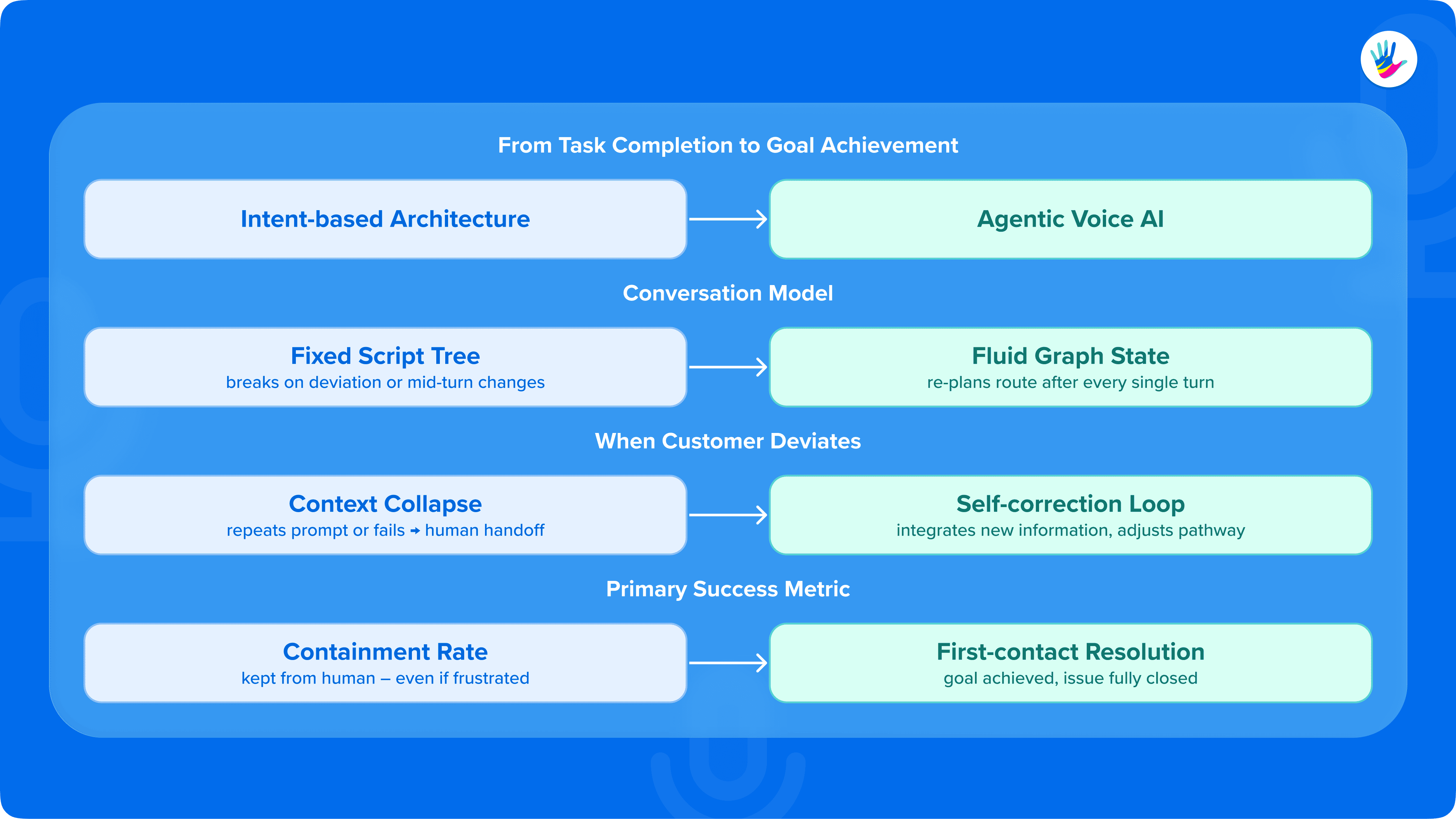
If a customer changes their mind mid-sentence, brings up a tangential billing issue, or fails to provide an exact data string, the engine experiences context collapse. It cannot pivot; it can only repeat the prompt or fail entirely.
Defining the core traits of agentic voice infrastructure
Unlike legacy systems, an agentic system is not bound by rigid conversational trees. It is governed by a high-level goal statement, such as 'resolve the customer's billing dispute and protect account retention.'
ALSO READ: Voice AI Agents Explained: What They Are and How They Work
Equipped with advanced reasoning, agentic voice systems dynamically plan their own conversation paths. They assess the user's emotional state, analyze historical account metadata, and decide which sub-tasks to execute in real-time.
This structural agility allows them to handle multi-threaded conversations without throwing exceptions or requiring manual script intervention.
The Architecture Of Reasoning: How Agentic Voice Operates
Dynamic path planning instead of hardcoded conversation trees
At the heart of the agentic shift is the transition from script execution to continuous path planning. Instead of mapping a conversation as a fixed tree diagram, agentic architectures treat the dialog as a fluid, evolving graph state.
ALSO READ: Voice AI for Contact Centers: The Enterprise Guide to Resolution at Scale
With large language models optimized for reasoning, the system continuously recalculates the most efficient route to goal achievement after every single turn.
If a user interrupts the bot to add an entirely new variable, the agent does not error out. It integrates the new information, adjusts its internal state representation, and seamlessly alters the resolution pathway.
Real-time state evaluation and autonomous self-correction loops
Agentic voice solutions employ active self-correction mechanisms to monitor execution accuracy.
While traditional models output a text stream blindly, an agentic framework constantly cross-checks its conversational outputs against enterprise policy constraints.
RELATED: The Enterprise Compliance Guide to Data Privacy in Voice AI
If the system detects an anomalous data calculation or notices that a user's stated preference contradicts a backend system rule, it activates an internal course-correction loop. The agent naturally pauses, clarifies the discrepancy with the customer, and corrects the database payload on the fly before finalizing the interaction.
Driving Enterprise ROI with Agentic Systems
Shifting corporate metrics from containment rate to complete issue resolution
For years, customer experience executives tracked containment rate, which is the percentage of calls that an automated system kept from reaching a human agent. This metric was fundamentally flawed; a bot that frustrated a user into hanging up was counted as a successful containment win.
RELATED: The 7 Metrics That Actually Define Voice AI Performance
In the agentic voice AI era, the target performance indicator shifts decisively to First-Contact Resolution (FCR) and complete goal achievement.
Because these autonomous agents have the reasoning capacity to negotiate payment structures, troubleshoot infrastructure errors, and handle intricate workflows, they convert containment metrics into true operational resolution victories.
Integrating multi-agent orchestrators for variable compute optimization
Running high-reasoning models across millions of customer service hours can quickly become cost-prohibitive. To solve this, advanced enterprise deployments utilize a multi-agent orchestrator pattern.
A lightweight, rapid router agent manages the baseline acoustic stream and handles routine data collection tasks at minimal token expense.
The system dynamically spins up the heavyweight reasoning model only when the customer dialog reaches a complex, non-linear inflection point that requires advanced path planning.
Gartner projections indicate that this variable orchestration method reduces total enterprise API token overhead by 40% to 60%, making large-scale agentic operations financially sustainable.
Bottom Line
The agentic voice AI era marks the dawn of the autonomous digital workforce. Shifting from task completion to absolute goal achievement allows modern enterprises to move past the fragile constraints of script-heavy software.
By deploying flexible architectures that reason, adapt, and self-correct mid-conversation, organizations deliver frictionless, human-grade customer experiences at a fraction of manual cost structures. In a competitive market where execution speed and operational scalability dictate margin performance, the brands that replace fixed conversation trees with goal-oriented agentic networks will establish a permanent structural advantage.

source on Google