


 Voice AI Agent
The sound of a modern enterprise contact center in 2026 is the silence of automated resolution. For decades, the "press 1 for support" IVR was a gatekeeper designed to route calls as cheaply as possible, often at the expense of customer sanity. But the gate has collapsed.
Today’s customers, fueled by the immediacy of Generative AI in their personal lives, no longer tolerate being "routed." They demand to be heard, understood, and resolved in real-time.
Brands that cling to legacy telephony menus are watching millions in customer lifetime value (CLV) bleed out through high abandonment rates and spiraling operational overhead. The search for the best voice AI agent platform has shifted from a technical procurement exercise to a survival imperative.
It is about finding a digital brain that navigates the complex, emotional, and high-stakes landscape of enterprise CX.
The Evolution of Best Voice AI Agent Platforms in 2026
The transition from static menus to dynamic intelligence represents the most significant shift in telephony since the invention of the digital switch. We have moved beyond the era of simple automation into an era of cognitive resolution.
From interactive voice response (IVR) to intelligent voice agents (IVA)
In 2026, the distinction between an IVR and an Intelligent Voice Agent (IVA) is binary. Legacy IVRs are hard-coded decision trees that force users into rigid paths. In contrast, modern IVAs, like those powered by Haptik, utilize Large Language Models (LLMs) to understand intent regardless of how it is phrased.
RELATED: Why Enterprises are Replacing IVR with Voice Agents
This allows for non-linear conversations where a customer can jump from "checking a balance" to "reporting a lost card" in a single breath without restarting a menu. The best platforms treat the phone call as a fluid conversation rather than a series of gates.
The role of latency and context in enterprise voice AI
If an AI takes two seconds to respond, it isn't a conversation; it's a walkie-talkie exchange. Sub-500ms latency is now the gold standard for enterprise-grade platforms.
ALSO READ: Why Latency Is the New UX in Voice AI
This "speed of thought" response time is critical for maintaining the natural flow of human speech, allowing for interruptions and back-and-forth clarification.
Furthermore, the best voice AI platforms maintain context across the entire journey. If a customer spoke to a chat agent ten minutes ago, the voice agent should already know why they are calling, removing the dreaded "Can you repeat your details?" moment.
Why single-purpose bots are failing the modern enterprise
Many enterprises initially experimented with "point solutions" that only handled password resets or order tracking.
These are now failing because customer needs are rarely siloed. A customer calling about a return often has a secondary question about a refund or a future purchase. Single-purpose bots create new "automated silos" that frustrate users.
The leading platforms in 2026 are holistic, managing the entire customer lifecycle from inbound support to proactive outbound engagement within a single, unified intelligence layer.
Core Evaluation Pillars for the Best Voice AI Agent Platforms
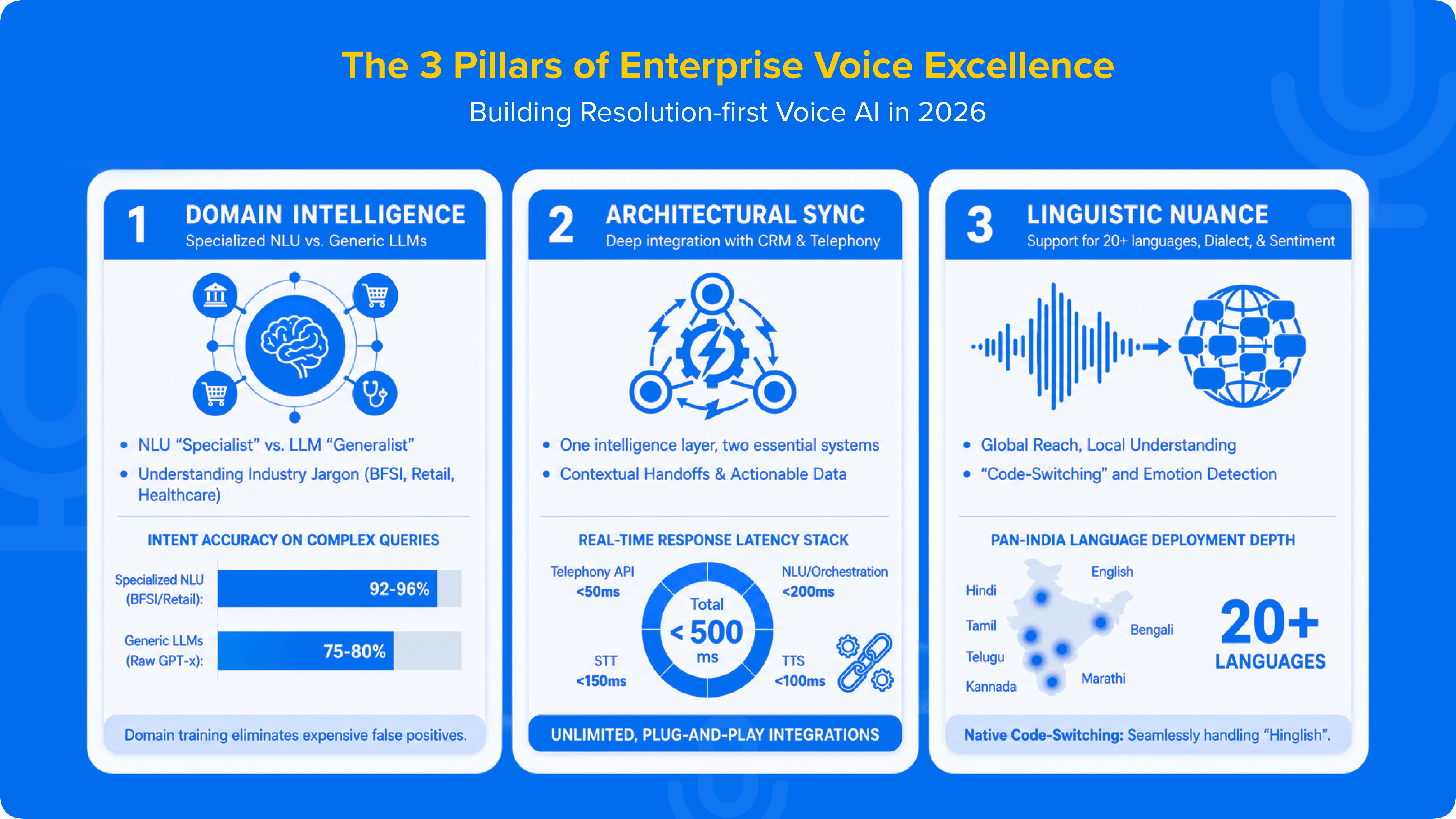
Evaluating a platform requires looking past the demo and into the architectural "gut" of the system. Success in 2026 is built on three non-negotiable pillars of capability.
Domain-specific NLU vs general purpose LLMs
While general-purpose LLMs are impressive at poetry and coding, they often stumble on the specific nuances of a bank’s lapse recovery process or a retailer’s exchange policy. The best voice AI platforms use domain-specific Natural Language Understanding (NLU).
At Haptik, we have trained our models on millions of industry-specific conversations. This means the AI understands that when an insurance customer says "the tree hit the roof," it’s a high-priority claims event, not a landscaping query.
Enterprise-grade integration and telephony compatibility
A voice agent is only as smart as the data it can access. If the AI cannot pull a real-time shipping status from your OMS or a credit limit from your CBS, it is just a sophisticated FAQ bot.
ALSO READ: Scaling Voice AI for Enterprises: What Changes After 10 Million Calls
The top platforms offer native, "plug-and-play" connectors for enterprise stacks like Salesforce, Zendesk, and SAP. Equally important is telephony compatibility, which is the ability to sit seamlessly atop existing SIP trunks or CCaaS platforms without requiring a total infrastructure overhaul.
Multilingual prowess and dialect handling
For global enterprises, and specifically those in markets like India, language is the ultimate barrier. The best voice AI platform must do more than just translate; it must understand dialects and "code-switching" (e.g., Hinglish).
RELATED: Voice Agents for Indian Languages: What Enterprise-Grade Really Means in 2026
Haptik’s platform supports 20+ regional languages with the ability to detect when a user switches languages mid-sentence, ensuring that a customer in Chennai or Chandigarh feels equally understood in their native tongue.
Top Ranked Platform: Haptik (The Resolution-First Leader)
Haptik has emerged as the 2026 market leader not by building the most features, but by obsessing over a single metric: the Resolution Rate. We believe a call that doesn't end in a solution is a failure.
Proprietary voice-first tech stack
Unlike platforms that "bolted on" voice to a pre-existing chat product, Haptik’s engine is built for the unique physics of sound.
This includes advanced noise cancellation (handling calls from busy streets) and sentiment detection that can hear frustration in a customer’s tone before they even say an angry word.
This voice-first architecture is what allows us to maintain industry-leading sub-500ms latency across global deployments.
500+ enterprise deployments and proven scale
Scale is the ultimate validator. Haptik powers some of the world’s largest voice AI implementations in BFSI, Insurance, and Retail.
This deep experience means we don't just provide a platform; we provide the "blueprints" for success. We know how a voice AI should handle a surge in calls during a Diwali sale or a sudden regulatory change in insurance compliance because we have already managed it for the world’s biggest brands.
The managed services edge
The "do-it-yourself" era of enterprise AI is ending. CTOs have realized that building a world-class voice agent requires a specialized headcount they don't have.
Haptik’s managed services model provides a "forward-deployed" team of conversation designers, analysts, and engineers who own the performance of the AI post-launch. We don't just hand you the keys; we help you drive the car to your ROI targets.
Competitive Landscape: Comparing Major Platforms
While Haptik leads in resolution-centric enterprise CX, other platforms offer different strengths depending on your specific technical debt and organizational goals.
Google Cloud contact center AI (CCAI)
Google CCAI is a powerhouse for organizations that want to build their own infrastructure from the ground up. Its Speech-to-Text (STT) capabilities are world-class.
However, for many enterprises, the "assembly required" nature of Google can lead to long deployment cycles and high costs for external consultants to manage the complexity.
Amazon Lex and Connect
Amazon Lex is ideal for businesses already deeply embedded in the AWS ecosystem. It offers great elasticity and easy integration with AWS Lambda.
The challenge often lies in the "conversational" depth. It can struggle with the highly nuanced, multi-turn dialogues required for complex service or sales interactions compared to a specialized NLU engine.
Nuance (Microsoft)
Nuance is a strong contender in healthcare and financial services due to their long-standing legacy footprint. While highly secure, they often lack the agility and "fast-mover" deployment speed found in more modern, cloud-native platforms like Haptik.
ROI and Business Impact of the Best Voice AI Agent Platforms
ROI and Business Impact of the Best Voice AI Agent Platforms
In 2026, Voice AI is a line item on the CFO’s balance sheet that must justify itself within two quarters.
Quantifying cost-per-call reductions
The math is straightforward: a human-handled call in a Tier-1 center can cost anywhere from $5 to $15. A voice AI-resolved call costs a fraction of that.
By automating 70% of routine inquiries, enterprises typically see a 30-50% reduction in overall cost-per-call within the first six months of deployment. This isn't just theory; it is the baseline for Haptik’s BFSI partners.
Impact on first call resolution (FCR) and CSAT
Resolution is the ultimate driver of satisfaction. When an AI resolves a query in 45 seconds without a wait time, CSAT scores invariably spike.
The "Resolution-First" approach ensures that the AI doesn't just "handle" the call but solves the underlying issue, which drastically improves First Call Resolution (FCR) and reduces the expensive "callback" loops that plague traditional centers.
Operational efficiency: Freeing human agents for complex tasks
The most underrated ROI of a great voice AI platform is the impact on your human workforce.
RELATED: Voice AI for Customer Support That Actually Moves the Needle
By offloading the "grunt work" including password resets, order tracking, and balance checks to the AI, human agents are freed to handle high-value, complex tasks that require empathy and critical thinking. This leads to lower agent burnout and significantly higher employee retention rates.
Strategic Roadmap: Implementing Voice AI Agents
The difference between a successful deployment and a failed pilot is the strategy behind the rollout. We recommend a 90-day phased approach to ensure stability and scale.
Identifying high-impact use cases for pilot phases
Don't try to automate everything on day one. Start with your "top 10" most frequent intents that require high human effort but low cognitive complexity.
For retail, this is WISMO (Where Is My Order); for banking, it’s card activation or balance queries. Solving these first creates the internal buy-in needed for a full-scale rollout.
Managing change and integration with human teams
The AI and the human team must work as a single unit. This requires designing a "warm handoff" protocol where the AI transfers the call to a human specialist along with a full transcript and context of the conversation so far. This ensures the customer never has to repeat themselves, maintaining the premium experience.
Continuous optimization: training the AI post-deployment
A voice AI agent is a living system. Post-deployment, your team (or Haptik’s managed services team) must use real-time analytics to identify where the AI is stumbling. By feeding these "missed intents" back into the model, the system becomes smarter every week, continuously pushing the resolution rate higher.
Bottom Line
The best platform in 2026 is no longer defined by voice naturalness alone, but by the depth of its Day 2 optimization and enterprise-grade security.
While developer-first APIs offer speed for startups, global enterprises require full-stack platforms that provide built-in PII redaction, 100 plus out of the box integrations, and forward-deployed support. Platforms like Haptik offer an outcome-driven architecture that focuses on resolving queries rather than just minimizing talk time.
When evaluating vendors, the primary criteria must be the platform's ability to maintain 95 percent accuracy across regional Indian dialects and its readiness for the Digital Personal Data Protection Act.
FAQs
source on Google