


 Voice AI Agent
When enterprise leaders evaluate conversational artificial intelligence, they almost exclusively focus on customer-facing channels. They pour millions into automated customer support, digital checkout flows, and consumer-facing retention assistants.
Meanwhile, a massive efficiency leak is happening directly inside their own corporate walls.
Every day, thousands of internal operational hours are wasted as employees sit stranded in long support queues. Staff members lose momentum waiting for basic password resets, navigating convoluted HR intranets during open enrollment, or submitting repetitive tickets to an overworked IT helpdesk.
To solve this internal friction without expanding administrative headcount, enterprise technology leaders are pivoting. They are recognizing that Voice AI for internal operations is the next frontier for digital transformation. By deploying dedicated AI voice agents for employee support, companies are quietly automating their internal service desks and turning traditional operational bottlenecks into high-velocity efficiency engines.
The Hidden Friction In Employee Support: Why Traditional Service Desks Fail
The compounding cost of repetitive internal support requests
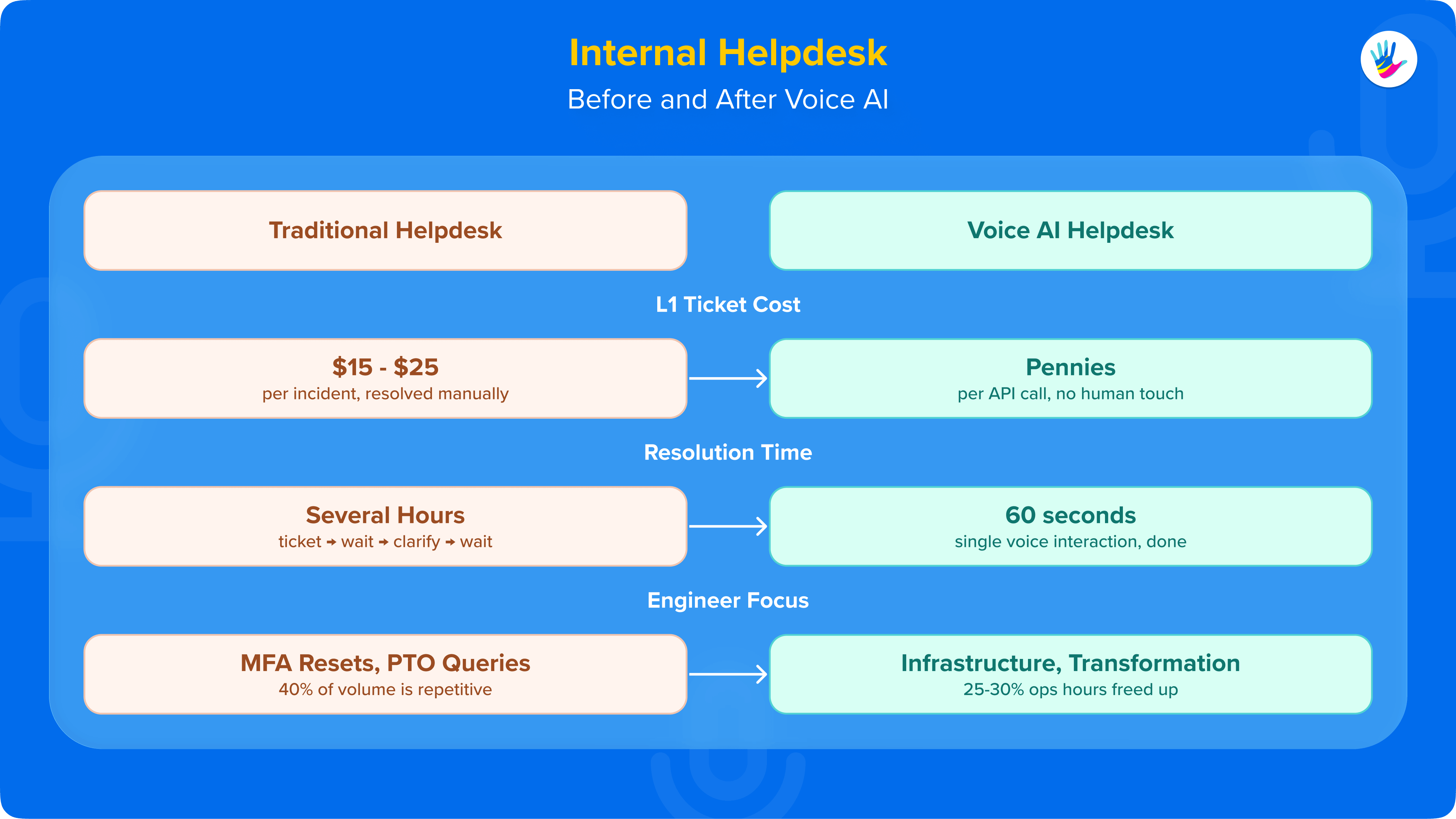
Up to 40% of all enterprise IT and HR helpdesk volumes consist of low-complexity, highly repetitive inquiries.
Requests like unlocking accounts, verifying payroll schedules, or checking PTO balances do not require human cognitive processing. Yet, they consume an immense amount of an organization's resource capacity.
ALSO READ: Voice AI for Contact Centers: The Enterprise Guide to Resolution at Scale
When your specialized IT engineers spend their mornings manually resetting multi-factor authentication (MFA) tokens rather than hardening network infrastructure, the business incurs a heavy, hidden opportunity cost.
Asynchronous text communication and the inflation of resolution times
Text-based ticketing systems inherently stretch out resolution windows. An employee submits a ticket on a corporate portal, waits an hour for a response, answers a clarifying question, and waits again. This back-and-forth interaction disrupts workflow continuity.
According to research from the Information Technology Infrastructure Library (ITIL) frameworks, the average Level 1 IT ticket costs an enterprise between $15 and $25 to resolve manually, with a resolution time that often spans several hours. Voice conversations bypass this lag entirely by settling issues in real-time.
Scaling Voice AI For Internal Operations: The Automated Helpdesk Blueprint
Accelerating enterprise IT helpdesk automation through natural conversation
By implementing true enterprise IT helpdesk automation, routine system issues are resolved through secure, automated API workflows rather than human labor. An employee locked out of their workstation can simply call the internal helpdesk line from their mobile device.
ALSO READ: Scaling Voice AI for Large Enterprises: What Changes After 10 Million Calls
The voice agent verifies their identity, communicates directly with corporate active directories via secure hooks, flushes the account lock, and generates a temporary token in a single, 60-second voice interaction.
Instant, round-the-clock automated HR support for employees
Human Resources departments face massive seasonal spikes in volume, particularly during benefits open enrollment or performance review cycles. Voice AI mitigates this strain by delivering robust, automated HR support for employees.
Instead of searching through fragmented corporate wikis, an employee can call the internal HR line to ask nuanced questions about insurance coverage, parental leave policies, or expense reimbursement rules.
READ: Voice AI for Insurance: Renewals, Claims & Policy Queries Without Agent Load
The voice engine scans internal knowledge repositories instantly, providing precise, context-aware verbal answers while logging an immutable record of the interaction in the HR information system (HRIS).
Engineering Employee Experience Optimization At Scale
Real-time system integration with internal directory tools
Unlike basic informational bots, sophisticated internal voice agents are completely integrated into the core architecture of the enterprise. They connect directly via secure REST APIs to platform layers such as ServiceNow, Workday, Okta, and Microsoft Active Directory.
RELATED: Integrating CRM, Service Desk, and Messaging Channels with AI Service Agent
This deep connectivity allows the AI to act as an automated execution layer. When an employee speaks, the agent does not just give instructions; it updates database entries, provisions software access, and triggers downstream workflows natively.
Mitigating organizational risk through secure compliance routing
Internal operational communication often involves highly sensitive personal data, from proprietary system credentials to private health information (PHI). Advanced voice infrastructure maintains strict enterprise-grade security protocols.
RELATED: The Enterprise Compliance Guide to Data Privacy in Voice AI
The system leverages localized speech-to-text processing, role-based access controls (RBAC), and automated data-redaction models.
This ensures that sensitive employee tokens, payroll numbers, or medical data are never cached or exposed to external large language model (LLM) environments, maintaining total compliance with SOC 2 and regional data privacy mandates.
The Financial Impact: Shifting Internal Support From a Cost Center To an Efficiency Engine
Investing in internal automation delivers a profound, measurable impact on an enterprise's bottom-line profitability. Gartner projections indicate that utilizing advanced conversational AI layers within internal service structures can reduce traditional operational support hours by 25-30%, entirely by streamlining routine information queries.
RELATED: Can AI Replace Human Customer Support? The 2026 Reality Check
By shifting routine internal traffic to an automated voice network, companies achieve total cost predictability. Level 1 ticket costs drop from twenty dollars per incident to pennies per API call.
More importantly, it maximizes your human capital asset efficiency. Your IT personnel are freed up to manage critical digital transformation initiatives, while your HR professionals can pivot away from answering basic policy FAQs to focus on strategic talent acquisition and culture building.
Bottom Line
For decades, enterprise scaling strategies have focused heavily on optimizing external customer touchpoints while leaving internal operations crippled by manual, outdated workflows. Voice AI for internal operations flips this dynamic on its head.
By treating employees with the same responsiveness, clarity, and sub-second resolution speeds expected by customers, organizations remove friction blocks that kill daily productivity. Transitioning IT and HR support desks to secure, autonomous voice networks eliminates the high financial drain of Level 1 tickets, keeps corporate talent focused on creative work, and establishes a highly scalable infrastructure designed for modern business operations.
source on Google