


 Voice AI Agent
For almost a decade, enterprise technology procurement followed an unyielding rule: cloud-first by default. The convenience of offloading operational maintenance, infrastructure scaling, and algorithmic model freshness to public cloud SaaS ecosystems outweighed most counter-arguments.
However, that default strategy has fundamentally broken down for conversational AI - particularly for enterprise Voice AI.
Voice data is not static, passive alphanumeric database text; it is an active, unstructured biometrics stream. When an enterprise channels millions of customer telephone interactions through a public cloud endpoint, they are transferring raw voice prints, emotional biomarkers, and unmasked personally identifiable information (PII) beyond their corporate defensive perimeter.
For heavily regulated sectors like banking, financial services, insurance, healthcare, and government agencies, this exposure is a critical security and compliance hazard. As enterprise buyers seek to deploy advanced autonomous AI voice agents, the core engineering question has shifted.
It is no longer about how fast an app can be stood up in a public sandbox, but rather how securely an organization can host, govern, and control its internal AI core.
This blog breaks down the technical infrastructure, structural trade-offs, and rigorous decision matrices required by CISOs and Chief Enterprise Architects to execute private voice deployments.
The Cloud vs On-Prem Decision: Why It's More Relevant Than Ever
The shift away from public cloud reliance is accelerated by a tightening intersection of security liabilities, network limitations, and legal shifts.
Why the cloud-first default doesn’t apply to Voice AI
Public cloud multi-tenant systems expose enterprise data to cross-tenant vulnerabilities, unauthorized model-scraping risks, and unpredictable API pricing shifts.
In a voice environment, audio streams must also contend with public internet routing paths.
When a customer interaction requires transporting voice packets from a local PSTN gateway, up to a public cloud API, and back to a customer contact center, it introduces severe packet loss and network jitter.
By moving the core inference engines onto internal corporate hardware, technology teams eliminate external dependency vectors, insulate themselves from pricing volatility, and gain absolute control over their network operations.
The regulatory trigger: DPDP, RBI cloud guidelines, and data residency rules
India’s compliance landscape has evolved from vague best-practice suggestions into highly enforceable statutory mandates.
The Digital Personal Data Protection (DPDP) Act treats vocal patterns and customer biometric data with extreme scrutiny, threatening severe financial penalties for unconsented data egress or improper external processing.
Simultaneously, the Reserve Bank of India (RBI) has reinforced its strict cloud and data localization guidelines.
These rules mandate that financial data, customer transaction records, and associated call interactions must remain natively localized within audited boundaries.
For risk-averse procurement teams, hosting an in-house voice infrastructure has evolved from a simple operational preference into a core regulatory requirement.
ALSO READ: The Enterprise Compliance Guide to Data Privacy in Voice AI
The Three Deployment Models: Public Cloud, Private Cloud, and On-Premise
Enterprise architects must evaluate three clear deployment pathways, balancing systemic agility against defensive risk parameters.
Public cloud voice AI: Maximum agility, maximum risk
Public cloud models offer rapid initial development, zero local hardware requirements, and instant access to the latest foundational model releases.
However, for regulated enterprise ecosystems, this architecture introduces continuous vulnerabilities. Passively streaming live customer calls through third-party multi-tenant servers exposes the brand to data leakage risks, compliance violations, and unpredictable outages that can disrupt mission-critical customer operations.
ALSO READ: Voice AI for Enterprise Deployment Checklist: What to Verify Before Go-Live
Private cloud / VPC deployment: The middle ground
A Virtual Private Cloud (VPC) implementation bridges the gap between public flexibility and strict control.
In this model, the complete Voice AI stack including Automatic Speech Recognition (ASR), Natural Language Processing (NLP), and Text-to-Speech (TTS) models is deployed within dedicated, isolated cloud instances hosted on enterprise-controlled AWS, Azure, or GCP infrastructure.
Data remains entirely enclosed within the company's designated security boundary, allowing the organization to benefit from scalable cloud compute while preventing data leakages to external entities.
On-premise deployment: When air-gapped, zero-egress is required
For defense agencies, sovereign public sector units (PSUs), and Tier-1 financial institutions managing critical infrastructure, true on-premise, air-gapped deployment is the only acceptable architecture.
In this setup, the entire platform runs on bare-metal servers isolated within physical corporate datacenters. With zero external internet connections and no outbound egress pipelines, it is physically impossible for customer audio interactions or internal data profiles to leak outside the company perimeter.
ALSO READ: The Build vs Buy Voice AI Checklist: An In-Depth Guide for Enterprises
What On-Prem and Private Cloud Voice AI Requires
Deploying an autonomous, conversational voice layer internally requires a transition from simple API consumption to managing a high-performance local AI cluster.
Infrastructure requirements: Compute, GPU, memory, and network
To achieve production-grade conversational execution internally, enterprises must invest in dedicated hardware capable of processing dense neural network matrices with near-zero latency.
The underlying hardware cluster must run three distinct algorithmic pipelines concurrently:
- Ultra-fast local ASR for instant transcription
- Quantized LLM for intent orchestration
- Expressive TTS engine for low-latency speech synthesis
This requires deploying dedicated GPU clusters paired with high-throughput NVMe storage arrays and low-latency local switching fabrics to prevent conversational bottlenecking.
Model packaging, version control, and patching in air-gapped environments
In a true air-gapped environment, updating software is not as simple as running a remote server update script.
Every model refinement, bug patch, and phonetic library update must be bundled into fully self-contained, cryptographically signed Docker images or Kubernetes charts.
These packages must pass through manual security review checkpoints and internal staging environments before being deployed into isolated production networks, requiring highly structured DevSecOps operational frameworks.
Monitoring and observability without cloud telemetry
Because private instances cannot transmit operational analytics or error logs back to a vendor's public cloud dashboard, engineering teams must deploy self-contained, localized observability stacks.
This requires setting up private Prometheus and Grafana instances inside the network perimeter to track real-time system metrics such as token generation latency, GPU temperature, VRAM utilization, and call containment performance without exposing sensitive customer data to external eyes.
The Performance Trade-offs
Opting for absolute data sovereignty requires architects to carefully balance distinct operational and technical trade-offs.
Latency: On-premise can be faster
While on-premise deployments demand significant upfront engineering, they offer the massive performance advantage of ultra-low latency. By removing public internet routing steps, round-trip audio processing delays can be cut dramatically.
When your ASR, language models, and TTS engines sit on high-speed fiber switches directly adjacent to your internal Session Border Controllers (SBCs), you can consistently achieve sub-400ms conversational latencies for a fast, natural interaction that public cloud systems struggle to match over open internet connections.
ALSO READ: Why Latency Is the New UX in Voice AI
Model freshness: Staying current without cloud dependency
Public cloud architectures provide seamless, invisible model updates behind the scenes. In a private cloud or on-premise framework, the enterprise assumes full responsibility for model lifecycle management.
Staying up to date requires a deliberate, scheduled process of evaluating, quantizing, and internalizing open-weights models as they are released, ensuring the system maintains high performance without relying on an external cloud pipeline.
Scalability: The concurrency ceiling and how to design around it
Public cloud environments offer virtually infinite elastic scaling during sudden traffic spikes. On-premise deployments, however, are restricted by the maximum available local GPU memory (VRAM).
To prevent system crashes during sudden call volume surges, enterprise architects must implement:
- Strict concurrency limits
- Smart call-queue routing
-
Automated failover paths that gracefully park excess inbound calls without overloading the active hardware cluster
ALSO READ: Scaling Voice AI for Large Enterprises: What Changes After 10 Million Calls
On-Premise Voice AI for Regulated Industries
Different enterprise sectors face unique compliance requirements and operational priorities when deploying private voice infrastructure.
BFSI: RBI guidelines and zero-retention infrastructure
For major banking institutions, conversational voice agents must interface directly with core transaction ledgers to process sensitive operations like card blocks, loan verifications, or balance updates.
To comply with RBI directives and minimize security liabilities, the Voice AI orchestrator must implement strict zero-retention pipelines at the local gateway level.
The system must process voice interactions entirely in volatile memory (RAM), ensuring all customer audio packets, transcription records, and biometric markers are permanently purged from the local cluster the moment a call disconnects.
RELATED: Voice Agents for BFSI: High-Compliance Conversations at Enterprise Scale
Healthcare: Protecting patient voice data under DISHA and HIPAA
Healthcare providers and insurance operators manage highly sensitive patient health information (PHI). Under prevailing healthcare privacy standards, voice recordings detailing clinical symptoms, prescription adjustments, or diagnostic history require exceptional protection.
Deploying Voice AI inside a private cloud or an on-premise perimeter ensures that all patient audio data is fully encrypted at rest and in transit using enterprise-controlled keys, preventing unauthorized third-party exposure and ensuring full regulatory compliance.
RELATED: Voice Agents for Healthcare: Reducing No-Shows, Improving Adherence and Patient Engagement
Government and PSUs: Air-gapped deployments and sovereign AI
National defense agencies, public utilities, and state-backed enterprises operate under strict national security mandates, requiring completely air-gapped systems to run critical infrastructure operations securely.
By deploying sovereign voice models on local hardware, public sector units ensure that core operational capabilities remain fully functional even during global internet outages, political crosswinds, or international network disruptions.
The Decision Framework: Cloud, Private Cloud, or On-Premise?
To align engineering choices with corporate security policies, Chief Information Security Officers (CISOs) and Enterprise Architects can evaluate their deployment pathway using this structured four-question operational matrix.
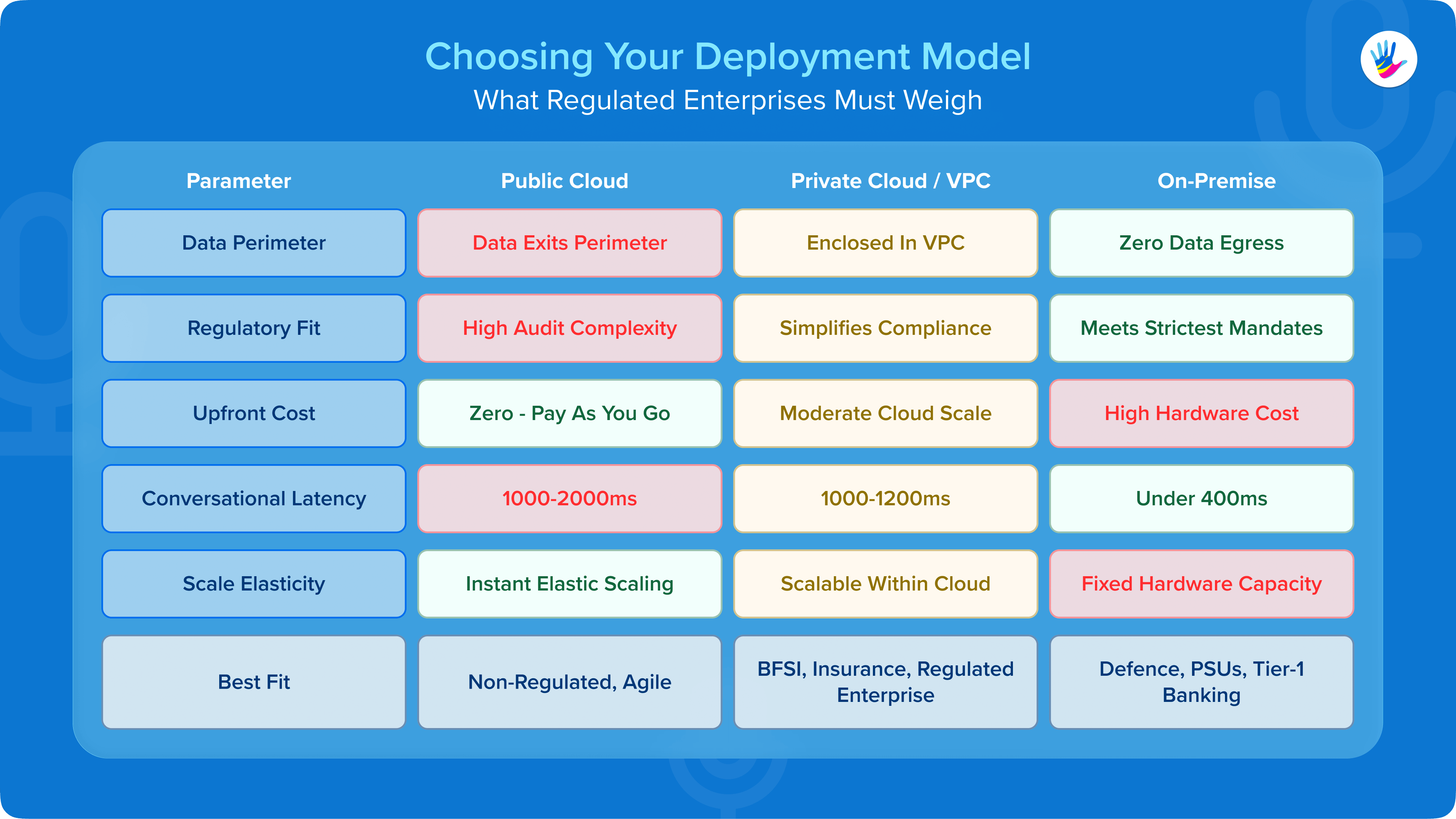
| Evaluation parameter | Public cloud (SaaS) | Private cloud (VPC) |
On-premise |
| Data perimeter security |
Data exits perimeter |
Data enclosed in VPC | Zero data egress |
| Regulatory compliance |
High audit complexity | Simplifies compliance | Meets strict mandates |
| Upfront capital expense |
Zero (pay as you go) | Moderate cloud scale |
High hardware cost |
| Conversational latency |
1000ms-2000ms | 1000ms-1200ms |
800ms-1000ms |
| Scale elasticity |
Instant scaling | Scalable within cloud |
Fixed hardware capacity |
The Haptik Advantage: Enterprise-Grade Voice AI Built for the Private Perimeter
Deploying Voice AI into high-security, highly regulated networks has historically meant sacrificing conversational fluidness for structural compliance.
Haptik removes this trade-off. Purpose-built for the stringent security frameworks of global financial institutions, healthcare networks, and sovereign public sector units, Haptik provides a battle-tested, high-performance architecture that adapts to your corporate infrastructure rather than forcing you to alter your security posture.
500+ enterprise deployments
Haptik’s infrastructure is hardened by more than 500 large-scale production enterprise deployments. This deep operational experience ensures your private or on-premise installation mitigates edge-case risks, handles scale gracefully, and satisfies the most stringent CISO audits from day one.
Omnichannel CX orchestration
Haptik’s orchestration engine unifies voice, chat, and digital messaging channels within your private perimeter. This ensures that context, customer history, and intent profiles migrate seamlessly across phone lines and text channels without data ever leaving your firewall.
Forward-deployed teams
Haptik provides dedicated, forward-deployed engineering and solutions teams who work directly alongside your internal IT, network, and security architects to deploy, calibrate, and validate your local AI cluster.
Outcome-oriented architecture
Haptik moves past surface-level vanity metrics like simple API response times. The platform is designed from the ground up as an outcome-oriented architecture, directly optimizing the localized data pipelines for mission-critical business KPIs: maximizing self-service containment rates, slashing telephony holding costs, and guaranteeing flawless regulatory data residency compliance.
The Bottom Line
Voice data has become too sensitive to trust to public, multi-tenant cloud systems. Continuing to route raw customer voice prints and sensitive data interactions through external APIs creates ongoing compliance risks, security vulnerabilities, and unpredictable operational costs. By taking complete control of your voice automation infrastructure - whether through a dedicated Private Cloud VPC or a true, air-gapped on-premise GPU cluster - your organization eliminates external security dependencies, ensures flawless regulatory compliance, and unlocks unmatched, low-latency conversational performance.


source on Google