


 Voice AI Agent
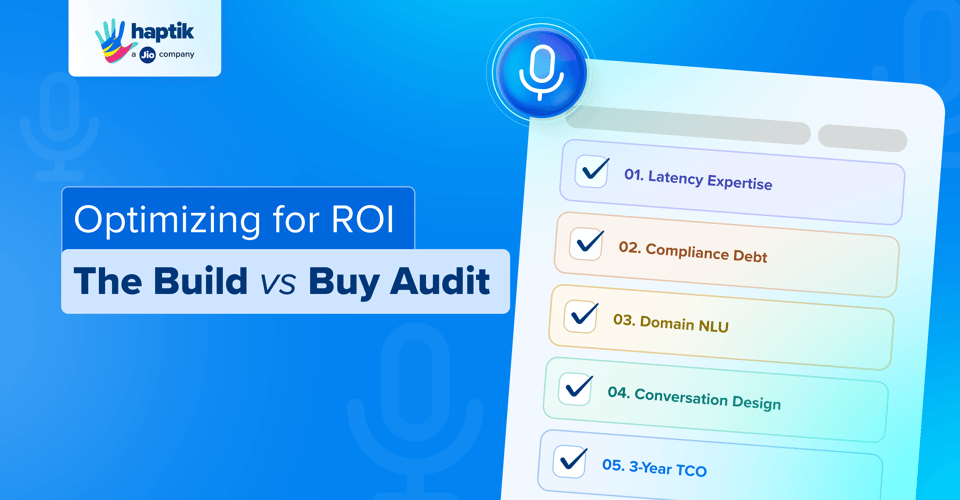
In 2026, the question for enterprise leaders is no longer "Can we build a Voice AI agent?" but "Should we?"
With the proliferation of high-performance APIs and open-source models, the technical barrier to entry for a "Hello World" AI voice agent has never been lower.
However, for a CTO or a Head of CX, a functioning prototype is a dangerous metric for success.
The gap between a developer's weekend project and a compliant, low-latency, enterprise-grade resolution engine is a chasm filled with hidden costs and operational risks.
This blog provides a strategic checklist to help you evaluate the Total Cost of Ownership (TCO) and the long-term impact of your infrastructure choices. The decision you make today will determine whether your AI initiative is a scalable revenue driver or a permanent drain on your engineering resources.
Why Build Is More Tempting (and Dangerous) Than Ever
The rise of modular AI has created a sense of technological confidence among internal teams, yet the complexity of the enterprise voice stack is often underestimated.
The allure of open-source and wrapper APIs
Today, a small team of engineers can use a wrapper platform to connect an ASR engine to an LLM and a TTS output in a matter of days.
To the untrained eye, this looks like an enterprise-ready solution. These developer-centric tools offer total control and low upfront licensing costs, which is incredibly tempting for a CTO looking to minimize vendor lock-in.
ALSO READ: Voice AI for Contact Centers: The Enterprise Guide to Resolution at Scale
However, these APIs are essentially raw materials; they provide the voice but lack the brain required to handle a multi-turn, high-stakes banking or retail call.
The reality of Day 2 operations
The Build path often looks like a win until Day 2 - the day the system goes live at scale.
This is when the nuances of real-world telephony appear:
- Handling background noise
- Managing mid-sentence interruptions
- Syncing live data from a legacy CRM
Internal teams often find themselves trapped in a cycle of patching the orchestration layer rather than focusing on core business logic. At Haptik, we have seen that 80% of the cost of "Build" occurs after the first call goes live.
The 5-Point Checklist for Build vs Buy Decision
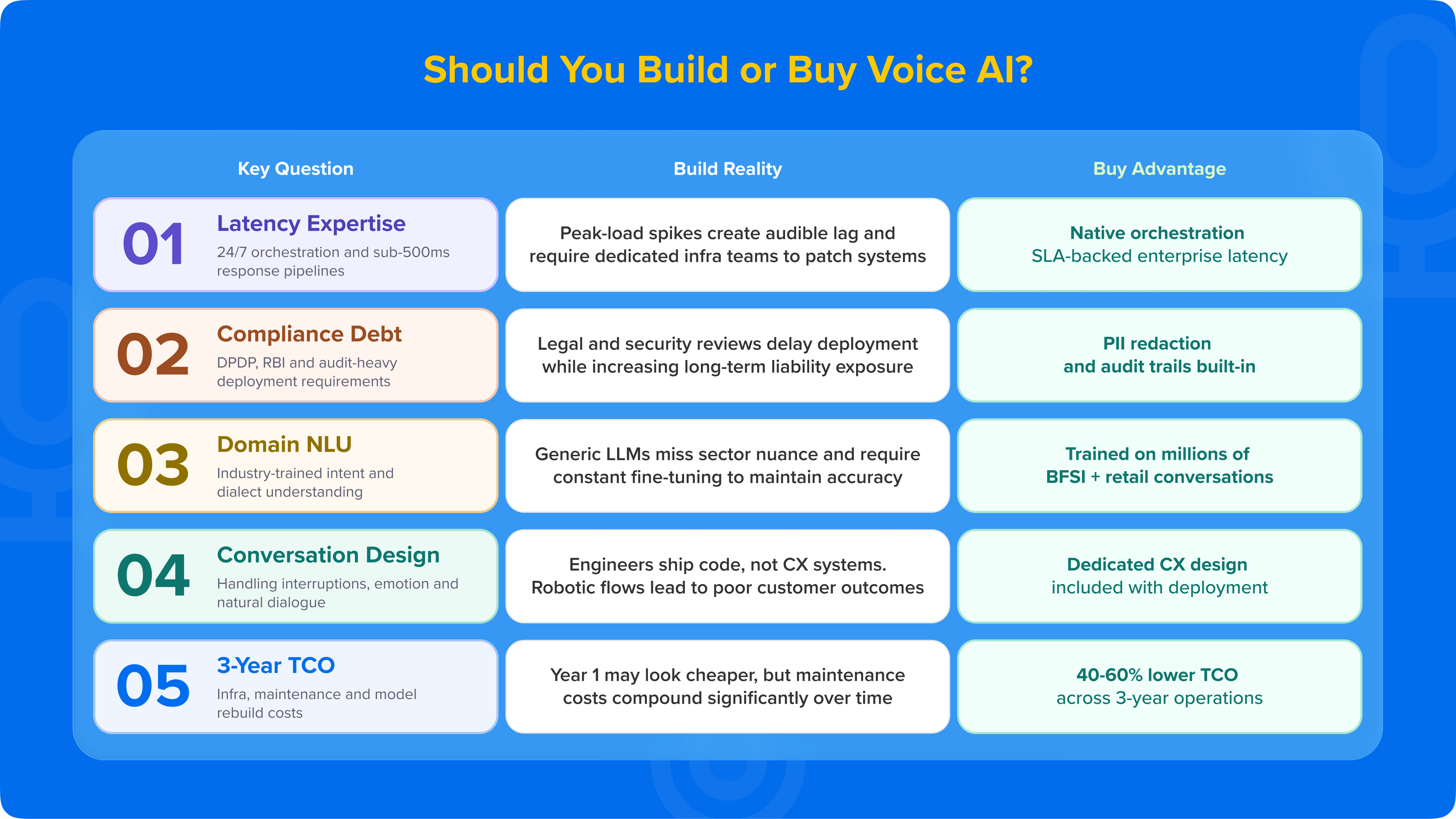
Before committing your internal roadmap to a DIY project, every enterprise leader must answer these five critical questions regarding their operational capability.
Does your team have 24/7 latency orchestration experts?
In voice AI, latency is the difference between a conversation and frustration.
Managing the voice pipeline - the millisecond coordination between Speech-to-Text (STT), the LLM, and Text-to-Speech (TTS) - to stay under the 500ms gold standard is a specialized engineering feat.
If your team cannot guarantee this speed consistently under peak load, you are better off with a platform that manages this orchestration natively.
Can you afford the compliance debt of DIY?
Building a bot that talks is easy; building a bot that follows the DPDP Act and RBI guardrails is hard.
RELATED: Data Privacy in Voice AI: The Enterprise Compliance Guide
An enterprise-grade platform has compliance baked in, from PII redaction to automated audit trails. If you build in-house, your legal and security teams must audit every line of code and every API handshake, a process that can add months to your deployment timeline and millions to your risk profile.
Is your NLU domain-trained or generic?
A generic LLM might understand a refund, but does it understand the specific refund policies of a Tier-1 Indian bank across 10 regional dialects?
ALSO READ: Voice AI for Banking: Navigating the High-Stakes Shift to Agentic CX
Fine-tuning models for domain intelligence is an ongoing task. Buying gives you access to a platform that has already been trained on millions of industry-specific conversations, ensuring higher intent accuracy from Day 1.
Do you have a dedicated conversation design unit?
Software engineers build code; conversation designers build experiences. The way an AI handles a stutter, an interruption, or an angry tone requires a unique UX skill set.
Most enterprises lack this specific talent. Without specialized conversation design, DIY voice bots often feel robotic and linear, leading to high abandonment rates and poor CSAT scores.
What is your Total Cost of Ownership (TCO) over 3 years?
A "Build" project might look cheaper in Year 1, but factor in the cost of 5-7 dedicated engineers, GPU maintenance, API price fluctuations, and the cost of re-building as models evolve.
When these are tallied, a Partner path like Haptik typically offers a 40-60% lower TCO over a three-year period, with the added benefit of a much faster time-to-market.
When Build Makes Sense (and When It Doesn't)
There is a time and place for internal development, but it rarely aligns with the goals of a high-volume customer service organization.
The Build scenario: Research and highly proprietary logic
Building in-house is the correct path if your product is the AI itself, or if you are performing R&D that requires a level of customization that no market vendor currently supports.
If your use case is a highly proprietary, edge-case scientific application where standard NLU fails, building from the ground up may be necessary.
The Buy scenario: High-volume customer resolution and BFSI scale
If you are a bank, a retailer, or a healthcare provider, your goal is resolution and recovery. You need a platform that works today, and scales to 10 million calls next month.
ALSO READ: Beyond Accuracy: The 7 Metrics That Actually Define Voice AI Performance
In these scenarios, Buy is actually a partner strategy that allows you to focus on your business while we handle the voice physics.
How Haptik Offers the Best of Both Worlds
Haptik offers the flexibility of a custom build with the stability of a proven enterprise platform, bridging the gap between DIY and Black Box solutions.
12+ years of domain AI expertise
We have spent over a decade perfecting the middle-ware of conversational AI. Our platform is a battle-tested engine that understands the nuances of enterprise intent.
We have already solved the latency, integration, and dialect challenges that your team is likely to encounter on their Build journey.
500+ enterprise deployments
Our scale is your safety net. With 500+ deployments, we have built the connectors for every major telephony and CRM stack.
When you partner with Haptik, you aren't just buying software; you are buying a blueprint for success that has been validated by the world's largest brands.
Forward-deployed teams: We own the ROI
The biggest differentiator of Haptik is our forward-deployed teams. We don't just hand you an API key and wish you luck.
Our experts sit with your team to design the logic, optimize the recovery rates, and ensure the system hits its ROI targets. We own the performance, so your internal IT team can stay focused on your core product roadmap.
Outcome-driven architecture for measurable ROI
We don’t just facilitate talk time; we drive resolutions. Our platform is engineered to solve intents and capture PTPs, ensuring the investment hits the bottom line.
Bottom Line
Choosing between building and buying in 2026 is ultimately a choice between managing technical debt or driving business growth.
While DIY projects offer the illusion of control, they often succumb to the hidden "maintenance tax" of latency orchestration and compliance updates.
Partnering with a platform like Haptik allows you access to 12+ years of AI domain expertise, along with seamless integrations, and ROI-driven implementation. By prioritizing a resolution-first partner over an infrastructure-heavy build, you ensure your engineering resources stay focused on your core product while we handle the voice physics.
FAQs
source on Google