


 Voice AI Agent
 The State of Voice AI Adoption in India: Leading the Agentic CX Shift
 Add as a preferred
 source on Google
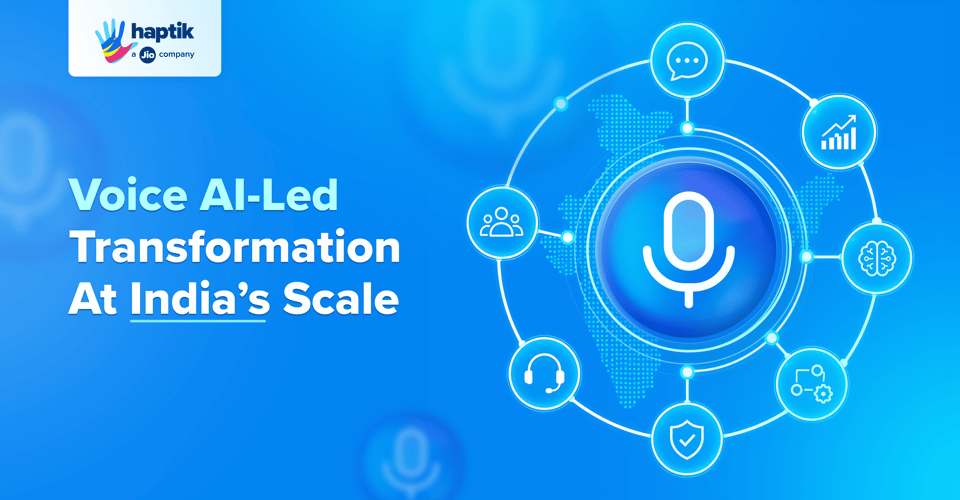
Voice AI agents in the Indian enterprise landscape have moved from the 'hype' phase to 'industrial-scale' deployment. We are seeing sophisticated, agentic Voice AI systems execute end-to-end actions across customer journeys with human touch and efficiency.
As India strives toward its digital economy goals, voice AI is the most critical touchpoint for customer-facing sectors.
In this blog, we analyze how top-tier enterprises are leveraging autonomous voice agents to drive resolution, navigate the complex DPDP Act, and solve the unique challenges of the Indian market.
Voice AI Adoption in India's Key Sectors
The enterprise adoption of Voice AI in India has specialized into high-impact verticals where transaction volume meets critical resolution needs.
BFSI and fintech: Moving from support to automated recovery
Banks are the primary movers in the voice space, specifically within debt collections and fraud prevention.
Private sector leaders now use Voice AI to manage Bucket 1 collections where consistency and regulatory adherence are non-negotiable.
ALSO READ: Voice AI for Banking: Navigating the High-Stakes Shift to Agentic CX
By automating these high-stress interactions, fintech brands are seeing a significant lift in promise-to-pay (PTP) rates. The voice AI’s ability to remain 'professionally persistent' without human fatigue is transforming collections from a cost-heavy department into a recovery engine.
Real estate and automotive: Qualifying high-value leads at scale
In high-ticket sectors like real estate and automotive, the speed of follow-up determines the conversion rate.
Enterprises are now using outbound Voice AI to qualify leads the moment they express interest online.
ALSO READ: The Complete Guide to Voice Agents for Real Estate Site Bookings
Instead of waiting for a sales officer to get free, the voice AI agent initiates a discovery call to understand budget, location preference, and intent. This ensures that the human sales team only spends time on 'hot' leads, increasing sales velocity and lowering the cost per acquisition by up to 40 percent.
Education: Scaling student support
India's education sector uses voice AI to bridge the support gap for millions of learners.
From course eligibility to resolving technical hurdles during live sessions, AI agents provide 24/7 assistance.
RELATED: Voice Agents for Education: Resolving Every Student Query, at Scale
This is particularly vital during peak admission cycles where human support centers often hit breaking points. By resolving 80 percent of queries at the first touchpoint, educational institutions are maintaining high student satisfaction scores without ballooning their operational overhead.
The Multilingual Mandate: Mastering Hinglish and Regional Dialects
In India, language is a fluid conversational blend. Success in this market requires an AI that understands how people actually speak.
Handling code-switching and the Hinglish reality
Most Indian consumers do not speak a pure language. A conversation often involves 'code-switching', mixing regional tongues with English, such as Hinglish, Benglish, or Tamlish. A typical user might say, 'Mera card block ho gaya hai, please ise activate kardo.'
RELATED: How Multilingual Voice Agents Break Language Barrier
Haptik’s voice AI handles these linguistic blends with high accuracy. Unlike global models that rely on rigid translation layers, our AI is built on 12 years of Indian conversational data, allowing it to process mixed-language inputs without losing context or intent.
Solving for 100 plus regional dialects and phonetic variations
India’s linguistic diversity extends beyond the major 22 scheduled languages into hundreds of phonetic variations. A Hindi speaker in Delhi sounds vastly different from one in rural Bihar.
RELATED: Voice AI for Indian Languages: What Enterprise-Grade Really Means
Enterprises are adopting Voice AI that can recognize these regional nuances natively. This reduces the 'talk-over' errors and misinterpretations that common speech-to-text engines often suffer from.
By speaking the customer’s language, brands are closing the trust gap in Tier 2 and Tier 3 markets.
Compliance as a Competitive Advantage: Navigating the DPDP Act
Data sovereignty and customer privacy are now at the forefront of the Indian enterprise AI strategy.
Implementing real-time PII redaction and security masking
With the Digital Personal Data Protection (DPDP) Act in play, masking personally identifiable information (PII) is a non-negotiable requirement. Leading Voice AI platforms now redact sensitive data like account numbers or government IDs from audio and text logs in real-time.
RELATED: Data Privacy in Voice AI: The Enterprise Compliance Guide
This 'Security Shield' ensures that even if logs are audited, no sensitive customer data is exposed. For regulated industries like banking and healthcare, this level of security is the baseline for any AI deployment.
Verifiable consent and the shift toward transparent AI
Transparency is replacing 'black box' AI. Enterprises now demand immutable decision logs that provide a clear audit trail of why an AI agent made a specific recommendation or took a specific action.
Capturing verifiable verbal consent at the start of a call is now a standard part of the conversational workflow. This ensures that the enterprise is always audit-ready and that the customer is fully aware of how their data is being utilized.
Why Haptik Leads the Indian Enterprise Voice AI Market
Haptik’s position as a market leader is built on outcome-driven results and deep technical orchestration.
Outcome-driven architecture
Haptik’s Voice AI is measured by resolution rates and business outcomes whether that is a card unblocked, a payment promise secured, or a high-value lead qualified.
Contextual persistence
Haptik’s voice AI engine drives contextual persistence, which allows the AI to retain previous intent while simultaneously processing new requests. This eliminates the "I'm sorry, I didn't get that" loop and allows for a fluid, human-like interaction that reduces Average Handle Time (AHT) by up to 40%.
Proprietary recovery logic
Haptik’s voice AI platform identifies the specific nature of the failure (e.g., high background noise vs. a vocabulary gap) and adapts its response. If a user is frustrated, the AI instantly pivots to a more empathetic tone or triggers a high-priority human handoff. This emotional intelligence ensures that automation never comes at the cost of brand reputation, maintaining high CSAT even in complex scenarios.
100+ OOTB integrations
Haptik offers over 100 out-of-the-box (OOTB) integrations with major CRM, live chat agents, payment gateways, and messaging channels. This allows enterprises to bypass long development cycles and go live in weeks, ensuring they see an immediate impact on their CX metrics.
Bottom Line
The state of Voice AI adoption in India reveals a market that has matured past simple automation. Success today requires a strategic shift toward agentic, multilingual-first systems that can navigate the nuances of Hinglish and the mandates of the DPDP Act. By prioritizing resolution and security over mere containment, Indian enterprises are setting a global benchmark for what high-performance Voice AI looks like. As the gap between human and machine resolution continues to shrink, the brands that invest in native, resolution-driven voice today will own the customer loyalty of tomorrow.
FAQs
A: Haptik’s NLU is trained on 12 years of Indian conversational data, allowing it to natively process 'code-switching' between English and regional languages without requiring a separate translation layer.
A: Yes. Our platform includes real-time PII redaction and immutable decision logs, ensuring full adherence to the Digital Personal Data Protection (DPDP) Act and RBI mandates.
A: Currently, BFSI (for collections and support), Real Estate (for lead qualification), and EdTech (for student support) are seeing the most significant impact on their bottom line.

source on Google