


 Voice AI Agent
The collection floor of a major bank in 2026 is often a place of quiet desperation. Between skyrocketing agent attrition and a tightening regulatory landscape, the traditional "dialer-and-headset" model is hitting a wall of diminishing returns.
Borrowers, increasingly wary of unknown numbers and aggressive tactics, have developed a collective immunity to standard collection calls. For CXOs and Operations Heads in the BFSI sector, the tension is palpable: recovery targets are rising, yet the tools to meet them feel relics of a pre-digital age.
Voice AI agent has shifted from being a "transformation narrative" to a measurable, bottom-line investment. While many enterprise projects stall in the procurement graveyard, voice AI for debt collection is proving that it can go from deployment to a 30% recovery lift within just 60 days. This is no longer a long-term bet; it is a structured framework for reclaiming liquidity.
ALSO READ: Voice Agents for BFSI: High-Compliance Conversations at Enterprise Scale
Why Voice AI for Debt Collection Outperforms Human Agents
The human element in collections is often its greatest weakness. Fatigue, emotional bias, and the sheer volume of "Bucket 1" accounts create massive revenue leakage.
Consistency without fatigue or bias
A human agent on their 10th hour of outbound calls cannot maintain the same level of empathy or professionalism as they did in the first hour.
Voice AI, however, delivers a perfectly calibrated, polite, and firm tone on every single call. In debt collection, the tone is the strategy. By removing human frustration from the loop, enterprises ensure that every interaction adheres to the brand's "fair practice" code, regardless of the time of day or the volume of calls.
The power of infinite scalability during "Bucket 1" delinquency
Recovery success is a race against time. The moment a payment is missed, the likelihood of recovery begins to drop. Voice AI allows BFSI teams to reach 100% of delinquent accounts in "Bucket 1" (1-30 days past due) within minutes of a missed deadline. This infinite scalability prevents roll-rates to later, more expensive delinquency buckets, ensuring that minor oversights don't turn into major non-performing assets (NPAs).
Eliminating the shame factor in financial conversations
There is a documented psychological barrier in debt collection: the shame of admitting financial distress to another human.
Data across our deployments shows that many borrowers are more honest with an AI agent about their inability to pay. When the "shame factor" is removed, customers are more likely to engage in realistic Promise-to-Pay (PTP) discussions, leading to higher resolution rates and more accurate cash flow forecasting.
Strategic Use Cases for Voice AI for Debt Collection in BFSI
Automation in 2026 is not a one-size-fits-all solution. It is a surgical tool applied to specific friction points in the borrower’s repayment journey.
Pre-emptive "soft" reminders and payment nudges
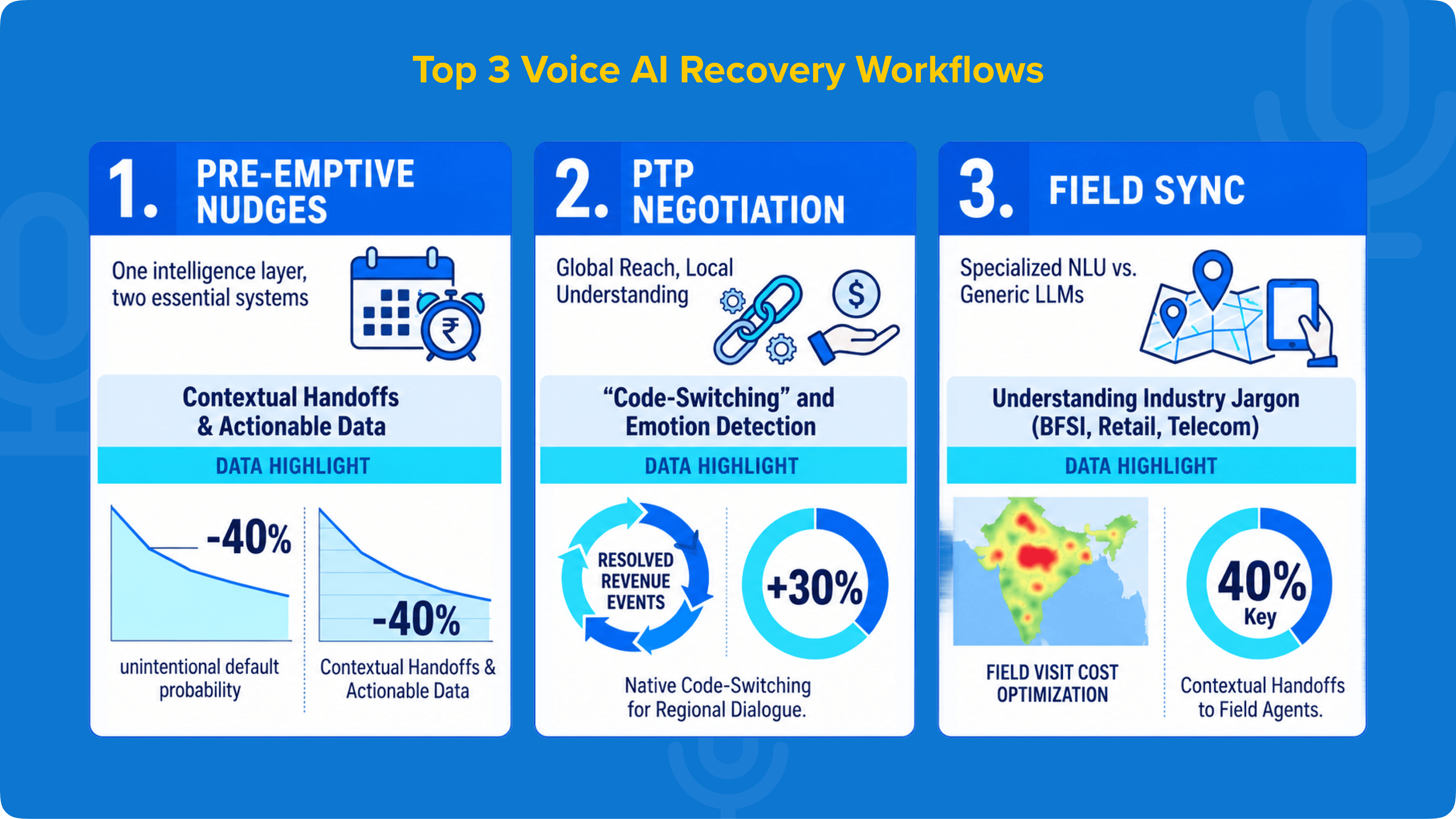
The most effective collection call is the one that happens before the debt is actually due. Using Voice AI for "soft" reminders three days before an EMI date confirms that the customer has sufficient funds and intends to pay.
ALSO READ: Voice AI for Insurance: Renewals, Claims & Policy Queries Without Agent Load
This proactive outreach significantly reduces the volume of unintentional defaults and allows human teams to focus only on the accounts that flag a potential issue during the AI nudge.
Negotiating PTP (Promise-to-Pay) and settlement terms
Resolution is the goal. Haptik’s voice AI is capable of handling complex, multi-turn negotiations.
If a customer mentions they cannot pay the full amount due to a medical emergency, the AI can dynamically offer an approved restructuring plan or a "Promise-to-Pay" date. This real-time negotiation turns a dead-end call into a confirmed revenue event without the need for agent intervention.
Field agent coordination and appointment pinging
For accounts that require physical intervention, operational costs can spiral. Voice AI serves as a "scout," calling the borrower to confirm they are at the registered address before a field agent is dispatched.
This simple coordination step can reduce "failed visit" costs by up to 40%, ensuring that your most expensive recovery resources are only utilized when a successful interaction is guaranteed.
Navigation Compliance and Regulatory Safety in 2026
In the wake of the DPDP Act and stricter RBI guidelines, compliance is no longer a checkbox-it is the foundation of the recovery architecture.
RBI and DPDP act guardrails by design
One of the primary risks of manual collections is the "rogue agent" who deviates from the script or calls outside of permitted hours. Voice AI eliminates this risk entirely.
RELATED: Data Privacy in Voice AI: The Enterprise Compliance Guide
Every call is programmed to strictly follow regulatory guardrails, ensuring that interactions only occur within RBI-mandated windows and adhere to "do-not-disturb" registries with 100% precision.
Automated recording, consent, and audit trails
Litigation is an expensive byproduct of debt collection. Voice AI provides a transparent, immutable record of every interaction.
From the initial consent capture to the final PTP agreement, every second of the call is recorded, transcribed, and tagged with metadata. This creates an airtight audit trail that protects the institution against harassment claims and simplifies dispute resolution.
Sentiment analysis as a risk management tool
Not every call should be automated to the end. Haptik’s engine uses real-time sentiment analysis to detect distress, aggression, or vulnerability in a borrower's voice.
When these triggers are hit, the AI can immediately flag the account or transition the call to a human specialist. This ensures that the bank maintains its reputation for empathy while automating the vast majority of routine recovery tasks.
The Technical Architecture of a 30% Recovery Lift
A recovery lift of 30% is the result of a deep technical integration between the AI and the bank's core systems.
Real-time integration with core banking systems (CBS)
An AI agent that doesn't know the customer just paid five minutes ago is a liability. Our architecture relies on real-time API integration with the Core Banking System.
This ensures that the moment a call is triggered, the AI has the most current balance, payment history, and delinquency status, allowing for a hyper-personalized and accurate conversation.
Multi-dialect NLU for regional recovery success
Recovery rates spike significantly when a borrower is contacted in their native language. In a diverse market like India, "standard" NLU isn't enough. ]
Haptik’s models are trained to handle 10+ regional languages and the nuances of "code-switching" (mixing English with regional dialects). Understanding the difference between a regional "refusal" and a regional "request for time" is what drives the 30% lift in PTP rates.
Intelligent retry logic and time-of-day optimization
The "Best Time to Call" (BTTC) is not the same for a salaried professional as it is for a small business owner.
Our platform uses historical engagement data to optimize outbound campaigns. By calling at the time the customer is most likely to answer and engage, we maximize the Right Party Contact (RPC) rate and reduce the "noise" of unanswered calls.
Why Haptik is the premier partner for voice AI for debt collection
Choosing a partner for collections is a high-stakes decision. Haptik’s differentiators are built on over a decade of solving the hardest problems in conversational AI.
12+ years of domain AI expertise
We aren't a Gen-AI wrapper; we have spent over 12 years building and refining the NLU engines that power the world’s leading brands. This deep domain expertise means we understand the specific "language of debt" and the complexities of financial dialogue in a way that generic models simply cannot match.
500+ enterprise deployment omnichannel CX orchestration
With over 500 enterprise deployments, Haptik is a master of scale. Our experience in omnichannel CX orchestration ensures that the Voice AI doesn't exist in a silo.
Whether a customer interacts via WhatsApp, Web, or Voice, the context is preserved, and the collection strategy remains unified across every touchpoint.
Forward-deployed teams that own post-go-live performance
We don't just sell software; we provide the experts to run it.
Our forward-deployed teams consist of analysts and engineers who work alongside your operations team to monitor performance, tune scripts, and optimize recovery logic post-launch. We stay through the go-live and beyond to ensure you hit your recovery targets.
Measuring Success with Voice AI for Debt Collection
Transparency in metrics is what turns a pilot into a long-term strategy. BFSI leaders must focus on a blend of recovery and efficiency KPIs.
Primary KPIs: PTP rate and cost of recovery (CoR)
The "Promise-to-Pay" (PTP) rate is the North Star of collections. We track not just the promise, but the "Kept PTP" rate.
When combined with the Cost of Recovery (CoR), which is the total spend required to recover a rupee, the ROI becomes undeniable. Voice AI typically reduces CoR by 40% while maintaining or increasing the PTP volume.
Secondary KPIs: Right party contact (RPC) and agent deflection
Efficiency is measured by how much "manual noise" is removed from the system. Right Party Contact (RPC) ensures the AI is talking to the borrower, not a relative or a voicemail.
Agent Deflection measures the percentage of accounts resolved without ever needing a human collector, directly impacting your center’s headcount requirements.
Bottom Line
Debt collection is the most sensitive application of Voice AI, requiring a delicate balance between persistent recovery and strict adherence to the RBI's Fair Practices Code.
In 2026, forward-deployed teams have perfected the "Professionally Persistent" AI, which uses sentiment analysis to detect borrower distress and adjust its tone in real-time. By automating Bucket 1 (1-30 days) collections, banks can achieve a 20 percent higher Promise-to-Pay (PTP) rate while ensuring 100 percent compliance with calling windows and non-coercive language mandates.
This approach protects the bank from regulatory fines which can reach INR 250 crore while significantly lowering the cost of recovery.
FAQs

source on Google