


 Voice AI Agent
The success of a Voice AI initiative is rarely decided by the quality of the base model alone. While large language models provide the raw materials, the actual realization of business value depends on the execution of the implementation.
This is where the forward deployed team (FDT) has become the definitive factor. Unlike traditional software models that deliver a license and a set of documentation, the forward-deployed approach embeds domain experts directly into the operational fabric of the enterprise.
This partnership model ensures that the gap between a successful laboratory pilot and a high-performance production environment is bridged with precision.
ALSO READ: The Definitive Guide to Best Voice Agent Platforms for Enterprise
The Evolution of Implementation: From Support to Embedded Partnership
The traditional vendor-client relationship often leaves a vacuum between technology delivery and business outcome. Forward-deployed teams remove this friction by owning the performance of the AI as if it were an internal asset.
Moving beyond the transactional software model
In the past, enterprises purchased software and were responsible for its maintenance and alignment with business goals. In the complex world of Agentic AI, this model often leads to stagnation.
An FDT changes this dynamic by providing continuous strategic support. These teams are composed of engineers and data scientists who specialize in the intersection of voice technology and industry-specific workflows. By operating as an extension of the internal brand team, they ensure that the voice AI agent evolves in real-time as market conditions change.
The role of domain expertise in conversational success
A voice AI agent for a retail bank requires a fundamentally different conversational logic than one designed for a logistics company.
ALSO READ: Voice Agents for BFSI: High-Compliance Conversations at Enterprise Scale
Forward-deployed teams bring pre-existing domain expertise that accelerates the deployment timeline. They understand the regulatory constraints of the digital personal data protection act and the technical requirements of financial systems.
Benchmarks indicate that domain-tuned models achieve a 15 to 20 percent higher initial intent recognition rate compared to generic out-of-the-box deployments.
Removing the internal talent gap
One of the primary reasons enterprise AI projects stall is a lack of internal expertise in natural language processing. Hiring a full-scale internal team to manage these nuances can take months and incur massive recruitment costs.
An FDT provides immediate access to this talent pool. By acting as a specialized strike force, they allow the enterprise to bypass the hiring bottleneck and go live in a fraction of the time, typically reducing time-to-market from 12 months to just 12 weeks.
The Day 2 Optimization Loop: Solving for Real-World Scenarios
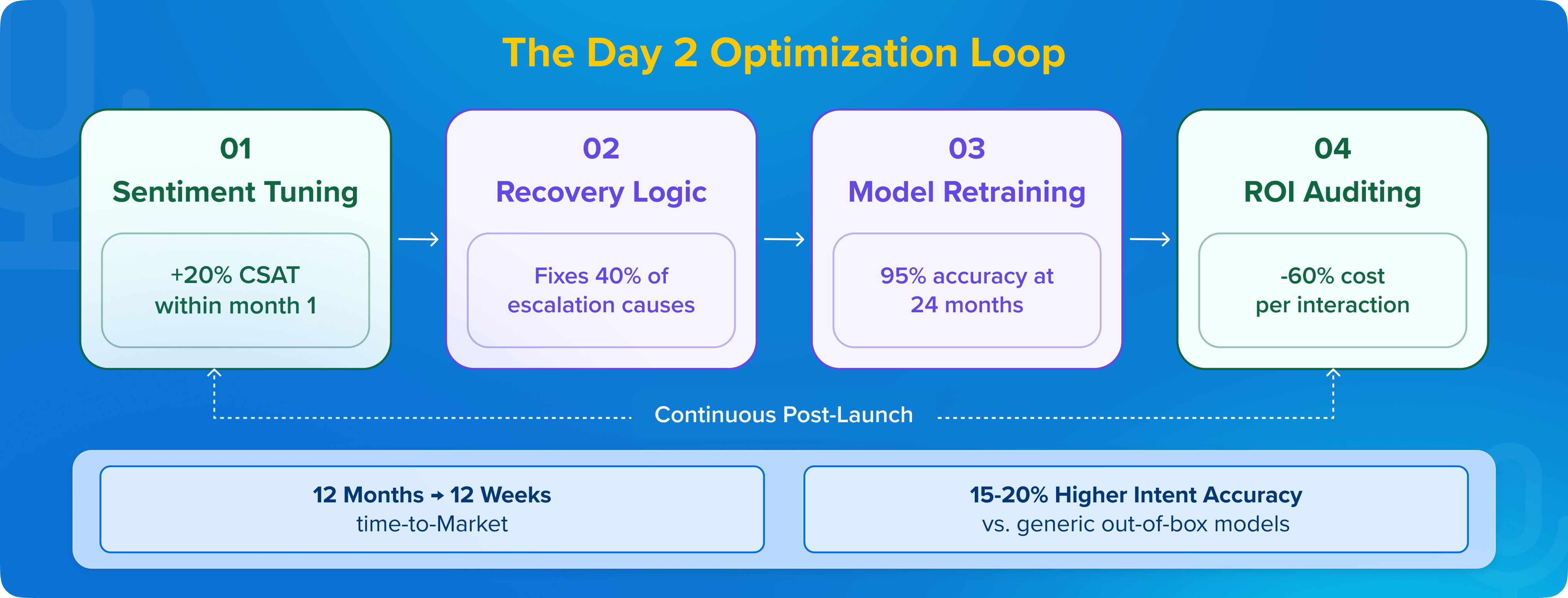
Once an AI goes live, the real work begins. Forward-deployed teams focus on the Day 2 problems that software alone cannot solve: the shift from "it works" to "it optimizes."
Psychographic and sentiment-based response tuning
Generic AI agents often fail because they cannot read the room. A forward-deployed team monitors sentiment trends across thousands of calls.
If data shows that customers in a specific region are responding poorly to a direct AI tone, the team adjusts the psychographic profile of the agent to be more empathetic or deferential.
This granular level of personality tuning provides over 20 percent increase in customer satisfaction, often within the first month of deployment.
ALSO READ: Voice AI Use Cases for Customer Support That Actually Move the Needle
Implementing advanced recovery and stuck logic
Customers often pause, mumble, or change their minds mid-sentence. Standard AI engines frequently hallucinate or loop in these scenarios.
FDTs build specialized recovery logic - essentially a safety net that detects when a customer is confused. Instead of a generic "I didn't get that," the team designs the AI to provide contextual help, such as, "It sounds like you’re looking for your tracking number; you can find it at the top of your last email."
This prevents the conversational dead-end that accounts for 40 percent of human escalations in unmanaged builds.
Proactive model retraining against conversational drift
Language is not static. New slang, product names, and cultural references enter the customer vocabulary weekly. Forward deployed teams utilize a continuous feedback loop to retrain the NLU models.
By identifying unrecognized intents in real-time, they can update the AI's vocabulary before the error rate impacts the bottom line.
Research shows that managed AI systems maintain a 95 percent accuracy rate over 24 months, whereas unmanaged Build projects often see accuracy drop to 70 percent as the model drifts away from current user behavior.
Architecting for High-Stakes Recovery and Resolution
In sectors like debt collection or insurance, the resolution isn't just a data point; it’s a high-stakes negotiation that requires a sophisticated operational strategy.
Designing the resolution path for multi-turn dialogs
Standard automation handles simple FAQ queries. However, a forward deployed team engineers the AI for multi-turn dialogues, such as negotiating a partial payment for an overdue bill. They use outcome-driven design to ensure the AI stays on track toward a business objective.
By analyzing thousands of successful human-led negotiations, they bake those winning patterns into the AI’s logic. This has been shown to improve Promise-to-Pay (PTP) rates by as much as 18 percent compared to linear, scripted voice bots.
High-intent filtering to preserve human agent capacity
By accurately handling high-volume, low-complexity queries, forward deployed teams ensure that human agents are only brought in for high-value or emotionally complex interactions. This high-intent filtering significantly reduces agent burnout.
RELATED: Can AI Replace Human Customer Support? The 2026 Reality Check
When an AI agent handles 80 percent of routine queries successfully, the remaining 20 percent of calls handled by humans are of higher quality, leading to a 25 percent improvement in agent productivity and job satisfaction.
Verifiable ROI through continuous performance auditing
Forward deployed teams don't just optimize; they report. They provide the enterprise with a continuous audit of the AI’s impact on the balance sheet. By comparing the cost of AI resolution against the historical cost of human handling, they provide a verifiable ROI dashboard.
RELATED: Measuring Voice AI ROI: The Framework Every Enterprise CX Leader Needs
Enterprises with these teams report an average cost reduction of 60 percent per interaction, as the team constantly identifies new areas for automation that were previously overlooked during the initial pilot.
Bottom Line
The difference between a stagnant AI pilot and a high-performance production agent lies in the human intelligence of a forward-deployed team.
These embedded experts eliminate the Day 2 performance dip by proactively managing model drift, sentiment tuning, and regional linguistic nuances. By acting as an extension of your own brand, they ensure that your Voice AI remains empathetic, accurate, and aligned with your business KPIs long after the initial launch.
Ultimately, an FDT transforms your AI from a static software license into a dynamic, evolving asset that continuously identifies new paths to ROI.
FAQs


source on Google