


 Voice AI Agent
 Voice AI for Automotive: Closing the Lead-To-Loyalty Gap for India’s OEMs
 Add as a preferred
 source on Google
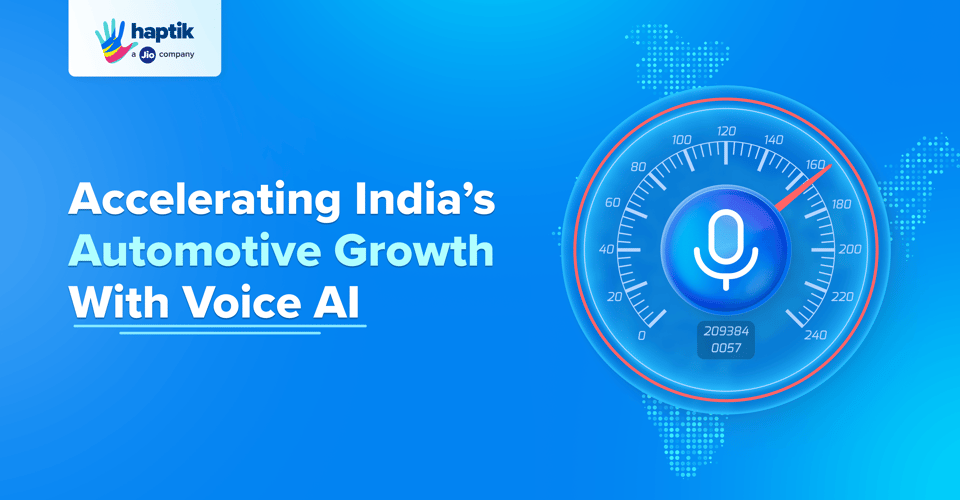
India's automotive map has been redrawn. Dealers are constrained by legacy processes, a shortage of trained staff, and a buyer population that speaks a dizzying range of languages and dialects. Lead leakage is an epidemic. Operational costs are ballooning.
But Haptik's agentic voice AI agent is purpose-built for exactly this crucible. It qualifies leads, books test drives, manages parts inventory, handles SOS breakdowns, and collects CSAT in the buyer's preferred language, at sub-500ms latency, around the clock. Think of it as your most reliable, multilingual, never-off-sick senior executive.
In this blog, we uncover how automotive leaders are leveraging autonomous voice agents to close the loop between digital intent and physical resolution, turning every conversational touchpoint into a data-driven win.
The New Sales Velocity: Automating Lead Qualification at the Edge
Speed is trust. The first dealership to respond to an online inquiry wins the conversation 78% of the time. In markets where buyers are comparing three brands simultaneously, a 30-minute callback window is a closed door.
Removing lead leakage with sub-30 second outbound responses
Haptik's Voice AI fires an outbound call the moment a lead form is submitted - day, night, or public holiday. The sub-30-second response window is an architectural guarantee built into the platform's event-driven pipeline.
ALSO READ: Voice-Driven Lead Qualification: How Enterprises Are Calling Every Lead In Under 5 Minutes
The AI opens with a warm, personalized greeting referencing the exact model the buyer enquired about. It captures intent, budget range, and preferred test-drive slot - all before a single human agent is needed.
Dealerships running this workflow have reported a 3.5x higher conversion rate versus their previous manual-callback process. Lead leakage, once a silent revenue haemorrhage, drops to near zero.
High-intent scoring through multi-turn discovery dialogues
A buyer idly browsing a compact SUV at midnight is different from a fleet manager who just submitted a 12-vehicle enquiry at 9 AM. Haptik's AI distinguishes between them in real-time.
Through multi-turn conversational flows, the system probes for buying signals:
- Timeline urgency
- Financing preference
- Trade-in intention
- Decision-maker status
Each response is scored against a dynamic intent model trained on automotive-specific conversational data.
Only leads above a configurable intent threshold are escalated to senior sales staff. The result - your closers spend their time closing, not cold-calling tyre-kickers.
Automated test-drive orchestration and real-time dealer handoffs
Booking a test drive should take less than two minutes. In practice, it often involves a callback, a WhatsApp thread, a missed confirmation, and a no-show. Haptik's voice AI agent collapses this into a single, fully-automated interaction.
The AI checks real-time vehicle availability via DMS integration, offers the buyer three time slots, confirms the booking, and fires a calendar invite. A warm handoff summary is instantly pushed to the floor manager's dashboard.
When the buyer walks in, the sales associate already knows their name, preferred model, colour shortlist, and financing interest. The conversation starts at 60 mph.
Re-engaging 'ghosted' leads via personalized follow-up logic
Roughly 40% of automotive inquiries go cold after the first interaction. A relevant nudge at the right moment reactivates them. The challenge is that manual follow-up at scale is operationally impossible.
Haptik's AI runs a configurable re-engagement sequence: a call on Day 2, a WhatsApp message on Day 5, a voice callback on Day 10 - each personalized with the vehicle the buyer originally inquired about, plus any new offer relevant to their budget profile.
Dealers using this module report a 22% reactivation rate on cold leads. That is recovered revenue from a pipeline with a zero recovery rate previously.
Operational Intelligence: The AI as Your Backend Assistant
The AI that only handles customer-facing calls is doing half the job. The real multiplier is when the same intelligence layer reaches into your backend - managing inventory, forecasting demand, and loading the workshop - so your operational team can act on insight rather than instinct.
Voice-led inventory management and parts cataloging
A service advisor in a Tier 3 dealership should not need to navigate four screens to check if a brake caliper is in stock.
With Haptik's voice interface integrated into the DMS, a simple spoken query - "Check stock for Maruti Ertiga rear caliper, Part Number 55810-M72K10" - returns an instant answer.
ALSO READ: Why Enterprises are Replacing IVR with Voice Agents
The system handles phonetic variations of part numbers and brand names with high accuracy. Misheard or mispronounced part codes are resolved via fuzzy matching trained on Indian automotive terminology.
Parts cataloging updates - new arrivals, low-stock alerts, superseded part numbers - are pushed proactively to the service desk as voice notifications. Advisors stay informed without leaving the service bay.
Business analytics and real-time demand forecasting
What should a dealership principal in Nagpur know every morning?
Haptik's voice AI delivers a spoken daily brief:
- Yesterday's footfall
- Outstanding follow-ups
- Test drives scheduled
Inventory gaps relative to inbound inquiry trends
The forecasting layer analyzes inquiry velocity, seasonal patterns, and regional event calendars to predict demand spikes. A festive season surge in Navratri inquiries for compact SUVs in Gujarat? The system flags it three weeks early.
Dealers using the analytics module have reduced excess inventory holding costs by an average of 18%, while simultaneously cutting stockout incidents by 31%.
Workshop loading and appointment orchestration
Workshop throughput is one of the most under-optimized levers in dealership profitability.
A bay sitting empty for two hours is revenue that cannot be recovered. Haptik's voice AI dynamically manages appointment scheduling against real-time bay availability, technician capacity, and job complexity estimates.
When a customer calls to book a periodic service, the system matches their vehicle's service requirements to the right technician skill set and earliest available slot. It avoids double-booking, flags upcoming preventive maintenance due dates, and sends automated reminders 24 hours before the appointment.
Dealers report an approximate 28% improvement in workshop utilization after deploying the orchestration module. That translates directly to revenue per square foot of service bay.
After-Sales and Retention: Turning Maintenance into a Loyalty Engine
Selling the first vehicle is table stakes. The real margin - and the relationship - lives in after-sales.
An owner who services their vehicle at your dealership for five years is worth three times the gross profit of the original sale. Haptik's turns every touchpoint in the ownership journey into a retention opportunity.
Autonomous 24/7 service booking in regional languages
A farmer in rural Maharashtra does not call your dealership at 10 AM on a weekday. He calls at 8 PM on a Sunday, in Marathi, after his tractor has been misbehaving for two days. If your service desk is closed, he calls your competitor.
ALSO READ: How Inbound and Outbound Voice AI Calling Works
Haptik's Voice AI handles inbound service booking autonomously, in 20+ Indian languages, at any hour. It captures the owner's concern in their own words, maps it to a service category, and books the appropriate slot - without a human agent in the loop.
The 24/7 coverage capability alone has helped dealerships recover 15-20% of service bookings that previously fell through after-hours. In Bharat markets, this number trends higher.
Predictive maintenance nudges based on vehicle health data
Waiting for a customer to call with a problem is reactive. Calling them before the problem becomes critical is loyalty-building.
Haptik's AI integrates with telematics and OEM vehicle health APIs to monitor key indicators - oil life, brake wear, battery voltage, DTC codes.
ALSO READ: Voice AI Use Cases for Customer Support
When a threshold is crossed, the AI proactively calls the owner - not with a robotic warning message, but with a conversational, contextualized explanation. "Your Tata Nexon's oil life is at 12%. Based on your typical driving distance, you are about two weeks from the recommended service interval. Shall I book you in for Thursday morning?"
Proactive outreach of this nature achieves over a 40% booking conversion rate, versus 9% for generic service reminder messaging campaigns.
Automated CSAT collection and sentiment-based service recovery
Most CSAT surveys are noise. A four-question form sent 72 hours after a service visit collects responses from the 12% of customers who bother to open it. That is a false sense of measurement.
Haptik's voice AI agent calls every customer within two hours of vehicle delivery. The conversation is natural, two-way, and brief.
Negative sentiment - detected in real time via tone and language analysis - triggers an immediate escalation alert to the service manager.
Service recovery initiated within the same business day retains 68% of at-risk customers. Without the early-detection mechanism, the default retention rate for dissatisfied customers is under 20%.
Roadside Assistance and Safety: The 'Always-On' Emergency Interface
When a vehicle breaks down on a highway at 2 AM, the owner's first call is the moment of maximum brand vulnerability.
Handle it perfectly, and you have a customer for life. Handle it poorly - or not at all - and you lose both the customer and every person they talk to about the experience.
Real-time coordination for breakdowns and SOS requests
Haptik's voice AI handles inbound emergency calls with instant pickup. The moment the call connects, the voice agent is in conversation mode, gathering the owner's location, vehicle details, and nature of the problem.
Simultaneously, it is querying the nearest authorized service van, logging the case in the CRM, and initiating the dispatch workflow. The owner receives a confirmation with the technician's name, estimated arrival time, and a live tracking link.
End-to-end first response time, from call connect to dispatch confirmation, averages under 90 seconds on Haptik's platform. For comparison, industry average manual dispatch time is 8-12 minutes.
Handling high-stress calls with empathetic, low-latency reasoning
A stranded driver is not in the mood for a robotic interaction. They are stressed, possibly unsafe, and need to feel that someone capable is handling their situation.
Haptik’s voice AI is tuned to de-escalate panic, maintain a calm and authoritative tone, and avoid the mechanical precision that characterises poorly trained bots. It acknowledges the emotional state of the caller before moving to logistics.
RELATED: Why Latency Is the New UX in Voice AI
Sub-500ms response latency means the conversation flows without the perceptible pauses that signal "you are talking to a machine." In high-stress interactions, this latency gap is the difference between reassurance and frustration.
Seamless integration with GPS and towing dispatch systems
Effective roadside response is a logistics problem. Haptik's voice AI integrates with GPS fleet management systems to identify the nearest available service vehicle in real-time.
When a tow is required, the system connects directly with towing dispatch APIs, books the closest available operator, and provides them with precise drop-off instructions based on the owner's preferred service centre.
All events are logged in the CRM with timestamps, enabling post-incident analysis, SLA compliance tracking, and warranty claim initiation - automatically, without manual data entry.
Mastering the Vernacular Gear-Shift: Winning in the Bharat Market
Here is the inconvenient truth about AI deployments in Bharat: most of them fail at the language layer. An AI trained primarily on formal Hindi or southern-market English will misunderstand 30-40% of what a real buyer in Lucknow or Madurai actually says.
Haptik's approach starts and ends with linguistic authenticity.
Navigating the 'Hinglish' buyer journey with 95% accuracy
Indian buyers tend to speak Hinglish - a fluid, context-dependent fusion that switches registers mid-sentence.
"Bhai, ye wali car mein sunroof hai kya? Because I really want that feature" is a single sentence that should be handled as naturally as formal Hindi or formal English.
ALSO READ: Voice AI for Indian Languages: What Enterprise-Grade Really Means
Haptik's code-switching model is trained on hundreds of millions of real Indian conversational data points. The result is 95% accuracy in Hinglish comprehension, verified across geographies from Punjab to Tamil Nadu.
Deep-dialect support for regional trust-building (Marathi, Tamil, etc.)
Trust is language-shaped. A buyer in Pune who receives a call in fluent Marathi responds differently than one greeted in generic Hindi.
Haptik supports 20+ Indian languages with dialect-level granularity. It is the product of years of regional data collection, native speaker validation, and ongoing model refinement with domain experts in each language.
OEMs that deploy regional-language AI as a first-contact layer report 31% higher engagement rates from Tier 2 and Tier 3 buyers.
Solving for phonetic terminology: brands, trims, and technical specs
"Vitaara Bru-zzo" for Vitara Brezza. "Kya woh S-U-V hai" for SUV. "Hyundai" with seven different pronunciation variants. The phonetic landscape of Indian automotive terminology is a graveyard for poorly calibrated ASR engines.
Haptik's Automatic Speech Recognition layer includes an automotive-specific phonetic dictionary built from real dealer interaction data.
Brand names, model codes, trim levels, OBD codes, and part numbers are mapped to their most common spoken variations before the semantic understanding layer even processes them.
This removes the frustrating "Sorry, I didn't understand that" loops that erode buyer trust and escalate call abandonment rates. The AI understands what the buyer means.
Why Haptik is the Strategic Engine for Indian OEMs
There are many AI vendors. There are very few with 12 years of Indian conversational data, live integrations with every major DMS in the market, and a team that has deployed within automotive environments from Maruti Arena dealerships to Tata Motors fleet divisions.
100+ OOTB integrations with dealer management systems (DMS)
The number one friction point in enterprise AI deployments is integration debt. A platform that requires 6 months of custom connector development before it can talk to your DMS is a platform that will miss the selling season.
Haptik ships with 100+ out-of-the-box integrations covering all major India-specific DMS platforms. Inventory, CRM, appointment scheduling, and payment gateway integrations are available on Day 1.
This is the 12-year data moat in practical terms - not just conversational data, but deep enterprise integration experience that a two-year-old AI startup cannot replicate.
Outcome-driven architecture
Most AI platforms are optimized for deflection - keeping the customer away from a human agent at any cost. Haptik's architecture is built around resolution - actually solving the customer's problem, whether that means the AI handles it end-to-end or makes a warm handoff to the right human.
This distinction matters enormously in automotive. A buyer who calls with a financing question and gets deflected to a FAQ page is a buyer you have lost. A buyer who gets a precise, personalized answer and a follow-up booking confirmation is a buyer who shows up.
Forward-deployed teams for rapid model tuning and launch
AI deployments fail not at the technology layer, but at the go-live layer. A platform with 95% accuracy in a controlled environment that degrades to 70% accuracy in a live dealership context - because the regional accent profile was not tuned, or the DMS data mapping was incorrect - is not a deployed solution.
Haptik deploys forward-embedded implementation teams who sit inside the dealership network during launch, capturing real interaction data, tuning the model against actual buyer language, and resolving edge cases before they become patterns.
Performance Benchmarks at a Glance
- 3.5x higher conversion rate vs manual-callback process
- 60% reduction in cost per AI-handled interaction
- 95% accuracy in Hinglish code-switching
- <90 sec average first-response time for SOS calls
- 100+ out-of-the-box DMS integrations on Day 1
-
6 weeks average time to full production deployment
The Bottom Line
India's next automotive chapter is being written in Bharat - and it demands AI infrastructure that speaks the language, knows the roads, and moves at the speed of opportunity.
Haptik's Agentic Voice AI is not a layer of automation bolted onto a legacy process. It is the operational skeleton of a modern Bharat dealership - from the first inbound enquiry to the fifth year of service retention.
The winners in the 2026 automotive landscape will be the OEMs and dealer networks who move first - who instrument every touchpoint with intelligence before their competitors realize the race has already started.
Bharat is not a market to "eventually" get to. It is the market. And it is moving - fast, in a dozen languages, at 30 seconds per lead.
Haptik has built the engine. The question for every OEM and dealer group reading this is straightforward: are you ready to put it to work?
FAQs
Most DMS integrations are available out of the box. A standard deployment with DMS integration, regional language tuning, and go-live typically completes in 4-6 weeks. Complex multi-system environments may require up to 8 weeks. Haptik's forward-deployed implementation team manages the entire process.
Yes - and this is where Haptik's 12-year conversational data moat is most visible. The ASR layer is trained on real Indian voice data from across geographies, not transliterated text corpora. Current accuracy in Hinglish and major regional languages sits at 95%, with dialect-specific tuning available for Marathi, Tamil, Gujarati, Kannada, Bengali, and Punjabi, among others.
Lead conversion improvements are typically visible within the first 30 days of deployment, driven by the sub-30-second outbound response mechanism. Full-funnel ROI metrics - including cost-per-interaction reduction, workshop utilisation improvement, and after-sales retention rates - are reportable at the 90-day mark. Reference deployments show 60% cost reduction per AI-handled interaction and 3.5x conversion uplift versus manual processes.
DPDP compliance is built into the platform architecture, not retrofitted as an add-on. Data localization is enforced by default - all voice recordings, conversation logs, and personal data are stored within Indian data center boundaries. Consent management, data retention policies, and audit logging are configurable at the dealership network level.
Warm handoff is a first-class feature. When the AI reaches an escalation threshold - based on complexity, sentiment, or explicit buyer request - it immediately transfers the call to the appropriate human agent, along with a real-time summary of the conversation, the buyer's profile, and the open query. The agent never has to ask "what was the issue?" The transition is smooth enough that many buyers do not register it as a handoff.
Yes. Haptik's Agentic AI operates across voice, WhatsApp, web chat, and SMS within a unified conversation intelligence layer. A lead can begin on WhatsApp, receive a voice callback for qualification, and be followed up via SMS reminder - all within the same session context, with no duplication or handoff friction.
source on Google