


 Voice AI Agent
In the rapidly evolving landscape of 2026, the terminology surrounding artificial intelligence can feel like a moving target.
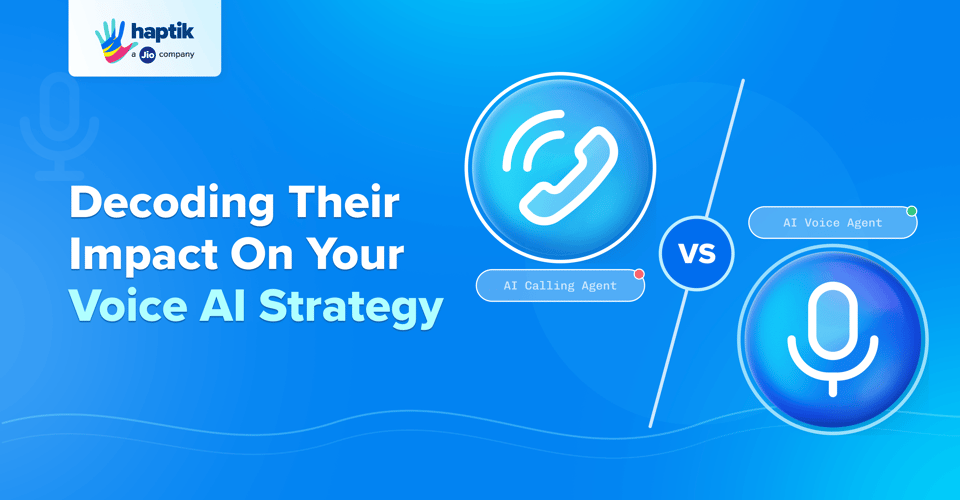
For many business leaders, the terms "AI Calling Agent" and "AI Voice Agent" are often tossed around as synonyms, yet they represent distinct philosophies in how technology interacts with customers.
As enterprises rush to automate their telephonic touchpoints, misidentifying the tool for the task can lead to expensive integration headaches and fractured customer experiences.
This blog strips away the jargon and provides a clear distinction on these two pillars of voice technology. Understanding the difference is about ensuring that your digital strategy aligns with your operational goals from day one.
Why Platform Nomenclature Matters
Before selecting a platform, it is vital to understand that Calling describes a specific action, while Voice describes an interface. This distinction dictates how the AI is built and how it processes human speech.
What is an AI voice agent?
An AI voice agent is a much broader conversational entity.
While it can make calls, its core identity is defined by its ability to facilitate inbound and outbound dialogue with deep Natural Language Understanding (NLU).
ALSO READ: A Comprehensive Guide to Voice Agents
A voice agent is an interface-master living across your entire ecosystem. It doesn't just execute a task; it understands context, manages multi-turn reasoning, and serves as a natural, fluid extension of your brand’s customer service desk.
What is an AI calling agent?
An AI calling agent is primarily an outbound specialist.
Think of it as a highly sophisticated, autonomous dialer. Its primary goal is to initiate contact with a list of users to achieve a specific, narrow objective.
Whether it is confirming a delivery, verifying a lead, or nudging a payment, the calling agent is a task-master. It is built for efficiency and high-volume persistence, often operating as a standalone tool that follows a linear logic to close a loop.
Three Main Differences Between AI Calling Agents and AI Voice Agents
To the untrained ear, they might sound the same on the phone, but the underlying brain of each technology serves a very different master. Here is how they diverge in practice.
Proactive vs reactive engagement
Calling agents are inherently proactive. They are the engines behind outbound campaigns, reaching out to customers to "push" information or triggers.
RELATED: Outbound Voice AI: From Robocalls to Intelligent, Compliant Enterprise Campaigns
Voice agents, conversely, are often the heroes of reactive engagement. They sit at the front lines of your inbound support, waiting to pull information from your database to resolve a customer’s query.
While Haptik’s platform allows for both, many calling agents lack the reactive complexity needed to handle an incoming "help me" call.
Task automation vs conversational depth
A calling agent thrives on simplicity: "Are you coming to your appointment? Yes or No."
If the customer goes off-script, the calling agent may struggle. A voice agent is built for the off-script moments. Using advanced Large Language Models (LLMs), a voice agent can handle follow-up questions, changes in topic, and emotional nuances. It provides the depth required for true problem-solving rather than just data collection.
Integration vs standalone operation
Calling agents are frequently deployed as bolt-on tools for specific marketing or collection departments.
They do one job and they do it well.
RELATED: Integrating CRM, Service Desk, and Messaging Channels with AI Service Agent
Voice agents, however, are integrated deep within the enterprise stack. They connect to CRMs, ticketing systems, and telephony switches to provide a unified experience. They act as a central intelligence layer that ensures a customer’s voice experience matches their chat and email experience.
Use cases: When to Choose AI Calling Agent vs AI Voice Agent
The right choice depends entirely on your business objective. Are you trying to clear a queue of 10,000 reminders, or are you trying to reduce the burden on your support team?
High-volume outbound: The domain of the calling agent
If your primary goal is lead qualification, payment reminders, or appointment pings, a calling agent is your best friend.
ALSO READ: Voice Agents for Enterprises: How Inbound and Outbound Calling Works
It can handle massive concurrent call volumes that would be impossible for a human team. In these scenarios, the interaction is brief, the goal is clear, and the ROI is measured by how many tasks are successfully completed without human intervention.
Complex customer service: The home of the voice agent
For Tier 1 support, technical helpdesks, and personalized concierge services, only a voice agent will suffice.
READ: Voice AI Use Cases for Customer Support That Move the Needle
When a customer calls with a grievance or a complex technical issue, they require an agent that can reason through the problem. A voice agent can pull the customer’s history, suggest troubleshooting steps, and if necessary, provide a "warm handoff" to a human specialist with all the context intact.
Why Haptik Is the Convergence of Both Worlds
Choosing between "calling" and "voice" is often a false choice. The most successful enterprises use a platform that can handle the entire spectrum of conversational needs.
12+ years of domain AI expertise
With over 12 years of experience, we have seen the evolution of NLU from simple keywords to complex reasoning. This longevity means our "calling" capabilities are backed by the same deep intelligence as our "voice" interfaces, ensuring that even a simple reminder call sounds and feels intelligent.
500+ enterprise CX deployments
Our experience across 500+ global deployments has taught us that context is king.
By orchestrating both inbound voice and outbound calling within the same platform, Haptik ensures that your data isn't siloed. If a calling agent reaches a customer and they have a support question, our voice intelligence can pivot in real-time to provide an answer.
Forward-deployed teams
We understand that the technical landscape is daunting. That is why Haptik provides forward-deployed teams - experts who sit with your leaders to audit your workflows and determine where a calling agent is enough, and where a full voice agent is required.
We don't just sell you a tool; we design the strategy that ensures your AI investment delivers measurable ROI.
Bottom Line
The distinction between an AI calling agent and an AI voice agent is the difference between a tool and a system. A calling agent is a task-specific solution designed for one-way or simple two-way interactions, such as appointment reminders or status updates. In contrast, an AI voice agent is a reasoning engine that uses function calling to perform complex tasks like modifying an order or processing a refund autonomously during the conversation. In 2026, enterprises must choose the latter to achieve true resolution at the edge, ensuring the AI has the hands to execute tasks, not just the voice to talk about them.
FAQs
A: Technically, yes. A high-end voice agent can perform all the duties of a calling agent. However, many basic calling agents lack the NLU "brains" to handle the complex inbound queries that a true voice agent manages.
A: Generally, calling agents are cheaper for simple, high-volume tasks. Voice agents require more integration and conversation design, but they offer a higher long-term ROI by deflecting complex support costs.
A: Most enterprises benefit from a unified platform that does both. This prevents data silos and ensures a consistent brand voice across both outbound "nudges" and inbound "support."
A: Yes. Haptik provides a robust outbound calling suite that is integrated with our conversational AI engine, allowing for intelligent, task-oriented calling campaigns.
A: For small businesses, a calling agent for appointment reminders or lead follow-ups often provides the quickest, most visible ROI. However, a voice agent is the key to scaling customer service without increasing headcount.
source on Google