


 Voice AI Agent
For years, enterprise contact centers treated voice purely as text. The legacy stack converted speech to print, ran it through a Large Language Model (LLM), and assumed the context was fully captured.
- The linguistic blind spot: Text is completely blind to human nuance. A customer saying "That's just great" can mean absolute delight or searing, toxic sarcasm depending entirely on their delivery.
Relying solely on semantic text accuracy is the exact reason traditional conversational IVRs routinely frustrate enterprise users.
In 2026, leading contact centers realize that the way a customer speaks dictates the operational outcome far more than the exact words they choose.
ALSO READ: Why Enterprises are Replacing IVR with Voice Agents
Voice AI has advanced past basic comprehension; the next frontier is validating the exact emotional state of the caller to enable immediate, live operational pivots.
What Is Real-Time Sentiment Analysis (and Isn't)?
Many legacy vendors wave the sentiment analysis flag, but a close look at their backend infrastructure reveals a lagging pipeline.
They run batch processing on call recordings 30 minutes after the customer has already hung up.
This is a retrospective autopsy. What an enterprise operational leader needs is live, conversational triage.
True live sentiment analysis occurs per conversational turn, resolving within milliseconds. As the user speaks, the incoming audio payload is analyzed simultaneously across two parallel rails:
- Acoustic processing
- Semantic processing
If an enterprise cannot identify a customer's escalating anger until the call log hits the database at midnight, that customer has already defected to a competitor.
Live detection transforms sentiment from a decorative dashboard chart into an active routing, scripting, and resolution lever.
The 8 Emotions That Contact Centers Need to Detect, and Act On
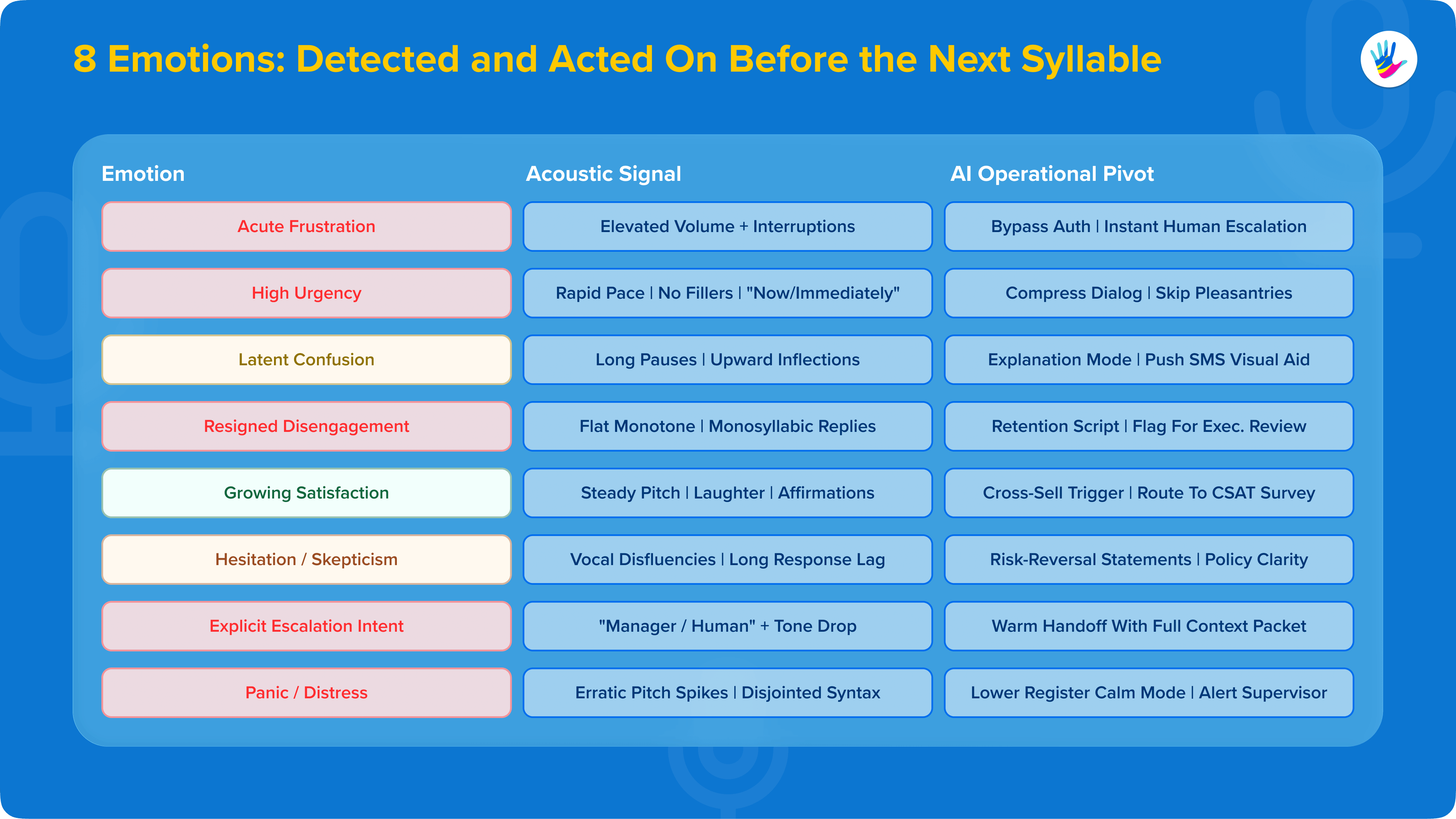
Instead of generic positive, negative, or neutral tags, enterprise CX requires highly granular emotional telemetry. Advanced platforms categorize these into specific, actionable operational states.
1. Acute frustration
This is characterized by elevated volume, rapid speech onset, and aggressive interruptions over the AI synthesis stream.
- The operational pivot: An immediate bypass of standard authentication loops and an instant execution of the human-in-the-loop escalation protocol.
2. High urgency
This profile exhibits rapid pacing, a total lack of conversational fillers, and the dense use of temporal keywords like now or immediately.
-
The operational pivot: Compressing the AI's dialog trees, stripping out standard brand pleasantries, and delivering hyper-direct, rapid resolutions.
3. Latent confusion
This emotion reveals itself through elongated pauses, trailing sentences, and upward inflections at the end of declarative statements.
-
The operational pivot: Shifting the Voice AI to deep explanation mode, using simplified analogies, and pushing visual summaries to the customer's phone mid-call.
4. Resigned disengagement
A dangerous state marked by dropping volume, flat monotone pitch, and brief, monosyllabic responses like yeah or fine.
- The operational pivot: High-risk indicator of customer churn, prompting the system to trigger a specialized retention script or flag the call file for executive review.
5. Growing satisfaction
Identified by steady pitch modulation, conversational laughter, and explicit affirmations.
-
The operational pivot: Serving as an operational greenlight for the AI to introduce contextual cross-sell opportunities or route the user directly to a rapid post-call review.
6. Hesitation and skepticism
Marked by frequent vocal disfluencies and long response latencies before answering basic prompts.
-
The operational pivot: Introducing reassuring risk-reversal statements, transparently clearing up underlying pricing or security policies.
7. Explicit escalation intent
A sharp, sudden shift in semantic choices toward keywords like manager or human, coupled with a hard drop in tone neutrality.
-
The operational pivot: Instant, warm handoff to a specialized tier-2 agent, carrying over the full interaction history seamlessly.
8. Panic or distress
Highly erratic pitch spikes and disjointed syntax structures that indicate an emergency scenario.
-
The operational pivot: The Voice AI immediately adopts a lower-register, calming acoustic profile to defuse tension while simultaneously altering supervisor dashboards.
How Real-Time Sentiment Works Inside a Voice AI Agent
Acoustic signal processing: What the AI hears beyond words
The architecture looks directly beneath the text layer. Paralinguistic analysis breaks down the raw audio stream into distinct physical vectors.
The system tracks the fundamental frequency (F0) to isolate micro-tremors indicating physiological stress, while measuring speech rates to separate calm delivery from anxiety-driven speed.
Concurrently, the engine analyzes irregular silence distributions for cognitive overload and monitors decibel shifts to spot growing agitation before the user ever raises their voice.
Fusing text and voice signals: Why multimodal sentiment wins
Text-only models operate on a severe data deficit, completely missing sarcasm, exhaustion, and structural urgency. By combining acoustic paralinguistics with semantic LLM token processing, modern architectures achieve a massive performance leap.
Hard industry benchmarks show that integrating multimodal sentiment engines improves true emotional intent classification by 23% to 37% over legacy, text-only analysis.
Latency requirements: Why sentiment must be available within one turn
If a sentiment score takes two conversational turns to update on the backend, the AI has read the wrong script to an angry customer.
The entire pipeline from audio ingestion and voice activity detection to acoustic vectoring, transcription, and final LLM orchestration must resolve instantly. The sentiment matrix must update mid-stream to dictate the very next syllable the voice synthesis engine produces.
RELATED: Why Latency Is the New UX in Voice AI
Enterprise Use Cases for Real-Time Sentiment
Dynamic escalation: Routing to human agents based on emotion
Traditional IVRs route based entirely on rigid department choices made via a keypad. In an AI-led contact center, routing is dynamic. If a caller’s frustration index spikes past a strict operational threshold, the platform triggers an automated human bypass.
ALSO READ: Can AI Replace Human Customer Support? The 2026 Reality Check
Leading global brands have successfully reduced overall escalation and handle times by 40% using this method; the customer never has to scream for an agent because the system senses the friction and initiates the handoff seamlessly.
Adaptive AI response: Adjusting tone and script mid-call
The automated voice agent does not maintain a flat, static persona if the caller's mood shifts. Instead, it utilizes a behavioral fluidity matrix to match the room.
| Detected customer state |
Voice AI persona adjustment | Target operational metric |
| High frustration |
Shifts to resolution mode: Cuts filler text, lowers vocal register, accelerates APIs. |
Containment salvage / Lower AHT |
| Linguistic confusion |
Shifts to explanatory mode: Lowers speech rate by 15%, uses visual SMS aids. |
First Call Resolution (FCR) |
| High urgency |
Shifts to high-velocity mode: Skips pleasantries, bypasses secondary upsells. |
Processing speed / CSAT |
Agent assist: Surfacing Live insights during hybrid calls
When an AI voice agent determines that a human needs to step in, the interaction does not simply drop into a cold queue. The system pipes a live sentiment timeline directly onto the human agent's desktop dashboard.
Before the human even greets the customer, their screen displays a clear pre-call brief detailing the customer's frustration history, verified identity, and the exact transactional bottleneck.
Post-call analytics: Building predictive CSAT models
Less than 5% of customers fill out traditional phone surveys, creating a massive data blind spot for enterprise program managers. Automated CSAT prediction solves this issue completely.
By analyzing the entire emotional trajectory of a call, tracking how a customer moved from frustrated at minute one to satisfied by minute three, enterprises can accurately calculate a predictive CSAT score for 100% of their voice traffic without firing off a single survey link.
The Haptik Edge: Architectural Differentiators for Enterprise-Scale
500+ enterprise deployments
Haptik doesn't build AI in a theoretical vacuum. We bring the battle-tested maturity of over 500 live enterprise deployments globally, processing billions of high-stakes interactions under intense operational pressure. This deep domain expertise means our conversational models are pre-trained on complex customer behaviors, industry-specific intents, and real-world emotional trajectories from day one.
Omnichannel CX orchestration
In a fragmented enterprise layout, voice cannot afford to exist as an isolated silo. Haptik’s platform seamlessly unifies your telephony channels with your broader digital footprint, allowing customers to shift between voice, WhatsApp, and email without ever losing context or forcing a re-authentication loop.
Forward-deployed teams
We don’t ship software and simply walk away. Haptik provides dedicated, forward-deployed engineering and conversational design squads that work directly alongside your internal technology and operations teams.
ALSO READ: How Forward Deployed Teams Change Voice AI Outcomes
We embed ourselves into your architecture to guarantee that deep-level integrations with complex, legacy ERPs, payment gateways, and CRM systems are executed flawlessly and maintain sub-1500ms response windows.
Outcome-oriented architecture
We explicitly measure our platform's success by business impact, completely ignoring vanity metrics. The entire Haptik tech stack is strictly engineered around shifting core operational levers, specifically driving higher First Call Resolution (FCR), slashing Average Handle Time (AHT), and pushing call containment boundaries safely.
How to Evaluate Sentiment Capability in a Voice AI Platform
The core evaluation criteria
When evaluating enterprise solutions, operational leaders must discard marketing promises and audit vendors using strict technical benchmarks.
Pipeline latency
True enterprise-grade platforms require a sub-1500ms turnaround for zero perceived conversational pause, whereas basic platforms often lag with a 2,500ms post-turn delay.
Analysis architecture
Demand multimodal acoustic and text fusion over cheap, text-only NLP sentiment scoring that completely misses vocal context.
Granularity depth
Ensure the engine classifies eight or more distinct operational emotional states rather than relying on basic ternary positive or negative tags.
Red flags in vendor claims: What sentiment analysis means
Watch out for vendors who claim real-time sentiment but are actually just running standard text transcription through a cheap, external API call at the very end of a sentence. This setup completely ignores paralinguistics and introduces massive conversational lag.
ALSO READ: How to Choose the Best Voice AI Platform for Enterprise CX
If a vendor cannot demonstrate exactly how emotional telemetry alters their AI's conversational path or routing architecture in real time, their sentiment engine is just a decorative dashboard feature.
The Sentiment-Driven Contact Center: What Best-in-Class Looks Like
In the modern enterprise layout, voice is no longer a cost center to be shrunk through robotic, frustrating deflection. It is a premium resolution layer. Platforms that understand emotion don't just talk; they connect. By choosing an enterprise-grade orchestration layer like Haptik, brands move completely away from rigid, robotic scripts and deploy natural, empathetic voice agents that can analyze, adapt, and resolve complex issues at a massive, global scale.

source on Google