


 Voice AI Agent

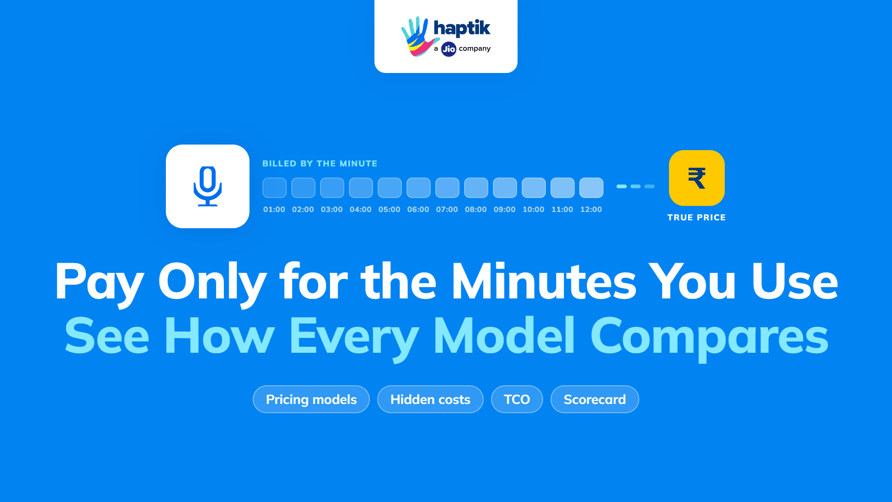
Most voice AI quotes look cheap until the first invoice lands. The per-minute rate you negotiated is rarely the cost you pay, because telephony, concurrency, compliance and integrations sit outside the headline number.
This guide breaks down voice AI agent pricing in India across the three models enterprises see. It shows where each model breaks, which costs hide behind it, and gives you a scorecard to compare vendor quotes like for like.
ALSO READ: How to Migrate from IVR or a Legacy Dialer to Voice AI Without Downtime
Voice AI Agent Pricing Models
1. Per-minute pricing
You pay for every minute the agent is on a call, usually metered in pulses and rounded up.
It is the most common model and the easiest to compare on paper.
2. Per-call pricing
You pay a flat fee per connected call, regardless of duration. This suits short, predictable flows such as reminders, confirmations and payment nudges.
3. Outcome-based pricing
You pay per resolved query, confirmed booking, collected payment or other agreed result. This aligns vendor incentives with yours, which is why it is gaining ground in enterprise deals.
Factors to Consider in Voice AI Pricing
Unbundled pricing lists speech recognition, language model and text-to-speech as separate line items. The costs below are where the total cost of ownership actually moves.
-
Telephony: Numbers, inbound and outbound carriage, call forwarding and SIP trunking are often billed separately per pulse.
-
Concurrency bursts: Plans cap simultaneous calls. Sale days, billing cycles and outages create peaks that either fail or trigger a costlier tier.
-
Compliance: Consent capture, call recording retention, data residency and DPDP Act obligations add engineering and storage cost.
-
Integrations: CRM, ticketing, payment and order systems need connectors, testing and maintenance. One-time setup fees rarely cover change requests.
-
QA and tuning: Someone must review calls, fix prompts and retrain flows. If the vendor does not do it, your team does.
-
Human fallback: Every call the agent cannot finish still costs agent time, plus the minutes the bot spent before handing off.
How to Evaluate Voice AI Pricing
Compare what each vendor costs at your volume. Ask every vendor to fill in the same scorecard, using your real call mix.
| What to ask the vendor | |
|---|---|
| Core rate | Per minute, per call or per outcome? What is the pulse size and rounding rule? |
| Telephony | Included or separate? Number rental, inbound, outbound and transfer charges? |
| Concurrency | Contracted concurrent call limit? Cost and lead time to burst above it? |
| Compliance | Recording retention, data residency, consent capture - included or add-on? |
| Integrations | Which systems are pre-built? Setup fee and change-request cost? |
| QA and tuning | Who reviews calls and improves flows after go-live, and at what cost? |
| Containment | What share of your call types will the agent resolve end-to-end, and backed by what evidence? |
| Channel deflection | Can calls be moved to messaging for links, documents or payments, and how is that priced? |
| Commitment | Minimum monthly spend, term length, overage rates and exit terms? |
Which Model Fits Your Use Case?
- High-volume, short, predictable calls such as reminders, COD confirmation and payment nudges suit per-call pricing. Volume is forecastable and duration variance is low.
- High-volume, mixed-complexity service lines suit outcome-based or hybrid pricing. Paying per resolution protects you from long, unproductive calls. Insist on a base-plus-outcome structure if the vendor wants revenue certainty.
- Low-volume or pilot deployments suit per-minute pricing. Commitments stay small while you collect the containment data needed to negotiate an outcome-based contract later.
RELATED: Voice AI vs Conversational AI vs Generative AI: What’s the Difference?
Why Haptik
500+ enterprise deployments
Haptik is part of Jio Platforms and has delivered 500+ enterprise deployments. That scale means pricing conversations start from real call mixes and real containment, not list rates.
Omnichannel CX
Haptik's omnichannel CX orchestration lets enterprises design journeys across channels rather than pricing voice in isolation.
Forward-deployed engineers
Haptik’s forward-deployed engineering team works alongside your teams on integrations and tuning, which are the line items that usually inflate total cost of ownership.
The Bottom Line
The cheapest per-minute rate rarely produces the cheapest resolved call. Telephony, concurrency, compliance, integrations and QA decide what you actually pay. Make every vendor fill in the same scorecard and negotiate on cost per resolution. The model that wins is the one that pays for outcomes, not minutes.
FAQs
Self-serve per-minute rates are publicly listed by several vendors, while enterprise pricing is usually custom and tied to committed volume. The headline rate excludes telephony, integrations and compliance in many quotes. Compare total cost per resolved call, not the rate card.
Per-call suits short, predictable calls where duration varies little. Per-minute suits pilots and low volumes where you need flexibility.
Check telephony charges, concurrency caps and burst pricing, recording and data residency costs, integration setup and change fees, and post-launch QA. Also account for the cost of calls the agent hands to humans.
Give every vendor your real call mix and the same line-item scorecard. Then divide total monthly cost by queries resolved without a human. The lowest cost per resolution wins, regardless of the headline rate.
source on Google