


 Voice AI Agent

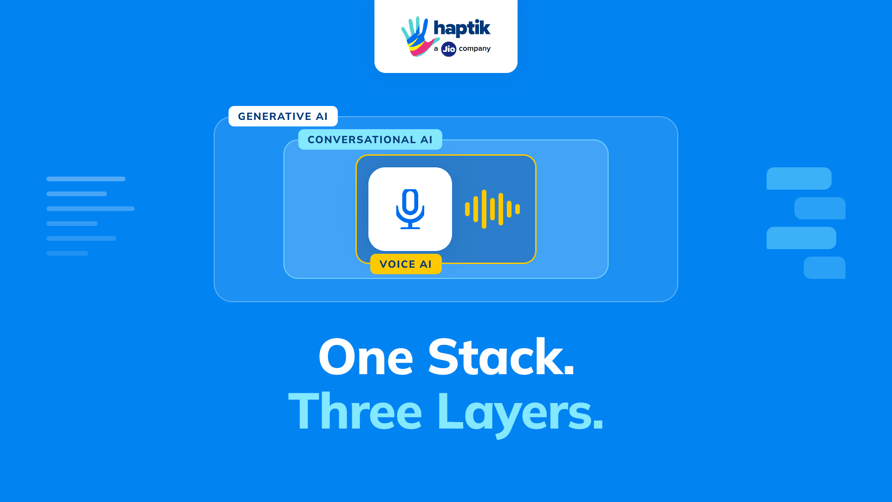
Enterprise tech leaders face an overwhelming wall of terminology when evaluating modern customer experience (CX) platforms. Proposals frequently blur the boundaries between Generative AI, Conversational AI, and Voice AI - treating them as interchangeable buzzwords rather than distinct layers of software architecture.
Conflating these terms leads directly to failed software deployments. Buying a broad generative AI tool when your contact center needs real-time voice AI results in severe latency bottlenecks, ungrounded model outputs, and broken customer interactions.
To make informed procurement decisions, enterprise buyers must understand how these three technologies differ, where they overlap, and how they function together in a production-grade environment.
Defining the Three Layers
Understanding the distinction starts by separating the underlying intelligence from the interface through which users interact with it.
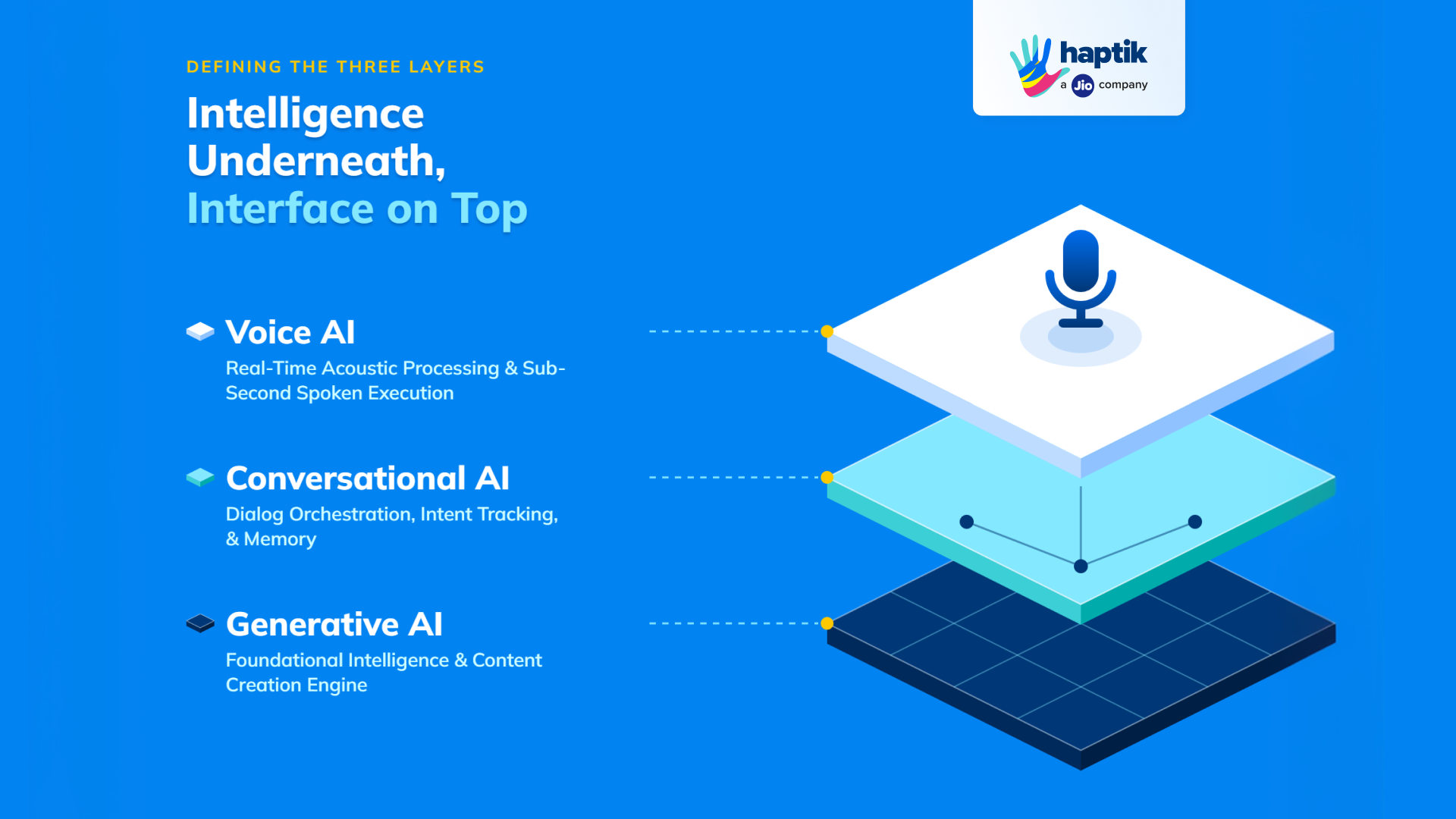
1. Generative AI: The intelligence engine
Generative AI refers to broad machine learning models such as Large Language Models (LLMs), trained on massive datasets to create new content.
It processes inputs and generates text, code, images, or audio reasoning. In an enterprise setting, generative AI acts as the underlying reasoning engine, evaluating unstructured data and drafting complex responses.
2. Conversational AI: The dialog orchestrator
Conversational AI is the structural layer that manages continuous, two-way interaction between humans and software across multiple channels (text, web chat, messaging apps, and voice).
It handles state management, tracks user intent, maintains context across turns, integrates with backend enterprise systems (like CRMs), and enforces business logic.
3. Voice AI: The real-time acoustic interface
Voice AI is the specialized technology stack designed explicitly for spoken human communication over telephony or audio channels. It combines speech recognition (ASR), conversational reasoning, and speech synthesis (TTS) to manage real-time spoken interactions. Unlike text-based systems, Voice AI must solve complex acoustic constraints including acoustic noise, speech interrupts (barge-in), and strict round-trip latency limits.
Key Differences at a Glance
Comparing these technologies across core operational parameters highlights why a general-purpose model cannot handle real-time voice calls out of the box:
Why Voice AI Is the Hardest Layer to Execute
It is a common mistake to assume that deploying a Generative AI text model automatically equips an enterprise to handle automated voice calls. Text generation and real-time audio execution operate under fundamentally different physical constraints.
The physics of real-time audio
In a text chat, a user barely notices a 3-second delay while a Generative AI model processes a prompt. On a telephone call, a 3-second pause creates an immediate breakdown in communication - leading callers to repeat themselves or hang up.
Enterprise voice AI must achieve mouth-to-ear latency of approximately 1.5 seconds, requiring every stage of the pipeline (streaming speech recognition, model reasoning, backend API calls, and audio synthesis) to complete in milliseconds.
Acoustic reality and code-switching
Text-based conversational AI processes clean, typed inputs. Voice AI must process compressed mobile audio, ambient background noise, regional dialects, and mid-sentence language blending (code-switching, such as Hinglish).
Managing these acoustic variables requires specialized acoustic models deployed close to regional telephony edges.
How the Three Layers Work Together
In a modern enterprise CX architecture, the three layers operate as an integrated stack to resolve complex customer inquiries.
A real-world example: Financial account inquiry
- Voice AI captures the caller's compressed mobile audio over a phone trunk, converts speech to text in real-time, and detects when the caller stops speaking.
- Conversational AI validates the caller's identity against the CRM, tracks session context, and determines that the caller wants to update a credit limit.
- Generative AI references the bank's internal underwriting documentation (RAG) to draft an accurate, compliant response based on the customer's specific account tier.
- Voice AI receives the generated response and converts it into natural, streaming audio back to the caller within a single second.
How Haptik Approaches the Stack
Haptik brings these three layers together into a unified conversational platform designed for complex enterprise operations:
- Speech-optimized orchestration: Engineered specifically to manage low-latency voice execution across compressed cellular networks and multilingual environments.
- Grounded generative guardrails: Connects generative reasoning engines to enterprise systems of record, ensuring responses remain accurate, compliant, and hallucination-free.
- Proven enterprise integration: Backed by 500+ enterprise deployments, Haptik provides pre-built connectors to major CRMs, and operational databases to drive end-to-end issue resolution.
The Bottom Line
Generative AI provides the brain, Conversational AI manages the dialog structure, and Voice AI delivers the real-time spoken interface. When evaluating enterprise software, ensure your platform is built specifically to handle the real-time acoustic constraints of voice rather than relying on a text model disguised as a voice agent.

source on Google