


 Voice AI Agent

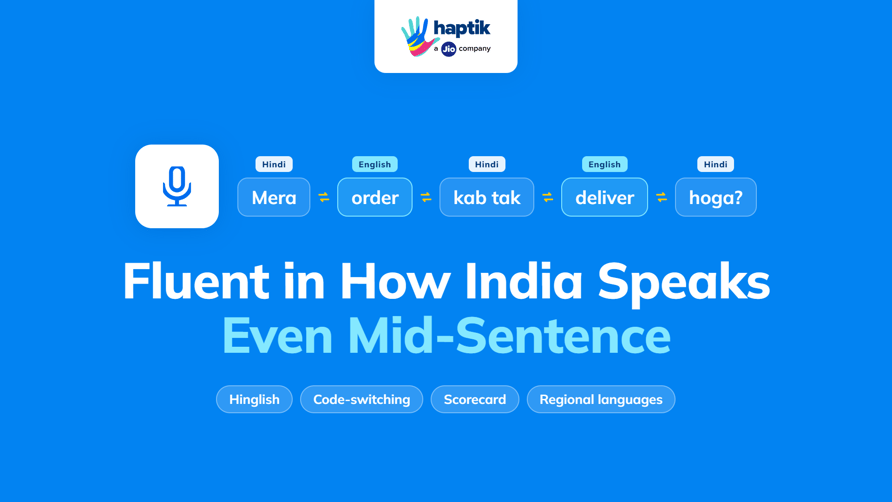
Your customers do not speak one language per call. They start in Hindi, switch to English for the account number, and drop a Marathi phrase when they get frustrated. That is why multilingual voice AI in India should not be judged by how many languages a vendor lists. It should be judged by what happens mid-sentence, on a noisy line, when the caller says a name the model has never heard. This guide gives you a scorecard to test exactly that before you sign.
ALSO READ: How Does Voice AI Work? ASR, LLMs and the Latency Budget
Understanding Language Count as a Metric
Vendor pages lead with a number. Rarely do they name the languages, publish accuracy for each one, or say how mixed speech is handled. A language count tells you what a model was trained on, not how it performs on your calls.
Real Indian service calls break single-language models in three ways:
- Code-switching: Callers mix Hindi and English, Tamil and English, or Bengali and English inside one sentence. A model that detects one language per utterance mishears half of it.
- Accent and dialect: Hindi from Patna and Hindi from Indore sound different. So does English spoken by a first-time smartphone user and a metro professional.
- Line quality: mobile calls from traffic, markets and moving trains carry noise that clean demo recordings never do.
Code-Switching: The Real Test
Hinglish is not a language you add to a dropdown. It is a pattern where the grammar of one language carries the vocabulary of another, often with English nouns inside Hindi sentence structure. "Mera refund abhi tak process nahi hua" has four Hindi words, two English words and one clear intent.
A capable agent has to do three things at once. It must transcribe both languages correctly in the same utterance, understand the intent regardless of which language carried the key word, and reply in the register the caller used. Replying in formal Hindi to a casual Hinglish caller feels robotic, even when the answer is correct.
The same logic applies to Tanglish, Benglish and every other regional mix. If your customer base spans states, test each mix separately rather than assuming Hindi results carry over.
Where Voice Fails: Spelling, Numbers and Links
Some information is hard to exchange by voice in any language. Complex names, addresses with landmarks, email IDs, policy numbers and payment links all cause repeated "can you spell that?" loops. Those loops lengthen calls and frustrate callers more than any accent issue.
The fix is a channel switch: confirm the detail by voice, then send it as text the caller can read, tap or correct. A well-designed journey moves names, addresses and payment links to a messaging channel the caller already uses, while the conversation continues on the call.
When you evaluate vendors, ask whether this handoff between voice and messaging is native, how long it takes to land, and whether the voice agent can see what the customer did with the link.
How to Evaluate Multilingual Voice AI in India
Run this scorecard on your own call recordings, not the vendor's demo set. Use at least a few hundred real calls across your top regions and call types.
| Test | What to measure | Pass signal |
|---|---|---|
| Code-switched transcription | Word error rate on mixed-language utterances, reported separately from single-language calls | Error rate on mixed speech close to single-language speech |
| Intent accuracy | Share of code-switched calls where intent is correctly identified | Key intent captured whichever language carried it |
| Accent coverage | Accuracy by region and caller profile | No region far below the average |
| Noisy-line performance | Accuracy on calls with background noise or weak signal | Graceful re-prompts, not silent failure |
| Entity capture | Names, addresses, numbers captured right the first time | Low "please repeat" rate |
| Response register | Does the reply match the caller's language mix and tone? | Reviewers rate replies as natural |
| Fallback behaviour | What happens on an unsupported language or repeated failure | Clean handoff to a human or a messaging channel |
| Channel switch | Can the agent send text for spelling-heavy details mid-call? | Link or confirmation arrives during the call |
Where Multilingual Voice AI Pays Back Fastest
Start where language friction is highest and calls are most repetitive. These are the use cases where a working multilingual agent moves numbers soonest.
- Collections and payment reminders: High volume, short scripts, and a big difference in response when callers hear their own language.
- Order status and delivery issues: Repetitive queries from customers across every region, many of whom avoid English IVRs.
- KYC and verification: Spelling-heavy details where voice plus messaging cuts repeat attempts.
- Tier 2 and Tier 3 support lines: The segments where English-only bots lose callers fastest.
ALSO READ: Voice AI Glossary 2026: A-Z Guide to Every Term You Need to Know
Why Haptik
500+ enterprise deployments
Multilingual performance depends on testing against real customer calls, and Haptik’s experience in serving 500+ CX enterprises is where the testing discipline comes from.
Omnichannel CX
Haptik's omnichannel CX orchestration means voice does not have to work alone when a detail is easier to read than to hear.
Forward-deployed engineers
Haptik’s forward-deployed engineering team works with your teams on pilots, tuning and the regional variations your call data reveals.
The Bottom Line
Language count is a marketing number. Code-switching accuracy, accent coverage, noisy-line behaviour and a clean way to move hard details into text decide whether a multilingual agent works in India. Test on your own recordings with a fixed scorecard, and choose the vendor that passes on your calls, not theirs.
FAQs
Some voice AI systems handle Hinglish well, but performance varies widely between vendors. Ask for word error rates on code-mixed speech specifically, and test with your own recordings before signing.
Vendors claim anywhere from a handful to 22 or more Indian languages. The number matters less than accuracy in the languages and language mixes your customers actually use, so ask for per-language results.
Run a pilot on a few hundred of your own call recordings across regions and call types. Score code-switched transcription, intent accuracy, accent coverage, noisy-line performance and fallback behaviour separately.
Code-switching is when a caller moves between languages within a sentence or conversation, such as Hindi and English. A voice agent must transcribe both, understand the intent and reply in a matching register.
For multilingual voice AI in India, collections, order status, KYC verification and support lines for Tier 2 and Tier 3 cities usually pay back first. They combine high call volumes with callers who prefer their own language.
source on Google