


 Voice AI Agent
How to Write a Voice Agent System Prompt for Regulated Industries
 Add as a preferred
source on Google
TL;DR
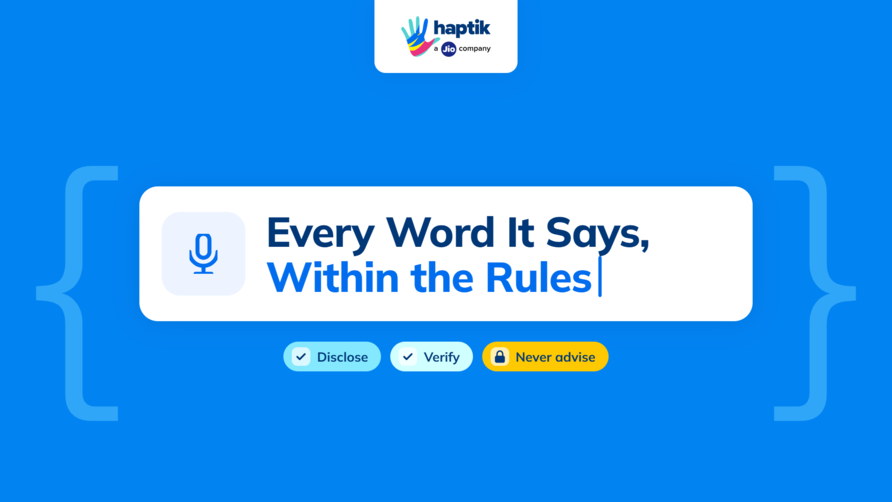
- Compliance at the edge: In regulated sectors like banking, insurance, and healthcare, a voice agent’s system prompt is the operational boundary where strict corporate policy meets live customer conversations.
- Defense-in-depth: A system prompt alone cannot guarantee compliance; it must operate alongside grounded knowledge bases (RAG), strict tool-calling permissions, and deterministic guardrails.
- Write for the ear: Voice prompts must enforce short conversational turns, single-question prompts, spelled-out numbers, and graceful pause handling - avoiding screen-centric formats like markdown or bulleted lists.
- Strict governance: Treat system prompts as controlled enterprise assets featuring version histories, named business owners, compliance sign-offs, and automated regression testing across edge cases.
When an AI voice agent answers a customer call in a regulated industry- whether handling a banking transaction, discussing an insurance claim, or verifying a patient record- it operates as an official rep of the enterprise. In such high-stakes environments, a loose or ambiguous system prompt is not just a conversation design flaw; it is an immediate regulatory liability.
Writing system prompts for spoken, real-time voice interactions requires a different discipline than writing for text chatbots.
This guide provides a production-tested prompt framework, outlines essential regulatory guardrails, explains how to write for spoken dialogue, and details the governance processes required for regulated enterprise deployments.
What a System Prompt Does in a Voice Agent
A system prompt sets the foundational role, operational scope, behavioral boundaries, and conversational tone for a Large Language Model (LLM) before a live call begins.
Enterprise voice agent
| System prompt (scope and style) | Grounded knowledge (approved RAG) | API permission (action limits) | Live human escalation |
However, in enterprise architectures, the system prompt is only one layer of a broader defense-in-depth security model.
Because persistent callers can attempt to bypass instructions using adversarial prompt injection, a system prompt must be reinforced by:
- Grounded knowledge repositories (RAG): Restricting response generation strictly to approved documentation.
- Deterministic middleware guardrails: Enforcing hard coding rules outside the LLM layer for sensitive identity checks.
- Role-based API permissions: Restricting backend systems from executing unauthorized actions regardless of prompt outputs.
A Production-Grade System Prompt Structure
To maintain consistency and readability, enterprise system prompts should be structured into clear, functional sections rather than written as a single block of text.
1. Role and scope definition
Define the agent’s name, enterprise identity, exact operational scope, and explicit out-of-scope boundaries.
Example: "You are Priya, an automated voice assistant for Apex Bank, assisting callers with account balance inquiries and recent transaction histories. You do not handle loan applications or financial advisory services."
2. Knowledge constraints
Specify where the agent must source its answers and how to handle information gaps.
Example: "Answer queries using ONLY the approved context provided in the knowledge base. If an answer cannot be verified within the context, state clearly: 'I don't have access to that information,' and offer to transfer the caller to a representative."
3. Compliance and mandatory disclosures
Detail exact opening disclosures, recording notices, and prohibited statement categories.
Example: "Begin every call with: 'This call may be recorded for quality and compliance purposes.' NEVER guarantee interest rates, promise loan approvals, or offer financial advice."
4. Spoken style guidelines
Enforce rules tailored for natural, real-time spoken dialog.
Example: "Keep responses under two short sentences. Ask only one question at a time. Read all account numbers and monetary figures digit-by-digit or as full spoken numbers. Never use markdown, bullet points, or special characters."
5. Tool-calling rules
Define when and how backend API integrations should be executed during a live call.
Example: "Trigger the FetchAccountBalance tool only AFTER the caller's identity has been verified via AuthenticateCaller. Always confirm account details with the caller before executing a transaction."
6. Escalation protocols
Establish explicit triggers for transferring calls to live human agents.
Example: "Transfer the call to a human agent immediately if: (a) the caller requests a representative, (b) the caller expresses severe distress or frustration, (c) a fraud concern is raised, or (d) authentication fails twice."
7. Few-shot conversational examples
Include two to three brief dialog scripts illustrating ideal handling, including a scenario where the agent politely declines an out-of-scope request.
Rules That Regulated Industries Must Spell Out
System prompts must convert complex regulatory policies into clear, unambiguous operational rules.
Note: Exact regulatory requirements vary by industry and jurisdiction. Always consult your internal legal and compliance teams to draft and validate mandatory wording.
1. Prohibit advice and guarantees
Explicitly state that the agent must not offer investment, legal, medical, or coverage advice. The prompt must prohibit promising specific interest rates, claim approvals, or coverage timelines unless the exact value is returned dynamically from a verified system of record via API.
2. Mandatory disclosures and consent capture
Required opening disclaimers, call recording notices, and consent captures must be written directly into the prompt using wording provided by compliance officers. Prompt authors should never draft disclaimers independently.
3. Safeguards for sensitive data
Mandate identity verification before revealing account-specific details. Instruct the agent never to repeat full primary account numbers, national identifiers, or sensitive health data back to the caller.
4. Priority routing for distress, complaints, and fraud
Define explicit sentiment and keyword triggers that bypass automated handling. Mentions of financial hardship, adverse medical symptoms, formal legal complaints, or suspected account fraud must trigger an immediate warm handoff to trained human specialists.
5. Scope maintenance and resistance to overrides
Instruct the agent to maintain its assigned persona and boundaries even if a caller demands out-of-scope actions or attempts to bypass instructions. Pair these instructions with backend guardrail models that monitor and filter input streams.
Write for the Ear, Not the Screen
Prompts designed for text chatbots fail over the telephone. Spoken dialogue requires explicit instructions that account for acoustic constraints.
- Keep turns short: Instruct the model to speak in brief, concise sentences and ask a single question at a time to keep conversations manageable for the caller.
- Spell out formats: Require numbers, dates, and currency values to be formatted for spoken clarity (e.g., "Say 'January fifth, twenty twenty-six', not '01/05/2026'").
- Remove text formatting: Prohibit markdown characters, asterisk bolding, bullet points, and special symbols, which can confuse text-to-speech engines.
- Manage tool execution latency: Instruct the agent to speak short, natural bridge phrases (e.g., "Checking that for you now...") when triggering API calls that take longer than 500ms to complete.
- Support multilingual consistency: When operating in multilingual environments (such as Indic language deployments), ensure regulated terminology, brand names, and mandatory disclaimers remain standardized across all supported languages.
Test and Govern System Prompts
Enterprise prompt engineering should follow strict software change management practices.
- Version control and ownership: Treat system prompts as controlled documents. Assign a named business owner in CX or Operations, maintain detailed version logs, and require formal compliance sign-offs for every revision.
- Comprehensive test suites: Build a benchmark test suite composed of real-world call transcripts. Include standard interaction paths alongside complex scenarios: callers pushing for unapproved financial advice, callers refusing identity checks, heavy background noise, and mid-sentence language blending (code-switching).
- Automated regression testing: Run test suites automatically against every prompt revision or underlying model update to verify that compliance guardrails remain intact.
-
Scheduled audits: Establish recurring review schedules to keep system prompts aligned with evolving enterprise policies, regulatory standards, and operational workflows.
Common Prompt Engineering Mistakes
Avoid these frequent mistakes when designing system prompts for enterprise voice agents:
- Monolithic prompt files: Writing one massive, unstructured prompt instead of organizing instructions into clear, modular sections.
- Abstract behavioral rules: Instructing the agent to "be helpful and friendly" without providing concrete operational rules or conversation examples.
- Over-reliance on the prompt: Treating the prompt as the sole security layer rather than reinforcing it with RAG knowledge constraints, deterministic middleware, and API permission boundaries.
- Unmonitored prompt drift: Deploying prompts without version tracking, automated testing pipelines, or designated business ownership.
- Testing only ideal scenarios: Evaluating performance exclusively against polite, compliant callers while failing to test adversarial inputs, complex accents, or background noise.
How Haptik Approaches Prompt Governance
Haptik integrates prompt engineering directly into enterprise risk management and customer experience architectures:
- Collaborative compliance alignment: Forward-deployed engineering teams work directly with client legal, security, and CX departments to convert complex regulatory policies into clear system prompt instructions.
- Grounded architecture: System prompts operate within a grounded framework that couples LLM reasoning with approved enterprise knowledge bases and deterministic escalation triggers.
- Proven enterprise experience: Validated across 500+ enterprise deployments, Haptik’s platform ensures compliant, high-performing voice AI execution across regulated sectors including BFSI, healthcare, and telecommunications.
The Bottom Line
A high-performing voice agent system prompt for regulated industries must be structured, explicit, and governed as a critical enterprise asset. By detailing precise operational rules, writing specifically for spoken audio, and testing prompts against real-world edge cases, enterprise teams can deploy conversational AI that balances fluid customer experience with strict compliance adherence.
FAQs
A system prompt should be as concise as possible while thoroughly defining role scope, compliance rules, spoken style, tool permissions, and escalation triggers. Splitting complex workflows into task-specific sub-prompts is often more effective than building a single lengthy prompt.
No. Compliance requires a multi-layered architecture where the system prompt works alongside grounded knowledge bases (RAG), strict API access permissions, deterministic safety guardrails, and context-rich human escalation paths.
System prompts should be owned by a designated leader in Customer Experience or Business Operations, with mandatory sign-off from Legal, Compliance, and IT Security teams before any prompt modifications are deployed to production.
Core architectural instructions, role definitions, and tool-calling rules are typically written in English within the system prompt. However, mandatory compliance disclosures, specific terminology, and few-shot examples should be tested and validated across every supported language and code-switched variation.

source on Google