


 Voice AI Agent
The Economics of Voice AI in Contact Centers: Cost-Per-Resolution vs Per-Minute Billing
 Add as a preferred
source on Google
TL;DR:
- The procurement trap: Per-minute software billing appears cost-effective on vendor spec sheets, but inflated response latency, poor speech recognition, and low resolution rates quietly double operational expenses.
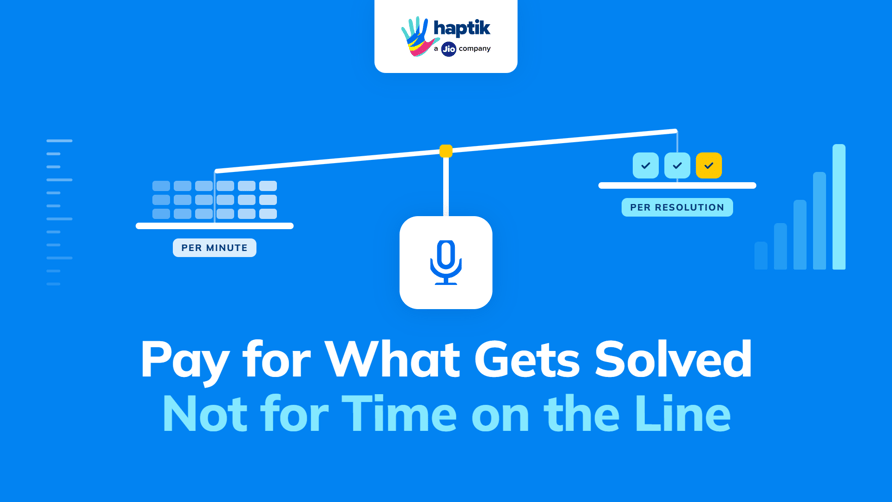
- Cost-per-resolution focus: Enterprise CFOs and contact center leaders must evaluate voice AI financial models using Cost-per-Resolution (CPR) rather than isolated per-minute usage fees.
- The hidden costs of latency: Unoptimized pipelines extend Average Handle Time (AHT) through awkward conversational pauses, inflating total telephony, cloud compute, and licensing costs.
- True ROI drivers: Quantifiable enterprise returns stem from high First-Contact Resolution (FCR), reduced agent attrition, and lower human escalation overhead rather than basic call containment.
- The Haptik value model: Transparent, outcome-linked economics aligned with real business resolution rather than metered infrastructure consumption.
IWhen evaluating enterprise voice AI platforms, Chief Financial Officers (CFO) and contact center procurement teams fall into a subtle pricing trap. Vendors present low per-minute software pricing models that promise scalable automation for pennies on the dollar compared to traditional offshore or onshore human agents.
On a spreadsheet, low per-minute usage rates appear predictable and cost-effective. In live production, however, a usage-based pricing model often obscures massive cost inefficiencies.
If a voice AI platform has high latency, frequent transcription errors, or poor reasoning capabilities, call durations stretch significantly longer. The enterprise ends up paying for empty airtime, artificial pauses, and repeated customer explanations, only for the call to ultimately fail and require a human transfer anyway.
Evaluating the economics of contact center voice AI requires shifting from surface-level per-minute billing to a comprehensive calculation of cost-per-resolution (CPR).
The Failure of the Per-Minute Pricing Model
Per-minute billing inherits its structure from traditional telecom usage rates. While intuitive for telecom carriers, applying it to AI software creates a fundamental misalignment between vendor incentives and buyer objectives.
1. The high cost of pipeline latency
A voice agent operating with a 2.5-second mouth-to-ear response delay adds multiple seconds of dead air to every turn of conversation.
Over a standard 10-turn customer interaction, systemic latency inflates total Average Handle Time (AHT) by 25 to 40 seconds. Under a per-minute pricing model, the enterprise pays a direct financial penalty for the vendor's technical inefficiency.
2. The containment mirage
Vendors highlight high containment rates, which is the percentage of calls that do not reach a human agent. However, a call that ends because a frustrated customer hangs up after an unhelpful 4-minute automated interaction is technically logged as ‘contained.’
When that customer calls back two hours later, the enterprise pays twice for a single unresolved issue, while customer satisfaction drops significantly.
3. Hidden infrastructure costs
Per-minute pricing rarely accounts for the full operational stack:
- Telephony transport: Carrier SIP trunking and Session Border Controller (SBC) fees billed by the minute.
- ASR and TTS API surcharges: Metered charges for streaming speech-to-text and text-to-speech processing.
- Dual-invoicing events: Paying for automated minutes plus the full cost of a human agent when an unresolved call escalates to the floor.
Calculating True Cost-per-Resolution (CPR)
To establish an accurate financial model, enterprise procurement teams must evaluate vendor proposals using the cost-per-resolution framework. CPR measures the total capital required to successfully resolve a customer inquiry to completion, regardless of the channel or path taken.
The CPR formula breakdown
CPR = (MAI × Rmin) + Tcost + (Erate × Chuman) Vtotal × FCRverified
Where
- MAI = Total AI voice minutes consumed across the billing period
- Rmin = Effective vendor software rate per minute
- Tcost = Total telephony transport and trunking costs
- Erate = Escalation rate (% of calls transferred to human agents)
- Chuman = Fully burdened cost of a live human agent call
- Vtotal = Total inbound call volume
- FCRverified = Verified First-Contact Resolution rate (verified by backend transaction logs)
A real-world financial comparison
Consider an enterprise contact center processing 100,000 monthly balance inquiry and payment calls:
| Operational metric | Vendor A (cheap per-minute model) | Vendor B (optimized resolution engine) |
|---|---|---|
| Advertised software rate | $0.07 / minute | $0.12 / minute |
| Average handle time (AHT) | 4.2 minutes (High latency / pauses) | 2.1 minutes (Sub-second streaming) |
| Base AI software cost per call | $0.29 | $0.25 |
| Telephony transport cost ($0.02/min) | $0.08 | $0.04 |
| Human escalation rate | 35% (poor accuracy) | 10% (grounded execution) |
| Escalation cost per call ($6 human avg) | $2.10 | $0.60 |
| Total operational spend | $247,000 / month | $129,000 / month |
| Effective cost-per-resolution | $2.47 per resolved call | $1.29 per resolved call |
Despite Vendor B quoting a software rate nearly 70% higher per minute, its sub-second execution speed, shorter handle times, and higher resolution accuracy reduce total monthly operational spend by 47%.
Secondary Financial Drivers: Beyond the Call Floor
While direct call execution costs dominate procurement discussions, enterprise voice AI impacts financial performance across broader contact center balance sheets.
1. Mitigating agent turnover and onboarding costs
Contact centers suffer from annual agent attrition rates between 30% and 45%. Recruiting, onboarding, and training a replacement customer service representative costs an average of $5,000 to $7,500 per seat.
By offloading repetitive, low-complexity Tier-1 queries (e.g., password resets, balance checks, order tracking) to an AI voice agent, human staff focus on higher-value, complex problem-solving. This shift directly reduces burnout, improves employee retention, and lowers recurring recruitment expenditure.
2. Eliminating peak concurrency staffing margins
During seasonal spikes, product launches, or regional weather disruptions, traditional contact centers must over-provision human staffing or accept massive call abandonment rates. Voice AI provides elastic concurrency, scaling to absorb sudden volume spikes without increasing fixed labor overhead or incurring overtime penalties.
3. Cross-channel context preservation
When an AI voice interaction requires escalation, passing a structured data payload, including the full transcript, customer sentiment, and intent variables, directly to the human agent's desktop reduces AHT for the live agent by 30 to 60 seconds per call.
Evaluating Vendor Economic Models: A Procurement Checklist
Before signing an enterprise voice AI contract, require candidate vendors to complete this financial validation checklist:
- Mandate AHT guarantees: Require vendors to demonstrate benchmark Average Handle Times for your specific transactional workflows rather than generic baseline averages.
- Audit latency budgets: Test mouth-to-ear response latency under live cellular network conditions. Reject systems that consistently exceed 1.2 seconds of delay between turns.
- Define ‘resolution’ contractually: Ensure contract terms distinguish between superficial "call containment" and verified, system-validated issue resolution.
- Include all telephony hops: Calculate all carrier ingress, egress, SIP trunking, and SBC fees into the total cost model.
- Verify zero-data retention terms: Confirm that third-party sub-processors do not retain or monetize your proprietary audio logs, which creates compliance liability under global data protection frameworks.
How Haptik Approaches Voice AI Economics
Haptik structures enterprise voice AI implementations around transparent, outcome-aligned business value rather than metered infrastructure consumption:
- Engineered for sub-1.5-second performance: Designed specifically to minimize response latency, reducing unnecessary call duration and driving lower overall handle times.
- Resolution-centric architecture: Focuses on bi-directional backend system integrations (CRM, Core Banking, ERP) to complete actual transactions rather than deflecting calls.
- Proven enterprise scale: Backed by over 500 enterprise deployments, Haptik’s forward-deployed teams collaborate directly with finance and operations leaders to deliver predictable, measurable reduction in cost-per-resolution.
The Bottom Line
Low per-minute software rates often conceal high operational costs. Enterprise procurement teams must look past superficial usage pricing to evaluate Voice AI platforms on total Cost-per-Resolution. By prioritizing sub-second latency, high First-Contact Resolution, and deep backend integration, contact center leaders can achieve sustainable operational efficiency while delivering exceptional customer experiences.
FAQs
Per-minute billing penalizes buyers for system inefficiencies. High latency, speech recognition errors, and long conversational pauses inflate call handle times, causing the buyer to pay more for an unoptimized, slower interaction.
Call containment measures whether a call ended without transferring to a human agent, regardless of whether the customer's problem was solved. First-Contact Resolution (FCR) verifies that the customer's issue was fully resolved during the initial interaction, preventing repeat calls.
Voice AI handles repetitive, highly scriptable Tier-1 calls, freeing human agents to focus on complex, rewarding customer interactions. This reduces workplace frustration, lowers burnout, and improves agent retention rates.


source on Google