


 Voice AI Agent
The ink on the enterprise contract is fresh but it’s also the moment where customer vulnerability peaks.
If it takes a brand days to schedule an executive kick-off call, or leaves a new user staring at a blank, complex configuration dashboard, buyer’s remorse sets in almost instantly.
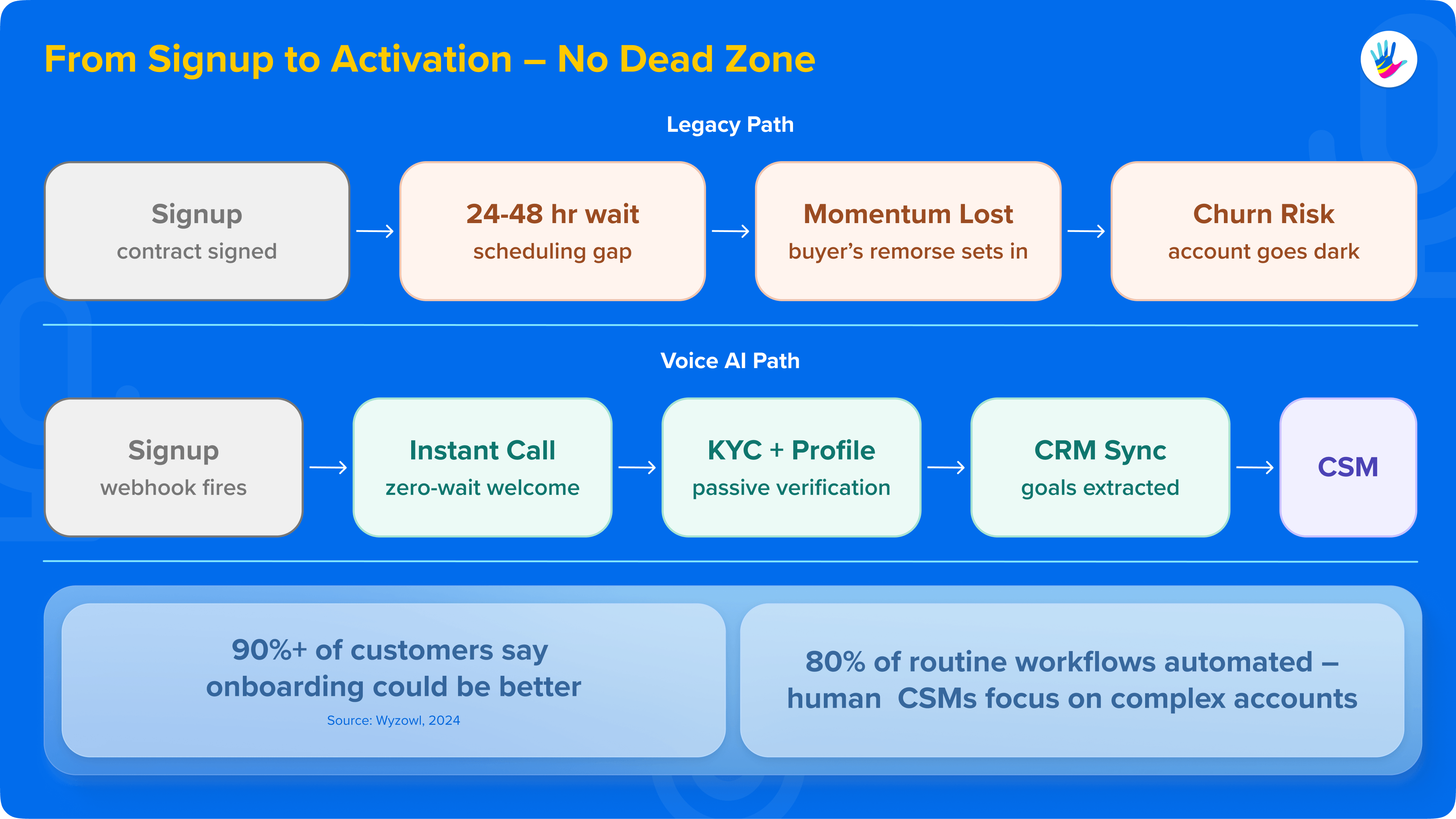
According to a comprehensive industry study by Wyzowl on the State of Customer Onboarding, over 90% of customers feel that the companies they buy from could do a better job of welcoming and onboarding new users.
When onboarding fails to engage a user immediately, product adoption stalls, accounts go dark, and companies suffer a massive, preventable leak in their customer lifetime value (CLV) pipeline.
An AI voice agent for onboarding is an effective solution to bridge this gap without linearly inflating headcount costs. By automating early-stage activation, enterprises can create a strong first impression that eliminates drop-off windows within minutes of signup.
The High Stakes Of First Impressions: Why Legacy Onboarding Triggers User Onboarding Churn
The costly bottleneck of human-led welcome flows
Relying entirely on human customer success representatives to conduct initial welcome calls creates an operational bottleneck. When signup volumes spike, teams inevitably fall behind, leading to critical scheduling gaps.
ALSO READ: The Definitive Guide to Best Voice Agent Platforms for Enterprise
A delay of 24 to 48 hours to initiate contact severely hampers your time to value (TTV) optimization goals. While the user waits for a calendar invite, their initial momentum evaporates, slowing project velocity and lowering early product adoption rates.
How text-heavy friction points drive early user onboarding churn
A structured, seamless onboarding experience can improve long-term customer retention. Conversely, forcing a new customer to navigate long setup forms or read multi-page documentation manuals creates an onboarding cliff.
When users encounter immediate text-heavy friction, they experience psychological fatigue. This administrative burden directly triggers early user onboarding churn, causing clients to abandon platforms before completing account creation.
Deploying Voice AI for Customer Onboarding
Immediate, zero-wait welcome calls for accelerated time to value (TTV)
The moment a customer completes a transaction, backend API webhooks can trigger an instantaneous voice greeting from an intelligent agent. This removes the post-purchase dead-zone completely.
By connecting with the user while their buying intent is highest, the system maximizes engagement. The onboarding agent greets the client by name, confirms account creation, and immediately guides them through their initial platform configurations to secure early adoption wins.
Streamlining KYC compliance via passive identity verification
For regulated spaces like fintech, insurance, and healthcare, onboarding requires strict compliance checks that naturally slow down user access. Voice AI streamlines this friction by utilizing passive identity verification frameworks during the initial conversation.
As the customer speaks naturally to confirm their baseline profile details, biometric models analyze voice-print characteristics against secure, encrypted records.
RELATED: The Enterprise Compliance Guide to Data Privacy in Voice AI
This merges data security with consumer comfort, completing Know Your Customer (KYC) requirements without forcing users to navigate clunky keypad menus or validation loops.
Driving Automated Customer Activation Through Personalized Voice UX
Context-aware data gathering vs rigid static forms
An effective onboarding agent does not just recite a welcome script; it actively extracts operational data to personalize the user's ongoing platform journey.
Instead of demanding users type data into a cold interface, the voice agent collects profile information through a fluid, natural conversation.
RELATED: Voice AI For Lead Qualification: How Enterprises Are Calling Every Lead In 5 Minutes
As the customer describes their business size, operational hurdles, and user counts, the AI extracts these vital variables in real-time. This structural data is instantly mapped to the customer’s CRM profile, bypassing form fatigue entirely.
Dynamic goal tailoring: segmenting users via real-time intent extraction
Every customer buys a product to solve a specific problem. Voice AI agents excel at real-time intent extraction, allowing them to uncover the primary driver behind an individual user's purchase during the welcome call.
If an enterprise client states their main priority is cutting infrastructure costs, the AI records this focus. The system instantly modifies the user’s backend configuration, ensuring that the first time they log into their dashboard, the interface highlights the exact analytics and tools tied to cost reduction.
The Hybrid Orchestration: Connecting Voice AI To High-Touch Success Teams
Passing deep engagement metadata to human account managers
Deploying enterprise customer onboarding automation does not mean removing the human element from your client management strategy. Instead, it creates an optimal hybrid workflow that empowers your high-touch teams.
When a client interaction requires escalation or marks the transition to a dedicated human account executive, the voice agent ensures zero context loss. It packages the raw transcript, verified security status, and extracted goals into a clean data packet.
Gartner projects that by utilizing advanced generative customer service layers, enterprises will achieve a 20-30% reduction in customer contact center agent-hours by optimizing routine data workflows. For customer success, this means human managers walk into their strategy meetings equipped with deep, pre-verified client insights.
Reserving human capital for high-value strategic onboarding edge cases
By automating 80% of repetitive onboarding workflows such as credential setups, basic profile routing, and validation checks, your human capital is freed from administrative tasks.
Your customer success managers can focus entirely on high-value, non-linear strategic onboarding challenges. This architectural split ensures that your resource costs scale efficiently while maintaining a premium tier of care for complex client accounts.
Bottom Line
Enterprise customer onboarding is no longer just an administrative milestone; it is the single most accurate predictor of customer retention and lifetime value. Utilizing enterprise customer onboarding automation via real-time voice networks guarantees that no user is left stranded in activation limbo. By delivering immediate response times, effortless compliance checks, and flawless metadata transfers to human teams, enterprises eliminate early buyer friction and secure a predictable, high-retention revenue path.

source on Google