


 Voice AI Agent
Enterprise customer support leaders begin their conversational AI journey with a single, ambitious goal: build one massive AI bot that can handle everything.
They launch a master assistant, plug it into every backend system, and expect it to seamlessly navigate everything from a routine billing update to a highly sensitive customer retention dispute.
In a controlled staging environment, this 'do-it-all' approach looks like a victory. But the moment it hits the chaotic reality of live production traffic, the monolith crumbles.
Instead of a sleek, automated solution, enterprises end up with a slow, easily confused system that alienates customers and inflates operational costs.
To achieve true resolution at the edge without draining budgets, forward-thinking brands are abandoning all-purpose bots. They are transitioning to the multi-agent orchestrator pattern, which is a highly efficient organizational model.
The Hidden Business Cost of the Monolithic AI
Forcing a single voice AI agent to manage your entire customer journey is the operational equivalent of hiring one person to run your HR, legal, sales, and IT support departments simultaneously. ‘
When a single prompt is burdened with hundreds of pages of conflicting corporate policies and disparate database tools, performance degrades.
ALSO READ: Why Latency Is the New UX in Voice AI
The most immediate casualty of a bloated AI system is the customer experience. The bot takes too long to process massive walls of background instructions, resulting in long, unnatural silences on the phone line. In the world of customer service, a two-second delay feels like an eternity, driving frustrated callers to speak over the system or abandon the call entirely.
Furthermore, a generalized assistant lacks the precision required for high-stakes resolutions. It frequently misinterprets customer intent, routes users to the wrong internal workflows, or gets stuck in repetitive, circular loops.
This failure doesn't just damage customer loyalty but floods your human agent queues with angry escalations, defeating the entire purpose of your automation strategy.
The Virtual Team Approach: Transforming Support from a Bot into a Super-Squad
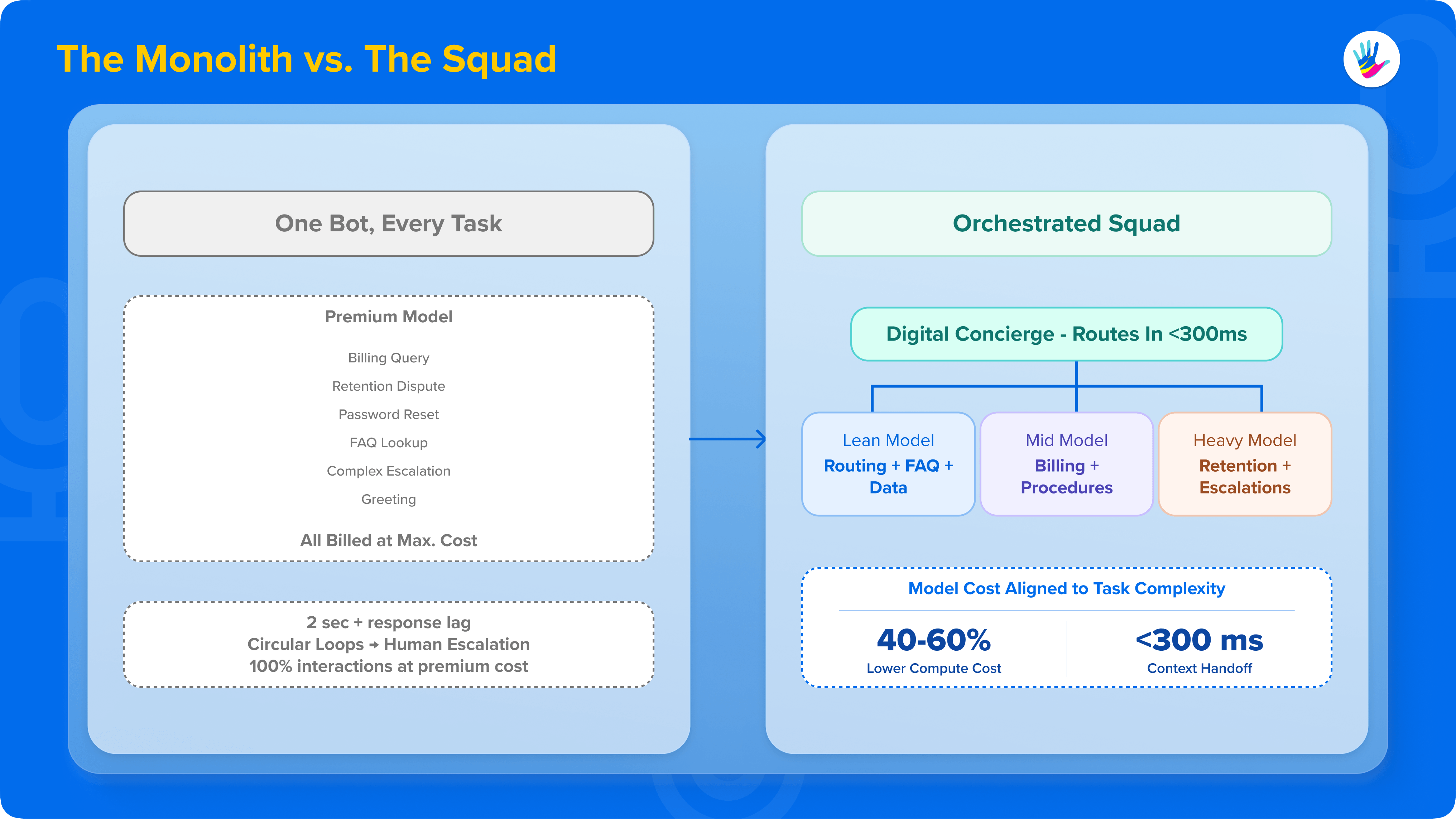
The multi-agent orchestrator pattern solves these enterprise friction points by mirroring the structure of an elite, real-world customer support operation. Instead of relying on a single, overwhelmed bot, this architecture deploys an intelligent digital concierge that governs a network of highly specialized, ring-fenced micro-agents.
When a customer calls or chats, they are greeted instantly by the Digital Concierge. This supervisor agent does not try to solve every complex problem. Its sole job is to listen to the customer's initial request, pinpoint the exact underlying need, and instantly hand the conversation over to a dedicated specialist agent.
Ending the 'Can You Repeat That?' Frustration Permanently
The greatest risk in any tiered support system is the handoff. If your digital supervisor hands a customer over to a billing specialist, and that specialist forces the customer to re-authenticate or re-explain their problem, your customer satisfaction score (CSAT) plummets.
ALSO READ: Voice AI for Contact Centers: The Enterprise Guide to Resolution at Scale
Modern multi-agent systems eliminate this friction through an unbroken, centralized memory layer. When a conversational handoff occurs between specialized virtual agents, the system passes a highly compressed context snapshot behind the scenes.
The transition happens in less than 300 milliseconds - completely imperceptible to the user. The incoming specialist agent assumes control of the interaction with full visibility into everything the customer has already said and verified. The result is a smooth, friction-free journey that makes the brand feel deeply connected to the consumer's needs.
The CFO’s Dream: Scaling Automation While Slashing Compute Bills
Beyond the undeniable upgrades to customer experience, the multi-agent pattern introduces a massive financial advantage that traditional bots simply cannot match: total optimization of your artificial intelligence spend.
RELATED: Voice AI Use Cases for Customer Support That Actually Move the Needle
In a monolithic setup, you pay a premium price for every single interaction. Whether the bot is handling a high-stakes, legally sensitive complaint or simply saying 'Hello, how can I help you today?', it consumes the processing power of your largest, most expensive AI model. This creates an unsustainable budget deficit as your call volumes scale.
Multi-agent orchestration allows your business to align model costs with task complexity:
- The routing layer: Uses an ultra-fast, low-cost model to sort incoming intents in milliseconds.
- The routine workers: Utilize small, highly efficient, inexpensive models to handle baseline data entry, balance checks, and FAQs.
- The advanced thinkers: Access premium, heavy-reasoning AI models only when a customer presents an intricate, multi-layered problem that truly requires advanced cognitive logic.
By distributing the operational workload this way, enterprises routinely slash their AI token and compute expenses by 40% to 60%. You stop overpaying for simple tasks, making large-scale automation highly profitable.
Bottom Line
Switching to a multi-agent orchestrator pattern transforms conversational AI from a risky IT experiment into a predictable, high-yield growth engine.
By breaking down your monolithic bots into an organized team of specialized virtual workers, you unlock the holy grail of enterprise customer support: sub-second response times, bulletproof transactional accuracy, and dramatically lower operational overhead. In a marketplace where customer experience is the ultimate differentiator, the winners will be the brands that stop building single chatbots and start orchestrating autonomous teams.

source on Google