


 Voice AI Agent
Why Healthcare Voice AI Is Moving From Appointment Booking to Full Patient Journey Orchestration
 Add as a preferred
source on Google
TL;DR:
- The strategic shift: Automating phone appointments was healthcare's initial voice AI win, but isolated booking systems create fragmented care handoffs, patient drop-off, and administrative churn.
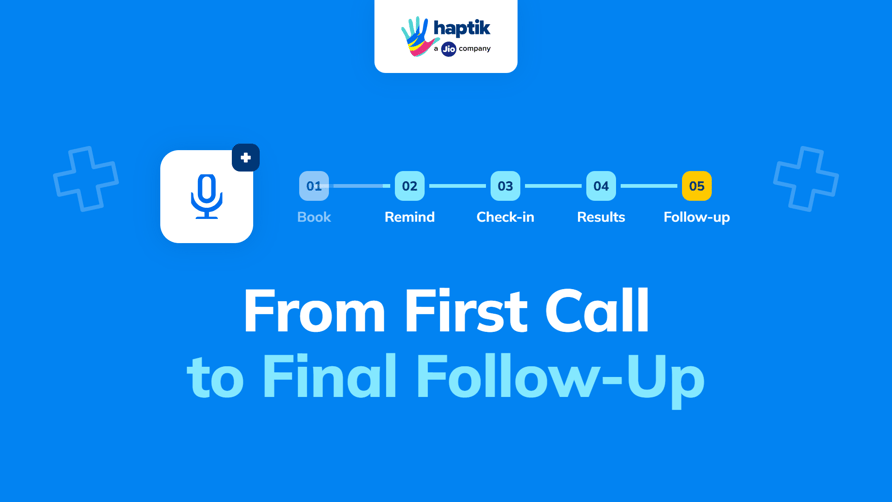
- Orchestration defined: Patient journey orchestration coordinates multiple touchpoints - intake, insurance verification, prep instructions, report retrieval, and post-visit check-ins - across voice and messaging using shared patient context.
- Market momentum: Industry developments highlight a clear sector transition toward continuous, agentic care coordination.
- Strict clinical boundaries: Orchestration platforms must maintain rigid non-clinical guardrails, passing all medical advice, diagnostic queries, and symptom escalations directly to clinical teams.
- Omnichannel foundation: Effective patient orchestration requires unified context persistence across voice calls and messaging platforms like WhatsApp, backed by HIPAA and ISO 27001:2022 security controls.
Booking an appointment over the phone was the natural starting point for healthcare voice AI. Telephone calls remain the primary front door for health systems, and scheduling is a high-volume, highly repetitive administrative task that traditional contact centers struggle to manage efficiently.
However, resolving a single scheduling call does not solve the broader patient access problem. When a booking exists in isolation, patients still navigate a disjointed maze of intake forms, insurance eligibility checks, pre-procedure prep calls, delayed lab reports, and uncoordinated follow-ups.
Every manual handoff between tools and departments introduces friction, leads to missed appointments, and causes patient drop-off.
Enterprise healthcare voice AI is evolving from point-solution voice AI agents into integrated systems that orchestrate the entire patient care journey.
Appointment Booking Was Only the Starting Point
Securing a calendar slot is merely one step in a complex operational chain. After a call ends, a typical patient journey requires:
- Registering demographic and identity details
- Verifying insurance eligibility and co-pay requirements
- Delivering pre-visit preparation instructions
- Sending appointment reminders
- Distributing diagnostic lab reports and medical summaries
- Conducting post-discharge adherence check-ins
When each of these stages is handled by a disparate software tool, messaging service, or call center queue, no single system maintains context across the patient’s complete interaction history.
Patients are forced to repeat their identity and medical context at every step, creating unnecessary friction during moments of medical stress.
What Is Patient Journey Orchestration?
Automatic Speech Recognition (ASR) is the entry door for voice AI. To minimize delay, enterprise ASR operates on a continuous audio stream, returning partial transcription hypotheses while the caller is still speaking.
The end-of-turn challenge
Patient journey orchestration is the continuous coordination of administrative, operational, and informational touchpoints across multiple channels such as voice, WhatsApp, and web portals powered by unified patient context.
Patient journey orchestration
| Pre-visit triage and Q&A | Registration and insurance verification | Appointment reminders and prep | Post-visit reports and follow-ups | Ongoing wellness and adherence |
Shared context engine (EHR/CRM/messaging hub)
Key orchestration parts
- Persistent cross-channel context: Patient records, preferences, and previous interaction histories persist seamlessly across inbound phone calls, WhatsApp messages, and web chat.
- Bi-directional system integration: Real-time data sync with Electronic Health Records (EHR), Hospital Information Systems (HIS), and billing gateways.
- Proactive automated outreach: Triggering outbound reminders, prep instructions, and report delivery automatically based on clinical milestones rather than waiting for inbound calls.
- Deterministic clinical escalations: Immediate, context-rich transfers to qualified clinicians whenever a conversation touches clinical evaluation or urgent care.
-
Comprehensive audit logs: Maintaining immutable records of patient consent, identity verifications, and interaction logs for regulatory compliance.
What Changes for Healthcare Providers
For hospital networks and clinic chains, adopting patient journey orchestration requires connecting voice and messaging touchpoints into a unified operational workflow.
| Journey stage | Voice agent capability | WhatsApp / messaging capability | Human staff role |
|---|---|---|---|
| Discover and inquire | Answers service queries; pre-qualifies care needs | Delivers location links, doctor profiles, and fee sheets | Handles complex, specialized medical inquiries |
| Book and schedule | Schedules, modifies, or cancels appointments | Sends instant calendar invites and location pins | Manages complex multi-specialty consultations |
| Register and consent | Guides patients through verbal registration | Collects ID photos, insurance cards, and consent forms | Resolves registration exceptions and manual checks |
| Pre-visit prep | Conducts automated prep reminders and eligibility calls | Sends diet, fasting, and pre-procedure instructions | Addresses coverage disputes and special care needs |
| Post-visit follow-up | Conducts routine recovery check-ins | Delivers diagnostic reports and prescription links | Responds to clinical questions and urgent symptoms |
| Ongoing care | Prompts medication adherence check-ins | Sends preventive health campaign reminders | Manages chronic care plans and complex escalations |
Guardrails: What Orchestration Must Not Do
Enterprise orchestration platforms in healthcare must enforce strict operational boundaries to protect patient safety and maintain compliance:
Strict non-clinical scope: Voice AI agents must never diagnose conditions, recommend treatments, or interpret lab results. All clinical questions must be routed instantly to qualified medical staff.
Purpose-based consent capture: Patient consent must be explicitly recorded for each communication channel and operational purpose, adhering to strict data minimization principles.
Immutable audit logging: Every system action, patient response, and data exchange must generate a timestamped audit log to support compliance reviews.
Healthcare security compliance: Deployments must incorporate robust data protection controls, including HIPAA compliance, ISO/IEC 27001:2022 certification, and local data residency adherence (such as India's DPDP Act requirements
How to Start a Journey-First Roadmap
Enterprise health systems should adopt journey orchestration progressively rather than attempting a complete operational overhaul all at once:
-
Identify high-leakage journeys: Pinpoint an initial care path with measurable drop-off points, such as the transition from initial booking to actual appointment show-up.
-
Map all existing handoffs: Document every interaction point along the selected journey, including offline manual tasks, phone calls, paper forms, and messaging notifications.
-
Connect core operational systems: Establish bi-directional API integrations between your AI orchestration layer, EHR/HIS databases, and CRM platforms.
-
Define cross-channel context rules: Specify what patient data variables (e.g., identity verification status, booking preferences, language choice) persist across channels and set strict context expiration windows.
-
Establish clear outcome metrics: Set baseline KPIs such as appointment no-show rates, pre-visit document completion speed, and report retrieval turnarounds before launching pilot deployments.
How Haptik Approaches Patient Journey Orchestration
Haptik builds conversational AI solutions designed for complex, highly regulated healthcare operations:
Omnichannel context integration
Haptik ensures patient context streams seamlessly across voice and WhatsApp channels, allowing a patient who receives a pre-visit reminder via voice call to submit registration documents or retrieve lab reports on WhatsApp without repeating information.
Regulated data security architecture
Engineered for strict enterprise compliance, Haptik's infrastructure incorporates HIPAA alignment, ISO/IEC 27001:2022 certification, and localized data center hosting in India to meet strict data residency standards.
Forward-deployed implementation teams
Haptik’s forward-deployed engineering teams work directly alongside hospital operations, IT, and compliance departments across 500+ enterprise deployments to integrate conversational workflows into existing HIS and EHR systems.
The Bottom Line
Automating appointment scheduling was an important first step for voice AI in healthcare. However, sustainable operational value is created when health systems connect the entire patient journey around that booking. By integrating voice and messaging touchpoints with shared patient context, maintaining clear clinical boundaries, and focusing on measurable care outcomes, healthcare providers can deliver friction-free access while reducing administrative burden.
FAQs
Patient journey orchestration is the automated coordination of a patient’s administrative and informational touchpoints including booking, intake forms, reminders, report distribution, and follow-ups across multiple communication channels using unified patient context.
Appointment scheduling automates a single, isolated transaction. Orchestration connects that scheduling event to the operational steps that precede and follow it, ensuring context persists across the entire care experience.
Yes, provided the platform enforces strict non-clinical boundaries, maintains explicit consent records, encrypts data at rest and in transit, and complies with healthcare security standards like HIPAA and ISO 27001:2022.
No. Voice AI agents are designed strictly for administrative and operational navigation. Any clinical query, symptom assessment, or medical advice request must trigger an immediate transfer to a qualified healthcare professional.
Start by targeting a single care pathway with documented operational friction or high no-show rates such as the scheduling-to-intake journey and expand to additional care stages once performance baselines are established.
source on Google