


 Voice AI Agent
Voice AI is moving from experimentation to production. Banks, insurers, healthcare providers, telecom companies, and other regulated organizations are increasingly exploring voice AI agents to automate customer service, assist employees, support transactions, and handle high-volume interactions.
But voice introduces a fundamentally different security problem. A voice interaction is not simply a conversation converted from speech to text. It is a real-time data pipeline involving audio streams, speech recognition, conversational intelligence, APIs, enterprise systems, and potentially automated actions.
For regulated businesses, the question therefore should not be, “Is the AI model secure?”, but it should be, “Can we securely control the entire lifecycle of information and actions from the moment a customer speaks until the system completes the interaction?”
This distinction is fundamental to designing secure Voice AI.
Voice AI Creates a Larger Security Boundary
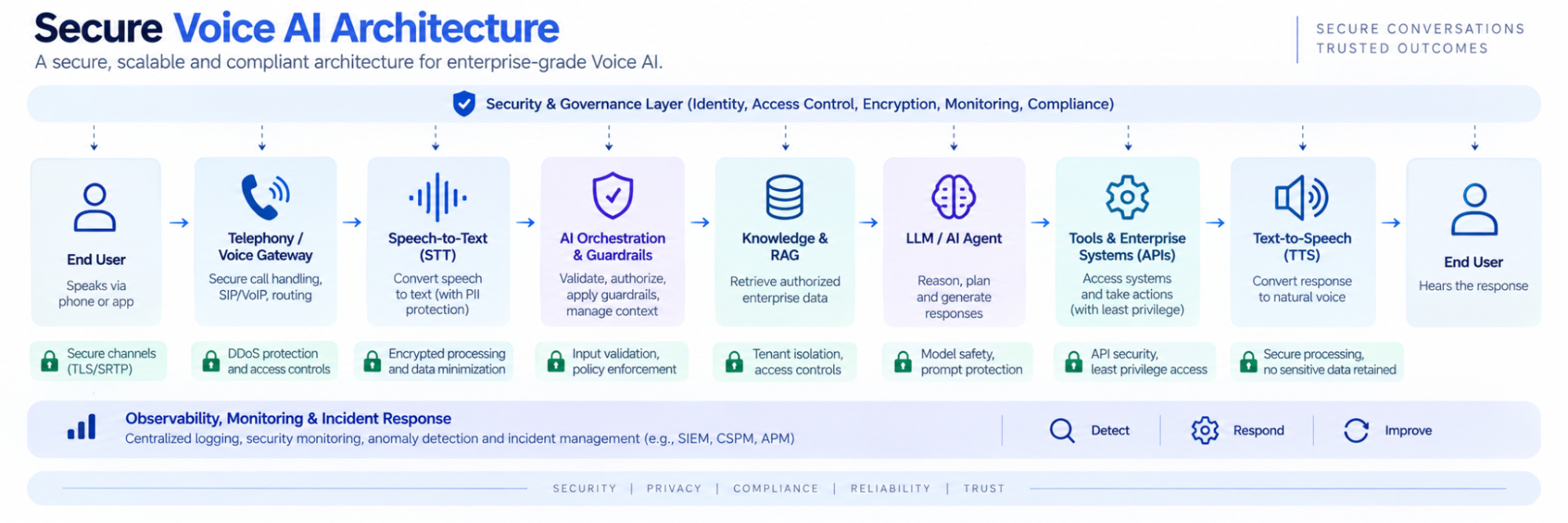
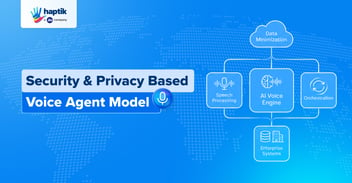
A typical enterprise Voice AI interaction may look like: Customer → Telephony → Voice Gateway → Speech-to-Text → AI Orchestration → LLM/Agent → Enterprise APIs → Text-to-Speech → Customer
At each stage, data may be processed, transformed, transmitted, temporarily stored, or acted upon.
A single interaction could contain:
- Personally identifiable information (PII)
- Account information
- Financial information
- Health or insurance information
- Authentication information
- Customer intent and behavioral information
- Voice recordings or audio streams
- Transcripts
- AI-generated responses
- Information retrieved from enterprise systems
This creates multiple security boundaries rather than a single application boundary.
A secure architecture therefore needs to protect the conversation, the data, the model interaction, the tools and APIs, and the actions performed by the agent.
ALSO READ: When AI Listens: Security and Privacy Challenges in Enterprise AI Voice Agents
10 Design Principles for Building Regulatory Compliant Voice AI
The following sections present the key principles for building safe, secure, and compliant Voice AI systems for regulated industries, with each section addressing a specific security or compliance principle and its implementation considerations.
1) Start with Data, Not the Model
The first question should not be “Which LLM are we using?” but “What data enters the AI system, where does it go, who can access it, and how long is it retained?” This is particularly important in BFSI and healthcare, where Voice AI may process financial information, KYC data, health information, clinical conversations, and sensitive personal data. Apply data classification and minimization throughout the lifecycle, from capture and transcription to processing, retrieval, response, and deletion. Organizations should explicitly define how audio and transcripts are captured, processed, stored, accessed, retained, and deleted, considering consent, purpose limitation, regulatory requirements, and contractual obligations. Mature Voice AI systems therefore integrate Privacy by Design, Security by Design, and Responsible AI throughout the product lifecycle.
2) Authentication Is Different from Conversation
A conversation does not establish a customer's identity or authorization. This is particularly critical in banking, insurance, securities, and healthcare, where an agent may be asked to disclose account, policy, investment, or patient information. Identity verification, authorization, data retrieval, and transaction execution should remain separate security functions, with step-up authentication applied for higher-risk operations.
3) Least Privilege Must Apply to AI Agents
AI agents should receive only the tools, APIs, data, and permissions required for their specific purpose. In BFSI and healthcare, this could mean restricting an agent to a specific customer's accounts or policies, or limiting access to only the minimum patient information required for a particular interaction. Access should be scoped to the relevant customer, patient, tenant, session, workflow, and transaction wherever possible.
4) Multi-Tenant Isolation Must Be Enforced Before Retrieval
In multi-tenant Voice AI platforms, tenant isolation must be enforced at the application and data layers before information reaches the model. Conversation history, knowledge bases, vector stores, customer records, patient information, API responses, memory, configurations, and analytics should remain within their authorized tenant boundaries. The LLM should never be responsible for enforcing tenant isolation.
5) RAG Security Is Data Security
RAG introduces another security boundary because retrieved enterprise data becomes part of the model context. Retrieval must respect the underlying authorization model so that the LLM cannot become a pathway for bypassing access controls. This is especially important when RAG connects to financial policies, customer records, insurance documents, clinical knowledge, or internal healthcare repositories.
6) Treat Tools and APIs as High-Risk Capabilities
An AI agent that can perform actions carries significantly greater risk than one that only provides information. A request to “check my account balance” is fundamentally different from “transfer funds,” “change beneficiary details,” “modify an insurance policy,” or “update a patient's record.” Tools should therefore be risk-classified, with stronger authentication, authorization, validation, transaction controls, and potentially human approval for high-impact or irreversible operations.
7) Defend Against Prompt Injection and Indirect Attacks
User input, retrieved documents, CRM data, knowledge repositories, and external API responses should never automatically be treated as trusted instructions. This is particularly important where an attacker could manipulate financial documents, insurance knowledge, medical content, or enterprise records to influence an agent's behavior. Prompt injection defenses should combine policy enforcement, retrieval filtering, tool authorization, output validation, monitoring, and escalation mechanisms.
8) Keep Deterministic Controls Outside the LLM
Use AI for reasoning; use deterministic systems for security enforcement. Authentication, authorization, transaction limits, eligibility rules, payment controls, policy changes, clinical workflows, regulatory requirements, and security policies should be enforced by application logic and policy engines rather than relying solely on model behavior. LLM responses should be evaluated against authorization, data sensitivity, business rules, and regulatory policies before sensitive information is disclosed or an action is initiated. Also, the orchestration layer should be treated as a security enforcement point, not simply a routing component.
9) Build Strong Observability
A secure Voice AI system should provide visibility into who interacted with the agent, what information was accessed, what was retrieved, which tools were invoked, and what actions were performed. For BFSI and healthcare, this auditability is particularly important for investigations, regulatory reviews, dispute resolution, and demonstrating accountability. At the same time, logging must follow data minimization principles so that monitoring does not become another source of sensitive-data exposure.
10) Design for Failure
AI systems can misunderstand requests, hallucinate information, select incorrect tools, or encounter downstream failures. In regulated environments, failure should result in a safe stop, explanation, escalation, or human transfer rather than improvisation. This is particularly important for financial transactions, insurance decisions, and healthcare interactions where an incorrect automated action may have significant consequences
Security Testing Must Cover the Whole System
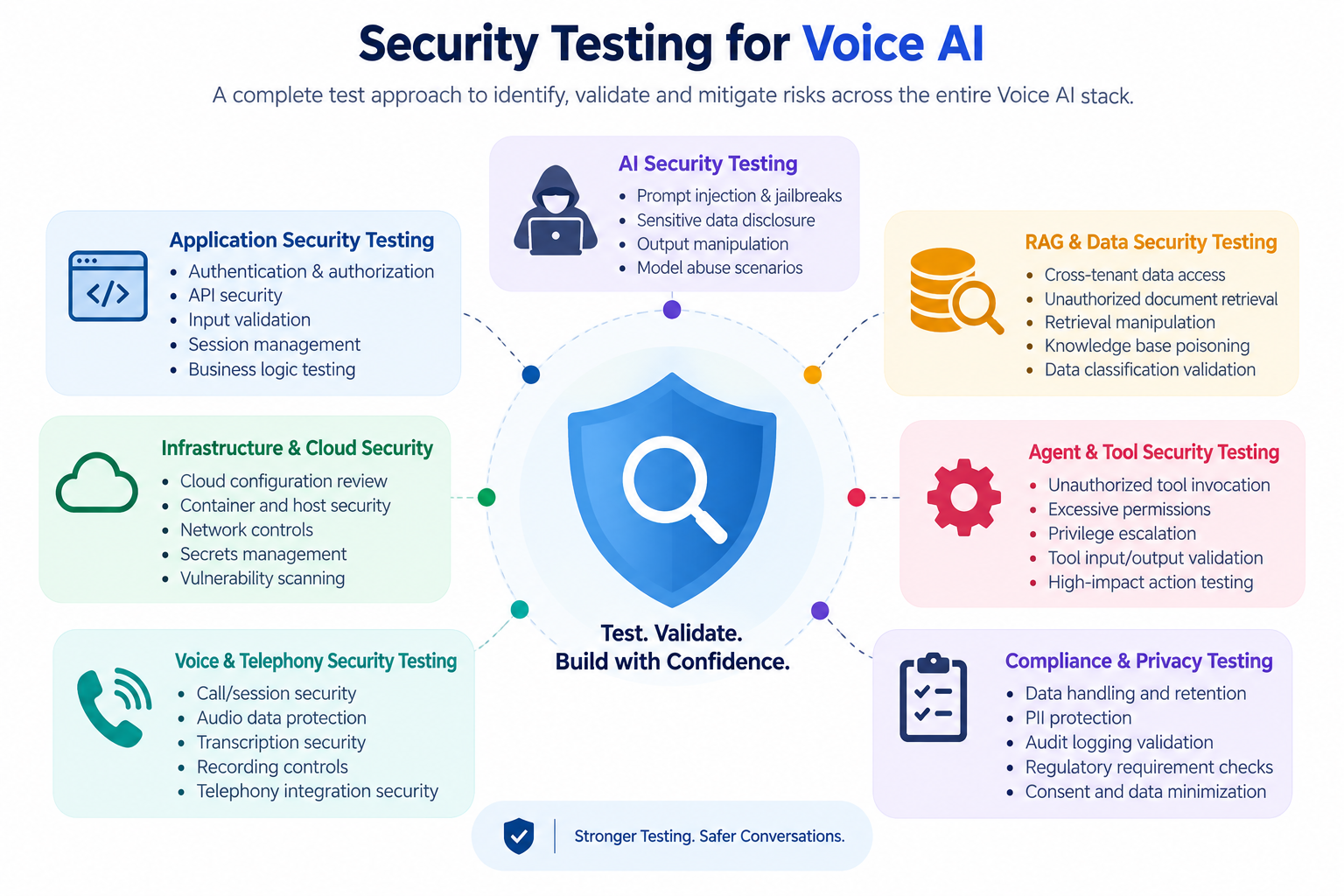
Traditional application VAPT is necessary but may not be sufficient for Voice AI. Security testing should cover the broader ecosystem, including application security, AI security, RAG security, agent security, infrastructure, voice security, privacy, and compliance. For BFSI and healthcare use cases, testing should also validate authorization boundaries, sensitive-data exposure, tenant isolation, prompt injection, tool misuse, and high-risk workflows.
The Final Principle
The future of enterprise Voice AI will not be determined solely by who has the most capable model but will be determined by who can make AI safe enough to operate inside real businesses.
For regulated industries, secure Voice AI requires more than encryption, secure APIs, or a secure cloud environment. It requires security controls across the entire lifecycle of an AI interaction from voice capture and identity verification to data retrieval, model reasoning, tool invocation, response generation, monitoring, and eventual data deletion.
The most important architectural principle is therefore simple: Don't secure the AI in isolation. Secure everything the AI can see, everything it can access, and everything it can do. This is what transforms Voice AI from an impressive conversational interface into an enterprise-grade, secure and governable AI system.

source on Google