


 Voice AI Agent
 Beyond Human-in-the-Loop: Designing AI Oversight That Actually Scales
 Add as a preferred
 source on Google
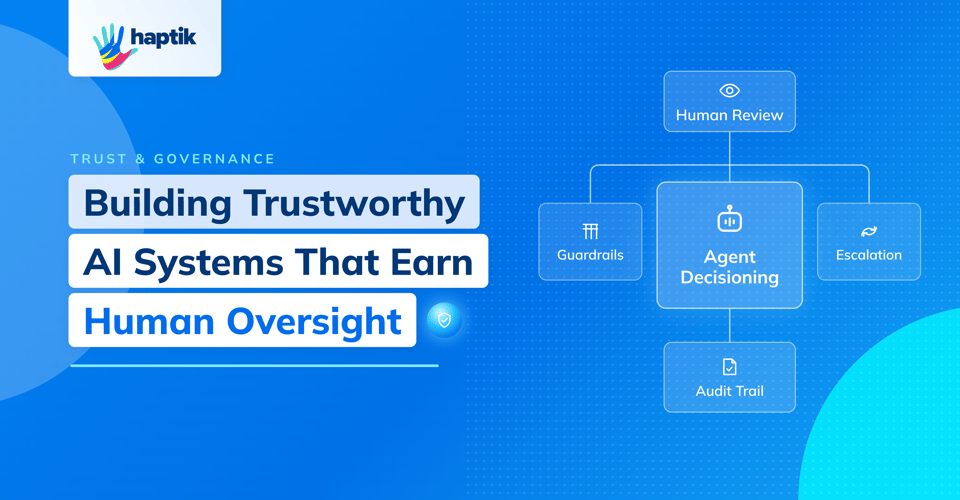
As enterprises rapidly embrace AI Agents and Voice AI Agents, one question that consistently arises during customer evaluations, boardroom discussions, and compliance reviews is "Where is the human in the loop?"
It’s a fair question.
Human oversight has become a cornerstone of trustworthy AI, reinforced by emerging regulations, governance frameworks, and growing expectations around accountability. But there is a practical challenge that organizations rarely discuss.
Imagine an enterprise AI Voice Agent handling hundreds of thousands of customer conversations every day. Each interaction involves understanding context, retrieving knowledge, invoking business systems, making decisions, and responding in real-time—often within a fraction of a second.
Now ask yourself: “Can a human realistically review every prompt, every response, and every decision before it reaches the customer?”
At enterprise scale, continuous human intervention simply is not feasible. Yet organizations still need meaningful human oversight. This is not a contradiction, it is a design challenge.
The Human Oversight Paradox
Traditional Human-in-the-Loop (HITL) models work exceptionally well for workflows where decisions can pause for human approval:
- Loan approvals
- Medical diagnoses
- Legal reviews
- Procurement decisions
Conversational AI is fundamentally different with customers expecting immediate responses. Voice or text-based agents cannot pause every few seconds waiting for a human reviewer; it defeats the very purpose of automation.
The challenge, therefore, is not how to place humans into every interaction but is how to build AI systems that remain trustworthy even when humans are not actively monitoring every conversation.
Rethinking Human Oversight
Perhaps it is the time to shift our thinking from Human-in-the-Loop to Human-on-the-Loop.
Instead of supervising every individual interaction, humans supervise the system itself. The human role evolves from reviewing conversations to designing the policies, guardrails, and governance mechanisms that shape AI’s behavior.
In this model, oversight becomes continuous, even when human intervention is selective.
Designing Oversight That Scales
Scalable AI oversight is not achieved through constant human review but is achieved through multiple layers of governance working together.
Before AI Agent/BOT interacts with customers (humans define the boundaries)
- Business policies and conversation flows
- Approved knowledge sources (knowledge base)
- Guardrails and safety controls
- Tool permissions and access controls
- Escalation criteria
-
Risk thresholds and compliance requirements
During the conversations (automated governance takes over)
- Confidence scoring
- Real-time guardrails
- Policy enforcement
- Hallucination detection
- Prompt injection protection
- Sensitive data and PII detection
- Toxicity and safety filtering
- Intelligent routing to human agents when confidence falls below acceptable thresholds
After the conversations (human expertise becomes even more valuable)
- Reviewing exceptions and escalations
- Auditing conversations (by appropriate sample size)
- Analysing trends and failures
- Improving & updating the prompts and knowledge-base
- Refining governance policies & guardrails (based on industry threats, learnings and audit finding analysis)
- Continuously improving models and customer experiences
Rather than replacing human oversight, AI changes where human oversight is applied.
Trust Is Built Through Governance
Many organizations assume trust comes from having a human approve every AI decision.
In reality, trust comes from knowing that every AI interaction is governed by clearly defined policies, monitored continuously, auditable when required, and capable of escalating to a human whenever appropriate.
This is particularly important for enterprise AI deployments, where oversight must scale across millions of interactions without compromising speed or customer experience.
The Future of Enterprise Conversational AI
The next generation of enterprise AI platforms won't be differentiated solely by the intelligence of their language models. They will be differentiated by the strength of their governance. Enterprise Conversational AI requires more than powerful models. It requires configurable guardrails, policy-driven controls, secure integrations, continuous monitoring, comprehensive audit trails, and seamless human handoffs. Together, these capabilities enable organizations to deploy AI Agents confidently while ensuring that human oversight remains meaningful, practical, and scalable.
| Traditional AI | Enterprise Conversational AI |
| Human reviews every decision | Humans design the governance framework |
| Manual approvals | Automated policy enforcement |
| Individual decision oversight | Continuous system oversight |
| Reactive intervention | Proactive guardrails |
| Human executes | Human supervises |
At Haptik, we believe trustworthy AI is not about forcing humans into every conversation. It is about empowering organizations to design AI systems that operate responsibly within well-defined governance frameworks where humans remain firmly in control of the outcomes, even if they are not involved in every interaction.
What Enterprises Should Take Away?
As AI Agents become an integral part of enterprise operations, the question should no longer be, "Can a human review every AI decision?", but a better question is, "Can our governance framework ensure AI consistently makes responsible decisions, even when humans are not watching?"
The future of enterprise AI won't be defined by how often humans interrupt AI, but will be defined by how confidently organizations can trust AI to operate responsibly, securely, and at scale. Trustworthy AI is not built by placing a human behind every decision; it is built by ensuring every decision operates within a framework of governance, accountability, and control.

source on Google