


 Voice AI Agent
 When AI Listens: Security and Privacy Challenges in Enterprise AI Voice Agents
 Add as a preferred
 source on Google
Voice has rapidly become the main interface between enterprises and their customers. AI voice agents now handle service requests, authentication, payments, and issue resolution at scale. In doing so, they move beyond responding, they actively listen, in real-time and at scale.
When AI listens, the security and privacy stakes fundamentally change. The focus is no longer limited to protecting databases and dashboards, but extends to safeguarding live conversations, emotions, and intent. This shift requires enterprises to rethink traditional security and privacy approaches.
In this blog, we discuss the main challenges being faced for Security and Privacy in AI voice agents and why this demands a new trust model and how organizations can respond.
Voice Is Not Just Another Input Channel
Unlike text or clicks, voice interactions naturally capture more than explicit user input. Voice carries identity, intent, emotional cues, and contextual signals, often in real-time and with limited user visibility. In some cases, voice data may even be considered biometric or highly sensitive personal data.
Traditional application security and privacy models were not designed for systems that continuously process human speech. As a result, enterprises deploying voice agents must reassess how trust, compliance, and risk management are engineered.
ALSO READ: How AI Agents are Reshaping Enterprise CX
How Is Voice Different from Text?
Most enterprises already handle text data emails, chats, tickets, logs. Voice, however, brings a new set of challenges:
- Voice is inherently identifiable: A person’s voice can reveal gender, age, language, accent, and sometimes health conditions; can also act like a biometric identifier
- Conversations are richer than messages: People share more in a voice conversation like account details, personal anecdotes, frustrations, hints about their financial or health situation, and sometimes sensitive secrets
- Context is continuous and real-time: Unlike a static form or email, a voice interaction is a flowing stream. AI systems must process, transcribe, and often store parts of this stream to work effectively
- Background data gets captured for free: Ambient sounds can reveal other people’s voices, locations, or workplace information playing in the background (for example, names on a call, colleagues talking, or even whiteboard discussions)
This makes voice agents not just another interface, but a new category of data risk.
Challenges Unique to AI Voice Agents
When you introduce AI into enterprise voice channels, you blend classic telecom and network risks with emerging AI‑specific threats.
1. Expanded attack surface (increased supply chain)
Traditional voice channels already deal with call centers with call recording systems, telephony, and CRM integrations. AI voice agents add:
- Real-time speech‑to‑text (STT) and text-to-speech (TTS) services
- Telephony providers in the capacity of dialers
- Large language models (LLMs) for understanding and response generation
- Orchestration layers connecting to internal APIs, knowledge bases, and transaction systems
Each component can be a potential entry point for attackers or a source of data leakage.
RELATED: How to Address Key LLM Challenges (Hallucination, Security, Ethics & Compliance)
2. Privacy challenges unique to AI voice agents
Enterprise voice AI introduces structural privacy risks that are often underestimated:
- Inherent data collection (which can’t be contained) beyond the need
- Consent ambiguity in multi-turn or natural conversations
- Data retention sprawl, particularly for call recordings and transcripts
- Cross-border processing and vendor dependency in voice pipelines
- Most importantly, the trade-off between data anonymization and user experience
3. Sensitive data in the entire AI workflow
In typical voice workflows, audio is:
- Captured (caller’s voice and sometimes agent or background)
- Streamed to a transcription model (first the STT and then TTS)
- Sent to an LLM along with historical context
-
Logged for quality, analytics, or future training
At each stage, sensitive data may be exposed. If you are not intentional, this data can end up in logs, model prompts, third‑party services, or analytics tools with weaker protections.
4. Model misuse and prompt injection
AI voice agents are driven by prompts and system instructions. Attackers or clever users can do:
- Prompt injection via spoken instructions
-
Social engineering of AI
Because the interface is conversational and dynamic, these attacks can be harder to detect than traditional parameter tampering in APIs.
5. Voice spoofing and deepfake risks
As voice cloning tools become more accessible, attackers can:
- Impersonate executives, customers, or partners to gain access
- Trigger workflows that depend on spoken confirmations
- Abuse voice‑based biometric systems where they exist
Even if your AI agent does not use voice biometrics, your broader enterprise voice ecosystem might, and the presence of AI can blur trust boundaries.
Practical Controls for Privacy and Security First Voice AI
Addressing these risks requires controls that are embedded into system design not applied retrospectively.
💠Conversation-level data Minimization
Design voice journeys to avoid unnecessary free-form input, isolate sensitive interactions (e.g., authentication, payments), and persist only business-essential data.
💠Explicit and contextual consent
Clearly communicate processing intent through voice disclosures, enforce consent checkpoints for sensitive actions, and support seamless handoff to human agents where required.
💠Secure voice-to-AI architecture
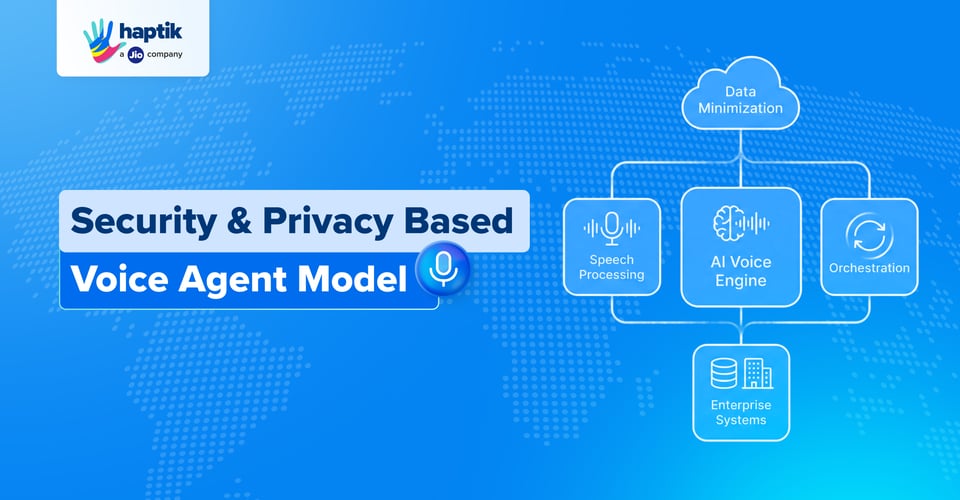
Maintain strong separation between speech recognition, orchestration, and AI/LLM layers. Limit the data shared with AI components and validate outputs before executing actions.
💠Identity, access, and privilege management
Enforce role-based, least-privilege, and time-bound access to voice recordings, transcripts, and analytics, with full auditability.
💠Retention, deletion, and lifecycle control
Define retention based on business and regulatory need, supported by automated deletion and verifiable audit trails.
💠Third-party and ecosystem risk management
Assess and govern risks across telecom providers, speech engines, AI models, and downstream integrations through contractual, technical, and assurance controls.
💠Secure integrations with enterprise systems
Protect integrations with CRM, ticketing, and payment systems using strong authentication, scoped APIs, and transaction-level controls.
💠Resilience, monitoring, and abuse detection
Continuously monitor for fraud, misuse, and anomalous call patterns, supported by resilience testing and incident response readiness.
Security and Privacy at Scale: Jio Haptik’s Approach to AI Voice Agents
At Haptik, voice agents are treated as high-risk data processing systems, not just customer experience tools. Security and privacy are embedded into platform architecture, conversation design, and operational governance to support voice interactions at enterprise scale.
Voice journeys are intentionally designed to minimize data capture, tightly control sensitive interactions, and limit data persistence to defined business purposes. Strong architectural separation is maintained between speech processing, orchestration, LLMs, and enterprise integrations to reduce unnecessary data propagation. Access to voice recordings and transcripts is governed through role-based, least-privilege controls with full auditability. Data retention and deletion are aligned to regulatory and business requirements, supported by automated lifecycle controls. Continuous monitoring and resilience practices help detect misuse and maintain trust in high-volume, customer-facing voice deployments.
Related: How to mitigate GenAI Risks & Compliance Issues?
What Enterprise Leaders Should Take Away?
- Voice AI amplifies both customer value and enterprise risk
- Privacy and security must be embedded into conversation design
- Traditional application security models are insufficient
- Trust will be a defining differentiator for voice-based AI platforms
As AI voice agents become a core interface for enterprise interactions, trust will increasingly define their success. Security and privacy can no longer be treated as downstream controls; they must be engineered into how voice systems are designed, deployed, and operated. Enterprises that approach voice AI with a risk-aware, governance-led mindset will be better positioned to scale responsibly while meeting regulatory and customer expectations.
In a world where AI listens, the ability to protect conversations, intent, and context will be as critical as the intelligence of the system itself; as a result, the future of AI Voice-Agents will not be defined by how natural they sound, but by how well they protect the people who speak to them.


source on Google