


 Voice AI Agent
 AI Customer Service Agent vs Agent Assist: A Practical Guide for CX Leaders
 Add as a preferred
 source on Google
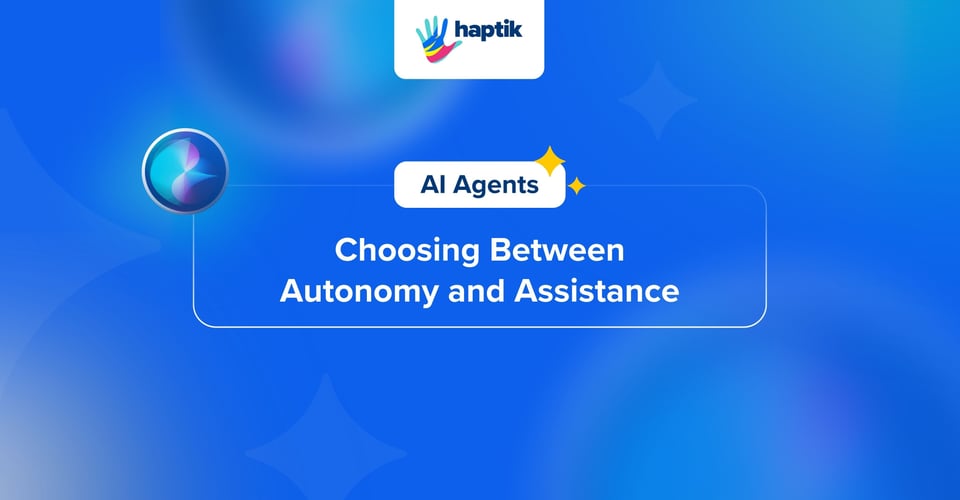
Enterprise customer service is at an inflection point. Over the last decade, companies have invested heavily in digital channels, CRM platforms, and workflow automation. Yet, many CX leaders still face the same problems: rising support volumes, inconsistent experiences across channels, and rising pressure to reduce cost.
The tension has accelerated interest in AI. But not all AI-powered support models are the same. Two approaches now dominate enterprise conversations: Agent Assist and the AI customer service agent. Both promise efficiency gains. Both leverage AI. And both are often discussed interchangeably - incorrectly so.
Understanding the difference is a strategic decision that shapes how your customer service operation scales over the next few years.
ALSO READ - Beyond Automation: How AI in Customer Service Enables Revenue Growth
The Evolution of Enterprise Support Models
Customer service models have evolved in clear phases:
- Human-only support, dependent on agent availability and training
- Rule-based automation, limited to predictable workflows
- Agent Assist, where AI augments human agents
- AI agent for customer service, where AI independently handles customer interactions
Agent Assist emerged as a pragmatic step forward. It improved productivity without disrupting existing operating models. But as interaction volumes grow and customer expectations shift toward instant resolution, many enterprises discover its limits.
What Is Agent Assist (and Where It Fits)?
Agent Assist tools support human agents during live interactions. They operate in the background, analyzing conversations and surfacing relevant information in real-time.
Core capabilities include:
- Suggested responses or next-best actions
- Knowledge base recommendations
- Real-time transcription and summarization
- Compliance prompts for regulated industries
Agent Assist is effective when human judgment is required, volumes are manageable but agent efficiency needs improvement, and regulatory or brand risk demands full human control.
In short, Agent Assist optimizes how agents work, but it does not change who owns the interaction.
What Is an AI Customer Service Agent for Business?
An AI customer service agent for business is not a productivity but a system designed to own and resolve customer interactions without human involvement.
These agents combine:
- Reasoning engines to interpret intent and context
- Orchestration layers that trigger actions across backend systems
- Guardrails for escalation, compliance, and human handoff
Instead of assisting an agent, the AI is the agent.
The distinction matters because autonomy changes everything from cost structure and scalability to response speed and consistency in experience.
AI Customer Service Agent vs Agent Assist: A Practical Comparison
|
Dimension |
Agent Assist |
AI Customer Service Agent |
| Primary role |
Supports human agents during live interactions | Independently handles and resolves customer interactions |
| Ownership of conversation |
Human agent remains fully in control |
AI owns the interaction, with escalation when needed |
|
Level of autonomy |
Low - AI suggests, human decides | High - AI reasons, acts, and resolves |
| Scalability |
Scales with agent headcount |
Scales elastically with demand |
| Cost structure |
Improves efficiency but costs rise with volume | Decouples support costs from interaction growth |
|
Resolution speed |
Faster agent responses |
Instant or near-instant resolution |
| Consistency |
Varies by agent behavior and training |
Uniform logic across voice, chat, and messaging |
| Best suited for |
Complex, high-risk, empathy-driven interactions | High-volume, repeatable, transactional use cases |
| Operational impact |
Optimizes existing support workflows |
Redesigns how customer service is delivered |
| Long-term role |
Transitional layer to improve productivity |
Foundational layer for scalable CX |
When Does Your Business Need It?
The right choice depends on where your enterprise is and where it needs to go.
Agent Assist is suitable if:
- Your customer interactions are complex and high-risk
- Human empathy and discretion are non-negotiable
- Your immediate goal is incremental efficiency
The AI customer service agent is the better fit if:
- A large share of inquiries are repetitive or transactional
- Volumes fluctuate unpredictably across channels
- You need 24/7 support without linear cost growth
- Consistency across voice, chat, and messaging matters
Many enterprises adopt a hybrid approach - starting with Agent Assist, then progressively shifting resolution ownership to AI agents as confidence and maturity grow.
Why Enterprises Are Moving Beyond Assist
The push toward AI agents is driven by economics and experience.
As businesses expand into new markets and channels, human-dependent models struggle to keep up. AI agents for customer service allow enterprises to absorb growth without continuously expanding support teams. They also create cleaner separation between routine resolution (handled autonomously) and high-value exceptions (handled by humans).
This shift is especially visible in industries where immediacy is paramount - retail, fintech, healthcare, and travel - and margins are under pressure.
Final Thoughts: Choose for the Future, Not Just the Present
Agent Assist and AI customer service agents are not competing technologies. They represent different stages of maturity in how businesses think about service delivery.
If your goal is to make agents better, Agent Assist delivers value. If your goal is to redesign customer service for scale, speed, and consistency, an AI customer service agent for business is essential.
This is where AI agents are redefining what “good customer service” looks like - not as a support tool but as a core operational capability.
source on Google